
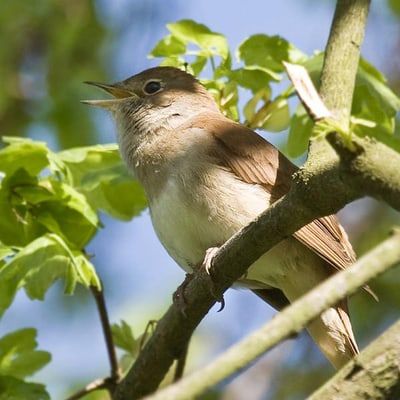
Heard by MfN Naturblick 8 years ago in __PLACE__
This observation is plausible. What does it mean?
Reviewed by Susan Karlebowski, Museum für Naturkunde Berlin
It lies within the geographic range.
B 52.6247537 L 16.220872
Many species only occur in certain areas, regions or countries of the world. These distribution areas change and can therefore only give an indication, but not a reliable confirmation. This is especially true for plants that are planted by humans.
It was made during the activity period.
May 9, 2018, 8:44 p.m.
Many species are particularly active during a certain period, for example at night. However, this information is not reliable and nocturnal animals can also sometimes be observed during the day. The activity period can therefore only give an indication, but not a reliable confirmation. We refer to Germany for the activity period. Many plants can be found at any time of day and throughout the entire year.
It was described in more detail by providing further information.
1 individuals
A more detailed description of the observation makes a correct identification of the species more likely. However, we do not automatically publish comments here as they may contain personal information.
This species identification was partially agreed to. What does it mean?
Reviewed by Team Forschungsfall Nachtigall, Museum für Naturkunde Berlin

An expert was able to confirm the identification.
Based on the medium
In order to confirm an observation, the photo or sound recording must show the traits necessary for the identification. Only in this case another person can give a reliable assessment of the identification result. However, it is always difficult, even for experts, to identify species from photos or sound recordings. For some species this is not even possible.
Pattern recognition was not used to identify this observation.
Pattern recognition always displays the three species with the closest match to the trained comparison material. The closer the score is to 100%, the more similar the photo or sound recording is to the comparison material of a species with which the pattern recognition was trained. More information about pattern recognition and which species were trained can be found below in the FAQs.
This observation is also used scientifically.
This observation is part of the citizen science project Forschungsfall Nachtigall.
FAQ
Why are the observations reviewed?
Everyone can use Naturblick and record nature observations as he or she wishes. However, we would like to give you and other users of our platform the opportunity to assess whether the observations are plausible or not. If you wish, you can also learn how to determine your own observations more confidently and discover what exciting observations other users have made in your area.
Why are not all observations of a species on the map?
On the map you will find only observations whose species identification was at least partially confirmed. It is possible that the expert has identified a different species for some of the observations. However, the species name can be changed only by the person who has seen the animal or plant and can therefore best decide that. In the future, we will send a private note in these cases so that the creator can decide what to do with the observation. We do not change or delete these observations. We get a lot of observations every day, so it may take some time to give feedback and for the observations to appear on the map.
Is an identification wrong if it is not plausible or cannot be confirmed?
No, only the observer can really say which species he or she has seen. We can only give advice to take a closer look if necessary and to pay attention to certain characteristics. For the confirmation of an identification we need a photo or a sound recording on which the most important identification features can be seen or heard. Only then our pattern recognition or a person can give an opinion on the identification result. However, it is always difficult, even for experts, to identify species on the basis of photos or sound.
Is an identification wrong if it has not yet been confirmed?
No, we receive a lot of observations and can only gradually work on them together with volunteers. Therefore, it is possible that no one has looked at an observation yet and it still takes some time until we can give feedback.
Can the species name be changed?
Yes, the creator of an observation can change the species name if it is wrong. This actually helps us and other users of the platform. At the moment, changes can only be made in the app.
Can the details of an observation, such as location and time, be adjusted?
Yes, if the location was recorded inaccurately by the app, the user can correct it later in the app. At the moment, the time cannot be adjusted afterwards, as we assume that the Naturblick app was used directly at the time of the observation. However, the place and time of an observation can be described in more detail in the comments.
Should an observation be deleted if it is not plausible or not confirmed?
No, we are happy about every observation. Our feedback is only meant to help you and other Naturblick users if you would like to identify your observations more confidently in the future. If a user wants to delete an observation, this is of course possible. It will then no longer be visible on the map and in the personal field book. However, if it has already been used in a publication or research project, it will remain there.
What helps to be able to confirm a species identification?
Observations with a photo or an audio recording can be validated more easily. The most important identification traits should be recorded. Information for each species can be found in the species portraits. The longer the sound recording the better. Care should be taken to hold the microphone in the direction of the bird. For photos of plants, it is helpful to photograph a typical feature such as a leaf or the flower as a whole from not too far away.
How can observations be made more useful for science and conservation?
For us, it's all about the fun and fascination for nature. How and if an observation is usable always depends on the question. Therefore, we cannot give a definite answer. But there are a few general points to improve the usability:
- Observations with photos or sound recordings allow confirmation of species identification.
- Comments provide more details about the observations.
- When participating in a Citizen Science project, the project's instructions on how to conduct an observation, e.g. at special times of the day, should be followed.
What species can be determined by pattern recognition?
Our algorithms are continuously improved and the number of species that can be recognized is continuously increased. Here you can find the species list for sound recognition and here for image recognition.
How does the expert confirm an identification?
The experts define traits that must be heard or seen in any case to identify a certain species. They then check the sound recordings or photographs of the observations reported as a particular species against these traits and confirm correct identifications. For observations with photos or sound recordings that do not contain these typical traits, confirmation with certainty is not possible, so the most the expert can do is give a tendency. In some cases, for example, if there is loud background noise on a sound recording or a particularly unusual specimen of a species has been photographed, even an expert cannot make an assessment based on a sound recording or a picture and will note it as such.
I would like to use these and other observations for my research. How can I use them?
All media have the license CC BY-SA 4.0, which means they may be reused. We would like to make it transparent for Naturblick users where and by whom the data was used. Therefore we ask you to contact us. Then we can give you all the information, in which context the observations were made and with which methods we validate them.