
Short Description
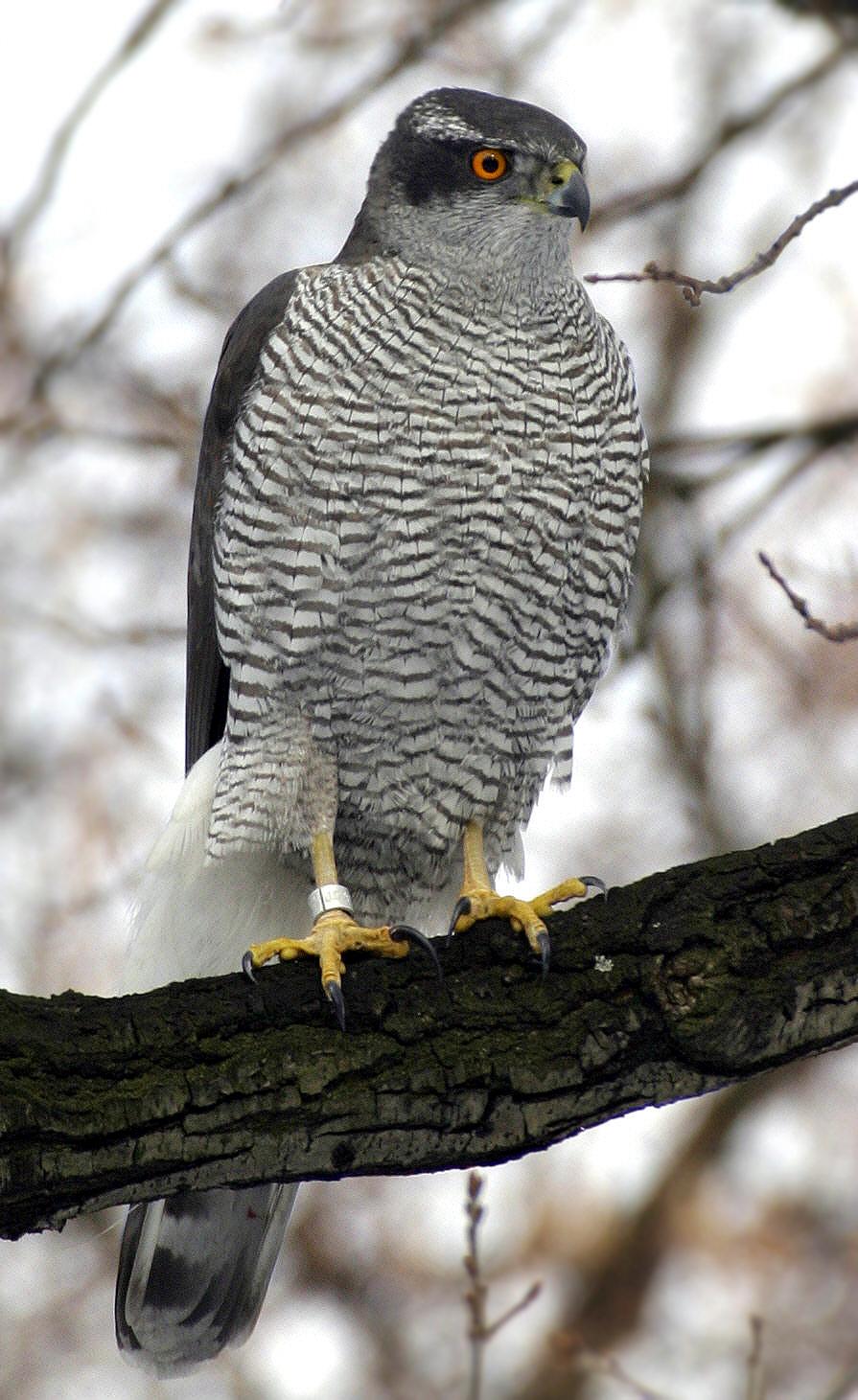
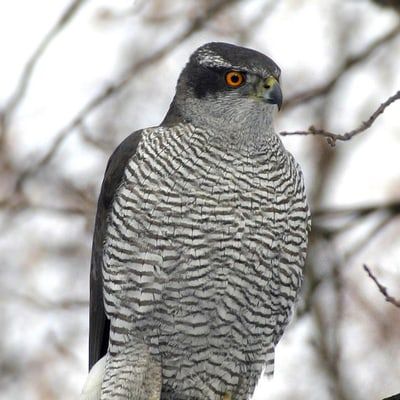
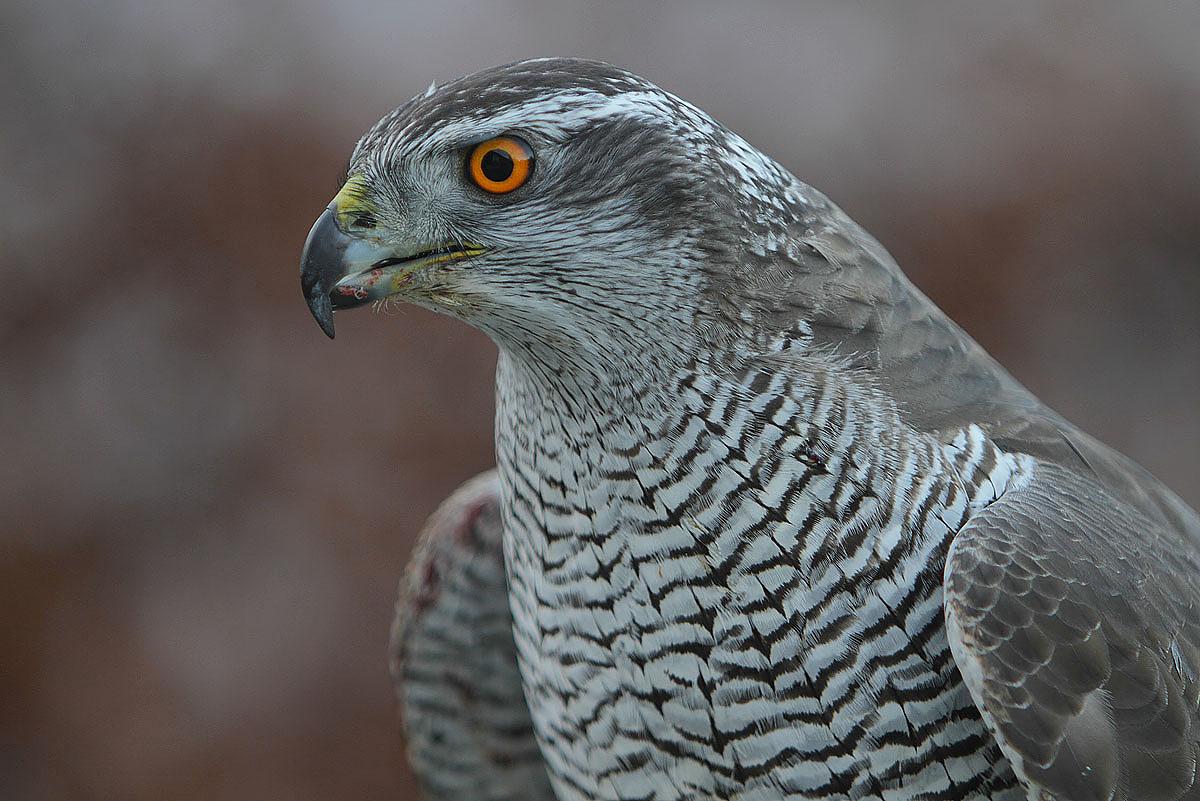
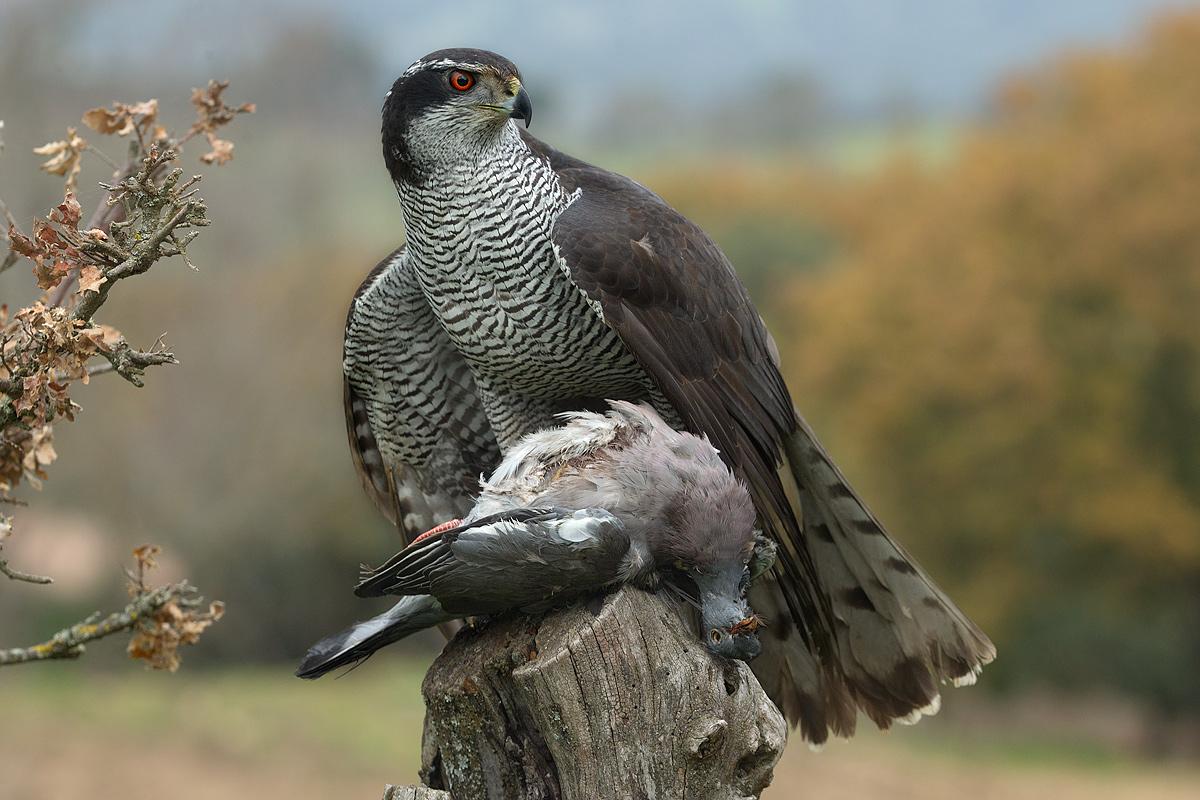
In flight, in particular, the Northern goshawk can be identified by its long tail. The medium-sized raptor is ideally built for fast short-distance flight (swoops) and seldom circles. It has comparatively short rounded wings and is slate grey-brown on the upper side. The underside is transversely striped in white and dark-brown. In addition to the pale eye-stripe, another characteristic feature is its yellow to red iris.
Females are markedly larger than males.
Juvenile birds have a grey-brown plumage. Instead of the transverse banding (countershading), their undersides bear a drop pattern.
Features
Eurasian goshawk
Astur gentilis
long tail and short rounded wings
delicate transverse bars on the underside
white supercilium (plumage on the head)
Rufreihen
Tembrock (CC BY-SA 3.0)

Similar species
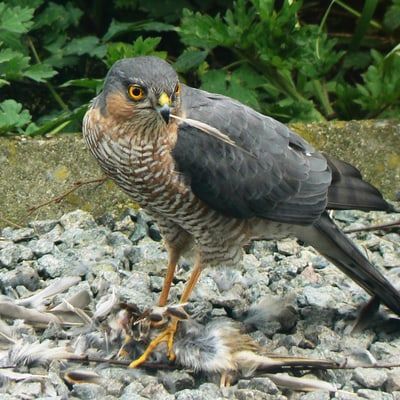
Sparrowhawk
Accipiter nisus
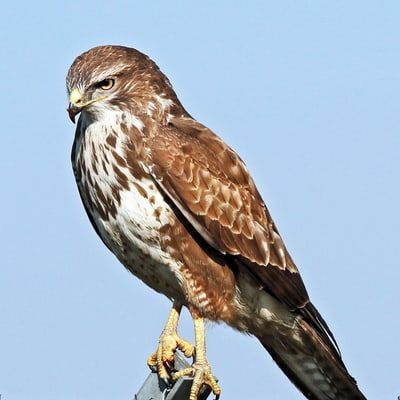
Common buzzard
Buteo buteo
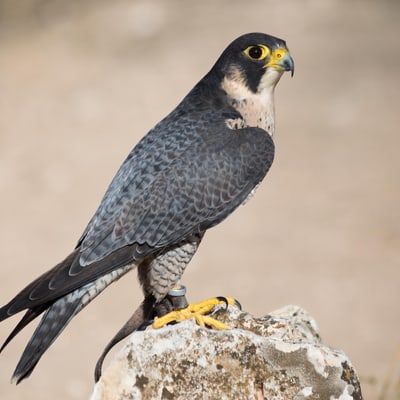
Peregrine falcon
Falco peregrinus
In the city
In addition to forests and urban fringes, the northern goshawk can be seen more frequently close to city centres: With approx. 100 breeding pairs in 2014, Berlin had one of the highest population densities of northern goshawks in the world. Especially in wooded parkland such as the Tiergarten and the vicinity of the Brandenburg Gate, northern goshawks make their living as adaptable opportunists.
Despite its reputation as a withdrawn hunter, the northern goshawk seems to thrive in the hubbub of a major city. In addition to the constant food supply in the form of smaller urban birds such as pigeons, crows or magpies, the northern goshawk is particularly attracted by the absence of natural predators.
Fun Facts
In addition to illegal hunting and putting down poison traps, the destruction of nesting sites as the result of forestry work constitutes a major hazard to northern goshawks. Another frequent cause of death in juvenile birds is crashing into glass-fronted buildings and windows.
The courtship flight of the northern goshawk takes place in late winter, providing an impressive natural spectacle. At that time of year, the raptor that is rarely seen otherwise can be observed performing breath-taking aerial acrobatics.
Northern goshawks can be seen in Germany all year round.
Because goshawks often used to kill free-roaming poultry (goshawk comes from “goose hawk”), they were seen as an enemy to humans. This bad reputation continues to this day: northern goshawks are still being hunted illegally, even though it has been placed under year-round special protection from being hunted in Germany since 1979.
- Endangerment level Germany: not endangered
Sources
Habitus , Norbert Kenntner, CC BY-SA 3.0, https://commons.wikimedia.org/wiki/File:Northern_Goshawk_ad_M2.jpg

Kopf, Steve Garvie, CC BY-SA 2.0, https://commons.wikimedia.org/wiki/File:Accipiter_gentilis_-owned_by_a_falconer_in_Scotland_-upper_body-8a.jpg

Habitus , Iosto Donedduc, CC BY-SA 2.0, https://commons.wikimedia.org/wiki/File:Accipiter_gentilis_by_Iosto_Doneddu.jpg

Svensson, L. (2011) Der Kosmos Vogelführer - Alle Arten Europas, Nordafrikas und Vorderasiens, Stuttgart: Franckh Kosmos Verlag.
Witt, K. & Steiof, K. (2013) Rote Liste und Liste der Brutvögel von Berlin, 3. version, 15.11.2013. : Berliner Ornithologische Arbeitsgemeinschaft e.V. (eds.) Berliner Ornithologischer Bericht, volume 23, Berlin: Berliner Ornithologische Arbeitsgemeinschaft e.V., 1-23.
Page „Habicht“. : Wikipedia, The Free Encyclopedia. Date of last revision: 04.02.2016, 00:33 UTC. URL: https://de.wikipedia.org/w/index.php?title=Habicht&oldid=151041008 (Accessed: 11.02.2016).
Fiedler, W. (2015) Die Vögel Mitteleuropas sicher bestimmen - Schlüssel zur Art-, Alters- und Geschlechtsbestimmung, Wiebelsheim: Quelle & Meyer Verlag.
Makatsch, W. (1989) Wir bestimmen die Vögel Europas, Leipzig: Neumann Verlag.
Voigt, A. (2006) Exkursionsbuch zum Studium der Vogelstimmen, Heidelberg: Quelle & Meyer Verlag.
Harrison, C. (1975) Jungvögel, Eier und Nester aller Vögel Europas, Nordafrikas und des Mittleren Ostens - Ein Naturführer zur Fortpflanzungsbiologie, Hamburg und Berlin: Verlag Paul Parey.
Artenfinder (2016) Accipiter gentilis (Habicht), URL: https://arteninfo.net/elearning/voegel/speciesportrait/2895 (Accessed: 19.04.2016).
NABU – Naturschutzbund Deutschland e.V. & Landesverbund für Vogelschutz in Bayern e.V. (LBV) (n.d.) Der Habicht: Vogel des Jahres 2015, URL: https://www.nabu.de/tiere-und-pflanzen/aktionen-und-projekte/vogel-des-jahres/habicht/index.html (Accessed: 11.02.2021).