
Short Description
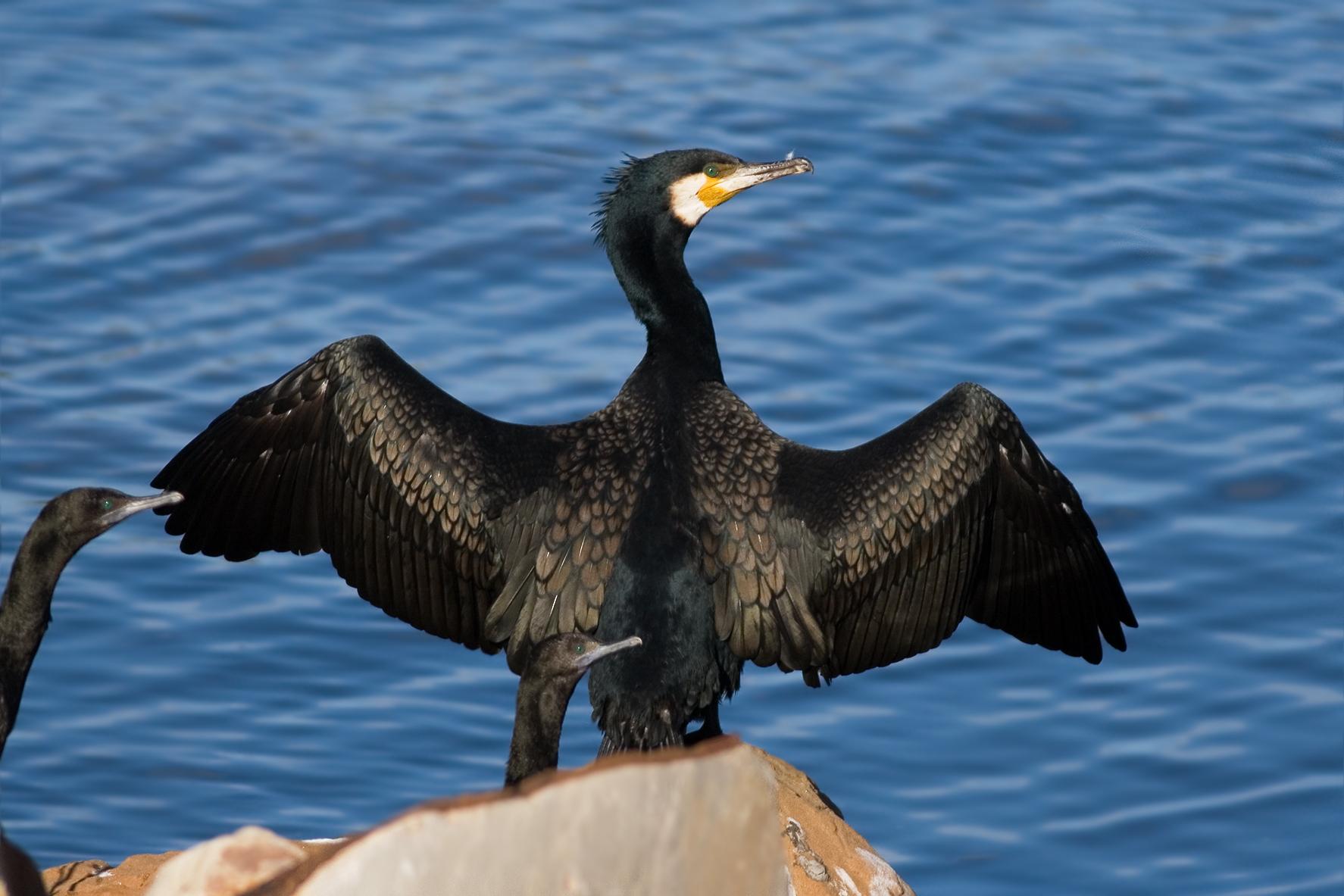
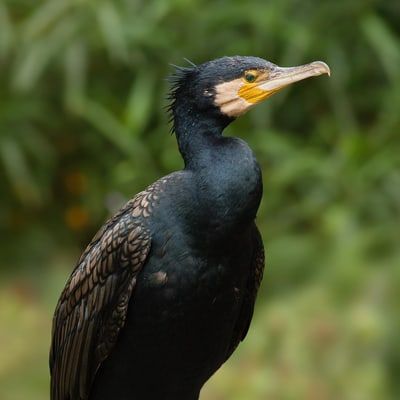
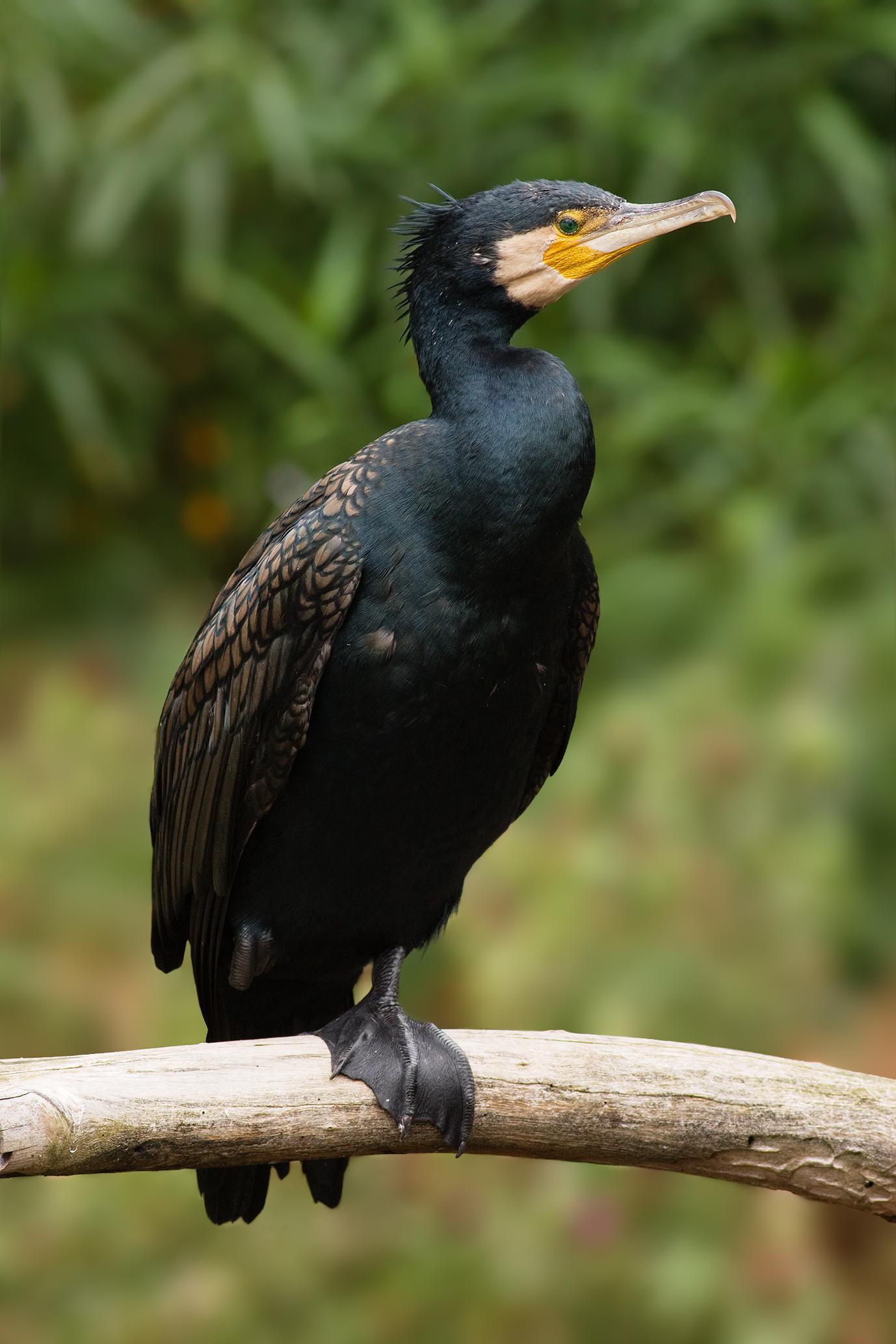
The great cormorant is about the size of a goose with black plumage that has a greenish-blue metallic sheen in light. Its wings have a bronze sheen. The bill has a distinctive hook-tipped bill. At the base of the bill is a bare yellow patch of skin with a white border.
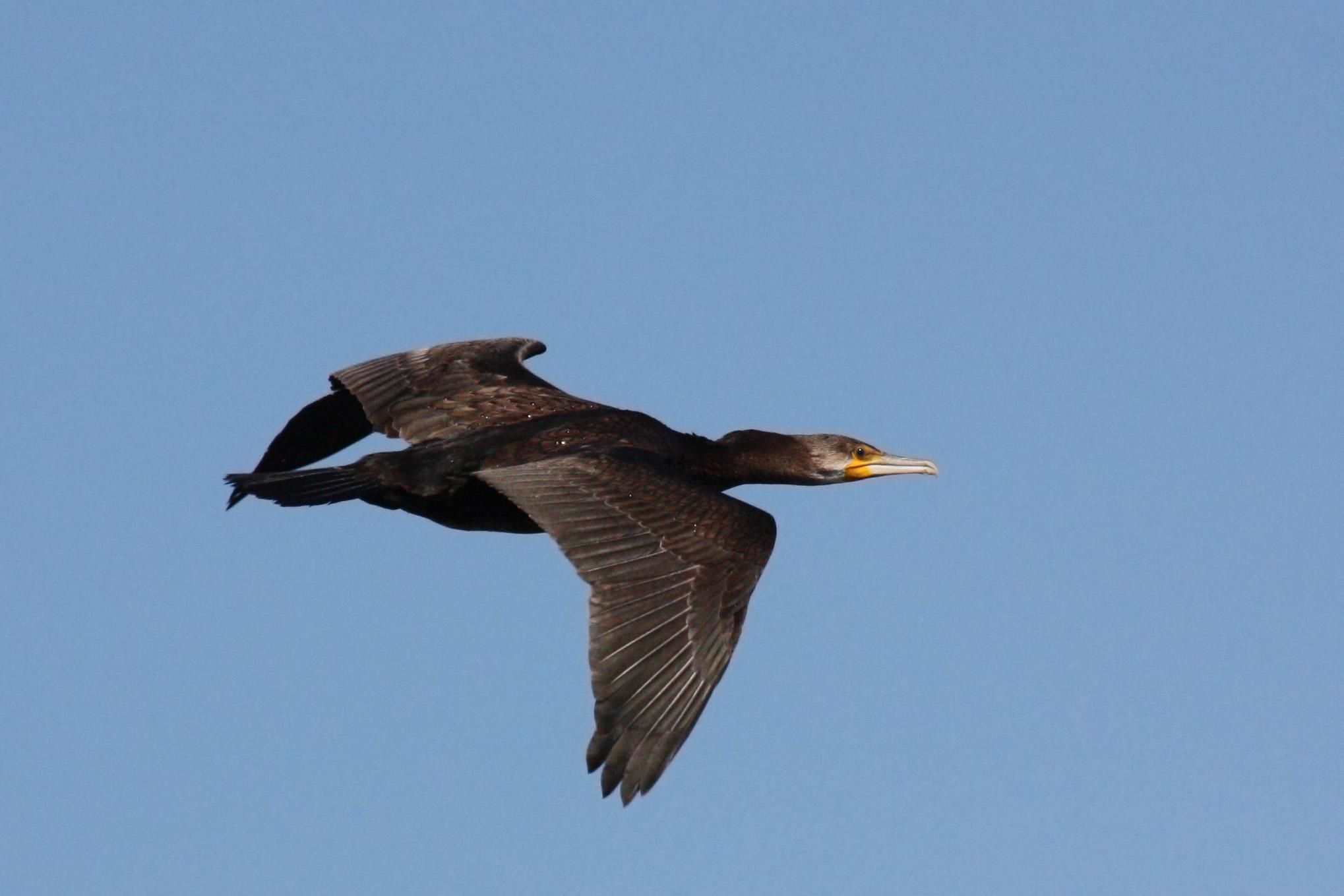
Young cormorants can be recognised by their brown plumage.
Features
Great cormorant
Phalacrocorax carbo
long powerful neck, wedge-shaped head
aquatic bird
Rufe
Tembrock (CC BY-SA 3.0)

In the city
Great cormorants live on all kinds of larger bodies of water. They can occasionally be observed in city centres.
Because of their alleged voraciousness for fish, they are often seen as competitors to fishermen and anglers and subsequently persecuted.
Fun Facts
The plumage of great cormorants is less waterproof than that of other aquatic birds. For that reason, they can often be seen near bodies of water with their wings opened wide to dry their feathers.
In some coastal regions across the world, cormorants are used for fishing.
Depending on breeding sites, great cormorants hibernate in Germany. More northern populations move south over the winter. They return between the end of January and March.
n around 1920, the great cormorant was almost extinct. But thanks to protective measures, population numbers have once again increased significantly.
Cormorants same as pelicans are classified as totipalmate swimmers (Pelicanoformes). With all four toes united by a web (hence totipalmate), it is an outstanding swimmer.
- Endangerment level Germany: not endangered
Sources
beim Trocknen des Gefieders, JJ Harrison, CC BY-SA 3.0, https://commons.wikimedia.org/wiki/File:Phalacrocorax_carbo_Austins_Ferry_1.jpg

im Flug, Charlesjsharp, CC BY-SA 3.0, https://commons.wikimedia.org/wiki/File:Great_cormorant_(Phalacrocorax_carbo)_in_flight.jpg
_in_flight.jpg)
Habitus , JJ Harrison, CC BY-SA 3.0, https://commons.wikimedia.org/wiki/File:Phalacrocorax_carbo_Vic.jpg?uselang=de

Witt, K. & Steiof, K. (2013) Rote Liste und Liste der Brutvögel von Berlin, 3. version, 15.11.2013. : Berliner Ornithologische Arbeitsgemeinschaft e.V. (eds.) Berliner Ornithologischer Bericht, volume 23, Berlin: Berliner Ornithologische Arbeitsgemeinschaft e.V., 1-23.
Page „Kormoran (Art)“. : Wikipedia, The Free Encyclopedia. Date of last revision: 20.11.2015, 23:50 UTC. URL: https://de.wikipedia.org/w/index.php?title=Kormoran_(Art)&oldid=148239980 (Accessed: 12.02.2016).
NABU - Naturschutzbund Deutschland e.V. (n.d.) Kormoran - Phalacrocorax carbo, URL: https://www.nabu.de/tiere-und-pflanzen/aktionen-und-projekte/vogel-des-jahres/11602.html (Accessed: 11.02.2021).
NABU Landesverband Schleswig-Holstein (n.d.) Aussehen und Brutbiologie. Kormorane auffällig gezeichnet | Koloniebrüter am Boden oder auf Bäumen, URL: https://schleswig-holstein.nabu.de/tiere-und-pflanzen/voegel/kormoran/lebensweise/03327.html (Accessed: 11.02.2021).