
Short Description
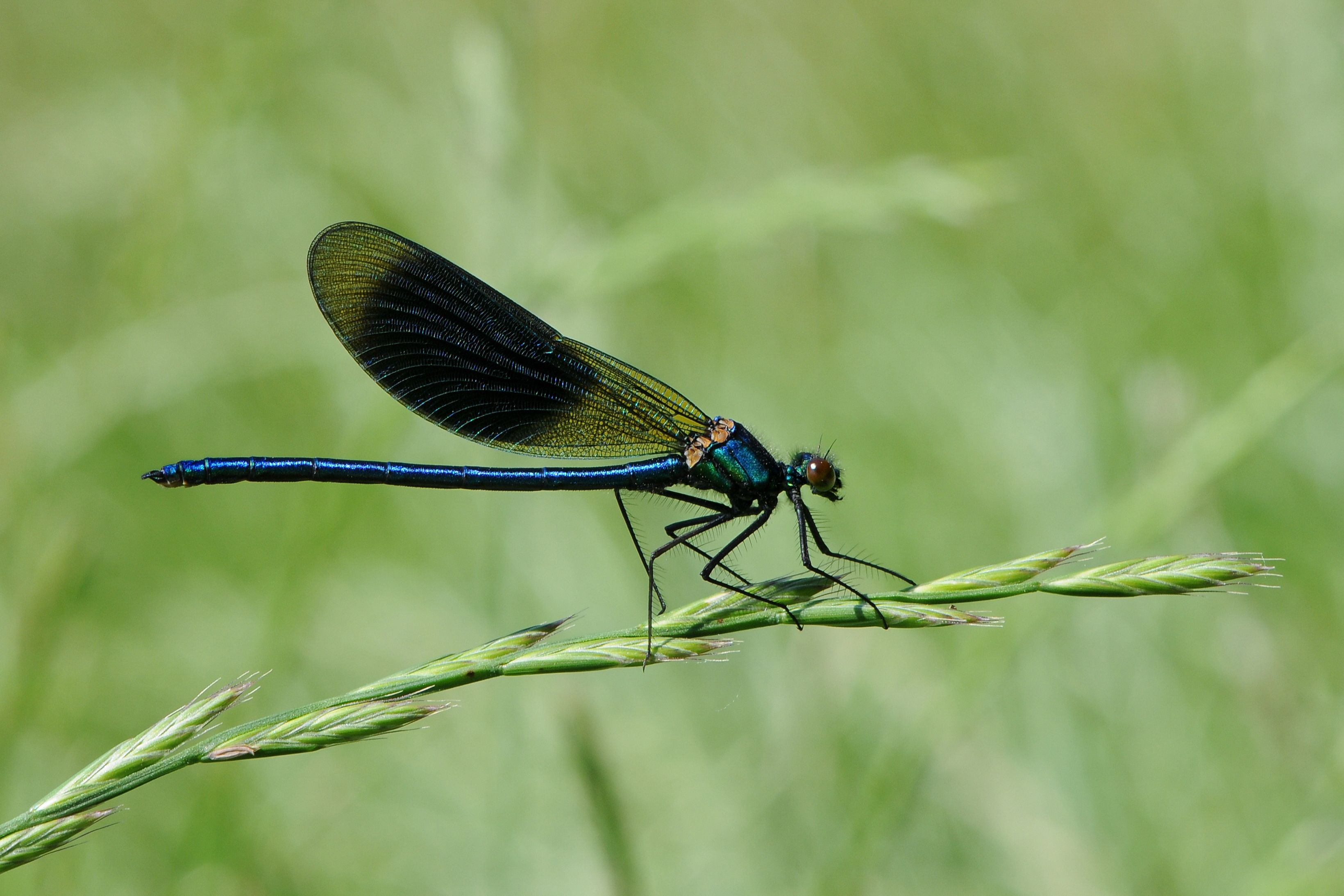
The banded demoiselle belongs to the damselflies and grows to about 5 cm long.
The males have striking bright blue-green iridescent bodies. Their greenish wings have a distinct black-blue band.
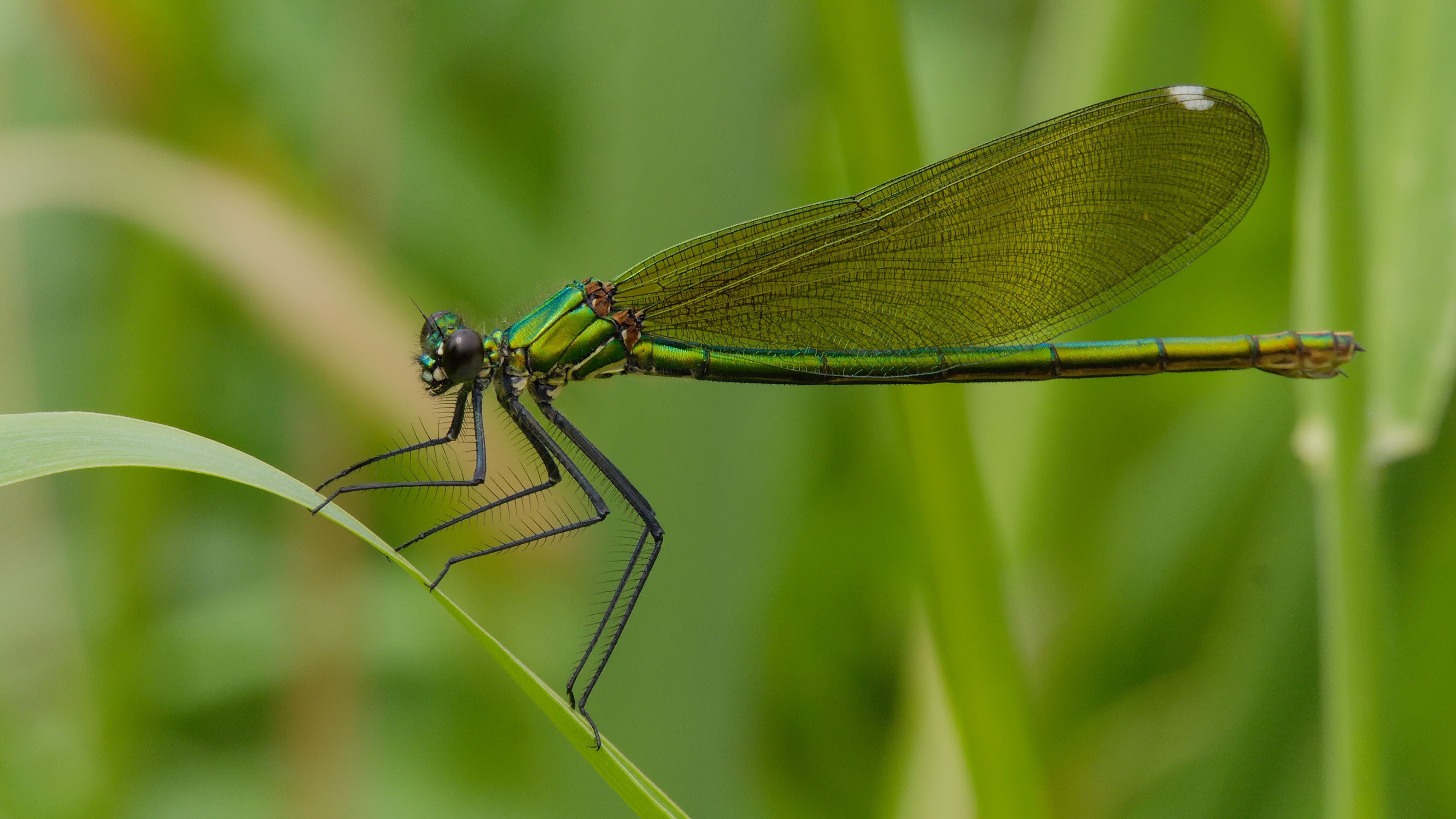
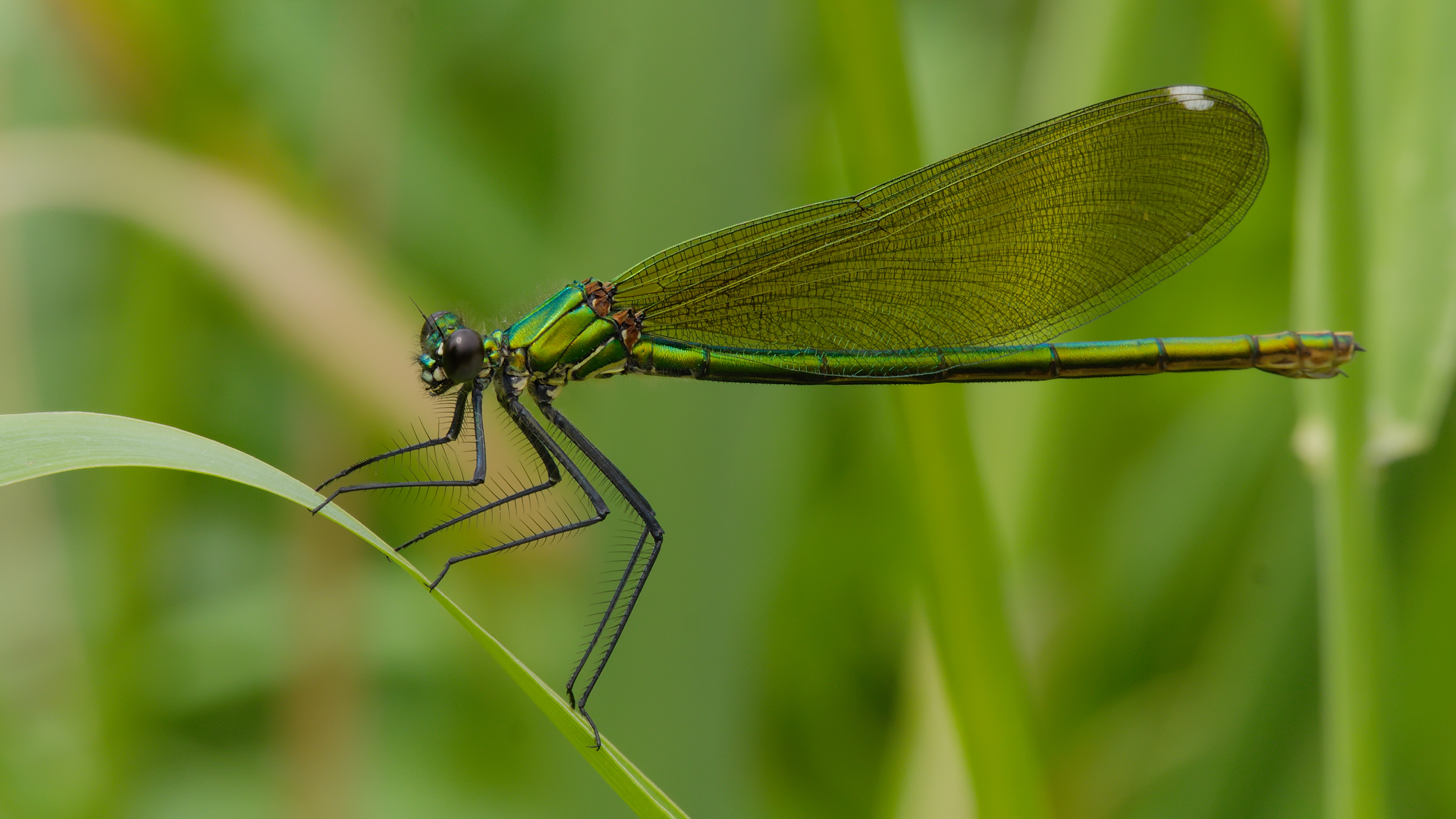
Females are metallic greenish and their wings are inconspicuous without coloration.
The development to an adult occurs via a larval stage in the water.
Features
Banded demoiselle
Calopteryx splendens
metallic shiny
dark band on the wings of males
Similar species
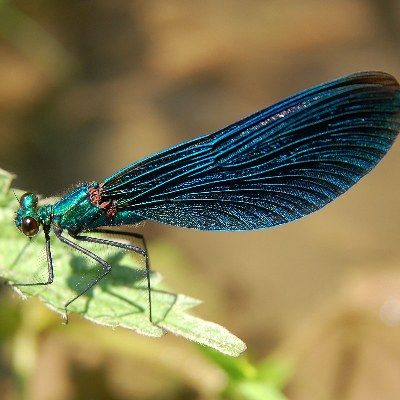
Beautiful demoiselle
Calopteryx virgo
In the city
Damselflies benefit from waters with good water quality. They prefer near-natural habitats along streams and rivers with intact underwater vegetation, varied riparian areas, and a sandy to gravelly bottom. The renaturation of water bodies can open up new habitats for the banded demoiselle.
Fun Facts
The larvae live in slow-moving streams and rivers.
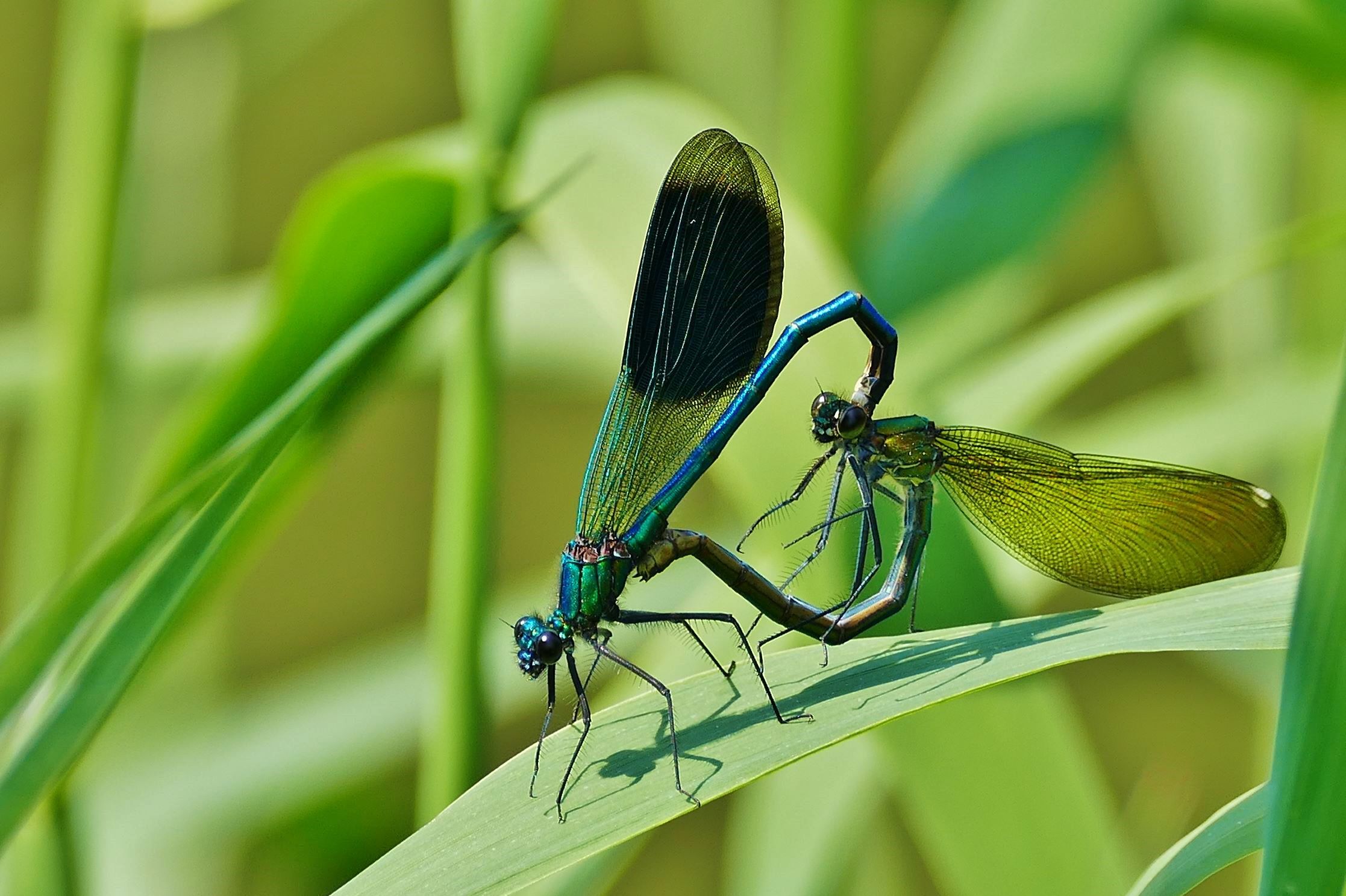
In the course of mating, a very acrobatic looking mating wheel is formed.
Their flight season is from mid-May to early September.
The fluttering flight style, reminiscent of butterflies, is typical of damselflies.
Like all dragonflies, it is a protected species in Germany.
- Endangerment level Germany: not endangered
Sources
Männchen, böhringer friedrich, CC BY-SA 2.5, https://upload.wikimedia.org/wikipedia/commons/4/49/%E2%99%82_Geb%C3%A4nderte_Prachtlibelle_Calopteryx_splendens_4.JPG

Weibchen, Andreas Eichler, CC BY-SA 3.0, https://upload.wikimedia.org/wikipedia/commons/6/60/2013.08.04.-15-Ladenburg-Gebaenderte_Prachtlibelle-Weibchen.jpg
Paarungsrad, Rudolf Eberhard Neuber, CC BY-SA 4.0, https://upload.wikimedia.org/wikipedia/commons/6/6d/Geb%C3%A4nderte_Prachtlibelle_als_Liebellenring.JPG

NABU – Naturschutzbund Deutschland e.V. (n.d.) Insektentrainer. Gebänderte Prachtlibelle. URL: https://insektentrainer.nabu.de/insekt/gebaenderte-prachtlibelle/ (Accessed: 05.07.2021).
Ineichen, S., Klausnitzer, B. & Ruckstuhl, M. (2012) Stadtfauna. Bern: Haupt Verlag.
Petzold, F. (2017) Rote Liste und Gesamtartenliste der Libellen (Odonata) von Berlin. : Der Landesbeauftragte für Naturschutz und Landschaftspflege / Senatsverwaltung für Stadtentwicklung (eds.) Rote Listen der gefährdeten Pflanzen und Tiere von Berlin, URL:https://www.berlin.de/sen/uvk/natur-und-gruen/naturschutz/artenschutz/artenlisten-rote-listen/insekten/#Libellen (Accessed: 30.07.2021).
Clausnitzer, V. (2020) Calopteryx splendens. The IUCN Red List of Threatened Species 2020. URL: https://dx.doi.org/10.2305/IUCN.UK.2020-3.RLTS.T158701A138711145.en. (Accessed: 07.09.2021).
Page „Gebänderte Prachtlibelle“. : Wikipedia, The Free Encyclopedia. Date of last revision: 18.03.2021, 21:24 UTC. URL: https://de.wikipedia.org/w/index.php?title=Geb%C3%A4nderte_Prachtlibelle&oldid=209940731 (Accessed: 07.09.2021).