
Short Description
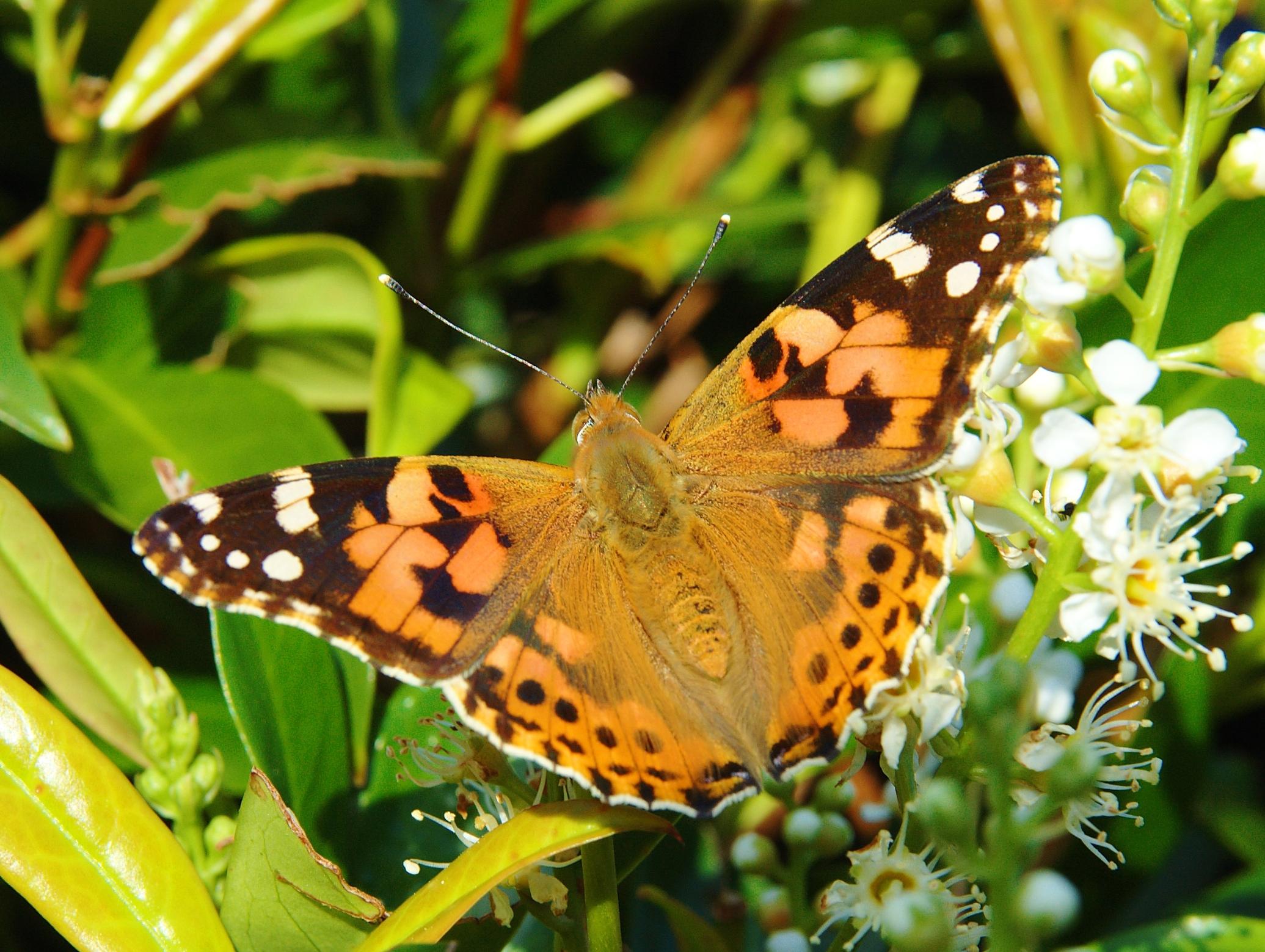
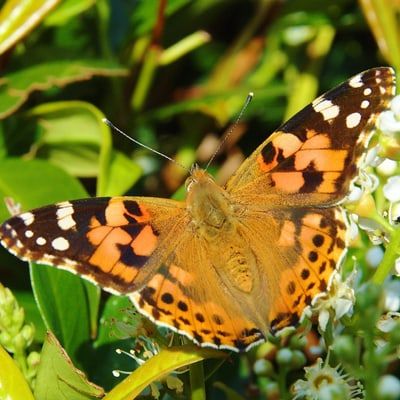
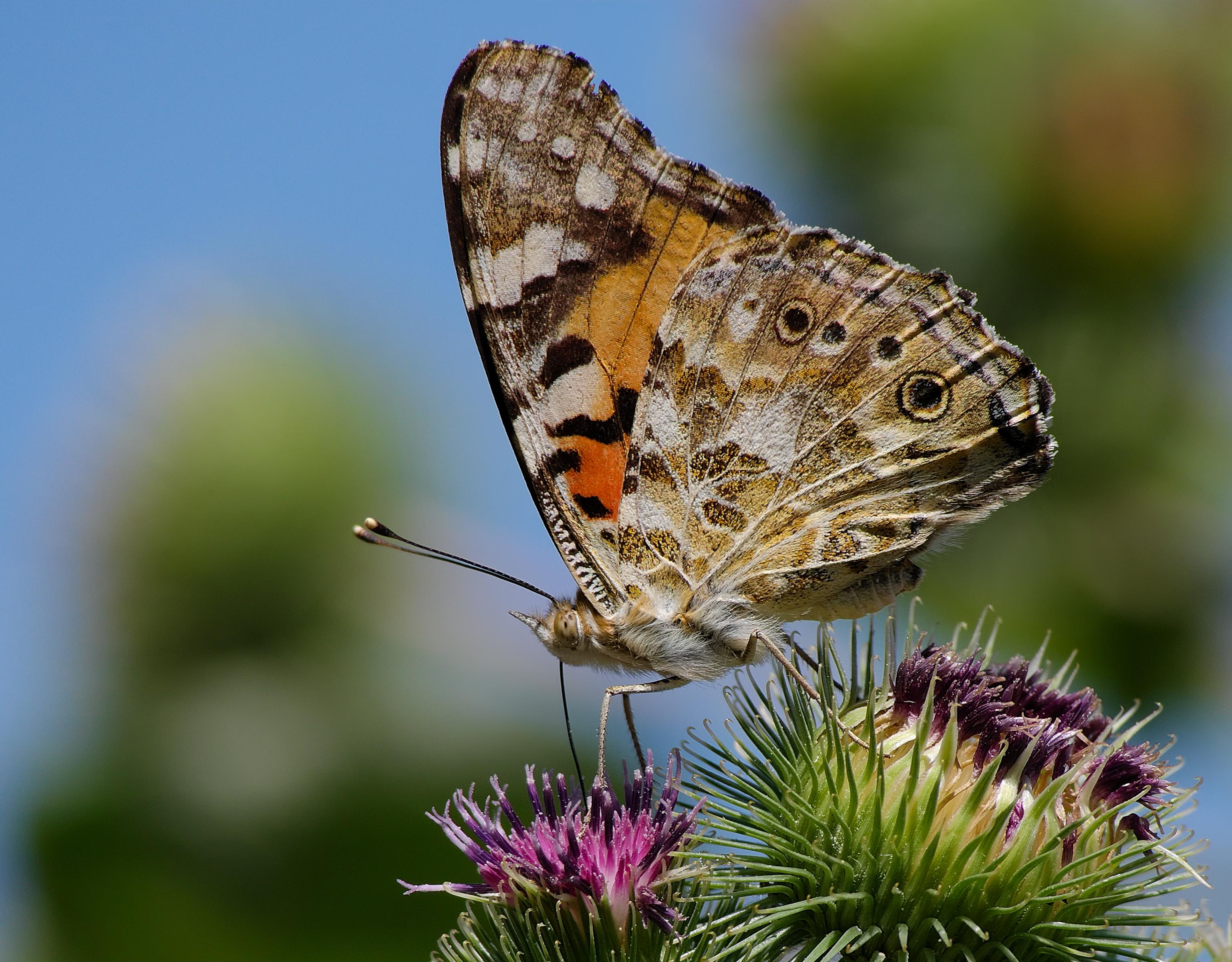
The painted lady is easy to recognise by its striking orange-brown markings. The upper sides of the wings are orange with dark-brown markings and white patches at the black forewing tips. The hind wings bear five eyespots. The undersides of the wings are inconspicuously marbled in light brown.
The caterpillars are ochre yellow to greenish-brown. They have spines and a pale broken longitudinal line on the side.
Features
Painted lady
Vanessa cardui
orange wings with dark-brown patches
In the city
Painted lady butterflies prefer to live in open spaces. They can be found in flower-rich verges of parks and gardens, in pioneer and ruderal sites such as uncultivated lands, roadsides, embankments and individual pastures.
The painted lady caterpillar prefers host plants such as thistles or stinging nettles. For that reason, they particularly like to live in near-natural or partially unkempt gardens.
Fun Facts
The painted lady is a migratory butterfly and hibernates in the south.
Its feeding plants include cabbage thistle and Canadian thistle, mugwort, burdock and stinging nettles.
- Endangerment level Germany: not endangered
Sources
Oberseite, I, Luc Viatour, CC BY-SA 3.0, https://commons.wikimedia.org/wiki/File:Vanessa_cardui_3_Luc_Viatour.jpg

Unterseite, Andreas Eichler, CC BY-SA 3.0, https://commons.wikimedia.org/wiki/File:2013.08.02.-19-Kirschgartshaeuser_Schlaege_Mannheim-Distelfalter.jpg

Settele, J., Steiner, R., Reinhardt, R. & Feldmann, R. (2005) Schmetterlinge. Die Tagfalter Deutschlands, Stuttgart: Verlag Eugen Ulmer.
Kolligs, D. (2014) Schmetterlinge Norddeutschlands. 100 Tagfalter, Kiel: Wachholtz Verlag.
Seggewiße, E. & Wyman, H.-P. (2015) Schmetterlinge entdecken, beobachten, bestimmen: die 160 häufigsten tagaktiven Arten Mitteleuropas, Bern: Haupt Verlag.
Gerstmaier, R. (2003) Schmetterlinge. Sicher bestimmen mit Foto und Zeichnung, Stuttgart: Franckh Kosmos Verlag.
BUND e.V. (n.d.) Steckbrief des Schmetterlings: Distelfalter, URL: https://www.bund.net/themen/tiere-pflanzen/schmetterlinge/steckbriefe/tagfalter/distelfalter/ (Accessed: 19.07.2016).
Nuß, M. (n.d.) Schmetterlinge (Lepidoptera), URL: https://www.insekten-sachsen.de/Pages/TaxonomyBrowser.aspx?id=7 (Accessed: 19.07.2016).
Pollrich, S. (n.d.) Tagfalter in Sachsen, URL: http://www.tagfalter-sachsen.de/arten/ (Accessed: 19.07.2016).
Entomologische Gesellschaft ORION Berlin (n.d.) Schmetterlinge (Lepidoptera), URL: http://www.orion-berlin.de/schmetter/schmetter_gesamt.php (Accessed: 19.07.2016).
Schön, W. (n.d.) Portal für Schmetterlinge/Raupen, URL: http://www.schmetterling-raupe.de/ (Accessed: 19.07.2016).
NABU – Naturschutzbund Deutschland e.V. (n.d.) Ein Garten für Schmetterlinge. Naturgärten halten ein ganzjähriges Nektarangebot bereit, URL: https://www.nabu.de/umwelt-und-ressourcen/oekologisch-leben/balkon-und-garten/naturschutz-im-garten/01446.html (Accessed: 31.01.2017).