
Short Description
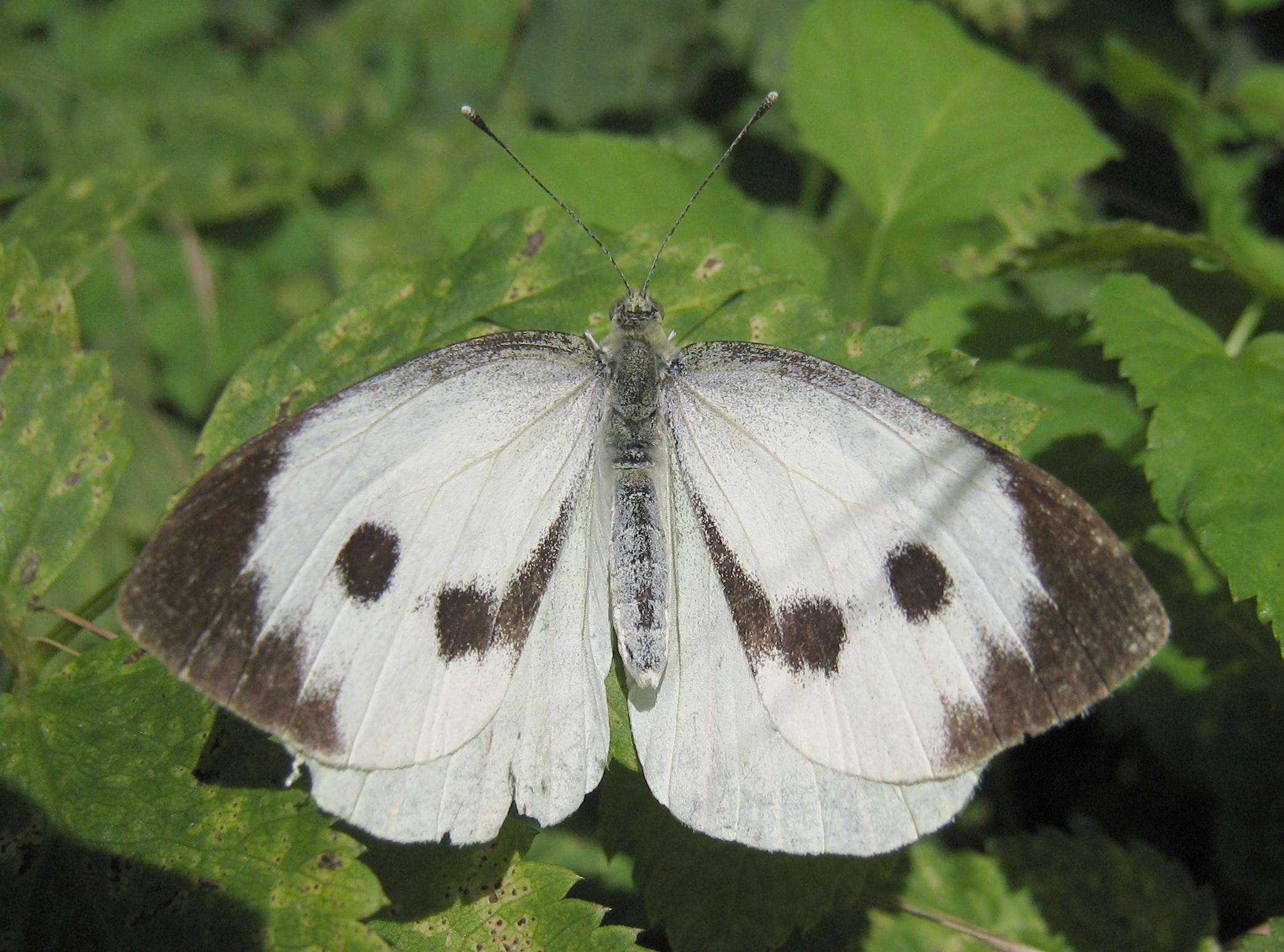
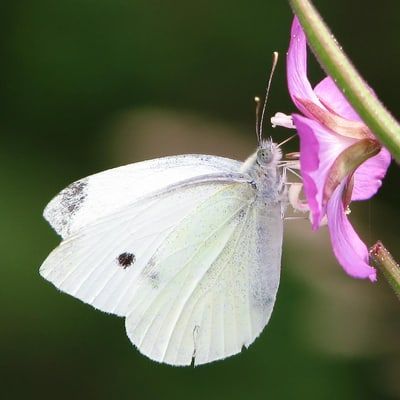
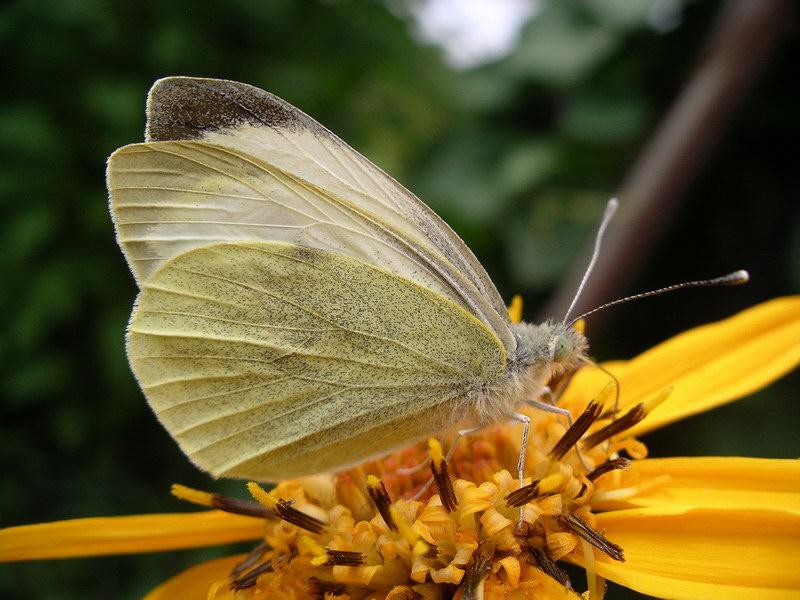
The large white is pure white with black wing tips. The undersides of its forewings are marked with large black spots.
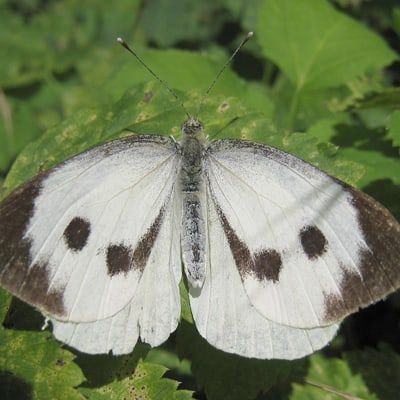
Males have no spot on the upper side of their forewings.
In females, two black spots can clearly be seen on the upper side of their forewings.
The caterpillar is yellowish with black spots and white hairs. The caterpillar’s head is white with fine black dots.
Features
Large white
Pieris brassicae
white with obvious black dots
black-tipped forewings
In the city
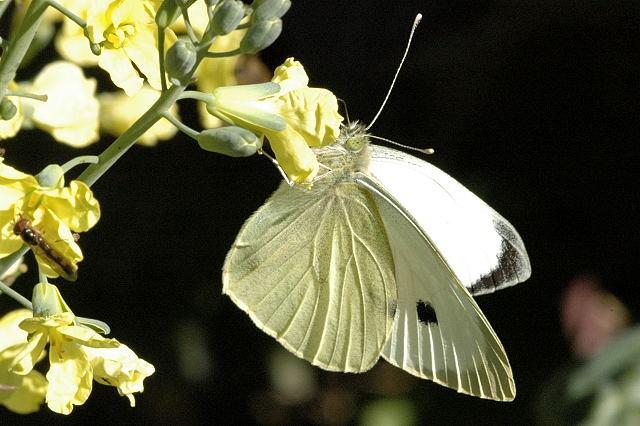
Large whites can be seen in sparse forests and open meadows. As a synanthrope (ecologically associated with humans), it is often found in human settlements, gardens and parks.
Its caterpillars feed on various types of cabbage. For that reason, it is mainly found in vegetable patches and allotments, where it lays its eggs. It often pupates on wooden fences or house walls.
Fun Facts
Every few years, there is a mass reproduction of large whites. Gigantic swarms can then be observed on their migratory flights.
Large whites can be seen from the middle of May to the middle of October.
Other than the small white, the large white lays its eggs in clusters.
The caterpillar of the large white tends to feed on the outer leaves of cabbage plants. The caterpillar of the small white penetrates to the inside of the cabbage flower.
- Endangerment level Germany: not endangered
Sources
Weibchen, S Sepp, CC BY-SA 3.0, https://commons.wikimedia.org/wiki/File:Large_white_spread_wings.jpg

Männchen, James Lindsey, CC BY-SA 3.0, https://commons.wikimedia.org/wiki/File:Pieris.brassicae.male.jpg

Habitus, Svdmolen, CC BY-SA 3.0, https://commons.wikimedia.org/wiki/File:Pieris_brassicae_-_lt.jpeg

Settele, J., Steiner, R., Reinhardt, R. & Feldmann, R. (2005) Schmetterlinge. Die Tagfalter Deutschlands, Stuttgart: Verlag Eugen Ulmer.
Kolligs, D. (2014) Schmetterlinge Norddeutschlands. 100 Tagfalter, Kiel: Wachholtz Verlag.
Seggewiße, E. & Wyman, H.-P. (2015) Schmetterlinge entdecken, beobachten, bestimmen: die 160 häufigsten tagaktiven Arten Mitteleuropas, Bern: Haupt Verlag.
Gerstmaier, R. (2003) Schmetterlinge. Sicher bestimmen mit Foto und Zeichnung, Stuttgart: Franckh Kosmos Verlag.
Nuß, M. (2018) Großer Kohlweißling (Pieris brassicae (Linnaeus, 1758)), URL: https://www.insekten-sachsen.de/Pages/TaxonomyBrowser.aspx?Id=440880 (Accessed: 24.03.2021).
Rennwald, E. (2021) Bestimmungshilfe für die in Europa nachgewiesenen Schmetterlingsarten. 06995 Pieris brassicae (LINNAEUS, 1758) - Großer Kohlweißling Gross, URL: http://www.lepiforum.de/lepiwiki.pl?Pieris_Brassicae (Accessed: 24.03.2021).
Page „Großer Kohlweißling“. : Wikipedia, The Free Encyclopedia. Date of last revision: 10.09.2016, 14:19 UTC. URL: https://de.wikipedia.org/w/index.php?title=Gro%C3%9Fer_Kohlwei%C3%9Fling&oldid=157815298 (Accessed: 20.01.2017).
Dienstleistungszentren Ländlicher Raum in Rheinland-Pfalz (n.d.) Kohlweißling, Großer und Kleiner, URL: http://www.dlr.rlp.de/Internet/global/themen.nsf/se_quick/2E3A8FDAA70B8FA0C125704A00303803?OpenDocument (Accessed: 20.01.2017).
Rennwald, E. (2021) Bestimmungshilfe für die in Europa nachgewiesenen Schmetterlingsarten. 06995 Pieris brassicae (LINNAEUS, 1758) - Großer Kohlweißling, URL: http://www.lepiforum.de/lepiwiki.pl?Pieris_Brassicae (Accessed: 25.03.2021).