

Short Description
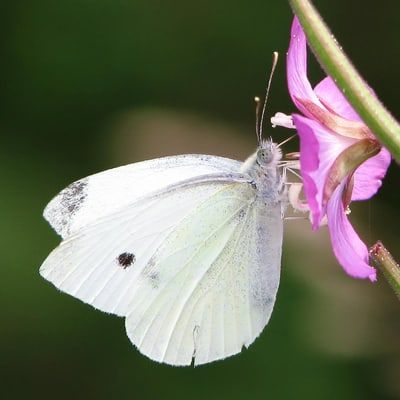
The small white is white with obvious black dots. The tips of the forewings are pale dark grey. The undersides of the wings are greyish-yellow to creamy-white. Its size and colouring set it apart from other whites.
Males have a black spot on the upper side of their forewings. This is not as pronounced as in females.
Females have two distinctive black spots on the upper side of their forewings.
The caterpillar is green with yellow spots. Its back is marked with a yellow longitudinal strip.
Features
Small white
Pieris rapae
pale greyish-black forewing tips
white with black dots
Similar species
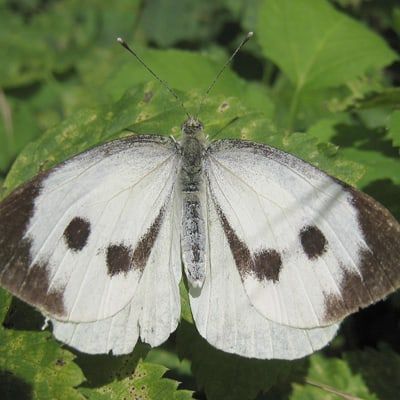
Large white
Pieris brassicae

Green-veined white
Pieris napi

In the city
This highly mobile butterfly can be found in gardens, uncultivated land and forest verges. As a synanthrope (ecologically associated with humans), it is often found close to human habitation. In gardens, it lays its eggs on various cultivated forms of cabbage or on nasturtium.
Fun Facts
From June onwards, caterpillars of the small white cause considerable damage in vegetable cultivation. Particularly vulnerable are the heads of various cabbage varieties, into which the caterpillars eat their way to the centre. For that reason, they are also known as cabbage worms.
Males hatch noticeable earlier than females from pupate stage. They can be observed flying around in their search for freshly hatched females.
In our latitudes, the small whites hibernate as pupae. In warmer regions, though, it flies all year round.
For nectar plants, it prefers those with purple flowers.
- Endangerment level Germany: not endangered

Sources
Weibchen, Rasbak, CC BY-SA 3.0, https://commons.wikimedia.org/wiki/File:Koolwitje_closeup.jpg

Männchen, Darkone, CC BY-SA 2.5, https://commons.wikimedia.org/wiki/File:Kleiner_Kohlweissling_Pieris_rapae_Profil.jpg?uselang=de

Unterseite (Männchen), Darkone, CC BY-SA 2.5, https://commons.wikimedia.org/wiki/File:Kleiner_Kohlweissling_Pieris_rapae_Profil.jpg

Settele, J., Steiner, R., Reinhardt, R. & Feldmann, R. (2005) Schmetterlinge. Die Tagfalter Deutschlands, Stuttgart: Verlag Eugen Ulmer.
Kolligs, D. (2014) Schmetterlinge Norddeutschlands. 100 Tagfalter, Kiel: Wachholtz Verlag.
Seggewiße, E. & Wyman, H.-P. (2015) Schmetterlinge entdecken, beobachten, bestimmen: die 160 häufigsten tagaktiven Arten Mitteleuropas, Bern: Haupt Verlag.
Gerstmaier, R. (2003) Schmetterlinge. Sicher bestimmen mit Foto und Zeichnung, Stuttgart: Franckh Kosmos Verlag.
Nuß, M. & Bauer, F. (2018) Kleiner Kohlweißling (Pieris rapae (Linnaeus, 1758)), URL: https://www.insekten-sachsen.de/Pages/TaxonomyBrowser.aspx?Id=440885 (Accessed: 25.03.2021).
Hensle, J., Ziegler, H. & Rennwald, E. (2021) Bestimmungshilfe für die in Europa nachgewiesenen Schmetterlingsarten. 06998 Pieris rapae (LINNAEUS, 1758) - Kleiner Kohlweißling, URL: http://www.lepiforum.de/lepiwiki.pl?Pieris_Rapae (Accessed: 25.03.2021).
NABU Landesverband Nordrhein-Westfalen (n.d.) Tagfalter in Nordrhein-Westfalen, URL: https://nrw.nabu.de/tiere-und-pflanzen/aktionen-und-projekte/tagfaltermonitoring/tagfalter-nrw/03157.html (Accessed: 27.01.2017).
Page „Kleiner Kohlweißling“. : Wikipedia, The Free Encyclopedia. Date of last revision: 28.12.2016, 16:53 UTC. URL: https://de.wikipedia.org/w/index.php?title=Kleiner_Kohlwei%C3%9Fling&oldid=161043489 (Accessed: 27.01.2017).