
Short Description
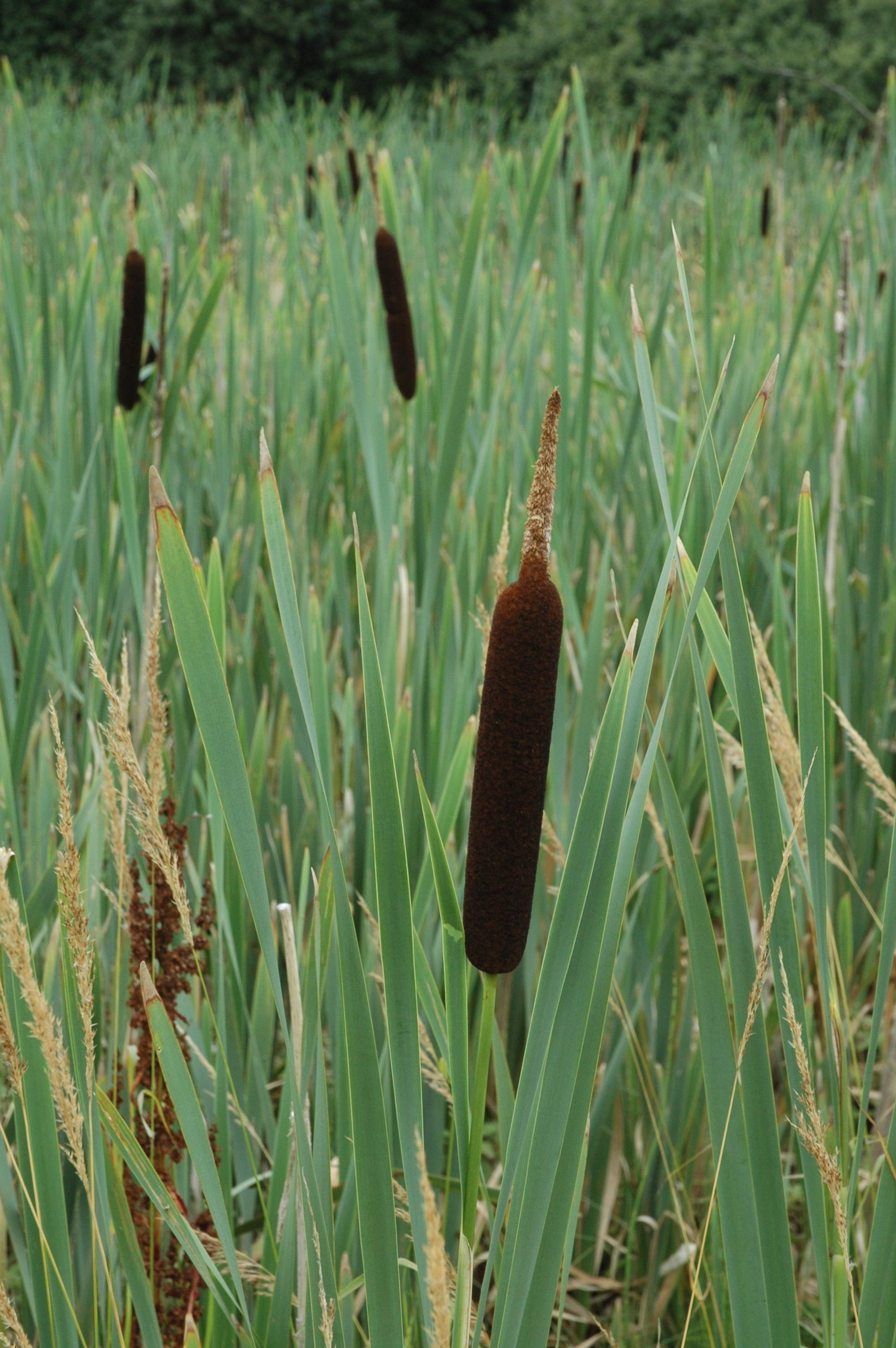
The broadleaf cattail belongs to the marsh and water plants. It can grow up to 3 meters high.
The blue-green leaves are elongated and narrow. The lower part of the leaves forms a leaf sheath, which encloses the stem. They are stiff and sit alternately on the stem.
The robust stem grows erect. It is round and has a diameter of 1 to 2 centimeters.
The bulbous inflorescence consists of purely female flowers in the lower part and purely male flowers in the upper part. It is dark brown and can grow up to 35 centimeters long in total.
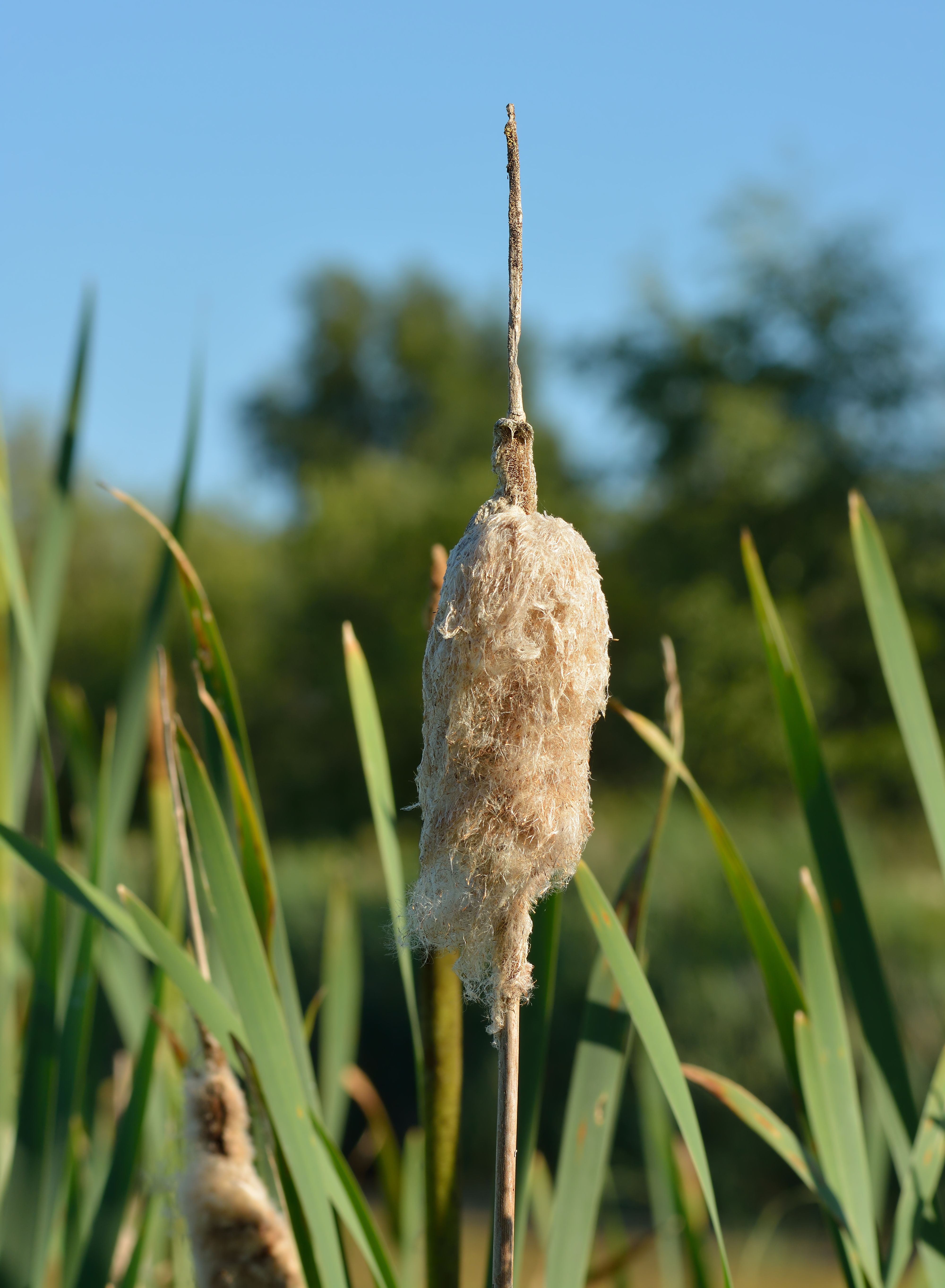
The ripe nut fruits are elongated, light brown and have long white hairs.
Features
Broadleaf cattail
Typha latifolia
large, brown, cob-shaped inflorescence
In the city
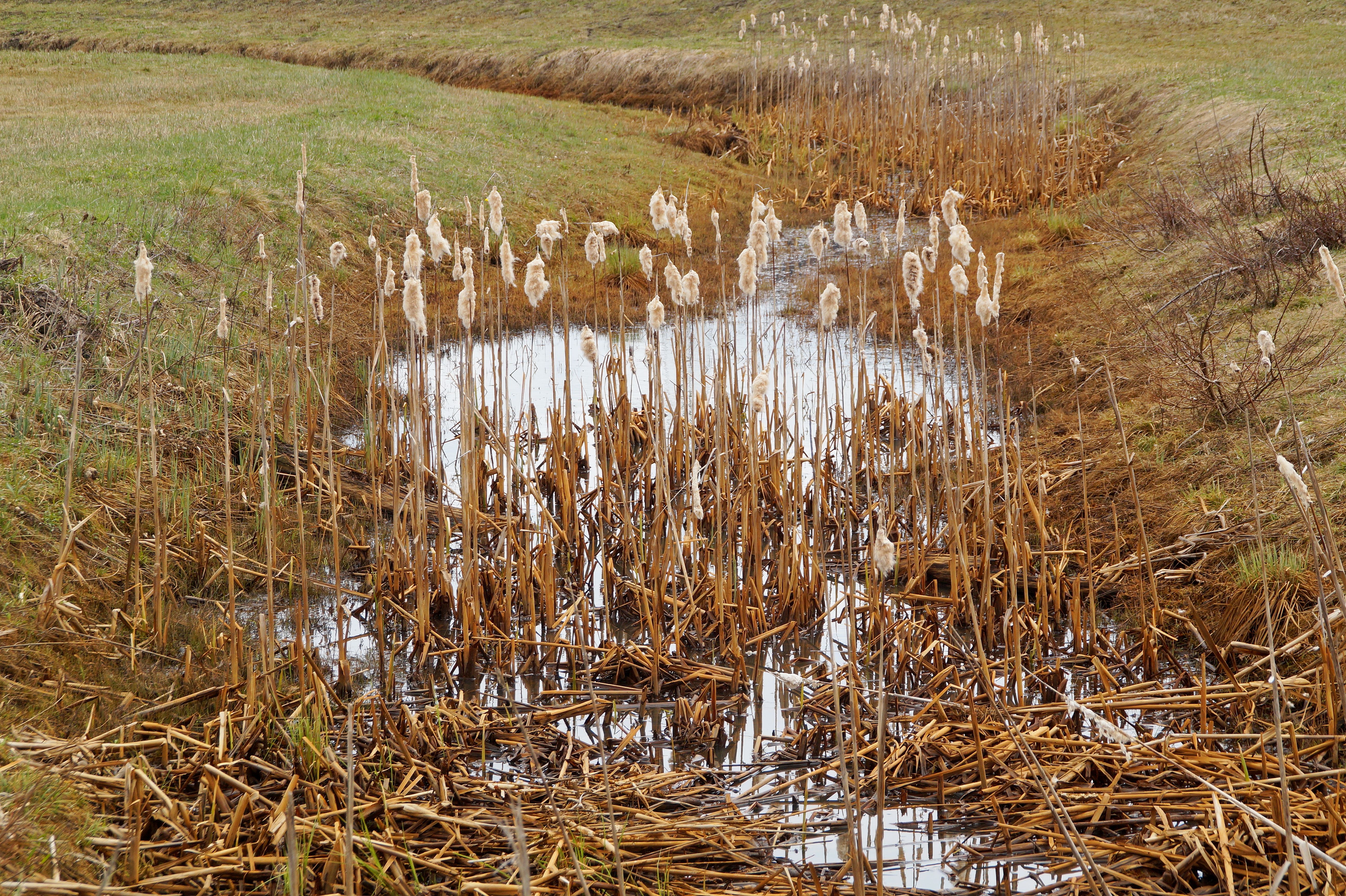
On the Berlin river "Panke", cattails are found within the reed belt. This can establish itself particularly well in slow-flowing, near-natural sections. Severe water body eutrophication, riparian development and recreational use can significantly worsen the site conditions.
Fun Facts
The leaves have a distinctive aeration tissue, a so-called aerenchyma. It serves the gas exchange in submerged leaves.
Cattails are interesting as a renewable raw material for the building materials sector.
As a component of reed beds, an important plant community in riparian and siltation areas of water bodies, cattail species provide nesting opportunities and shelter for a variety of waterfowl.
- Endangerment level Germany: not endangered
- Usage:
Many parts of the plant are edible both raw and cooked. Oil extracted from the seeds as well as the leaves have a hemostatic, disinfectant, anticoagulant and diuretic effect and can also be used against worm infestation.
Sources
Habitus, Ekko, PD, https://commons.wikimedia.org/wiki/File:Typha_latifolia_norway.jpg

Habitus im Herbst und Winter, Robert Kropf, CC BY-SA 4.0, https://upload.wikimedia.org/wikipedia/commons/5/58/2021-04-17_Fesitritz_an_der_Gail_G%C3%B6rtschacher_Moos09.jpg

Fruchtstand, Ivar Leidus, CC BY-SA 3.0, https://upload.wikimedia.org/wikipedia/commons/2/21/Typha_latifolia_-_laialehine_hundinui.jpg

Greifswald Moor Centrum (2020) Rohrkolben (Typha spp.), URL: https://www.moorwissen.de/de/paludikultur/imdetail/pflanzenarten/rohrkolben.php (Accessed: 30.07.2021).
Page „Breitblättriger Rohrkolben“. : Wikipedia, The Free Encyclopedia. Date of last revision: 28.11.2020, 11:14 UTC. URL: https://de.wikipedia.org/w/index.php?title=Breitbl%C3%A4ttriger_Rohrkolben&oldid=206012335 (Accessed: 08.09.2021).
Lansdown, R.V. (2017) Typha latifolia. The IUCN Red List of Threatened Species 2017, URL: https://dx.doi.org/10.2305/IUCN.UK.2017-1.RLTS.T164165A84300723.en (Accessed: 08.09.2021).