
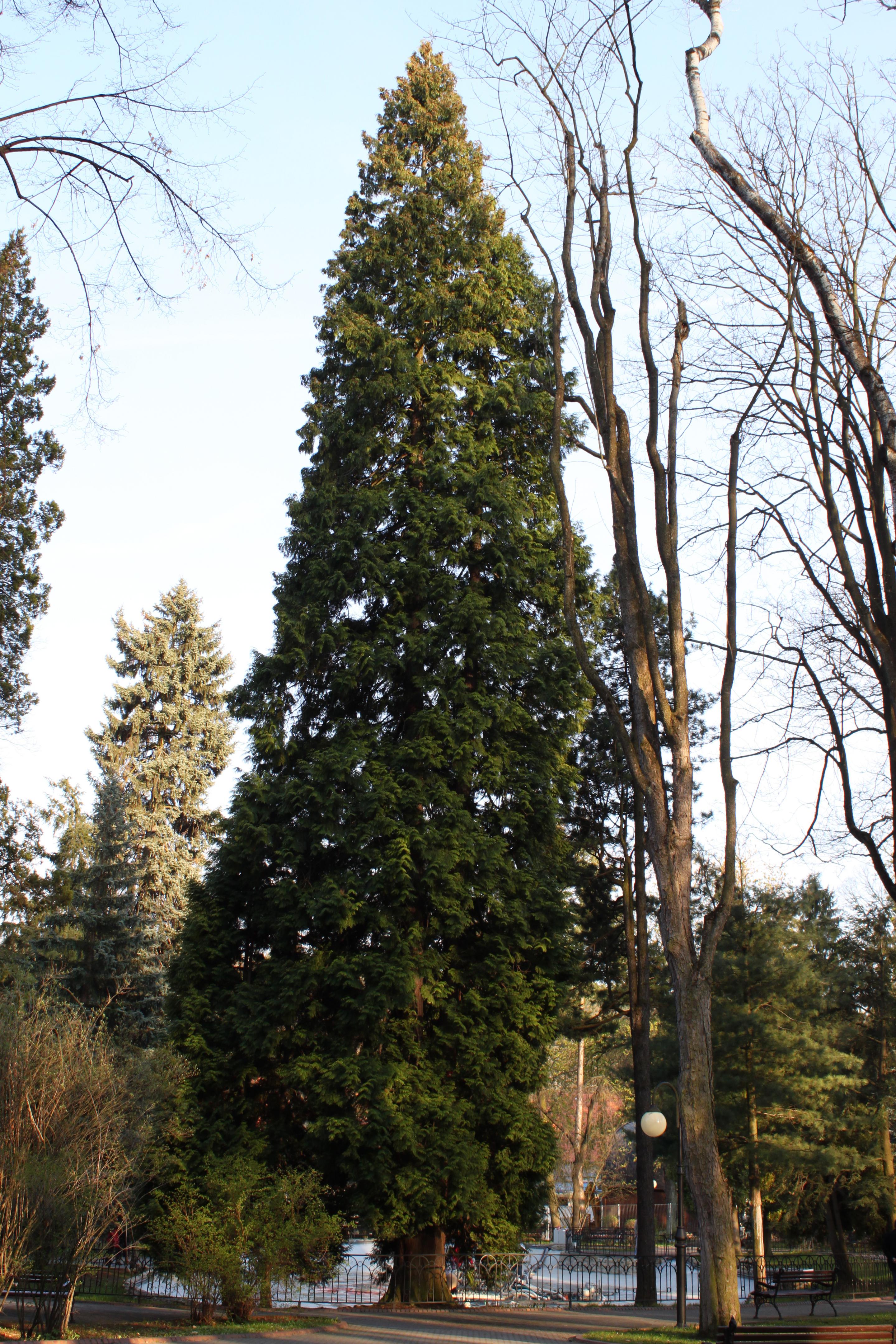
Short Description
The western redcedar is an evergreen conifer. It grows up to 40 metres high and has a narrow, conical crown.
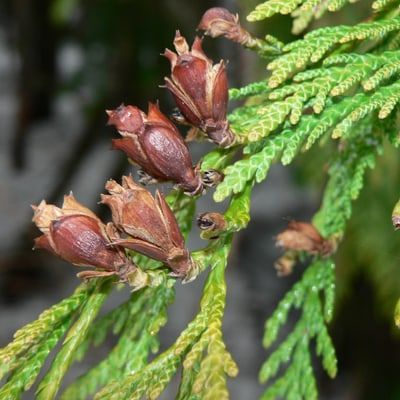
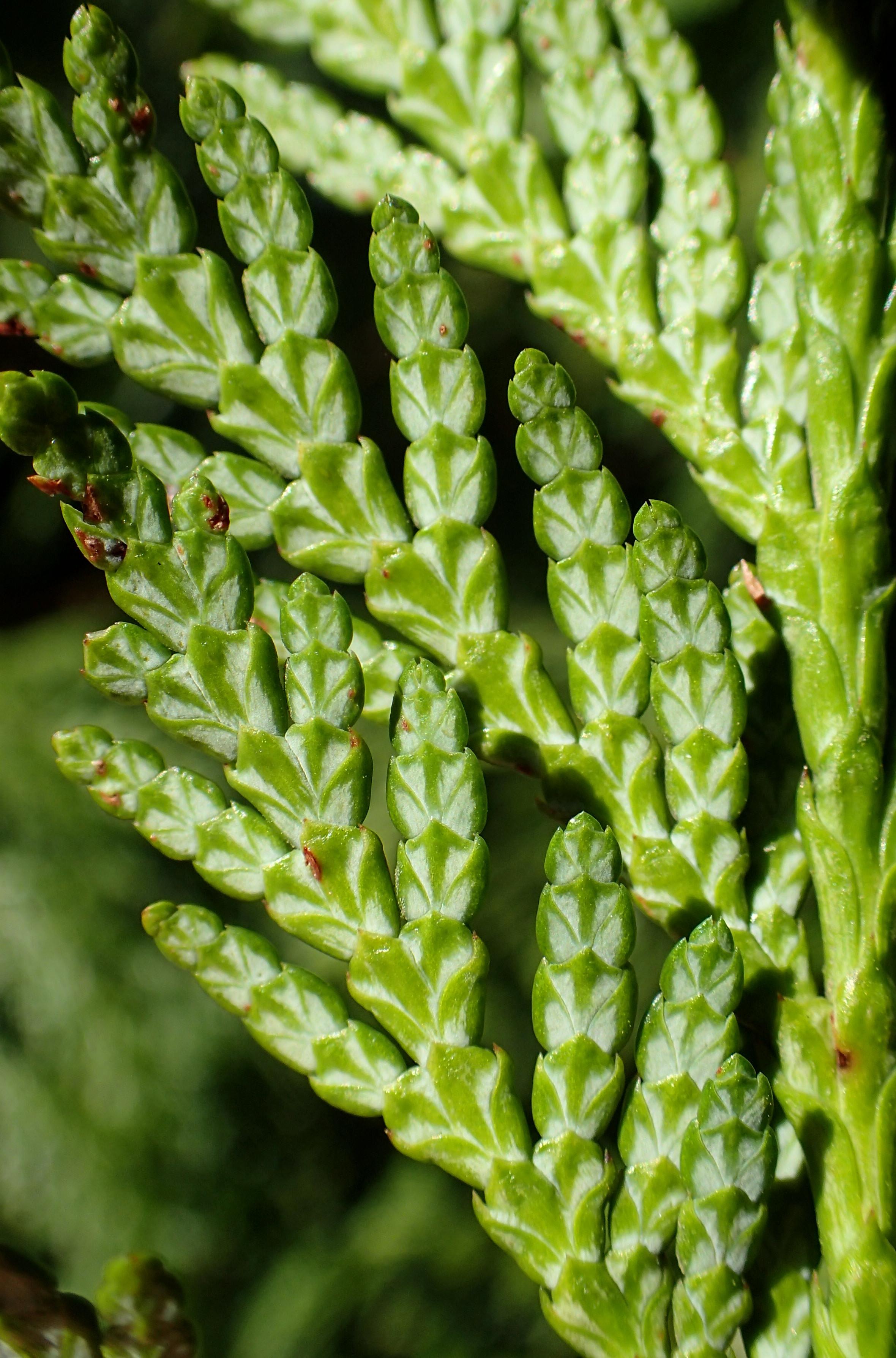
The small, scale-like leaves lie on top of each other like roof tiles and are pressed flat against the twig. The upper side of the leaves is a bright green. On the underside they have triangular, silver-grey patches.
The bark is dark reddish brown to purple and broadly grooved. With age it becomes greyish and peels off in plates.
The male flower cones are very small and pale yellow. They sit at the ends of the twigs. The female flower cones are about one centimetre in size and egg-shaped. They are green in spring and yellow in summer. They grow on the stronger branches.
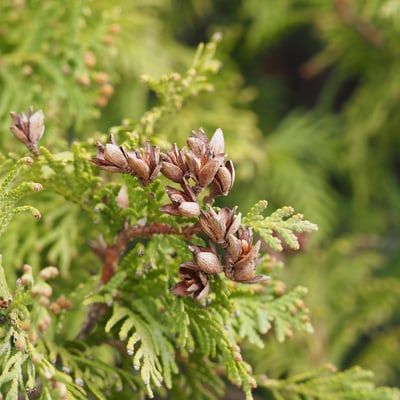
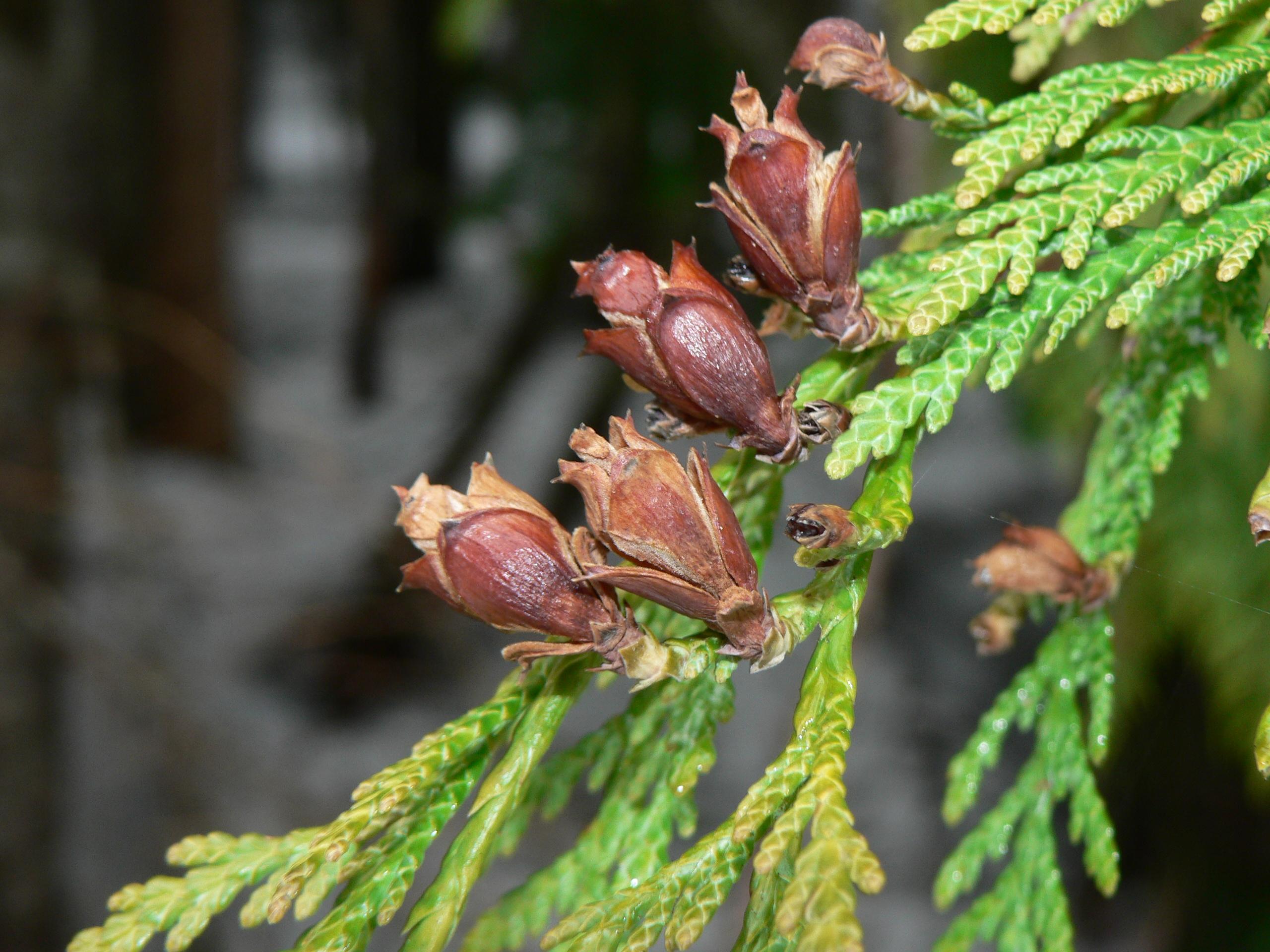
The mature cones are egg-shaped, brown and can sit upright, protruding or hanging on the twig. The cone scales have a small thorn at the tip.
Features
Western redcedar
Thuja plicata
grey triangles on undersides of leaves
Pineapple scent of the branches
In the city
Western redcedar is often planted as a solitary tree in parks and gardens in cities. In cemeteries, for example, it is often used as a hedge plant. It is shade tolerant and frost tolerant.
Fun Facts
The wood is light and very durable. It is often used for boats or sheds, but is also used to build guitars.
The flowering period is from March to April.
The leaves have a strong fruity scent of pineapple or apples.
Its roots grow shallowly below the surface of the soil. It is therefore vulnerable to windthrow.
- Endangerment level Germany: not evaluated
The western redcedar originates from western North America and was brought to Europe as an ornamental plant. It thus belongs to the non-native plants (neophytes).
The wood dust can cause allergies.
Sources
Habitus, Crusier, CC BY-SA 3.0, https://commons.wikimedia.org/wiki/File:Thuja_plicata_Polanica-Zdr%C3%B3j_2.JPG

Nadeln und Zapfen, Walter Siegmund, CC BY-SA 3.0, https://commons.wikimedia.org/wiki/File:Thuja_plicata_43569.JPG

Nadelunterseiten, Krzysztof Ziarnek, CC BY-SA 4.0 International, https://commons.wikimedia.org/wiki/File:Thuja_plicata_kz3.JPG

Spohn, M. & Spohn, R. (2011) Kosmos - Baumführer Europa. 680 Bäume, 2600 Zeichnungen, Stuttgart: Franckh Kosmos Verlag.
Krüssmann, G. (1979) Die Nadelgehölze. Eine Nadelholzkunde für die Praxis, Hamburg und Berlin: Verlag Paul Parey.
Godet, J.-D. (2007) Bäume und Sträucher. Bestimmen und nachschlagen, Stuttgart: Verlag Eugen Ulmer.
Mitchell, A. (1979) Die Wald- und Parkbäume Europas. Ein Bestimmungsbuch für Dendrologen und Naturfreunde, Hamburg und Berlin: Verlag Paul Parey.
Page „Riesen-Lebensbaum“. : Wikipedia, The Free Encyclopedia. Date of last revision: 02.08.2017, 14:01 UTC. URL: https://de.wikipedia.org/w/index.php?title=Riesen-Lebensbaum&oldid=167808084 (Accessed: 14.11.2017).