
Short Description
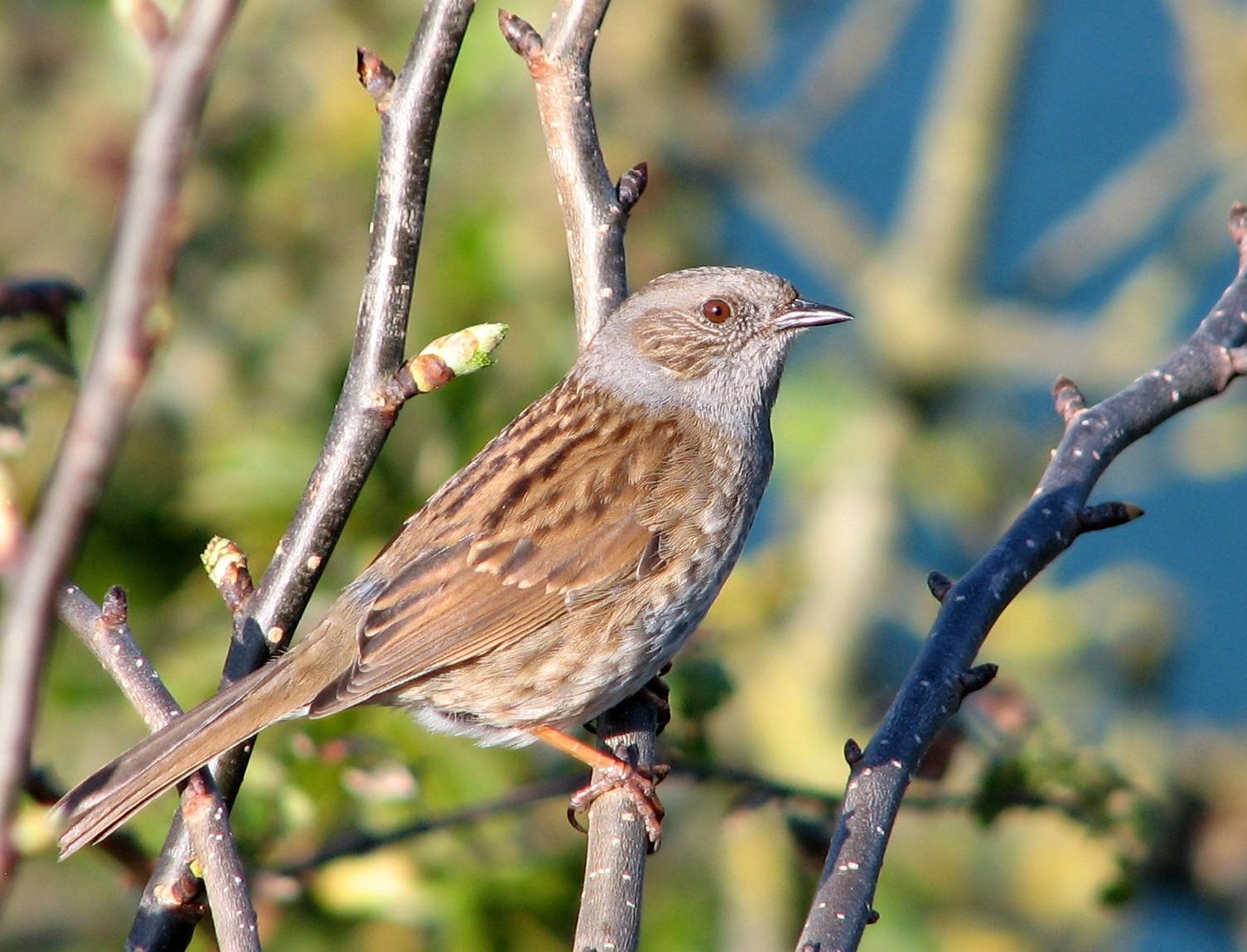
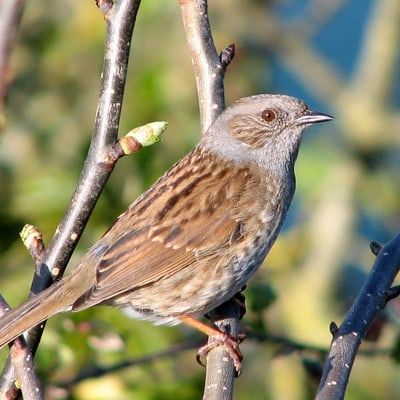
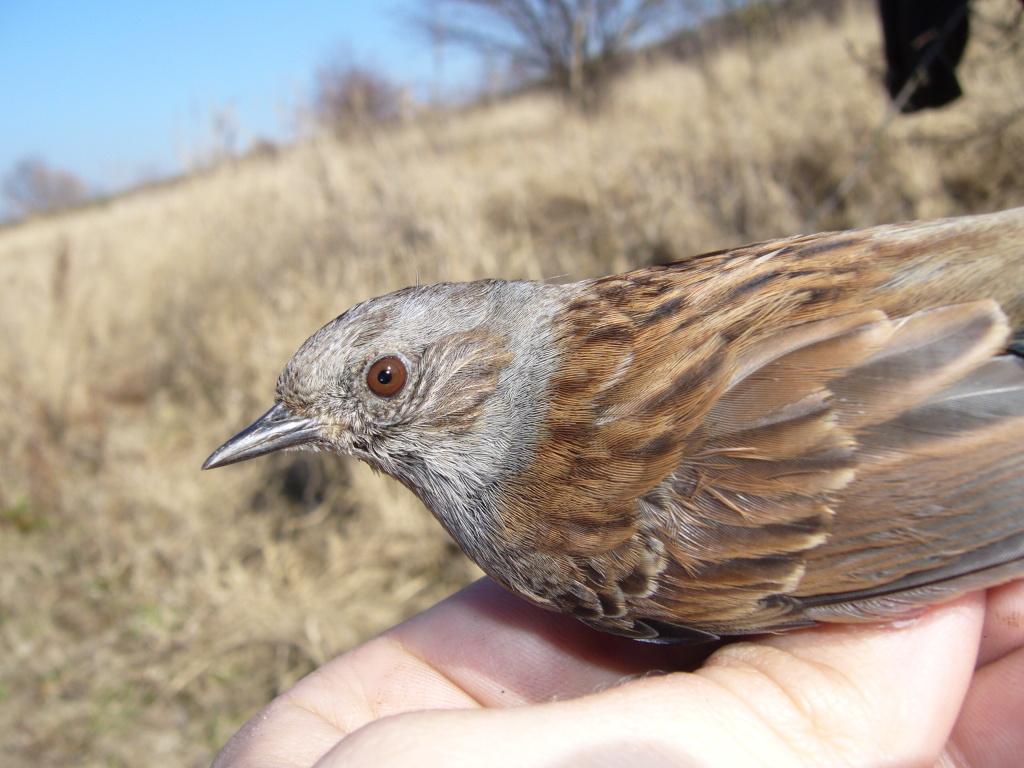
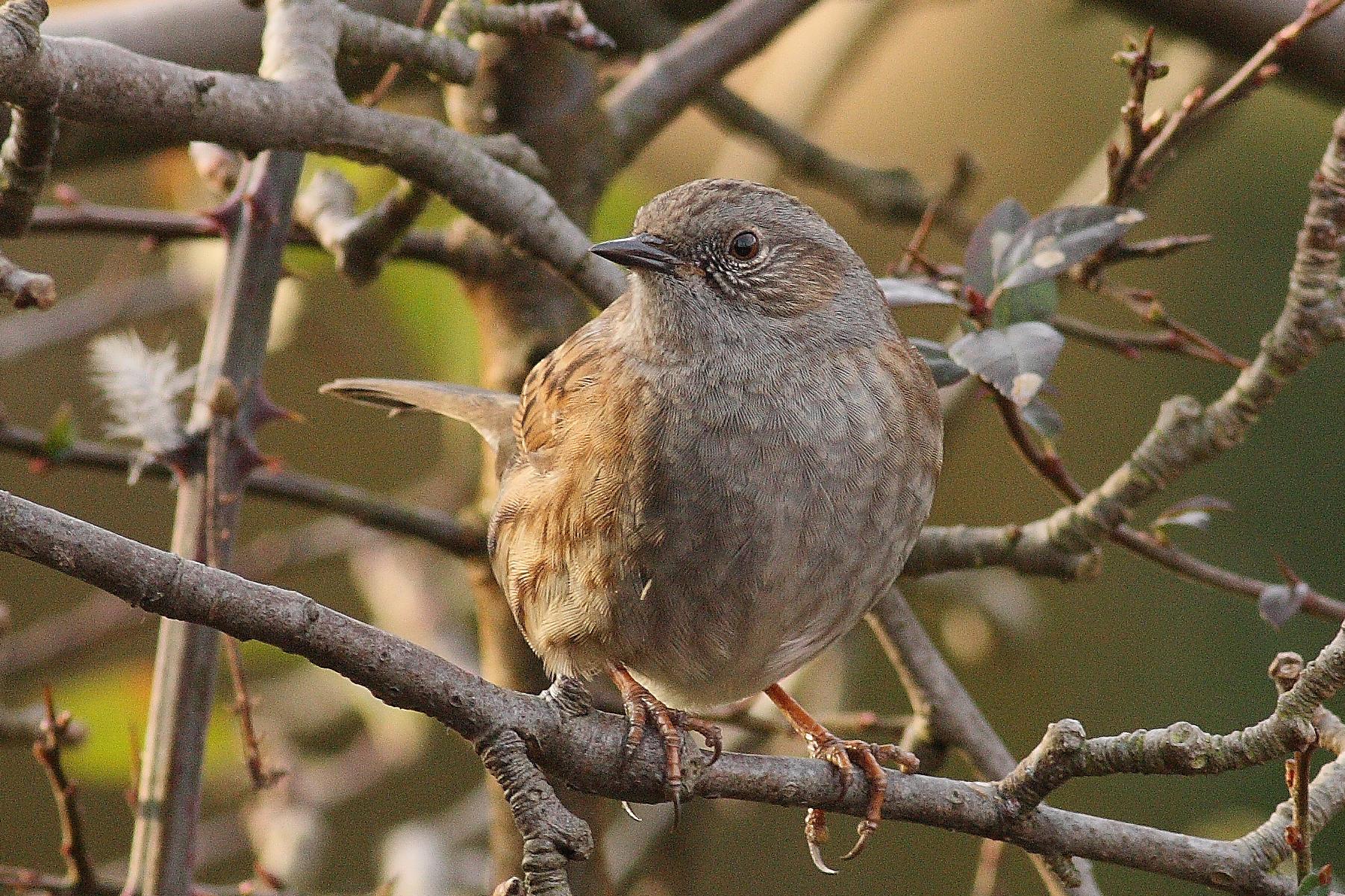
At first glance, the dunnock appears rather drab. The grey head and chest stand out against the back and wings which are dark-brown with black streaks. The bill is thin and black.
Features
Dunnock
Prunella modularis
grey head and chest
Gesang
Frommolt, CC BY-SA 3.0

In the city
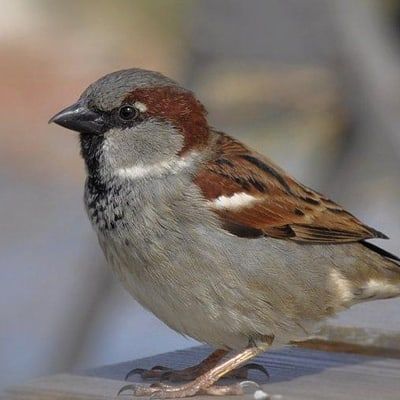
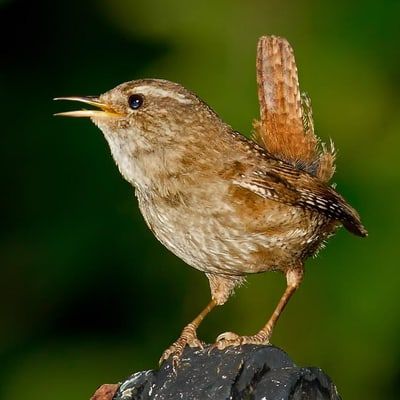
Dunnocks can now be seen quite often in urban settlements. Their habitats include gardens and parks.
Domestic cats hunting birds are amongst the main predators of dunnocks.
Fun Facts
Both male and female dunnocks have their own territories. If the territories of two males overlap, a female may occasionally take both as partners.
Dunnocks can be seen from March to October. If food is scarce, they move south in the winter. However, more and more dunnocks hibernate in Germany.
Dunnocks feed mainly on insects and small seeds. With their thin black bills, they are ideally equipped to search for their food.
- Endangerment level Germany: not endangered
Sources
Habitus , Smalljim, CC BY 3.0, https://commons.wikimedia.org/wiki/File:Dunnock_crop2.jpg

Kopf, Hedge Sparrow, CC BY 4.0, https://commons.wikimedia.org/wiki/File:Prunella_modularis_head_close-up.jpg

Habitus , Andy Vernon, CC BY 2.0, https://commons.wikimedia.org/wiki/File:Prunella_modularis_-Leicestershire,_England-8.jpg

Harrison, C. (1975) Jungvögel, Eier und Nester aller Vögel Europas, Nordafrikas und des Mittleren Ostens - Ein Naturführer zur Fortpflanzungsbiologie, Hamburg und Berlin: Verlag Paul Parey.
Page „Heckenbraunelle“. : Wikipedia, The Free Encyclopedia. Date of last revision: 13.11.2020, 20:51 UTC. URL: https://de.wikipedia.org/w/index.php?title=Heckenbraunelle&oldid=205508593 (Accessed: 11.02.2021).
Fiedler, W. (2015) Die Vögel Mitteleuropas sicher bestimmen - Schlüssel zur Art-, Alters- und Geschlechtsbestimmung, Wiebelsheim: Quelle & Meyer Verlag.
Makatsch, W. (1989) Wir bestimmen die Vögel Europas, Leipzig: Neumann Verlag.
Voigt, A. (2006) Exkursionsbuch zum Studium der Vogelstimmen, Heidelberg: Quelle & Meyer Verlag.
Svensson, L. (2011) Der Kosmos Vogelführer - Alle Arten Europas, Nordafrikas und Vorderasiens, Stuttgart: Franckh Kosmos Verlag.
Witt, K. & Steiof, K. (2013) Rote Liste und Liste der Brutvögel von Berlin, 3. version, 15.11.2013. : Berliner Ornithologische Arbeitsgemeinschaft e.V. (eds.) Berliner Ornithologischer Bericht, volume 23, Berlin: Berliner Ornithologische Arbeitsgemeinschaft e.V., 1-23.
NABU – Naturschutzbund Deutschland e.V. (2016) Rote Liste der Brutvögel Deutschlands. 5. version, published August 2016, URL: https://www.nabu.de/tiere-und-pflanzen/voegel/artenschutz/rote-listen/10221.html (Accessed: 07.04.2017).
NABU – Naturschutzbund Deutschland e.V. (n.d.) Stunde der Wintervögel. Die Heckenbraunelle, URL: https://www.nabu.de/tiere-und-pflanzen/aktionen-und-projekte/stunde-der-wintervoegel/vogelportraets/13045.html (Accessed: 07.04.2017).
Artenfinder (2016) Prunella modularis (Heckenbraunelle), URL: https://arteninfo.net/elearning/voegel/speciesportrait/3077 (Accessed: 11.04.2016).