
Short Description
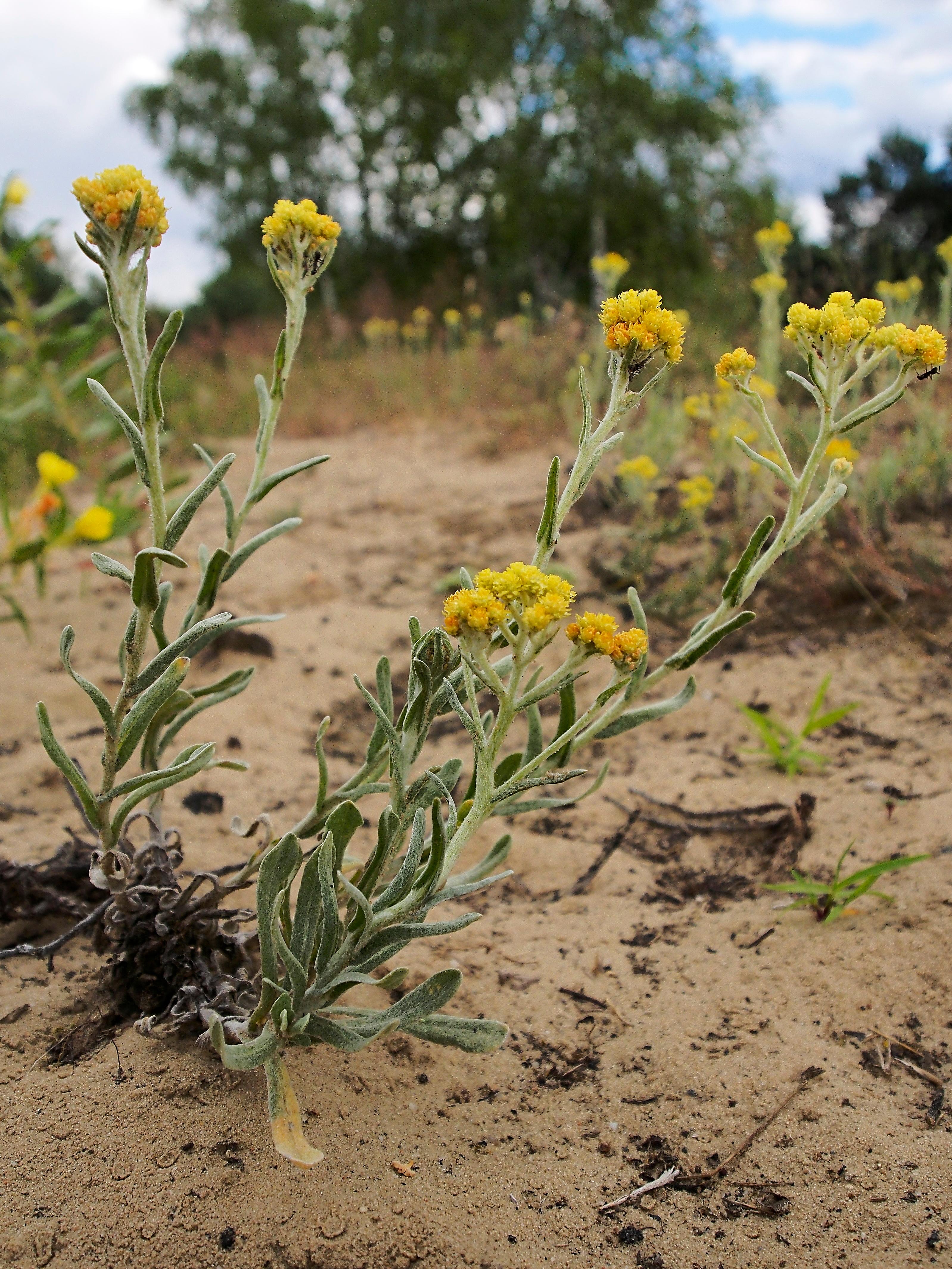
The dwarf everlasting can grow up to 30 cm high.
The leaves are grey-white on both surfaces, with felted hairs. The lower leaves are elongated-ovate. They become narrower up along stem.
Stem grows ascending and is covered with felted hairs.
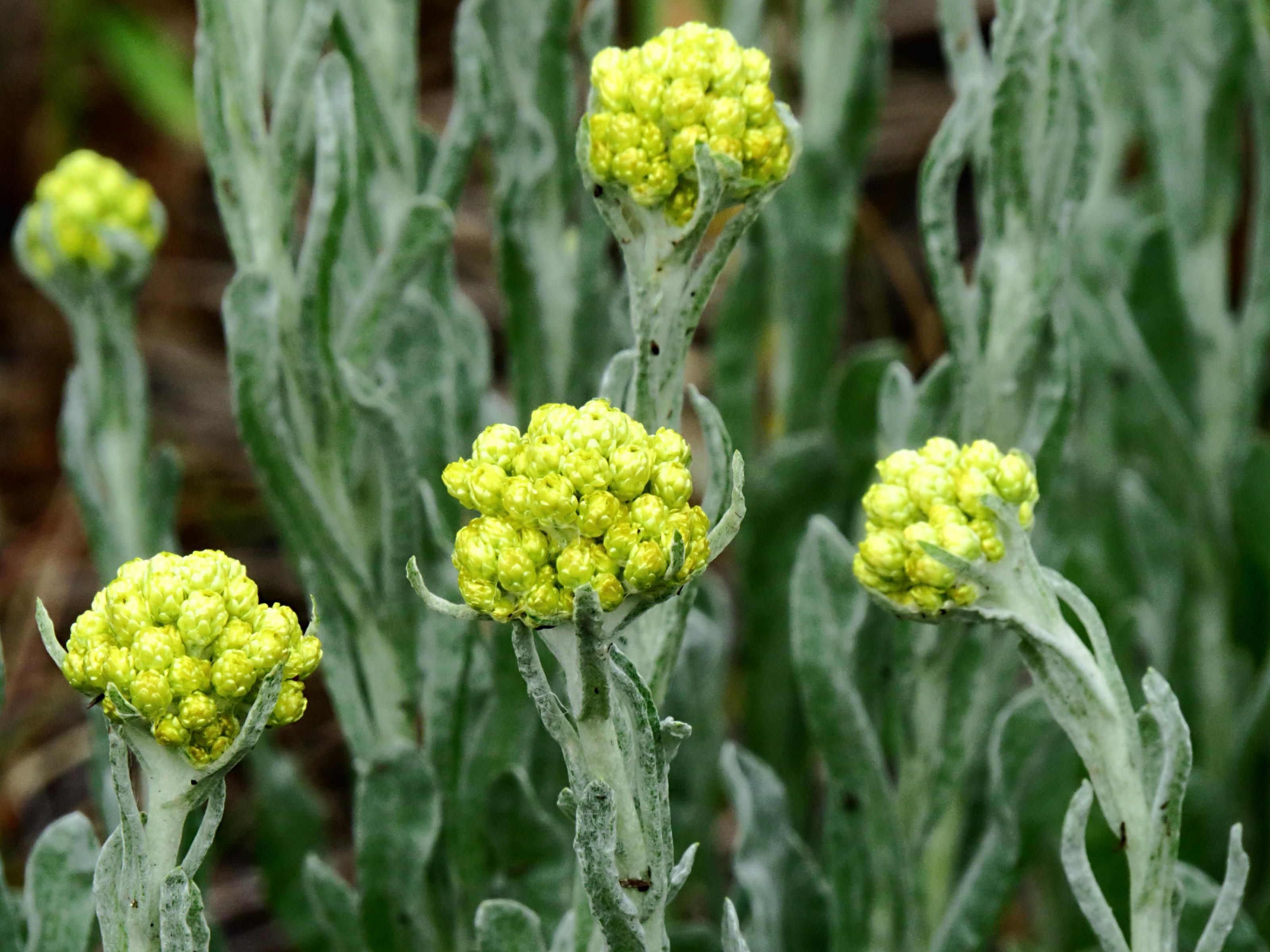
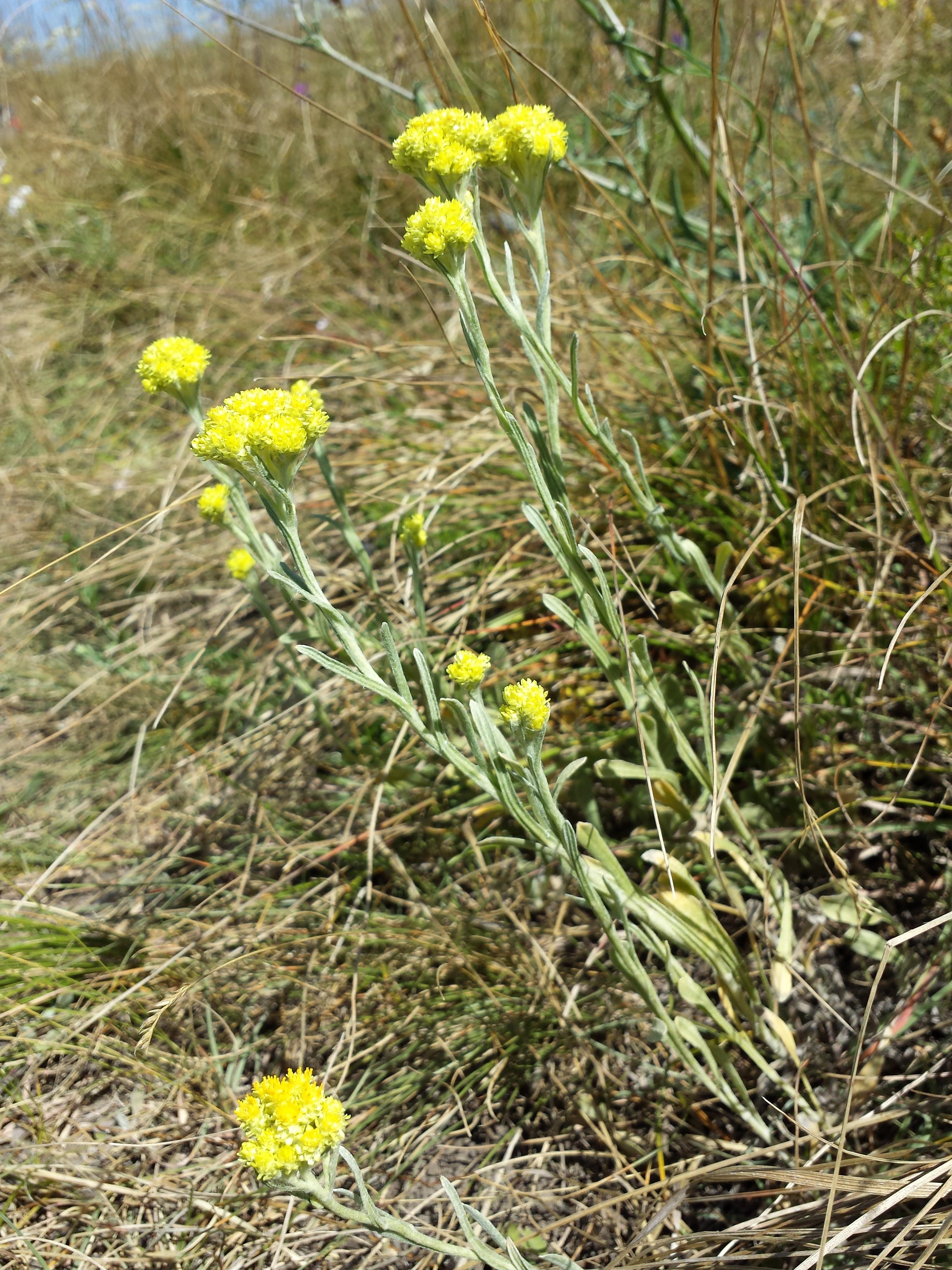
The flowers are yellow to orange tubular florets grouped in globular flower heads. The flower heads have scarious lemon yellow, shiny and protruding involucral bract. Many heads together form a terminal inflorescence.
The plant forms small, nut-like fruits with a simple, rough ring of hairs.
Features
Dwarf everlasting
Helichrysum arenarium
covered with grey-white, felted hairs
aromatic scent
In the city
The dwarf evrlasting prefers dry, loose and sandy soils in warm locations. It can be found on sandy grasslands, dunes and in dry pine forests.
Fun Facts
The involucral bract serves as a display organ and to protect the ripening fruit.
Due to its endangered status in Germany it is protected by the Federal Species Protection Ordinance.
The flowering period is from July to October.
It lives for several years and generally flowers and fruits annually (perennial plant).
- Endangerment level Germany: endangered
The dwarf evrlasting is found from southern Scandinavia through central Europe to south-eastern and eastern Europe. In Germany it is rather rare and more common in the north-east.
The heads contain bitter substances, flavonoids and some essential oil. They have a diuretic, bile-binding and antispasmodic effect.
Sources
Habitus, Joy-oature, CC BY-SA 4.0, https://commons.wikimedia.org/wiki/File:Helichrysum_arenarium_Sand-Strohblume_160703-1094_TegelFlie%C3%9F_SOOCx.jpg

Blütenstand, Аимаина хикари, CC0 1.0, https://commons.wikimedia.org/wiki/File:Helichrysum_arenarium2.JPG

Habitus, Stefan.lefnaer, CC BY-SA 3.0, https://commons.wikimedia.org/wiki/File:Helichrysum_arenarium_sl1.jpg

Schönfelder, I. & Schönfelder, P. (2010) Der Kosmos-Heilpflanzenführer. Über 600 Heil- und Giftpflanzen Europas, Stuttgart: Franckh Kosmos Verlag.
Spohn, M., Golte-Bechtle, M. & Spohn, R. (2015) Was blüht denn da? Stuttgart: Franckh Kosmos Verlag.
Page „Sand-Strohblume“. : Wikipedia, The Free Encyclopedia. Date of last revision: 28.02.2018, 22:25 UTC. URL: https://de.wikipedia.org/w/index.php?title=Sand-Strohblume&oldid=174493564 (Accessed: 31.07.2018).