
Short Description
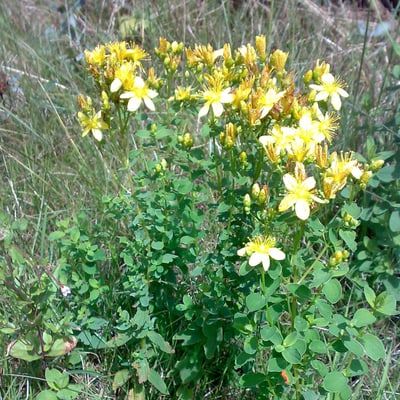
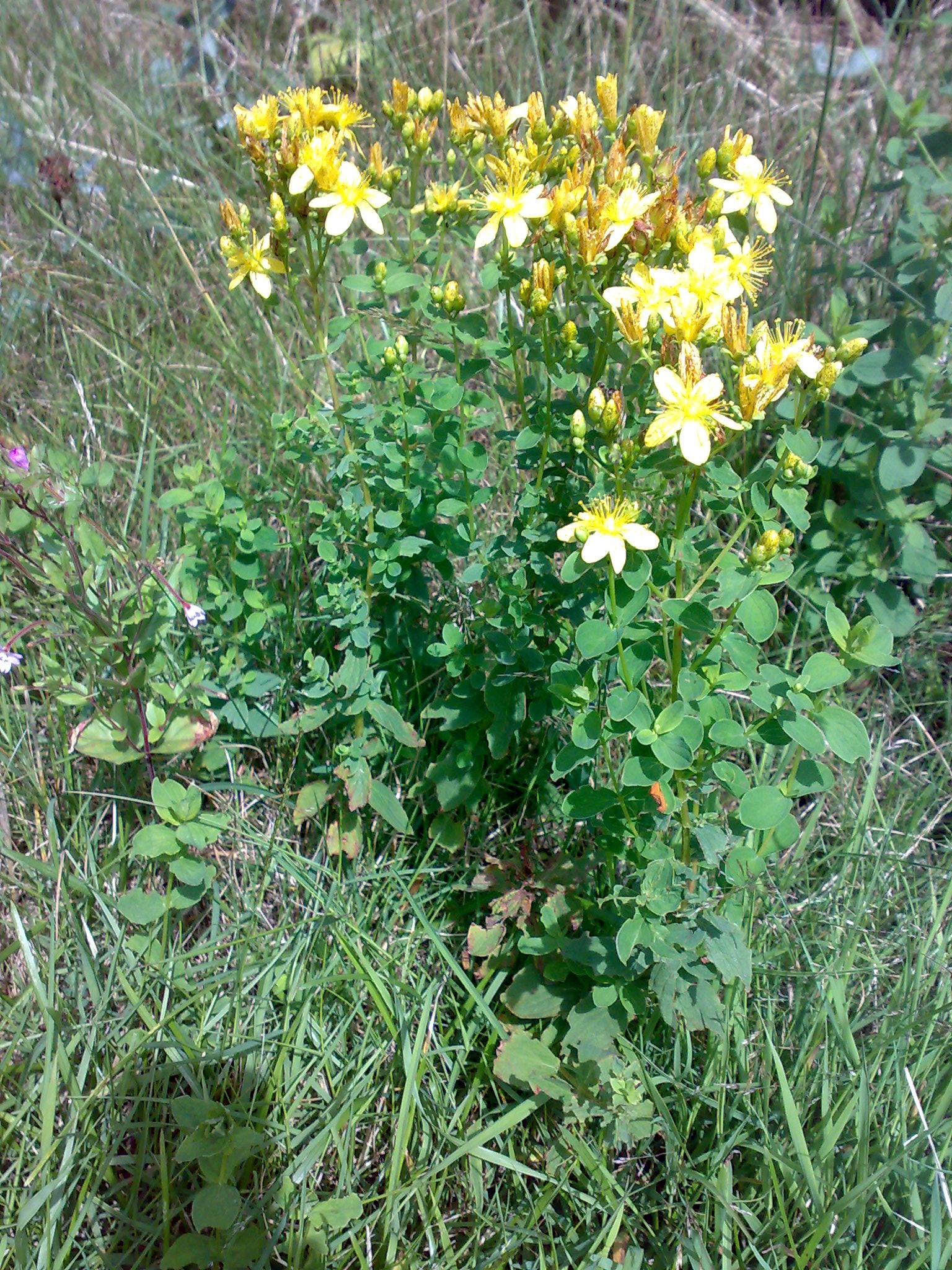
St John's wort can grow to a height of one metre.
The leaves are arranged in opposite pairs on the stem. They are oval to elongated and densely covered with translucent oil glands. The leaf margins are dotted with black glands.
The stem is upright, two-edged along its entire length and full. Underground, the plant develops a highly branched lateral-reaching root system.
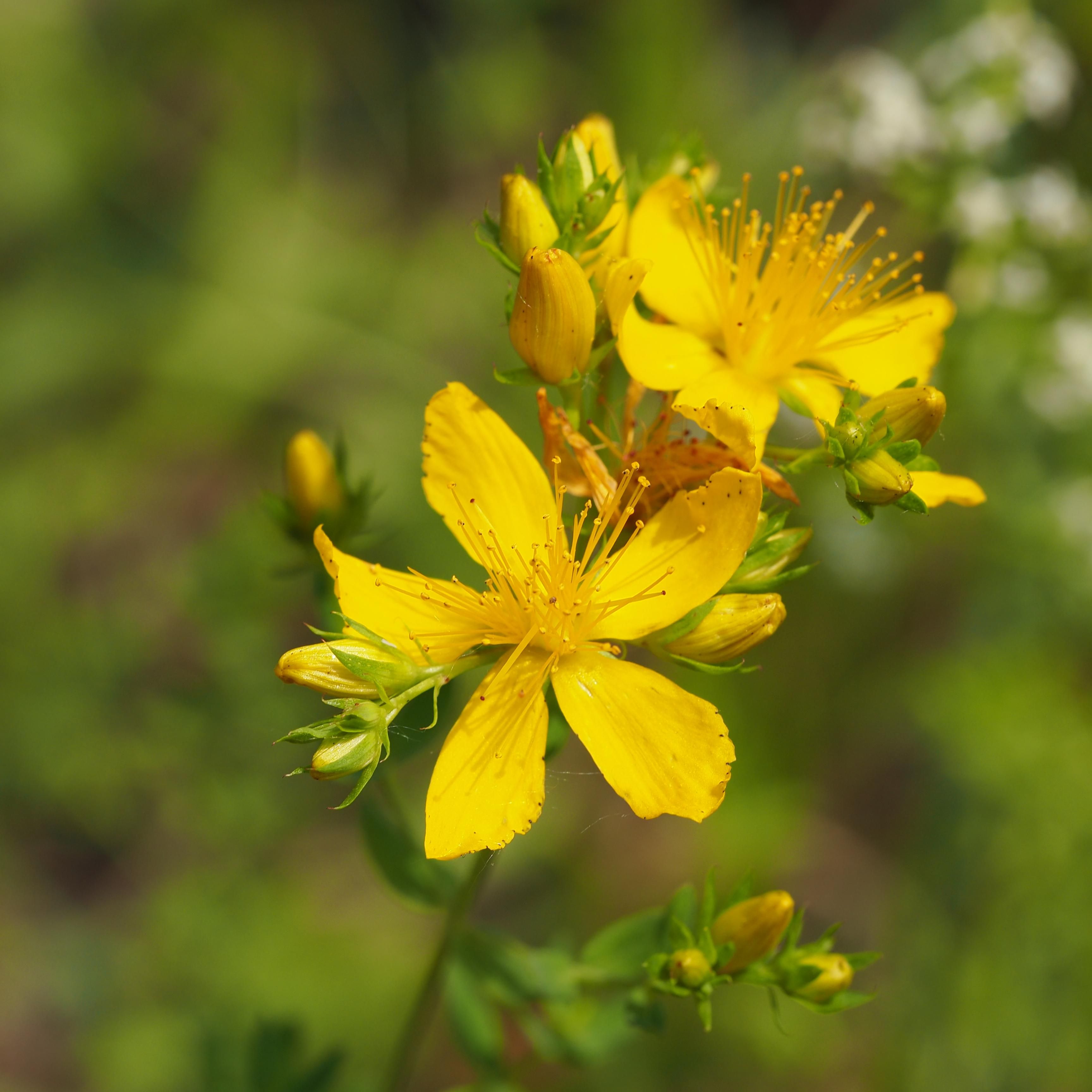
The individual florets are golden-yellow and have five petals. They are clustered in great numbers in flower heads. Rubbing the petals produces a dark-red liquid.
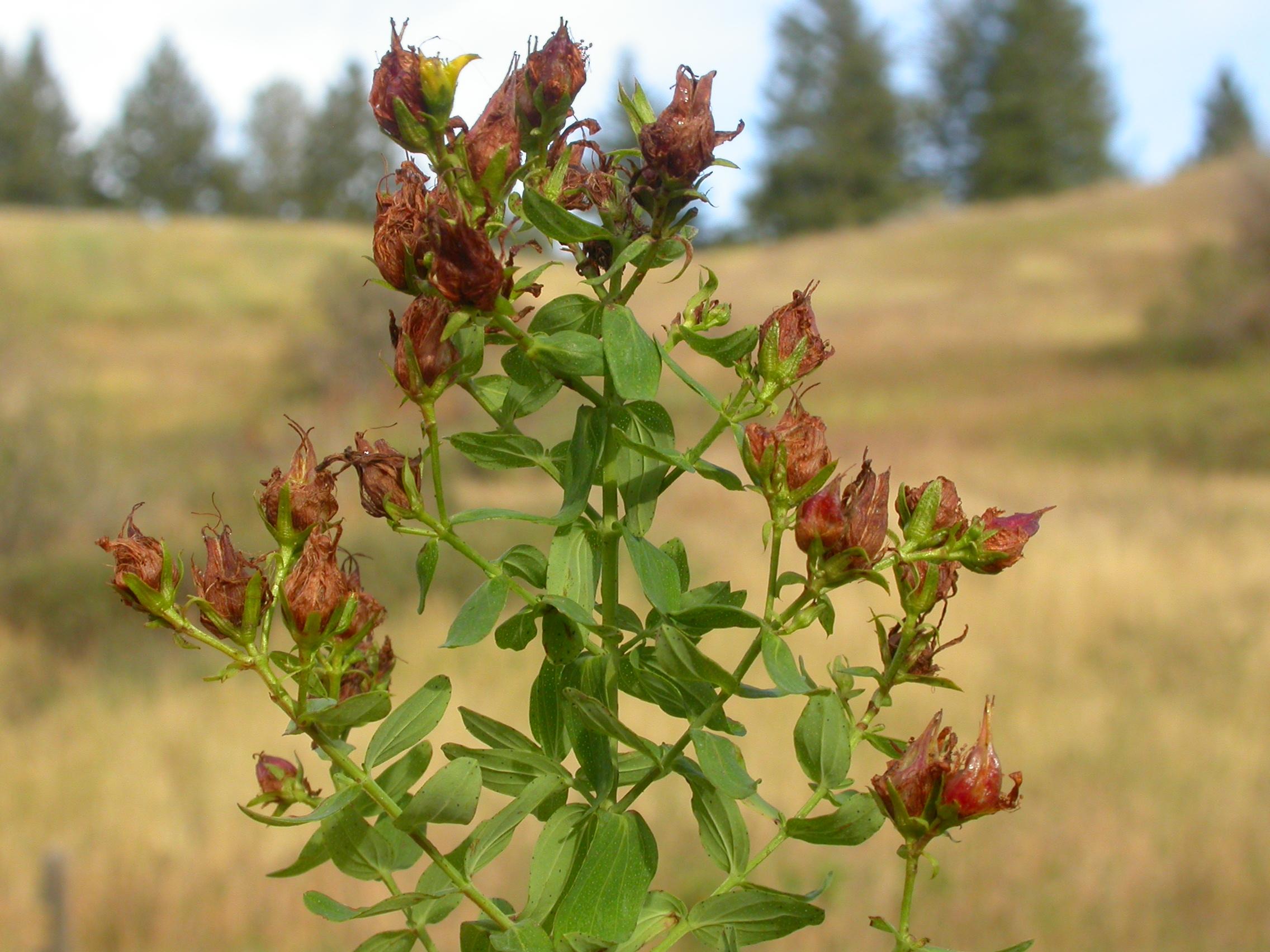
The fruit is a small oval tripartite capsule.
Features
St. John's wort
Hypericum perforatum
mildly poisonous
leaves with translucent dots
In the city
St John's wort is frequently found in an urban environment. It grows in shrubby borders, roadsides and forest verges, riverbanks, rough pastures and poor grassland, heathlands with gorse and heather, uncultivated land and forest clearings and in rail track ballast. It prefers semi-shaded, moderately warm, dry to moderately damp sites with nitrogen-poor soils.
Fun Facts
St John's wort is an ancient medicinal plant and is used to treat depressive mood and nervous agitation. It also has a positive effect on hormonal fluctuations, sleep disorders and general fatigue.
Upon ingestion or skin contact, the red colourant in St John's wort increases the skin’s sensitivity to light (photosensitivity). For that reason, exposure to sunlight should be avoided after taking products containing St John's wort.
It flowers from June to August.
It lives for several years and generally flowers and fruits annually (perennial plant).
- Endangerment level Germany: not endangered
All parts of the plant are mildly poisonous.
Sources
Blüten, Alice Kracht, CC BY-SA 4.0, https://offene-naturfuehrer.de/web/Datei:Hypericum_perforatum_(1).JPG
.JPG)
Früchte, Matt Lavin, CC BY-SA 2.0, https://commons.wikimedia.org/wiki/File:Hypericum_perforatum_(5258413313).jpg
.jpg)
Habitus, Bjoertvedt, CC BY-SA 3.0, https://commons.wikimedia.org/wiki/File:Hypericum_perforatum_09.jpg

Eggenberg, S. & Möhl, A. (2007) Flora Vegetativa: Ein Bestimmungsbuch für Pflanzen der Schweiz im blütenlosen Zustand, Bern, Stuttgart, Wien: Haupt Verlag.
Spohn, M., Golte-Bechtle, M. & Spohn, R. (2015) Was blüht denn da? Stuttgart: Franckh Kosmos Verlag.
Jäger, E. J. (2011) Rothmaler - Exkursionsflora von Deutschland. Gefäßpflanzen: Grundband, Heidelberg: Spektrum Akademischer Verlag.
Kammer, P. M. (2016) Pflanzen einfach bestimmen. Schritt für Schritt einheimische Arten kennenlernen, Bern: Haupt Verlag.
Lippert, W. & Podlech, D. (1993) GU Naturführer. Blumen: die wichtigen Blütenpflanzen Mitteleuropas erkennen und bestimmen, München: Gräfe und Unzer Verlag.
Schauer, T., Caspari, C. & Caspari, S. (2015) Der illustrierte BLV-Pflanzenführer für unterwegs. 1150 Blumen, Gräser, Bäume und Sträucher, München: BLV.
Page „Echtes Johanniskraut“. : Wikipedia, The Free Encyclopedia. Date of last revision: 06.12.2016, 19:16 UTC. URL: https://de.wikipedia.org/w/index.php?title=Echtes_Johanniskraut&oldid=160406224 (Accessed: 17.01.2017).
Bundesamt für Naturschutz (n.d.) Artensteckbriefe, URL: http://floraweb.de/pflanzenarten/artenhome.xsql?suchnr=3036& (Accessed: 17.01.2017).