
Short Description
The ivy-leaved toadflax can grow up to 60 cm long.
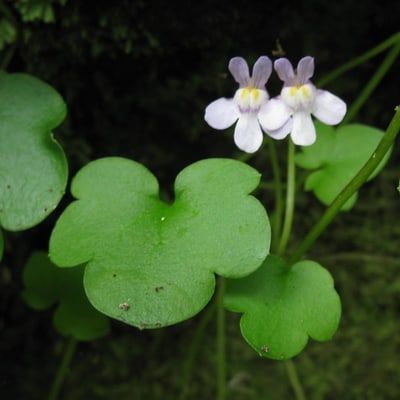
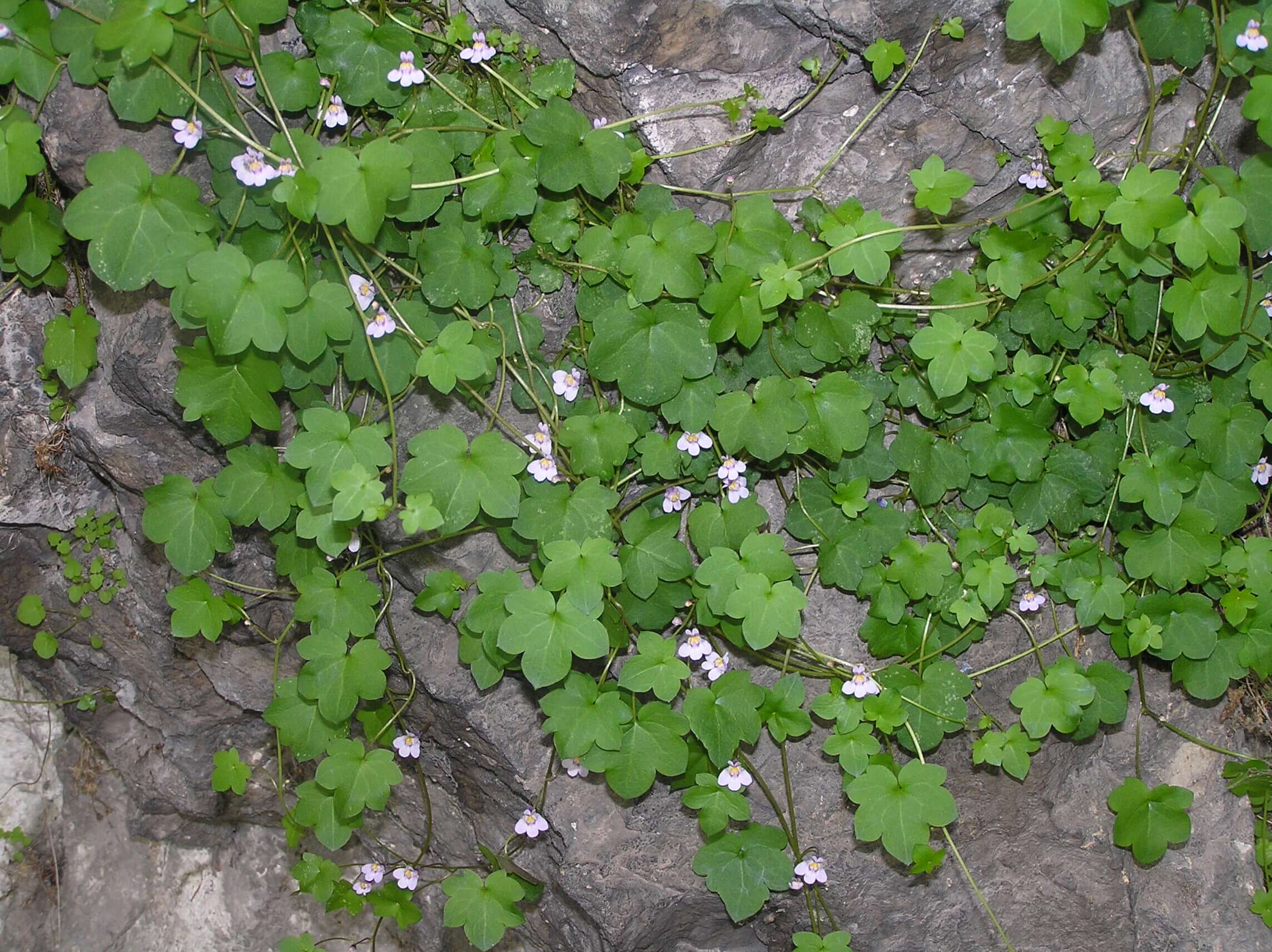
The leaves have long petioles. They are arranged singly and alternately on the stem. They are roundish-heart-shaped and usually divided into five lobes. The underside of the leaves is often purple-red.
The stem lies on the ground or hangs down.
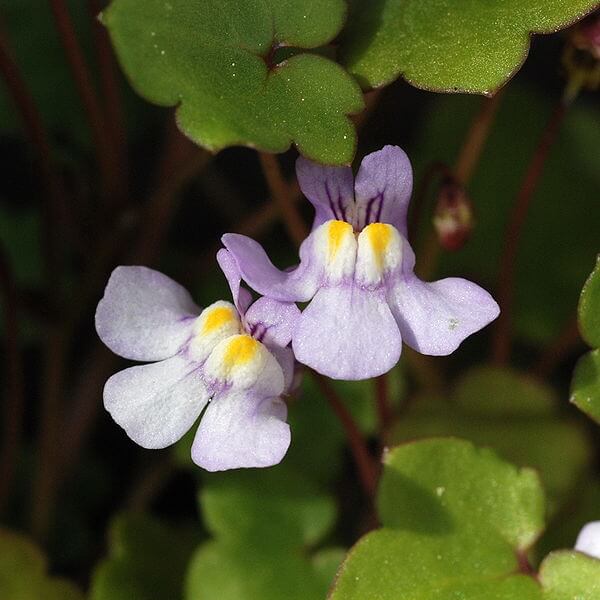
The flowers stand singly in the leaf axils. They are purple with a yellow throat. They have a blunt spur.
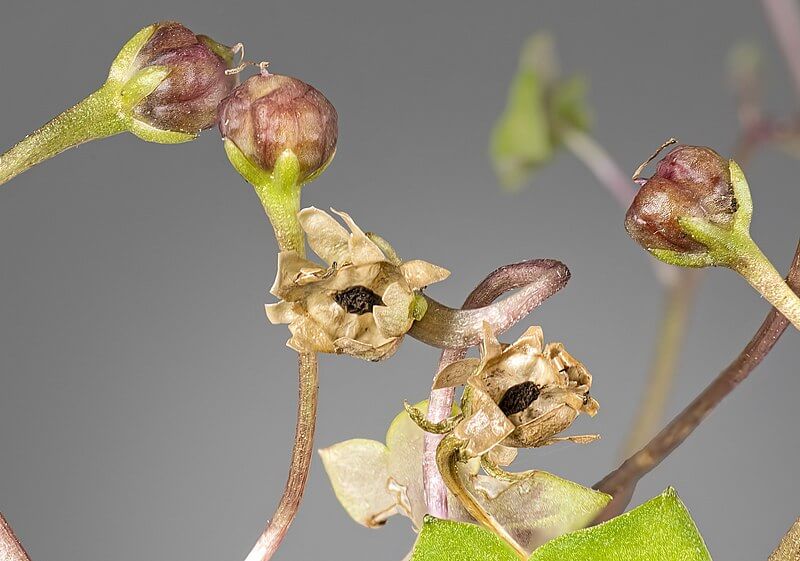
The fruits are roundish capsules.
Features
Ivy-leaved toadflax
Cymbalaria muralis
purple flowers with yellow throat
heart-shaped leaves
In the city
In the city, the ivy-leaved toadflax grows in wall and cobblestone cracks. It prefers warm and semi-shady locations with moist and stony soils.
Fun Facts
It was introduced to Central Europe in the 16th century as an ornamental and medicinal plant and quickly became established. It belongs to the non-native plants (neophytes).
After the flower has been fertilised, the fruit stalk curves towards the ground. Only there are the seeds released from the capsules and can germinate.
The flowering period is from April to October.
In the past, it was used to heal wounds.
Ivy-leaved toadflax is a perennial plant. This means that it grows older than two years, but flowers only once and dies after the seeds have matured.
- Endangerment level Germany: not evaluated
The ivy-leaved toadflax originates from southern Europe.
Sources
Blossom, Hans Bernhard, CC BY-SA 3.0, https://upload.wikimedia.org/wikipedia/commons/6/6e/Cymbalaria_muralis_close_up.jpg

Habitus, Petr Filippov, CC BY-SA 3.0, https://upload.wikimedia.org/wikipedia/commons/5/5f/Cymballaria_muralis.JPG

Fruit, Archaeodontosaurus, CC BY-SA 4.0, https://upload.wikimedia.org/wikipedia/commons/f/fc/%28MHNT%29_Cymbalaria_muralis_-_fruits.jpg
_Cymbalaria_muralis_-_fruits.jpg)
Jäger, E. J. (2011) Rothmaler - Exkursionsflora von Deutschland. Gefäßpflanzen: Grundband, Heidelberg: Spektrum Akademischer Verlag.
Kammer, P. M. (2016) Pflanzen einfach bestimmen. Schritt für Schritt einheimische Arten kennenlernen, Bern: Haupt Verlag.
Schauer, T., Caspari, C. & Caspari, S. (2015) Der illustrierte BLV-Pflanzenführer für unterwegs. 1150 Blumen, Gräser, Bäume und Sträucher, München: BLV.
Page „Zimbelkraut“. : Wikipedia, The Free Encyclopedia. Date of last revision: 10.05.2017, 08:23 UTC. URL: https://de.wikipedia.org/w/index.php?title=Zimbelkraut&oldid=165374631 (Accessed:15.08.2017).