
Short Description
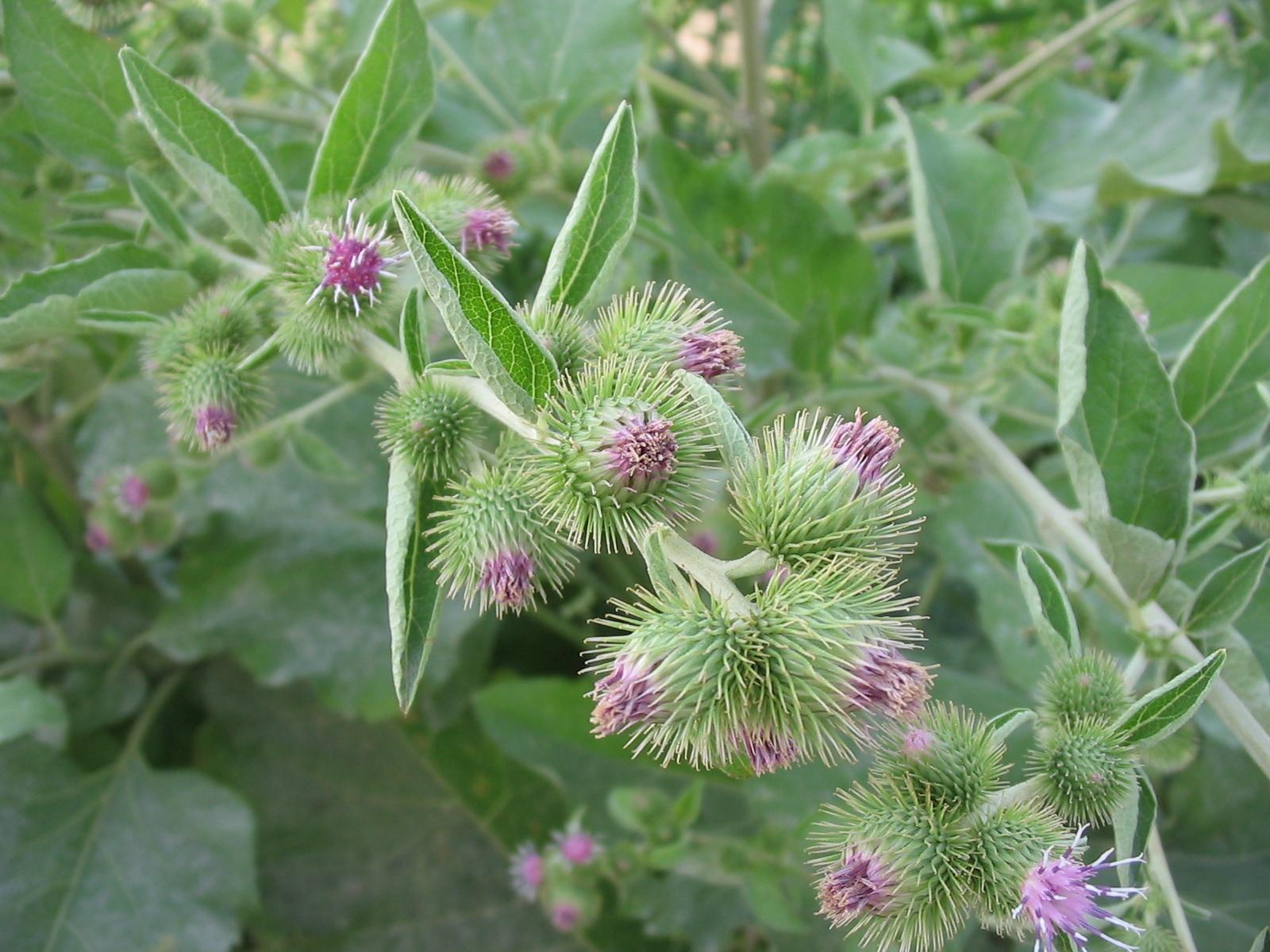
The lesser burdock can grow up to 1.2 metres high.
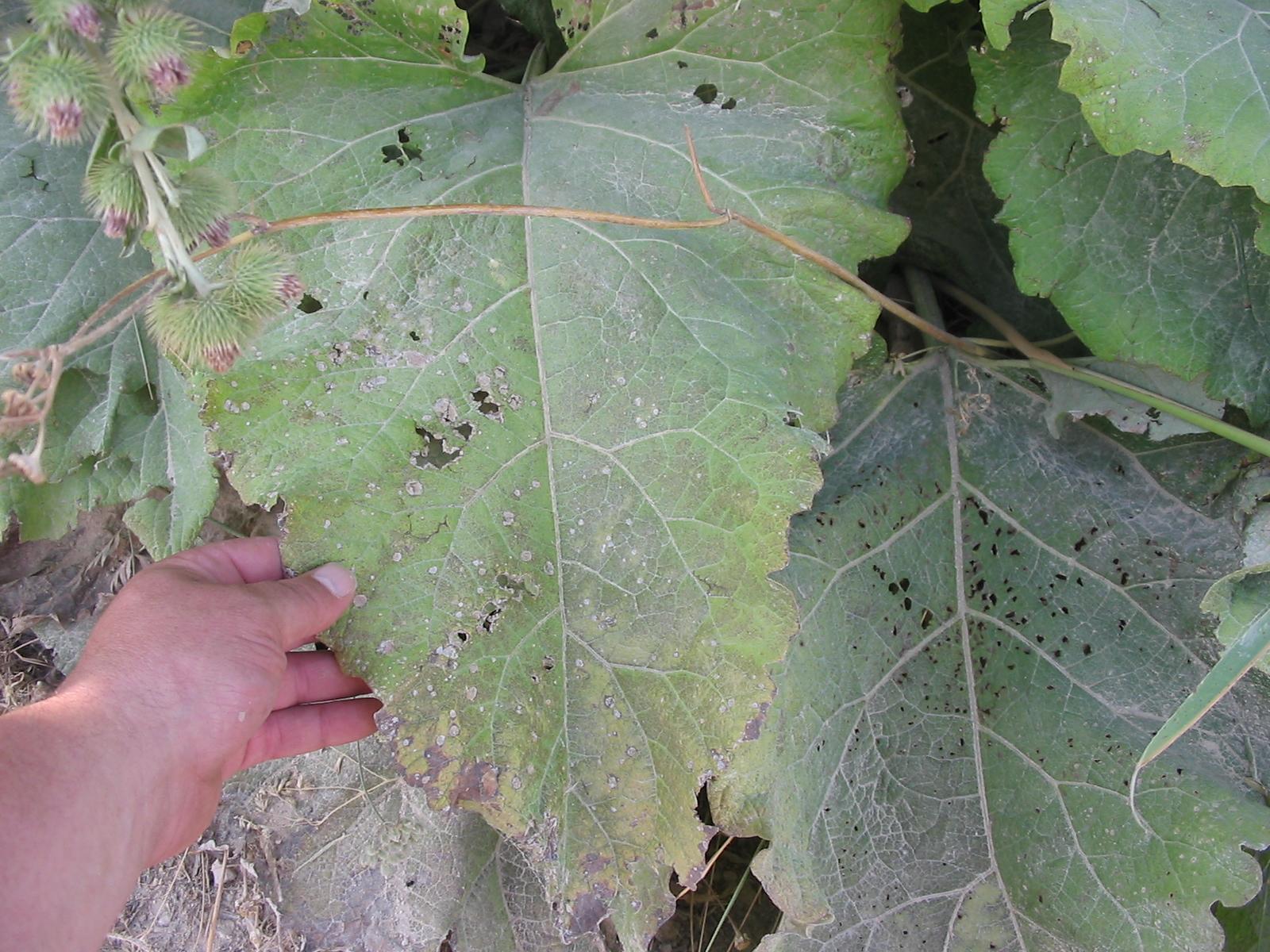
The large leaves are triangular to heart-shaped and usually have a few teeth on the margin. They are dark green on top and have woolly hairs on the underside. The petioles of the leaves close to the ground are hollow inside.
The erect stem is strongly branched and sparsely hairy or glabrous.
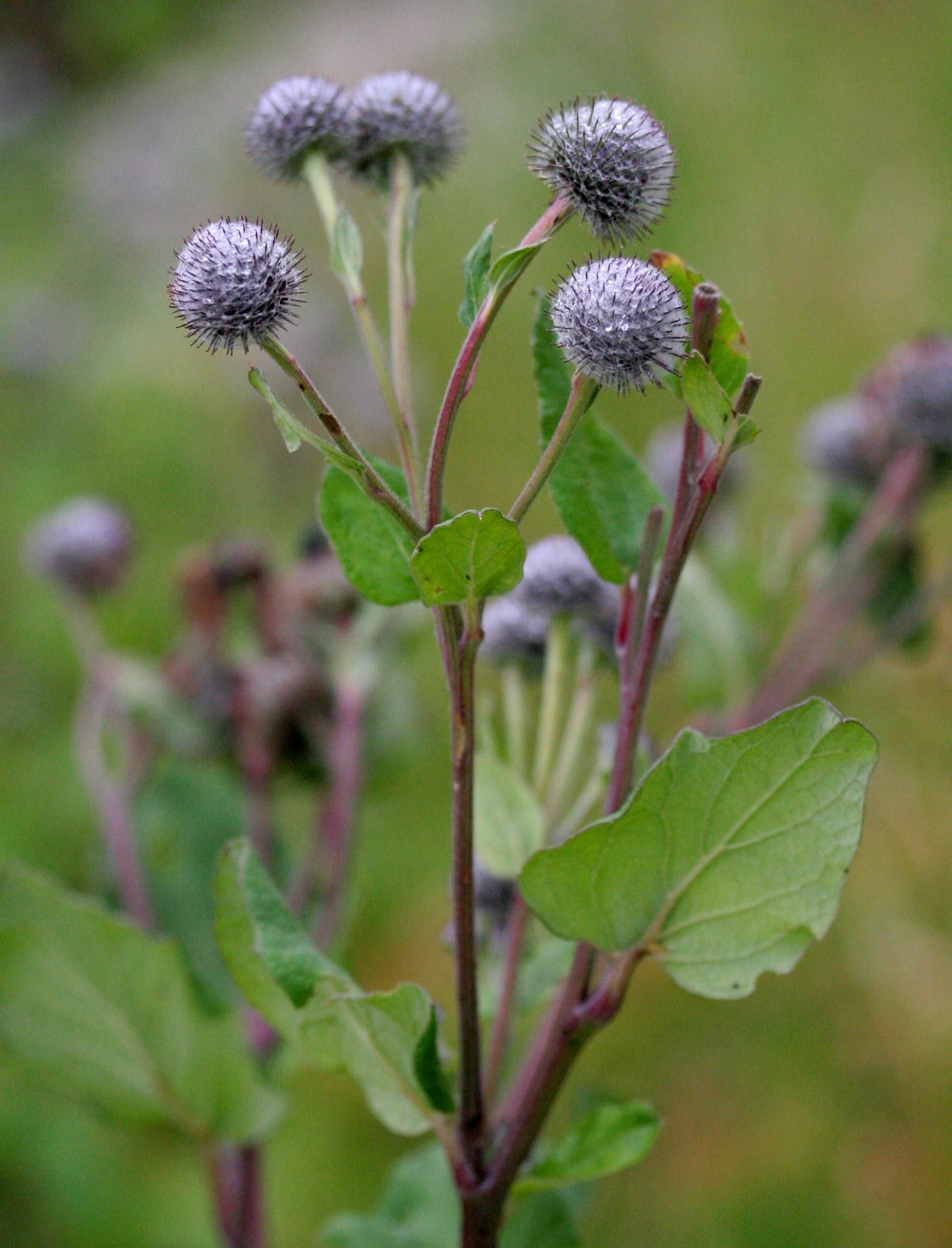
At first glance, the spherical flower head (capitulum) can be mistaken for one single flower. However, it is a false flower (pseudanthium). It consists of numerous, single, pink to light purple tubular florets surrounded by hook-pointed bracts. The flower heads are stalkless (sessile) or only up to 3cm stalked.
The plant forms small, nut-like fruits with a yellowish crown of bristles.
Features
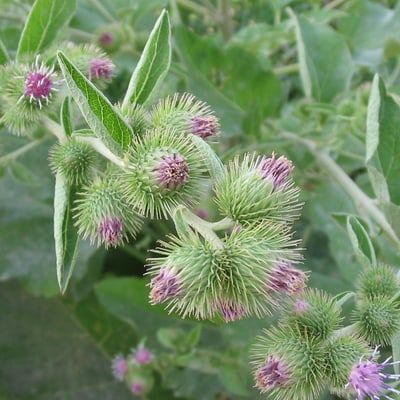
Lesser burdock
Arctium minus
spherical inflorescence
hooked involucral bracts (phyllaries)
woolly underside of leaf
In the city
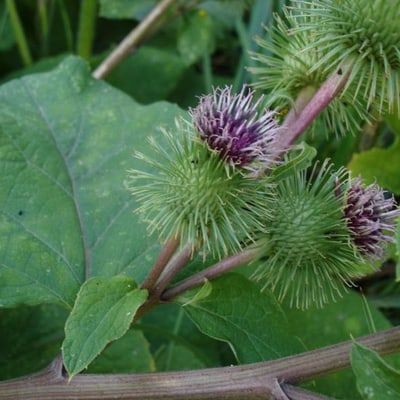
In the city, lesser burdock grows on rubble, roadsides, banks and fences. It prefers nitrogen-rich, lime-poor, loose-stony clay soils.
Fun Facts
The young parts of the plant can be cooked and taste similar to artichoke.
The hook-shaped involucral bracts, together with the ripe seeds inside the flower heads, remain attached to the fur of passing animals. In this way, the fruits are distributed over long distances.
The flowering period is from July to September.
It is a biennial plant. This means that a plant lives for two years, but flowers only once and dies after the seeds have ripened.
- Endangerment level Germany: not endangered
- Usage:
The oil from the roots is said to help against rheumatic complaints, dandruff and hair loss.
It is native in Europe.
The root is drunk as a tea for mild bile disorders or as a weak diuretic.
Sources
Blütenstand und Blätter, Alberto Salguero, CC BY-SA 3.0, https://commons.wikimedia.org/wiki/File:Arctium_minus_corimbo.jpg

Blatt, Alberto Salguero, CC BY-SA 3.0, https://commons.wikimedia.org/wiki/File:Arctium_minus_hoja_basal.jpg

Habitus, Enrico Blasutto, CC BY-SA 3.0, https://commons.wikimedia.org/wiki/File:Arctium_minus_ENBLA01.jpg

Kammer, P. M. (2016) Pflanzen einfach bestimmen. Schritt für Schritt einheimische Arten kennenlernen, Bern: Haupt Verlag.
Page „Kleine Klette“. : Wikipedia, The Free Encyclopedia. Date of last revision: 12.04.2018, 15:42 UTC. URL: https://de.wikipedia.org/w/index.php?title=Kleine_Klette&oldid=176421715 (Accessed: 08.05.2018).
Bundesamt für Naturschutz (n.d.) Artensteckbriefe, URL: http://floraweb.de/pflanzenarten/artenhome.xsql?suchnr=13702& (Accessed: 08.05.2018).