
Short Description
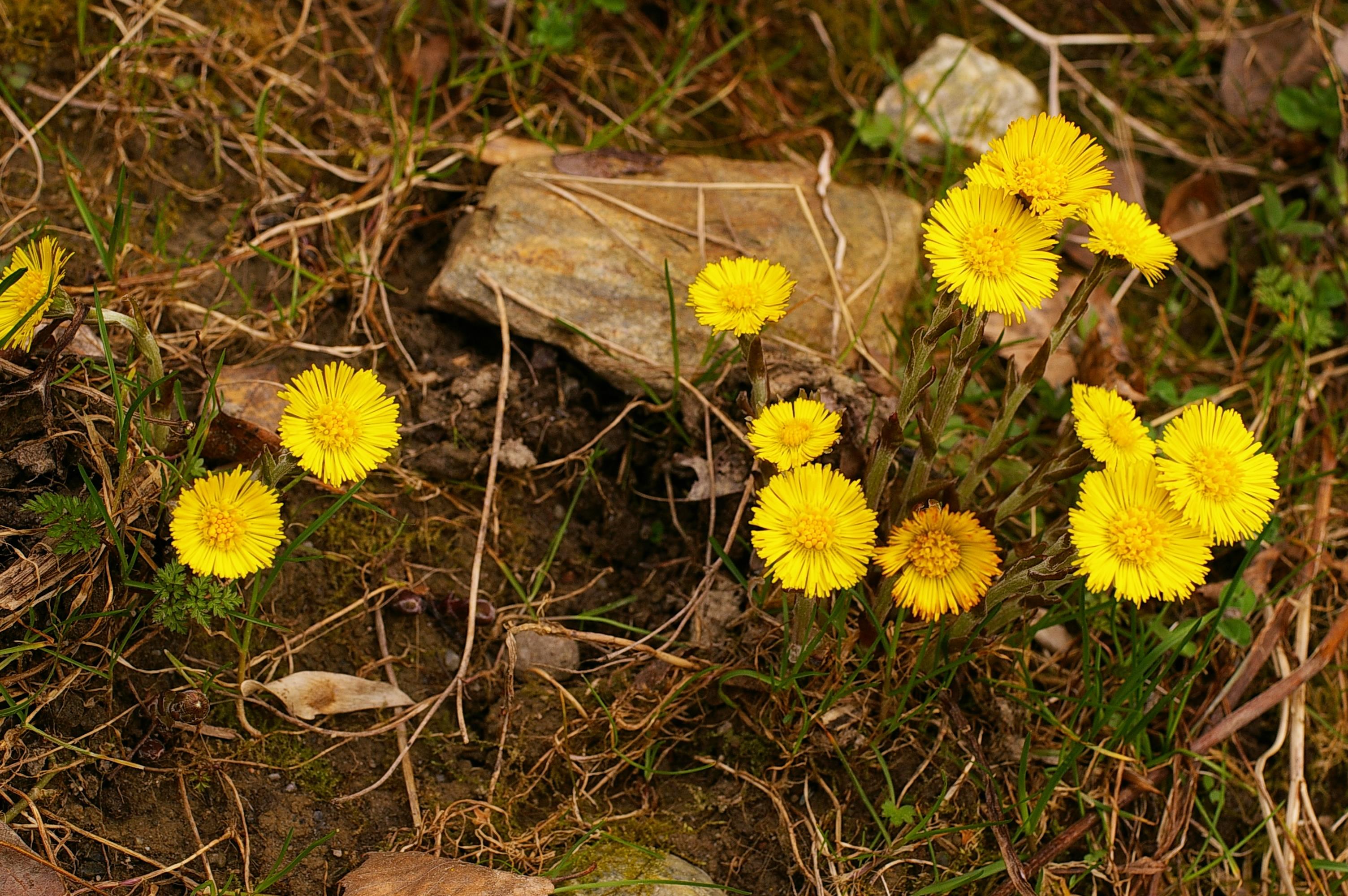
Coltsfoot can grow to a height of 30 cm.
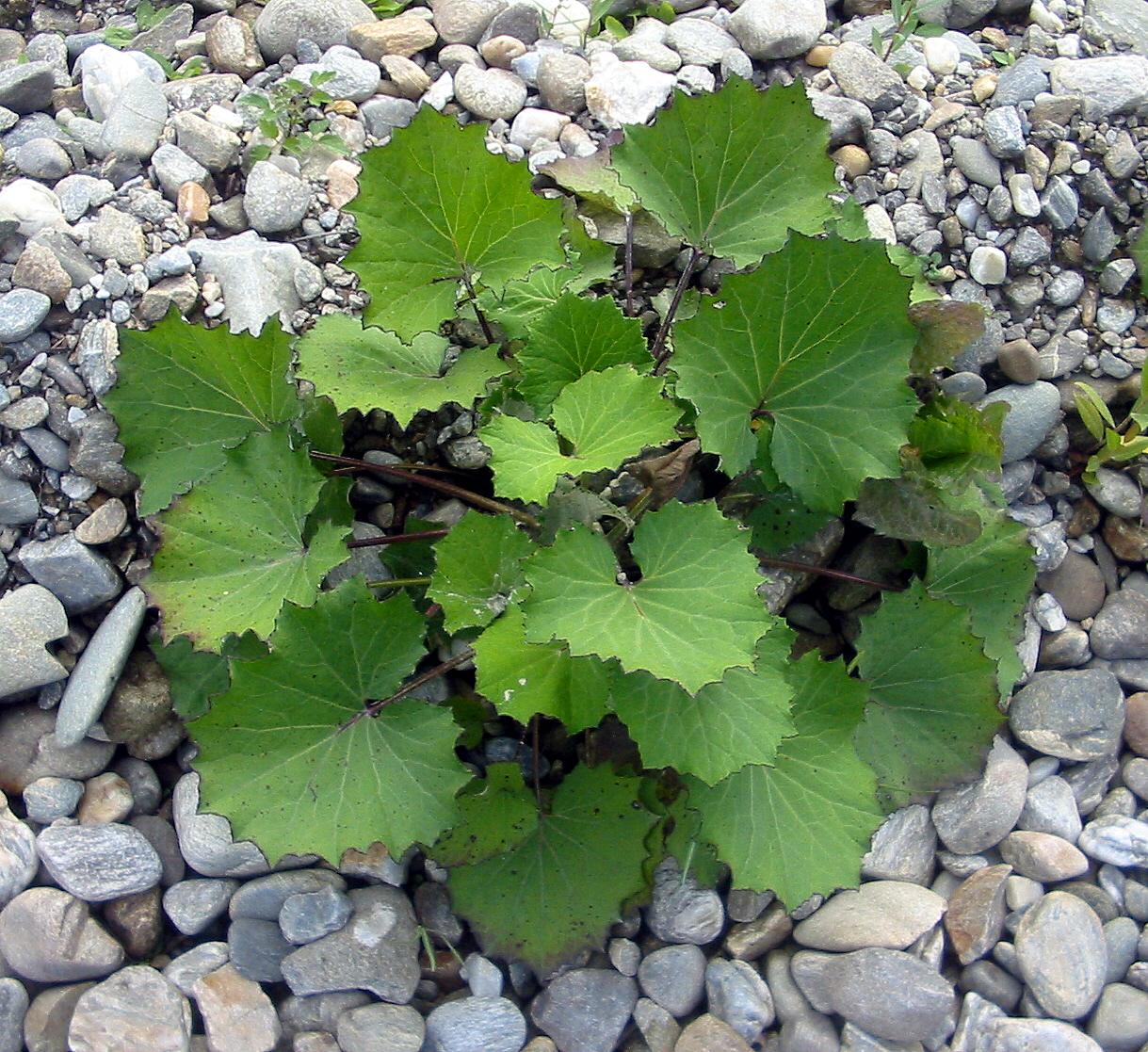
The leaves have long stalks and grow close to the ground (basal). They are heart- to hoof-shaped, with roughly serrated margins and undersides with felt-like white hairs.
The flower stalks are unbranched and covered in reddish hairy scaly leaves. They are initially upright and droop while the fruit is ripening.
The flower heads appear in spring before the leaves. At first glance, the flower head can be mistaken for the flower itself. The pseudanthium (“false flower”) consists of numerous individual yellow ray and tubular florets.
The seeds are small nut fruits with a ring of feathery hairs.
Features
Coltsfoot
Tussilago farfara
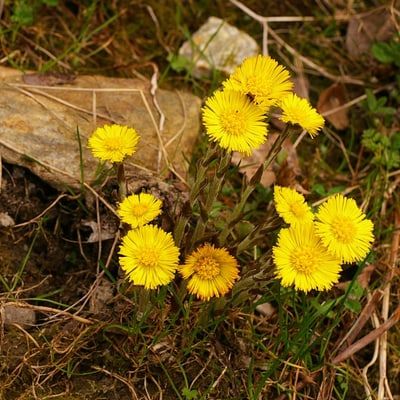
flowers appear before the leaves
hoof-shaped leaves
In the city
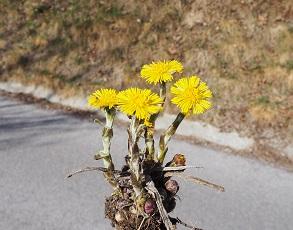
In towns, coltsfoot can be found mainly on stony soil, e.g. building sites, piles of earth, road verges and sand pits. It prefers wet-dry, warm sites on fresh soil.
As a well-known medicinal plant, coltsfoot is still being gathered today. However, this must be strongly advised against. Only particular species of this plant are licensed as medicinal plants, as the active substance in wild flowers are associated with additional harmful effects.
Fun Facts
At the end of World War Two, coltsfoot was the predominant plant on urban rubble sites.
The underground rhizomes of the coltsfoot can extend for up to two metres.
It flowers from February to April.
Pollination is mainly by bees, beetles and hoverflies.
Fruit dispersal takes place via the wind.
It lives for several years and generally flowers and fruits annually (perennial plant).
- Endangerment level Germany: not endangered
Coltsfoot suppresses the need to cough and has an expectorant (mucous-dissolving) effect. It is an ancient medicinal plant and is used in the treatment of various respiratory diseases.
Sources
Habitus, Nordschitz, CC BY -SA 3.0, https://commons.wikimedia.org/wiki/File:Tussilago_farfara,_group_of_flowering_plants.jpg

Habitus, Alice Kracht, CC BY-SA 4.0, https://species-id.net/openmedia/File:Huflat2.JPG

Blätter, Bogdan, CC BY -SA 3.0, https://commons.wikimedia.org/wiki/File:Tussilago_farfara_bgiu.jpg

Fleischhauer, S. G., Guthmann, J. & Spiegelberger, R. (2007) Essbare Wildpflanzen. 200 Arten bestimmen und verwenden, Baden und München: AT Verlag.
Lippert, W. & Podlech, D. (1993) GU Naturführer. Blumen: die wichtigen Blütenpflanzen Mitteleuropas erkennen und bestimmen, München: Gräfe und Unzer Verlag.
Schauer, T., Caspari, C. & Caspari, S. (2015) Der illustrierte BLV-Pflanzenführer für unterwegs. 1150 Blumen, Gräser, Bäume und Sträucher, München: BLV.
Scherf, G. (2006) Wildpflanzen neu entdecken, München: BLV.
Page „Huflattich“. : Wikipedia, The Free Encyclopedia. Date of last revision: 27.05.2016, 22:17 UTC. URL: https://de.wikipedia.org/w/index.php?title=Huflattich&oldid=154756908 (Accessed: 20.09.2016).