
Short Description
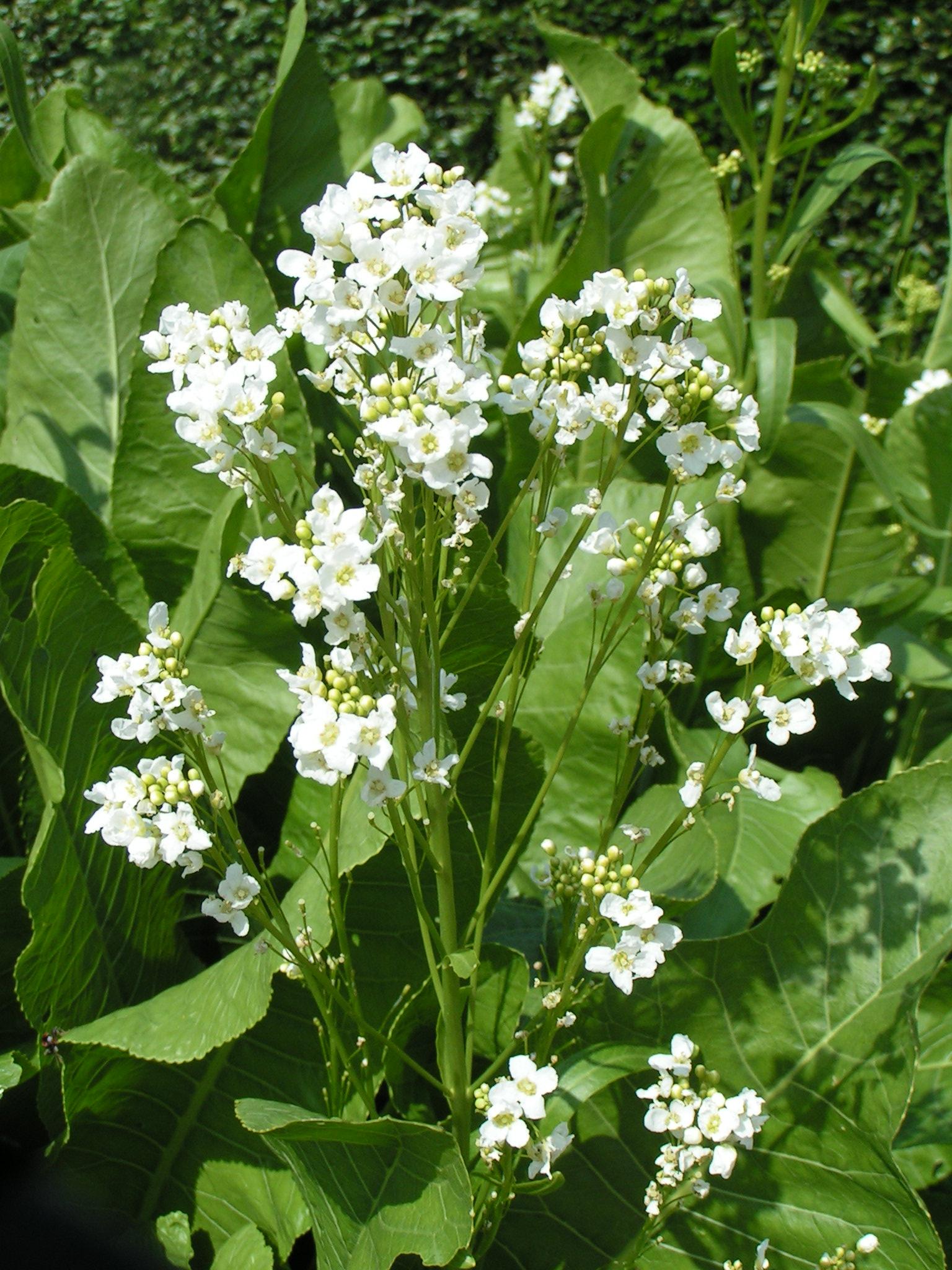
The horseradish can grow up to 120 cm high.
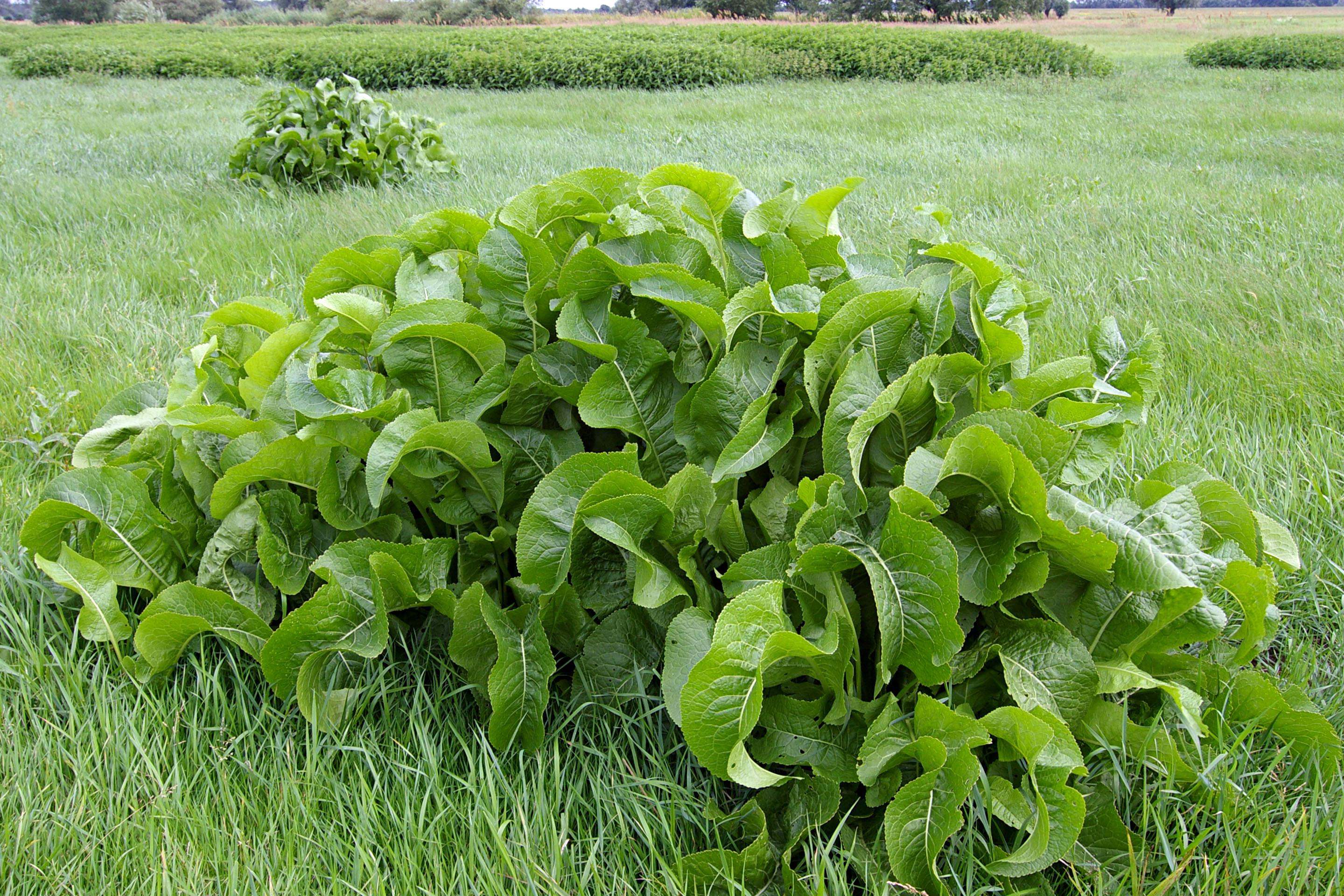
The leaves at the base are very large, oval and shiny. They often have a wavy and slightly toothed margin. The leaves on the stem are smaller and often incised (pinnatifid).
The stem is hollow.
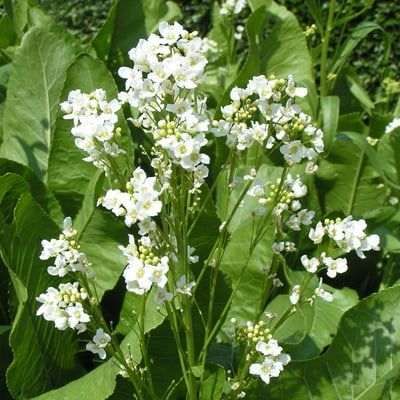
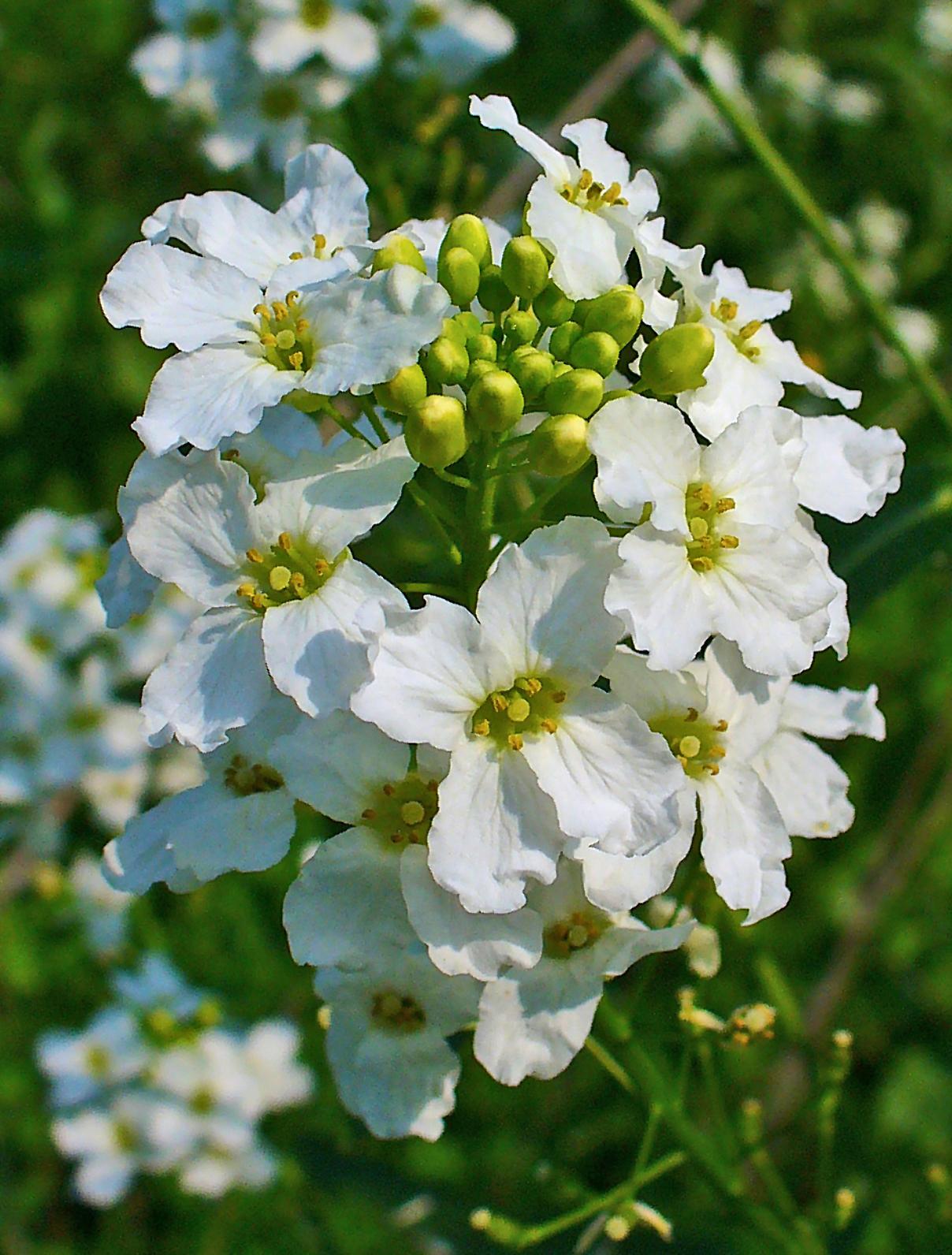
The flowers consist of four white petals. They stand together in numerous racemes with many flowers.
The fruits are ovoid to almost spherical pods.
Features
Horseradish
Armoracia rusticana
large, wavy and glossy basal leaves
ovate pods (siliquae)
In the city
In the city, wild herbs can be found along paths, rubble sites, roadsides, banks and wastelands. Horseradish prefers nutrient-rich, deep soils.
Fun Facts
In Germany, the plant hardly forms seeds, but reproduces via root pieces.
It belongs to the crucifer family (Brassicaceae), the same plant family as mustard, rocket and cabbage.
The flowering period is from May to July.
It lives for several years and generally flowers and fruits annually (perennial plant).
The flowers are pollinated by insects.
- Endangerment level Germany: not evaluated
- Usage:
In folk medicine, horseradish is used to treat digestive disorders. However, it can cause stomach and intestinal problems if consumed in excess.
Originally, the horseradish comes from south-eastern Europe. However, it has been planted in Central Europe since the 15th century and has often gone wild. It therefore probably belongs to the non-native species (neophytes) in Germany.
The origin of the name horseradish has only indirectly to do with the animal. In fact, the upper parts of the plant are inedible for humans as for grazing animals. A horse would also reject the pungent taste of the root. In this case, however, the name rather refers to something large, coarse or rough. It also appears in various other plant names, e.g. horsemint, horseparsley, horsevetch, and horsechestnut .
The roots taste hot and spicy due to mustard oils and are suitable as a seasoning for sauces and meat. Medicinally, the bactericidal and blood circulation stimulating effect is used.
Sources
Habitus, Pethan, CC BY-SA 3.0, https://commons.wikimedia.org/wiki/File:Armoracia_rusticana.jpg

Blüten, H. Zell, CC BY-SA 3.0, https://commons.wikimedia.org/wiki/File:Armoracia_rusticana_002.JPG

Blätter, Christian Fischer, CC BY-SA 3.0, https://commons.wikimedia.org/wiki/File:ArmoraciaRusticana.jpg

Kammer, P. M. (2016) Pflanzen einfach bestimmen. Schritt für Schritt einheimische Arten kennenlernen, Bern: Haupt Verlag.
Schönfelder, I. & Schönfelder, P. (2010) Der Kosmos-Heilpflanzenführer. Über 600 Heil- und Giftpflanzen Europas, Stuttgart: Franckh Kosmos Verlag.
Spohn, M., Golte-Bechtle, M. & Spohn, R. (2015) Was blüht denn da? Stuttgart: Franckh Kosmos Verlag.
Page „Meerrettich“. : Wikipedia, The Free Encyclopedia. Date of last revision: 07.05.2018, 21:27 UTC. URL: https://de.wikipedia.org/w/index.php?title=Meerrettich&oldid=177236999 (Accessed: 08.05.2018).