
Short Description
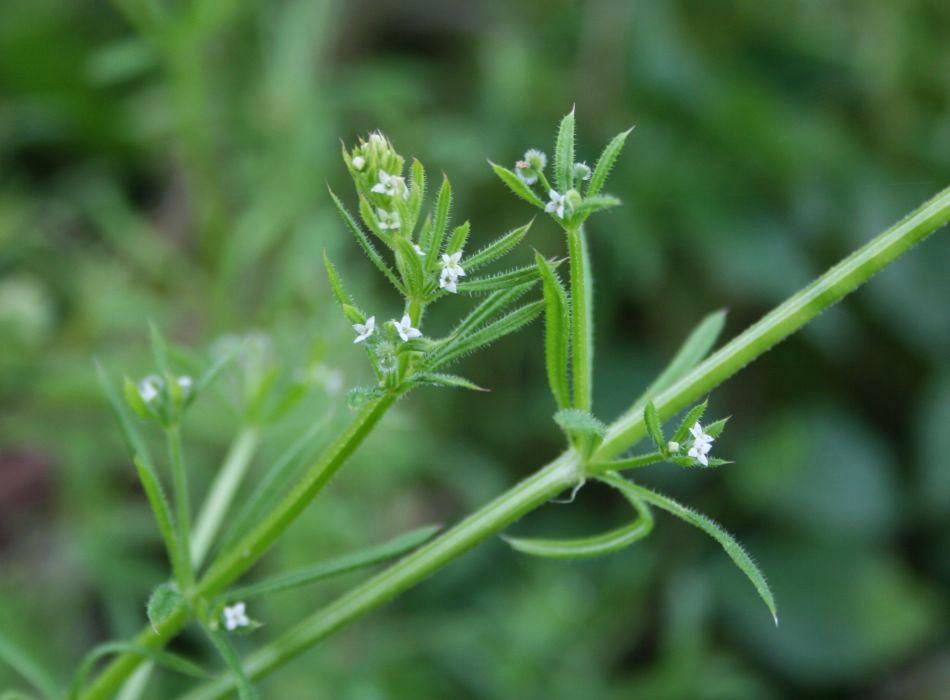
Catchweed bedstraw can grow up to two metres high.
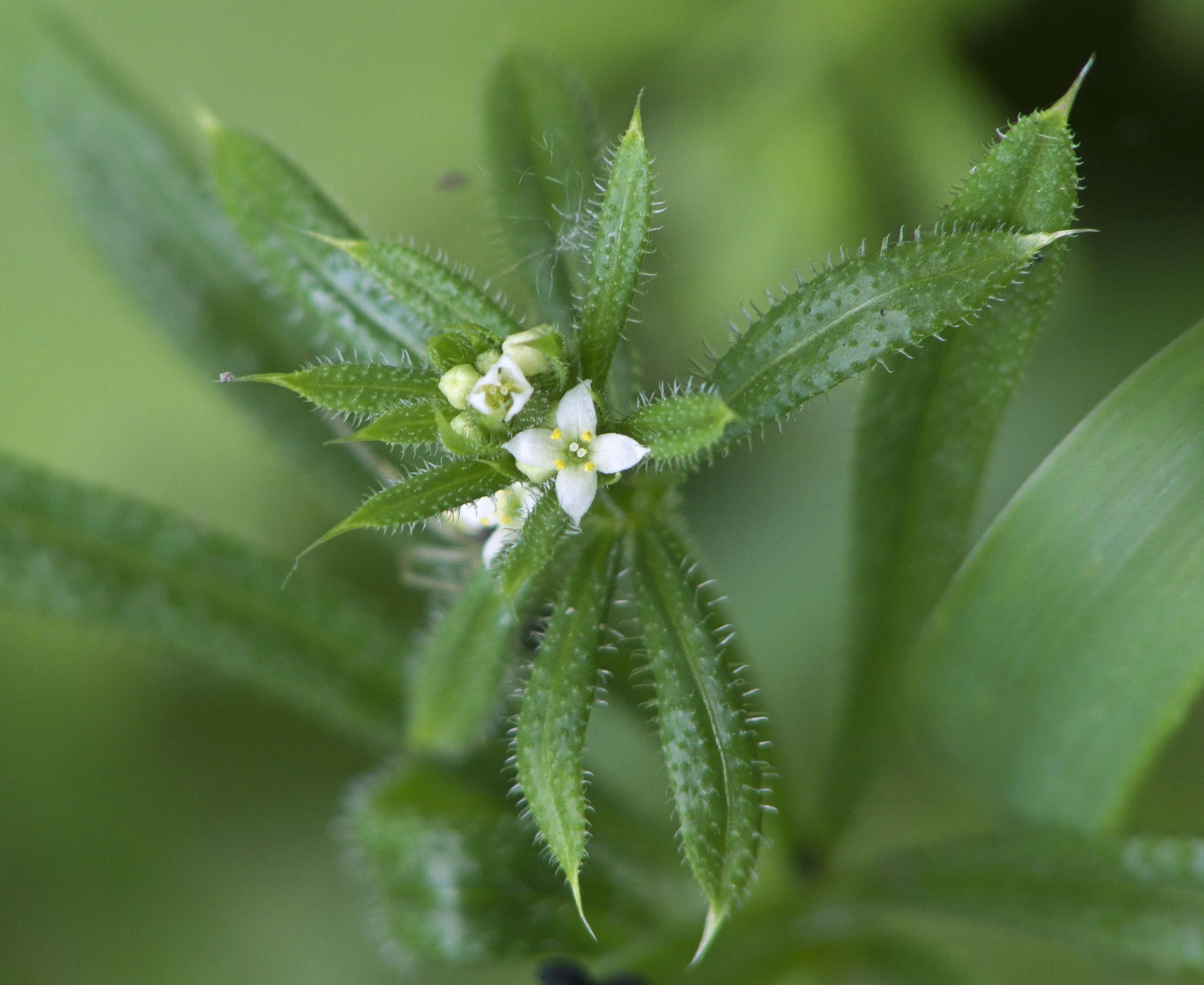
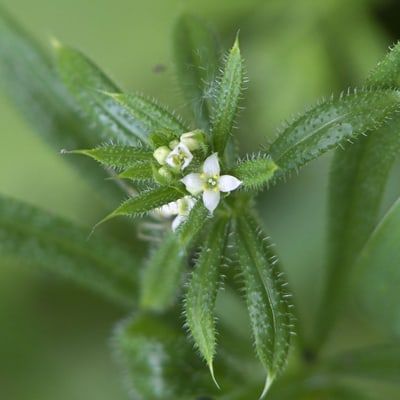
The leaves are narrow and elongated. They grow together in whorls of six to eight leaves. They have backward pointing spiny hairs on the edge. The tip of the leaf is a spiny point.
The stem is square and also has backward spiny hairs. It grows lying down or climbing. It often overgrows other plants.
The very small flowers have four, roundly arranged, white petals that are shortly fused together. The inflorescences are located in the upper corners of the leaves.
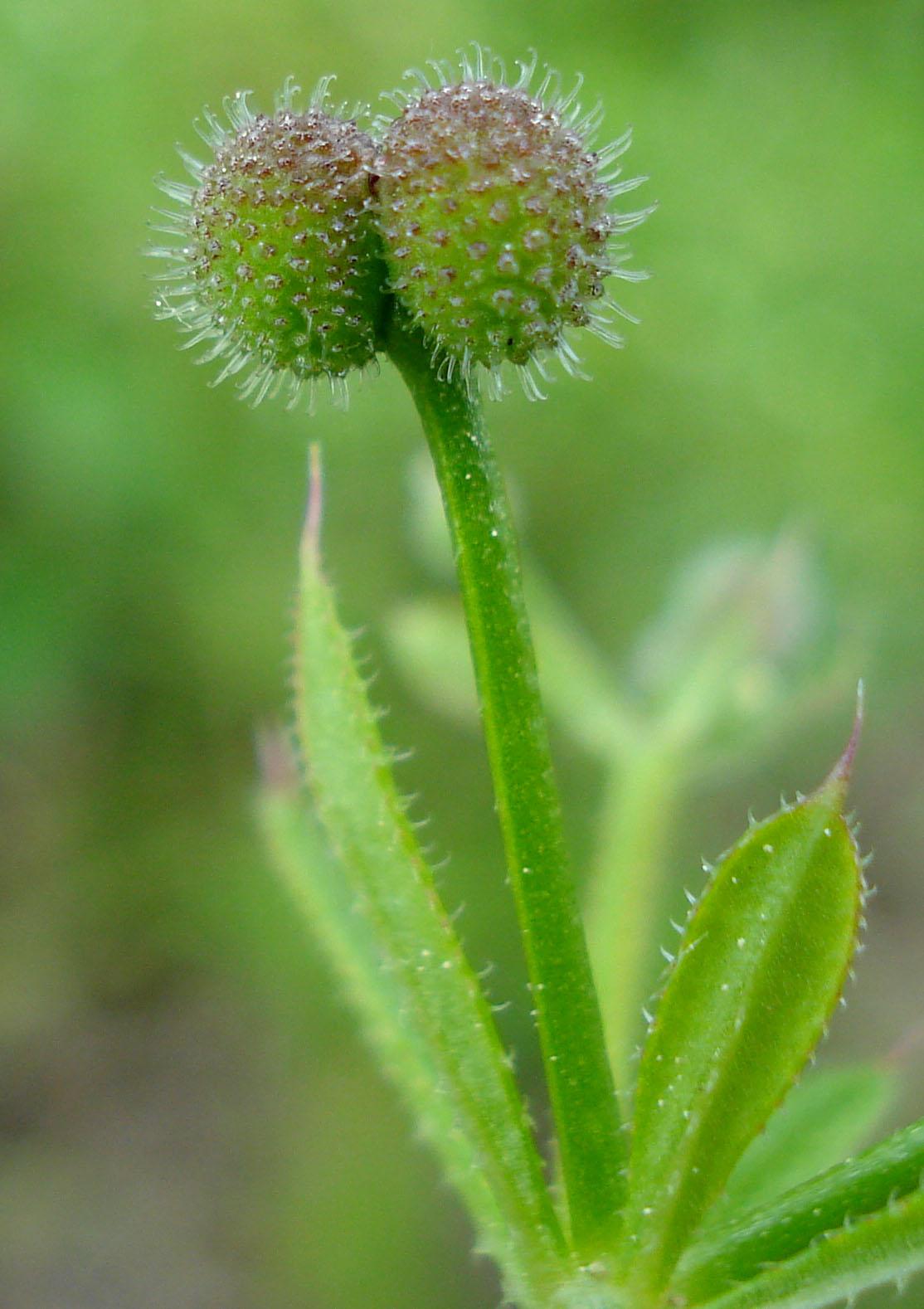
The fruit is a spherical, two-part schizocarp. It is covered with barbs.
Features
Catchweed bedstraw
Galium aparine
clinging
leaves in whorls
In the city
Catchweed bedstraw is a half-light plant that was originally common in forests. Today it grows mainly in fields, next to bushes and hedges or on forest edges. In the city, burdock ragwort is also found on disturbed areas such as rubble tips, as there is often a high nitrogen content in the soil there. It grows in moist, nutrient-rich and loose soils. It is a loam and nitrogen indicator.
Fun Facts
With its bristles it sticks to other plants and can overgrow them to reach the light.
It reproduces exclusively sexually. The hermaphrodite flowers are pre-male, i.e. the stamens ripen before the female organs. There is reliable self-pollination. The flowers are rarely visited by small insects.
The flowering period is from June to October.
It is an annual plant. This means that the plant dies after it has flowered and the seeds have ripened.
- Endangerment level Germany: not endangered
- Usage:
The upper stem sections are used cooked as a slightly bitter vegetable.
Catchweed bedstraw is native to almost all of Europe. Today it occurs in temperate areas worldwide as a non-native plant (neophyte).
It is used in folk medicine against skin conditions, kidney stones and cancer. However, its effectiveness has not been scientifically proven.
Sources
Habitus, Rasbak, CC BY-SA 3.0, https://commons.wikimedia.org/wiki/File:Galium_aparine,_Kleefkruid_bloem.jpg

Teilblütenstand und Blätter, Franz Xaver, CC BY-SA 3.0, https://commons.wikimedia.org/wiki/File:Galium_aparine_1.jpg

Früchte, Fornax, CC BY-SA 3.0, https://commons.wikimedia.org/wiki/File:Galium_aparine2_W.jpg

Kammer, P. M. (2016) Pflanzen einfach bestimmen. Schritt für Schritt einheimische Arten kennenlernen, Bern: Haupt Verlag.
Schauer, T., Caspari, C. & Caspari, S. (2015) Der illustrierte BLV-Pflanzenführer für unterwegs. 1150 Blumen, Gräser, Bäume und Sträucher, München: BLV.
Schönfelder, I. & Schönfelder, P. (2010) Der Kosmos-Heilpflanzenführer. Über 600 Heil- und Giftpflanzen Europas, Stuttgart: Franckh Kosmos Verlag.
Spohn, M., Golte-Bechtle, M. & Spohn, R. (2015) Was blüht denn da? Stuttgart: Franckh Kosmos Verlag.
Page „Kletten-Labkraut“. : Wikipedia, The Free Encyclopedia. Date of last revision: 09.02.2018, 18:30 UTC. URL: https://de.wikipedia.org/w/index.php?title=Kletten-Labkraut&oldid=173830003 (Accessed: 13.02.2018).
Bundesamt für Naturschutz (n.d.) Artensteckbriefe, URL: http://floraweb.de/pflanzenarten/artenhome.xsql?suchnr=2533& (Accessed: 13.02.2018).