
Short Description
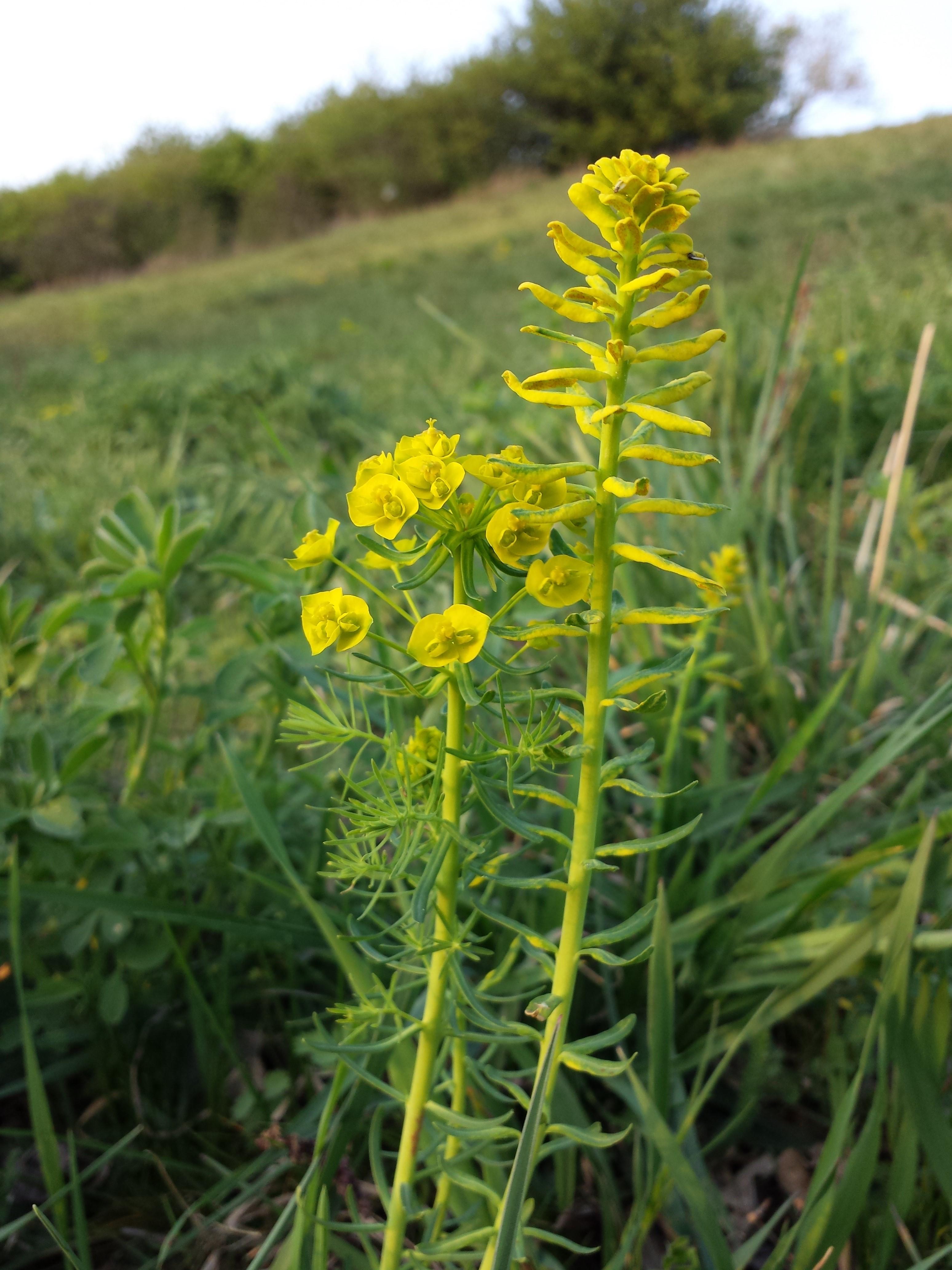
The cypress spurge can grow up to 50 cm high. It produces poisonous, white milky sap.
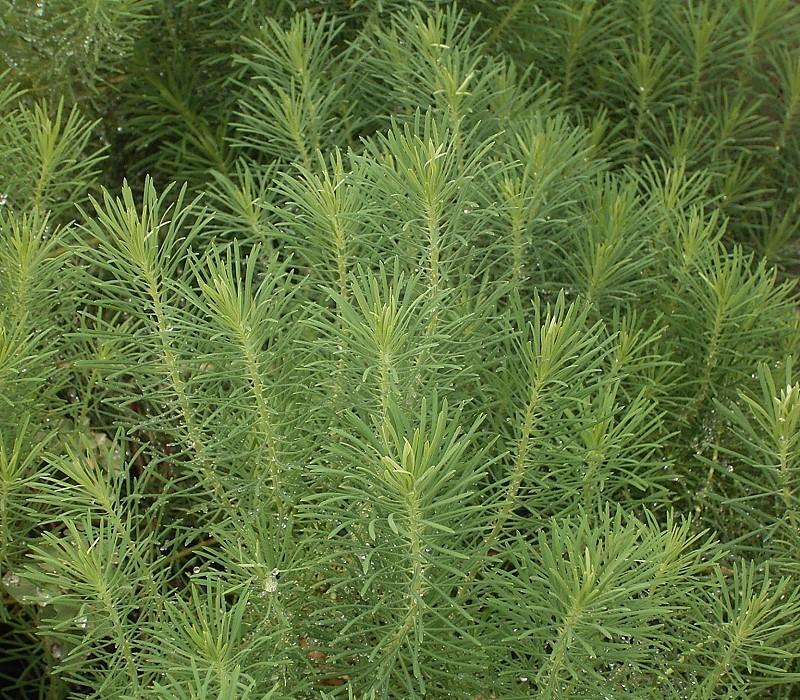
The leaves are narrowly linear, thin and look like needles. The leaves grow alternately on the stem.
The stem is blue-green and densely leafed.
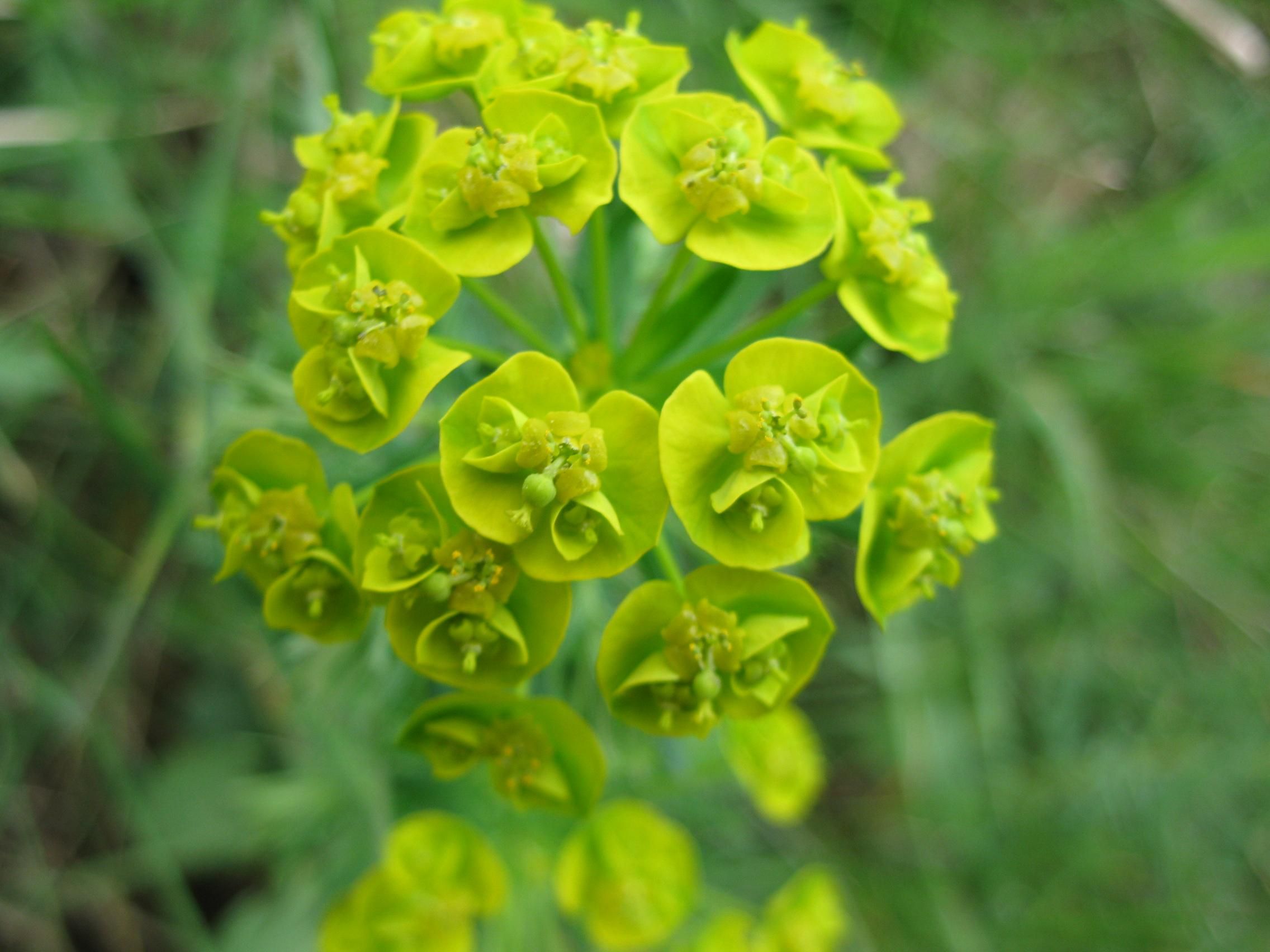
The small yellow flowers are enclosed by two larger floral bracts that are initially yellow and later reddish. In this way, the plant feigns larger flowers, thus attracting more pollinators.
The fruit is a capsule that splits into three sections when ripe.
Features
Cypress spurge
Euphorbia cyparissias
highly poisonous
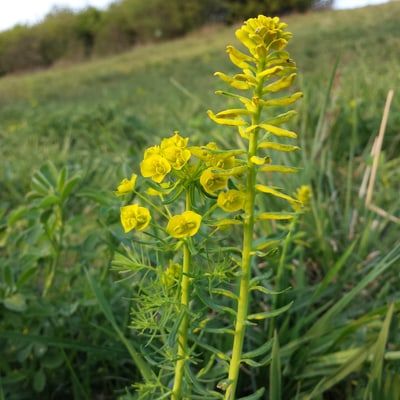
two yellow floral bracts per flower
small needle-like leaves
In the city
Cypress spurge can frequently be found in dry bushes, heathland and along dry forest and path verges. It prefers dry, warm, sunny to semi-shaded sites with chalky, nutrient-poor soil.
Fun Facts
The best-known member of the spurge family is the poinsettia (Euphorbia pulcherrima). It shares the characteristic poisonous milky sap and the colourful floral bracts enclosing the rather inconspicuous small flowers.
It is the main food source for the caterpillars of the spurge hawk-moth (Hyles euphorbiae), an endangered species in Germany. The poison from the plant ingested with the food is passed to the caterpillar and protects it throughout all stages of its development.
It flowers from May to September.
- Endangerment level Germany: not endangered
All parts of the plant are very poisonous, especially the milky sap is poisonous. Contact with skin or eyes with the sap can result in dangerous inflammations.
Sources
Habitus, Stefan.lefnaer, CC BY-SA 4.0, https://commons.wikimedia.org/wiki/File:Euphorbia_cyparissias_sl6.jpg

Blätter, Frank Vincentz, CC BY-SA 3.0, https://commons.wikimedia.org/wiki/File:Euphorbia_cyparissias_07_ies.jpg

Blüten, Krümelomat, CC BY-SA 3.0, https://commons.wikimedia.org/wiki/File:Zypressen_Wolfsmilch.jpg

Eggenberg, S. & Möhl, A. (2007) Flora Vegetativa: Ein Bestimmungsbuch für Pflanzen der Schweiz im blütenlosen Zustand, Bern, Stuttgart, Wien: Haupt Verlag.
Spohn, M., Golte-Bechtle, M. & Spohn, R. (2015) Was blüht denn da? Stuttgart: Franckh Kosmos Verlag.
Jäger, E. J. (2011) Rothmaler - Exkursionsflora von Deutschland. Gefäßpflanzen: Grundband, Heidelberg: Spektrum Akademischer Verlag.
Kammer, P. M. (2016) Pflanzen einfach bestimmen. Schritt für Schritt einheimische Arten kennenlernen, Bern: Haupt Verlag.
Lippert, W. & Podlech, D. (1993) GU Naturführer. Blumen: die wichtigen Blütenpflanzen Mitteleuropas erkennen und bestimmen, München: Gräfe und Unzer Verlag.
Schauer, T., Caspari, C. & Caspari, S. (2015) Der illustrierte BLV-Pflanzenführer für unterwegs. 1150 Blumen, Gräser, Bäume und Sträucher, München: BLV.
Page „Zypressen-Wolfsmilch“. : Wikipedia, The Free Encyclopedia. Date of last revision: 16.09.2016, 15:53 UTC. URL: https://de.wikipedia.org/w/index.php?title=Zypressen-Wolfsmilch&oldid=157976965 (Accessed: 12.01.2017).