

Short Description
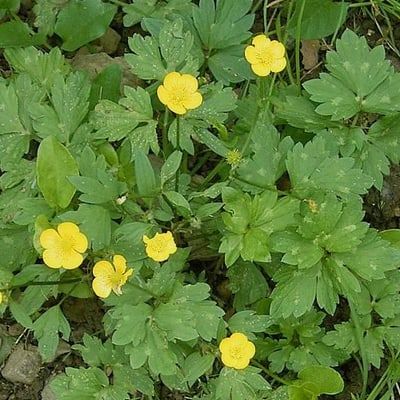
The creeping buttercup can grow half a metre high. It forms above-ground, often metre-long, leafy runners with roots and young plants.
The leaves are deeply incised. The leaf margin is toothed.
The stem grows creeping above the ground.
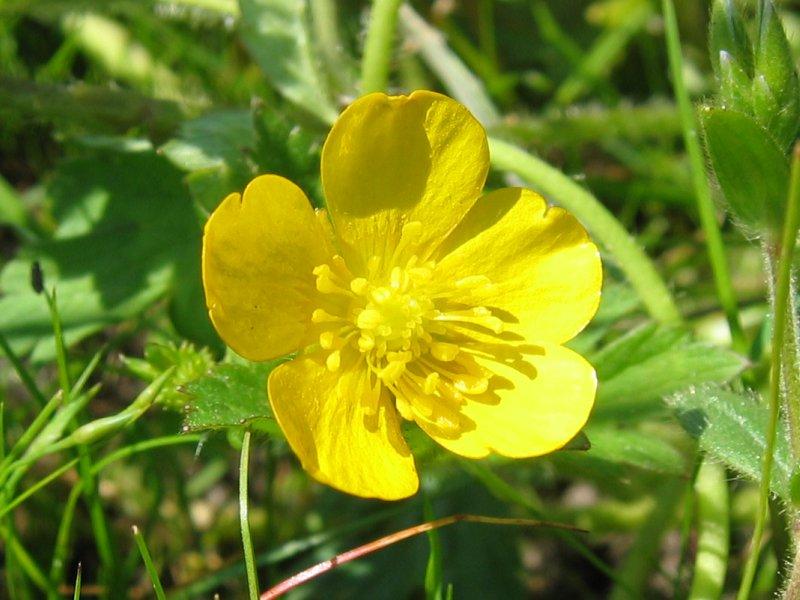
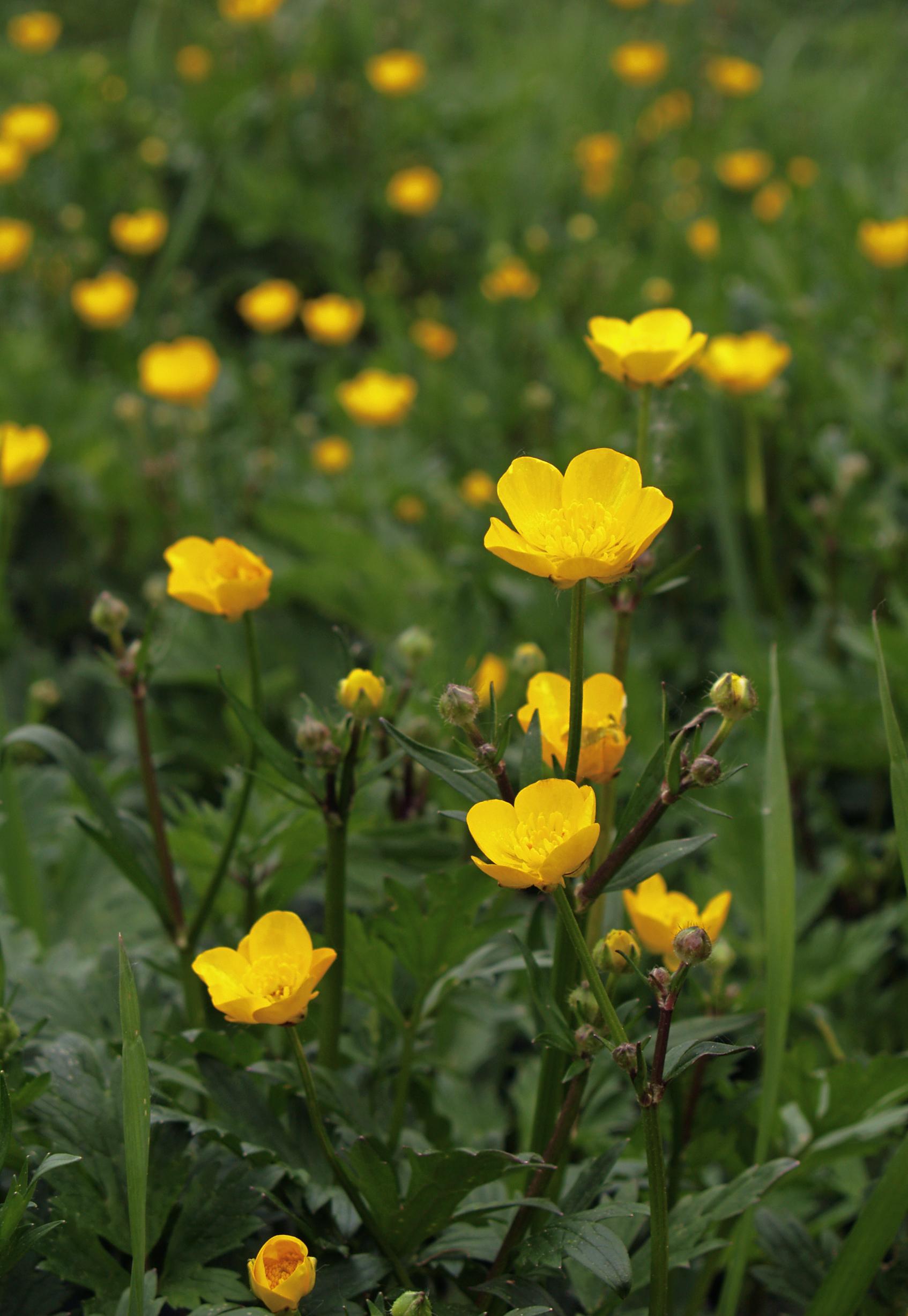
The yolk-yellow flowers have five petals. The flower stems have grooves.
The flowers contain numerous elongated nutlets.
Features
Creeping buttercup
Ranunculus repens
slightly poisonous
creeping stem
yolk-yellow flowers
In the city
The creeping buttercup grows on banks and roadsides as well as on damp meadows, fields and rubble piles. It is an indicator of moist clay soils, soil compaction and disturbances. It tolerates flooding well and is very common. With its deep roots it acts as a soil stabiliser.
Fun Facts
The flowering period is from May to August.
It reproduces vegetatively through its long runners. It grows quickly and reproduces very intensively. Seedlings grow into vigorous plants within a month.
The creeping buttercup is a perennial plant. It grows older than two years, but flowers only once and dies after the seeds have ripened.
- Endangerment level Germany: not endangered
The whole plant is slightly poisonous. Symptoms of poisoning may include skin irritation, vomiting and diarrhoea.
Sources
Habitus, Frank Vincentz, CC BY-SA 3.0, https://commons.wikimedia.org/wiki/File:Ranunculus_repens_01_ies.jpg

Blüte, Fabelfroh, CC BY-SA 3.0, https://commons.wikimedia.org/wiki/File:Ranunculus_repens_bluete.jpeg

Habitus, Jörg Hempel, CC-BY-SA 2.0, https://commons.wikimedia.org/wiki/File:Ranunculus_repens_LC0036.jpg

Kammer, P. M. (2016) Pflanzen einfach bestimmen. Schritt für Schritt einheimische Arten kennenlernen, Bern: Haupt Verlag.
Schauer, T., Caspari, C. & Caspari, S. (2015) Der illustrierte BLV-Pflanzenführer für unterwegs. 1150 Blumen, Gräser, Bäume und Sträucher, München: BLV.
Seitz, B., Ristow, M., Meißner, J., Machatzi, B. & Sukopp, H. (2018) Rote Liste und Gesamtartenliste der etablierten Farn- und Blütenpflanzen von Berlin. : Der Landesbeauftragte für Naturschutz und Landschaftspflege / Senatsverwaltung für Umwelt, Klima und Verkehr (eds.) Rote Listen der gefährdeten Pflanzen, Pilze und Tiere von Berlin, URL: https://www.berlin.de/sen/uvk/natur-und-gruen/naturschutz/artenschutz/artenlisten-rote-listen/farn-und-bluetenpflanzen/ (Accessed: 26.03.2021).
Spohn, M., Golte-Bechtle, M. & Spohn, R. (2015) Was blüht denn da? Stuttgart: Franckh Kosmos Verlag.
Bundesamt für Naturschutz (n.d.) Artensteckbriefe, URL: http://floraweb.de/pflanzenarten/artenhome.xsql?suchnr=4768& (Accessed: 21.08.2018).
Page „Kriechender Hahnenfuß“. : Wikipedia, The Free Encyclopedia. Date of last revision: 18.06.2017, 10:22 UTC. URL: https://de.wikipedia.org/w/index.php?title=Kriechender_Hahnenfu%C3%9F&oldid=166500508 (Accessed: 21.08.2018).