
Short Description
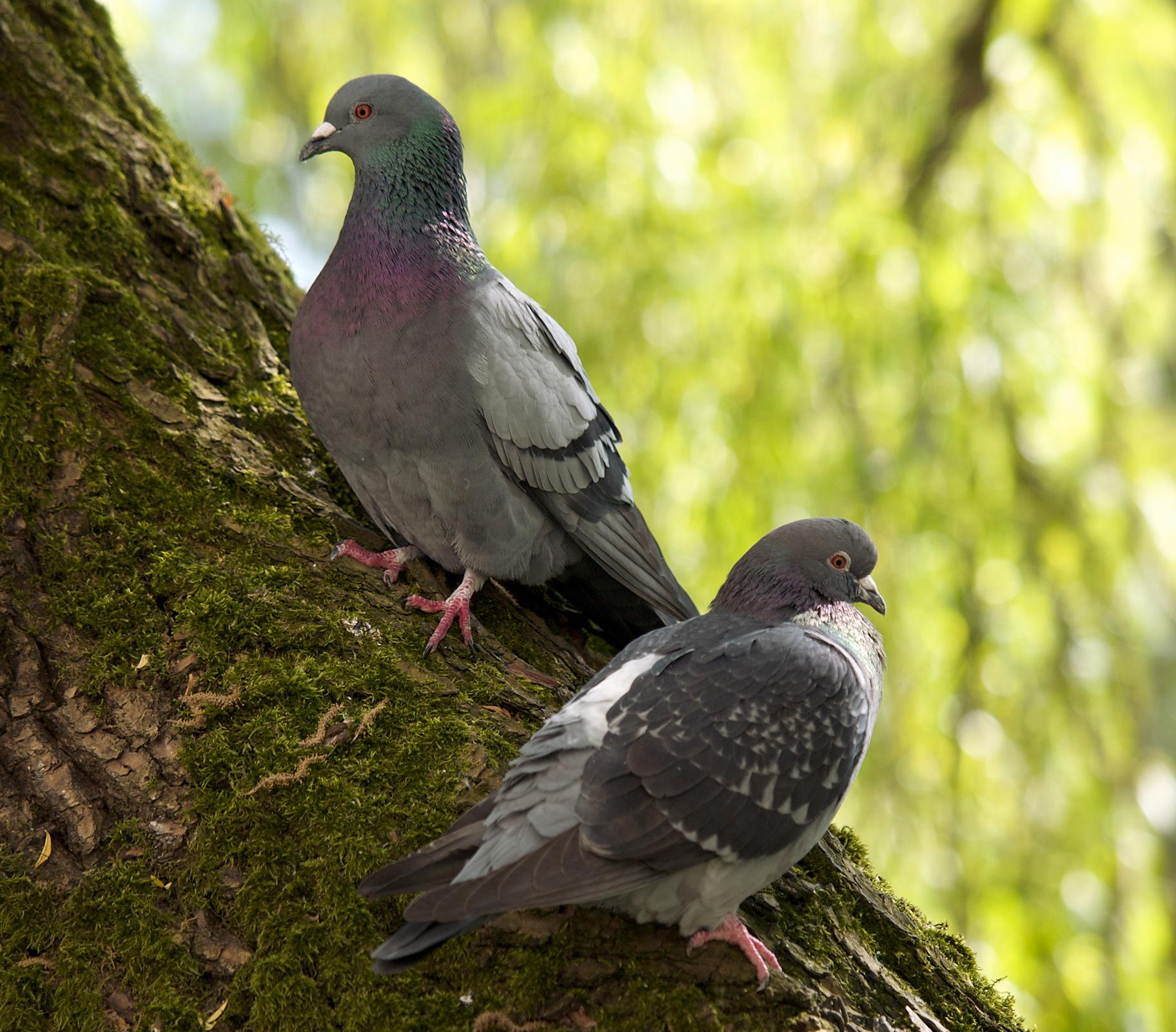
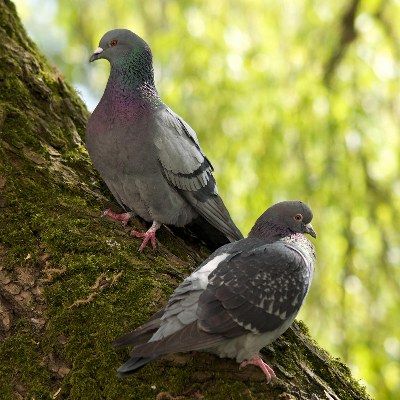
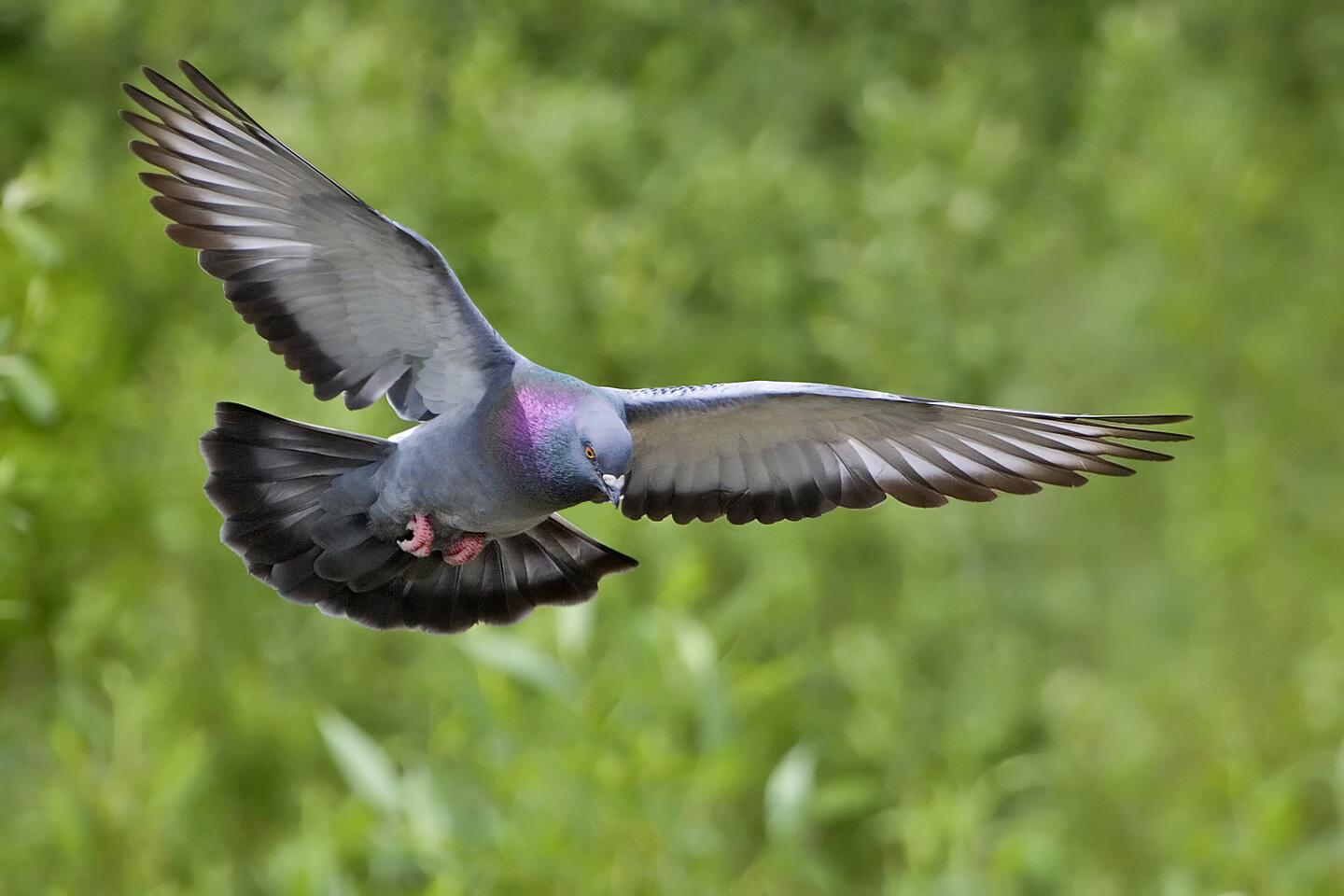
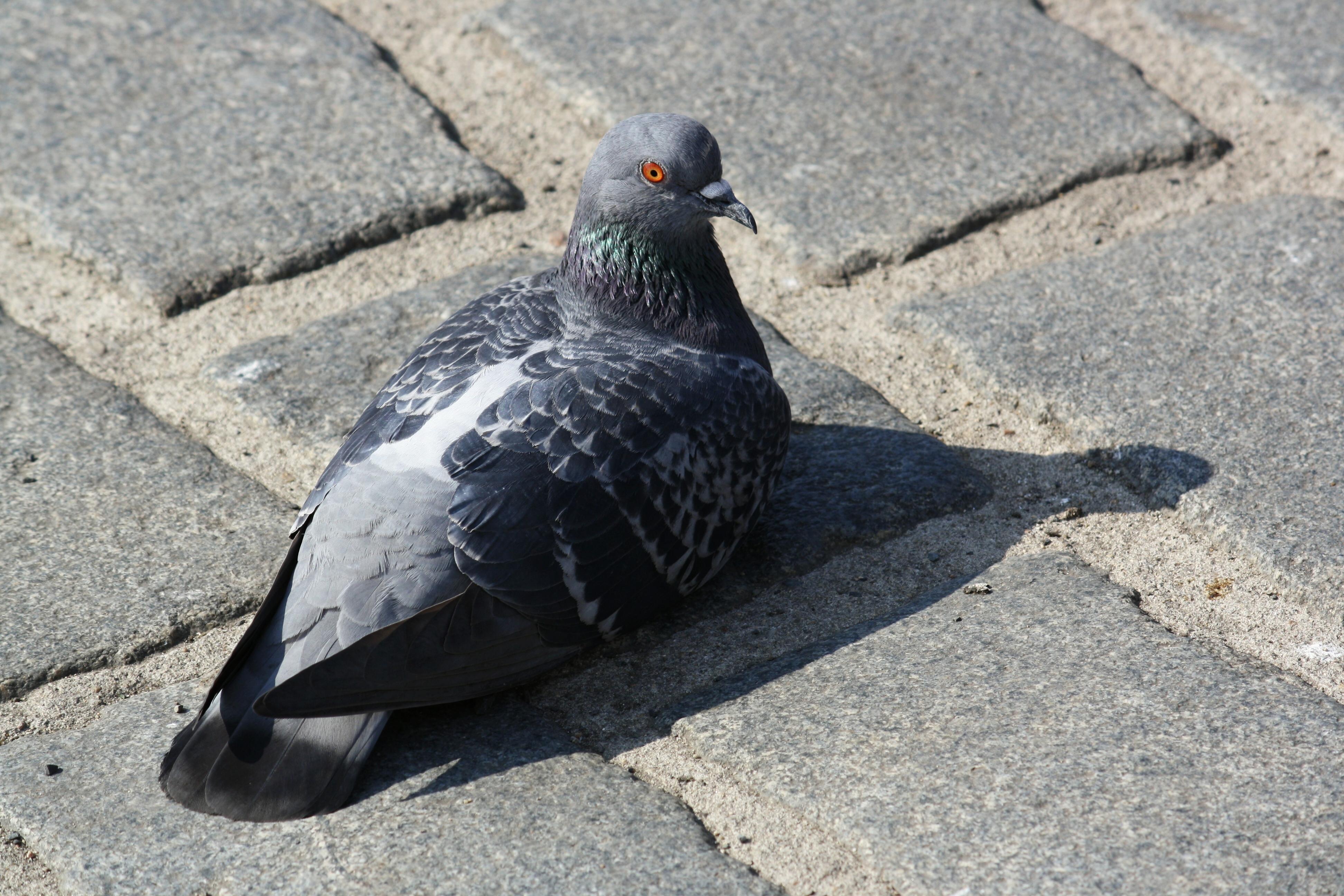
The plumage of the rock dove is very variable. Mostly, however, grey and blue tones dominate and it shimmers yellowish, greenish or violet. There are also white-grey patterned or dark pied colour varieties.
Features
Rock dove
Columba livia
no unique characteristics as very variable
Cooing and wing flapping of feral pigeons
Frommolt, CC BY-SA 3.0

Similar species
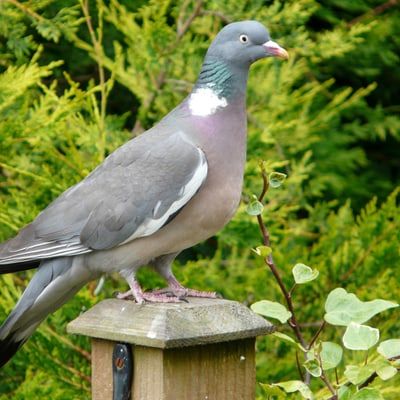
Common wood pigeon
Columba palumbus
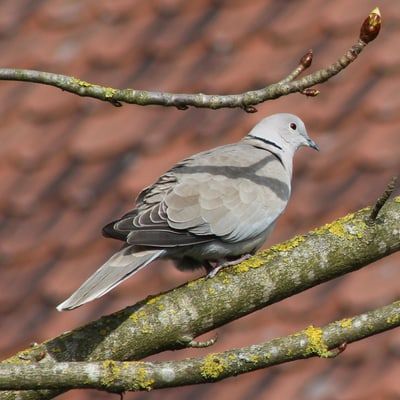
Eurasian collared dove
Streptopelia decaocto
In the city
The wild form of the rock dove is restricted to Eurasia and Africa, and its natural habitat is rocky cliffs on the coast. The formerly domesticated and now feral form of the rock dove, the feral pigeon, is found in cities around the world. Outside cities, it is mainly found in areas that have been altered by humans.
The domestication of the original rock dove began about 12,000 years ago. Thus, the pigeon was one of the first animals to be bred for consumption, to provide fertiliser and to send messages.
Fun Facts
The most common form of the rock dove today is the formerly domesticated and now wild living feral pigeon. However, they are both the same species.
Pigeons lay two eggs per brood. The chicks are fed with a kind of milk produced in the parents' heads.
They waggle their heads as they walk because they fixate on an object until it disappears from their view. Then the eyes jump to the next fixed point.
They are true super-recognisers: in tests, they were able to identify breast cancer on X-rays and distinguish between paintings by Picasso and Monet. They can also tell faces apart.
As orientation during their flights over sometimes very long distances, the pigeons use both optical landmarks, such as buildings, river courses and roads, but also physical clues, such as geomagnetism, movements in the earth's interior, intrasound and smells.
- Endangerment level Germany: not evaluated
Among the almost 6000 feathers of a pigeon are also special feathers, the tips of which break down into dust that covers the plumage as a water-repellent film.
Sources
Habitus, Jörg Hempel, CC BY-SA 3.0 de, https://commons.wikimedia.org/wiki/File:Columba_livia_LC0199.jpg

im Flug, Alan D. Wilson, CC BY-SA 2.5, http://www.naturespicsonline.com/
Habitus, Matěj Baťha, CC BY-SA 3.0, https://commons.wikimedia.org/wiki/File:Columba_livia_f._domestica_(Praha,_Ra%C5%A1%C3%ADnovo_n%C3%A1b%C5%99e%C5%BE%C3%AD)_622.jpg
_622.jpg)
Page „Stadttaube“. : Wikipedia, The Free Encyclopedia. Date of last revision: 20.03.2021, 09:13 UTC. URL: https://de.wikipedia.org/w/index.php?title=Stadttaube&oldid=209987963 (Accessed: 23.03.2021).
Artenfinder (2016) Columba livia f. domestica (Straßentaube), URL: https://arteninfo.net/elearning/voegel/speciesportrait/3014 (Accessed: 20.04.2016).
NABU – Naturschutzbund Deutschland e.V. (n.d.) Verwilderter Kulturfolger. Wie Mensch und Stadttaube besser miteinander auskommen, URL: https://www.nabu.de/tiere-und-pflanzen/voegel/helfen/05991.html (Accessed: 20.04.2016).
Epstein, R., Lanza, R. P. & Skinner, B. F. (1981) Self-Awareness in the Pigeon, Science, 212, 695 f.
Levenson, R. M., Krupinski, E. A., Navarro, V. M. & Wasserman, E. A. (2015) Pigeons (Columba livia) as Trainable Observers of Pathology and Radiology Breast Cancer Images, PLoS ONE 10(11), e0141357.
Scarf, D., Boy, K., UberReinert, A., Devine, J., Güntürkün, O. & Colombo, M. (2016) Orthographic processing in pigeons (Columba livia), Proc Natl Acad Sci USA, 113 (40), 11272–11276.
Schneider, K. (2021) Tauben. Ein Portrait, Berlin: Naturkunden, Nr. 69.
Watanabe, S., Sakamoto, J. & /Wakita, M. (1995) PIGEONS' DISCRIMINATION OF PAINTINGS BY MONET AND PICASSO, Journal of the Experimental Analysis of Behavior 63 (2), 165–174.
Page „Felsentaube“. : Wikipedia, The Free Encyclopedia. Date of last revision: 06.01.2026, 20:58 UTC. URL: https://de.wikipedia.org/w/index.php?title=Felsentaube&oldid=263102900 (Accessed: 18.02.2026).