
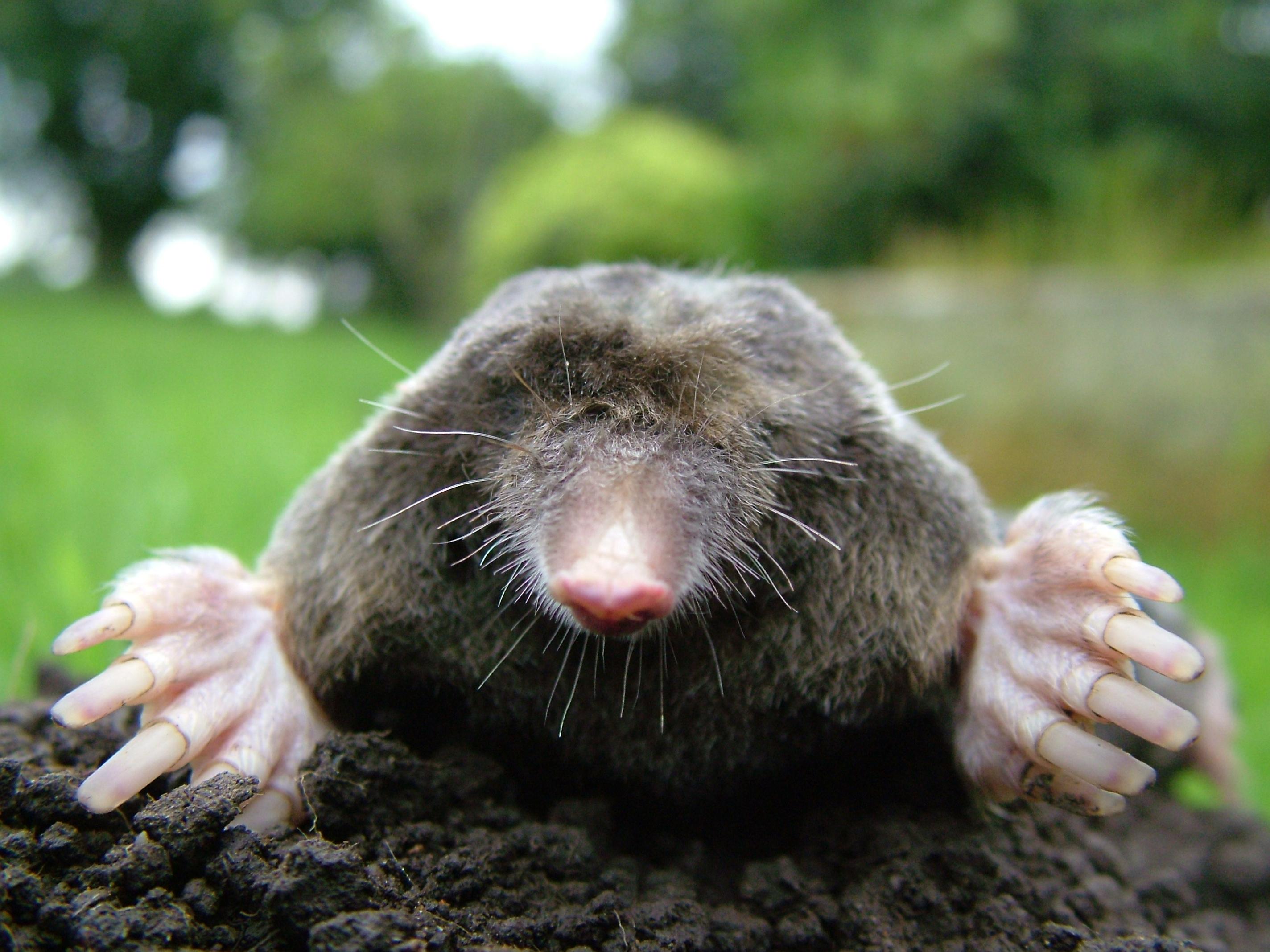
Short Description
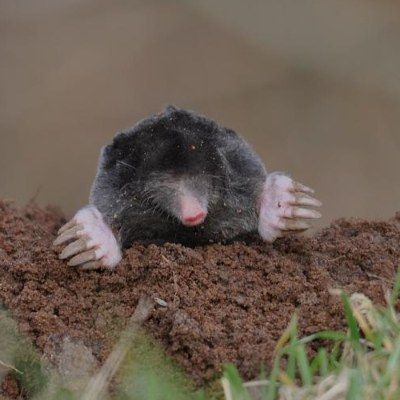
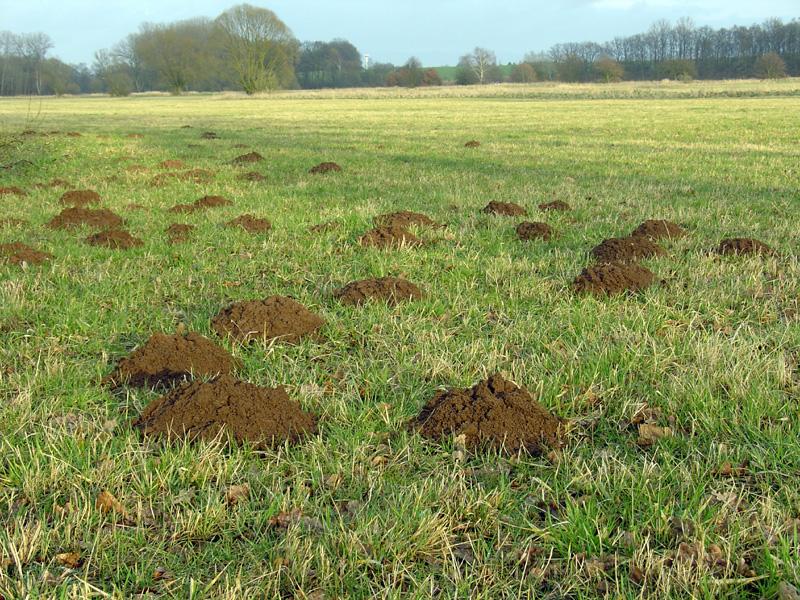
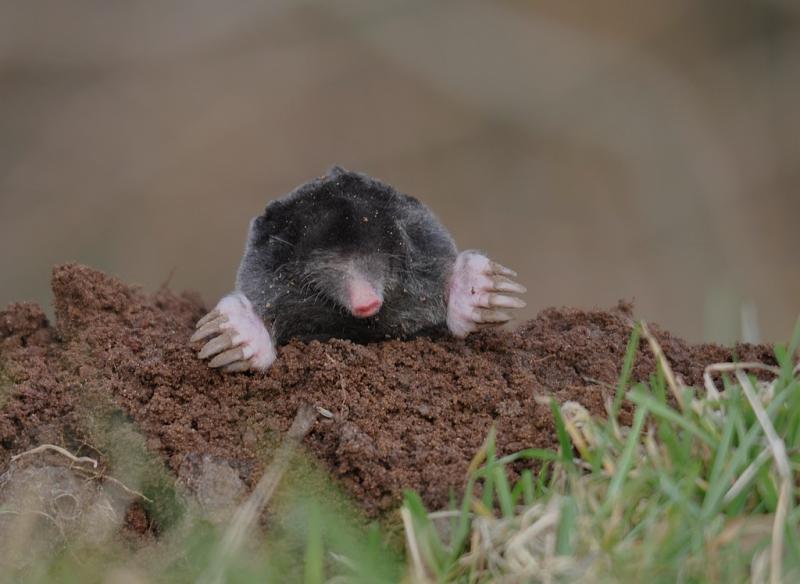
The mole is unmistakable thanks to its large digging paws. It has a dark, soft velvety fur and a flesh-coloured snout. Eyes and neck have undergone significant regression. Very often, their only tracks are the characteristic semi-spherical molehills at the entrances to their galleries.
Features
Mole
Talpa europaea
digging paws
molehills (mounds of earth)
In the city
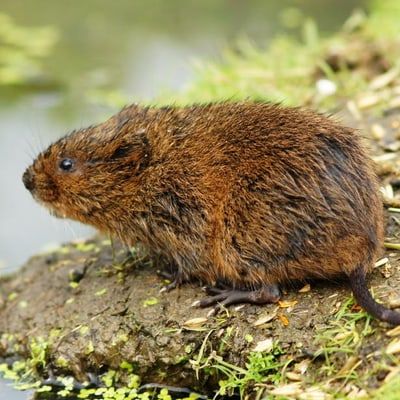
Moles can be found in green spaces with soil that is not too dry. There they can dig their subterranean galleries without disturbance.
Molehills are often perceived as disruptive or untidy. However, moles are protected and must not be caught, injured or killed.
Fun Facts
Moles are solitary animals.
Moles are adapted to underground life. Their little eyes are hidden in the fur and their outer ear is missing.
Moles find their way around with the aid of numerous sensitive whiskers. They are mainly located at the tips of their snouts.
Moles feed mainly on insects and earthworms. Occasionally, they may eat lizards or small rodents.
Because of their high metabolic rate, they need to feed every few hours. To that end, they create underground food depots for the winter.
- Endangerment level Germany: not endangered
Sources
Habitus , Michael David Hill, CC BY-SA 3.0, https://commons.wikimedia.org/wiki/File:Close-up_of_mole.jpg

Bau, Karelj, Gemeinfrei, https://commons.wikimedia.org/wiki/File:Krtek1.jpg

Habitus , Dieder Plu, CC BY-SA 3.0, https://commons.wikimedia.org/wiki/File:Mol_4.jpg

Page „Europäischer Maulwurf“. : Wikipedia, The Free Encyclopedia. Date of last revision: 01.04.2016, 10:42 UTC. URL: https://de.wikipedia.org/w/index.php?title=Europ%C3%A4ischer_Maulwurf&oldid=153067369 (Accessed: 09.05.2016).
Mex, T. (n.d.) Die Wühlmäuse, URL: https://www.wuehlmausbekaempfung.info/ (Accessed: 09.05.2016).
NABU – Naturschutzbund Deutschland e.V. (n.d.) Leben im Untergrund. Beim Maulwurf zu Besuch, URL: https://www.nabu.de/tiere-und-pflanzen/saeugetiere/sonstige-saeugetiere/maulwurf/03204.html (Accessed: 09.05.2016).
Haupt, H., Ludwig, G., Gruttke, H., Binot-Hafke, M., Otto C. & Pauly, A. (2009) Rote Liste gefährdeter Tiere, Pflanzen und Pilze Deutschlands. volume 1: Wirbeltiere, Bonn-Bad Godesberg: Bundesamt für Naturschutz.
Klawitter, J., Altenkamp, R., Kallasch, C., Köhler, D., Krauß, M., Rosenau, S. & Teige, T. (2005) Rote Liste und Gesamtartenliste der Säugetiere (Mammalia) von Berlin. : Der Landesbeauftragte für Naturschutz und Landschaftspflege / Senatsverwaltung für Stadtentwicklung (eds.) Rote Listen der gefährdeten Pflanzen und Tiere von Berlin, URL: https://www.berlin.de/sen/uvk/natur-und-gruen/naturschutz/artenschutz/artenlisten-rote-listen/saeugetiere/ (Accessed: 30.03.2021).