
Short Description
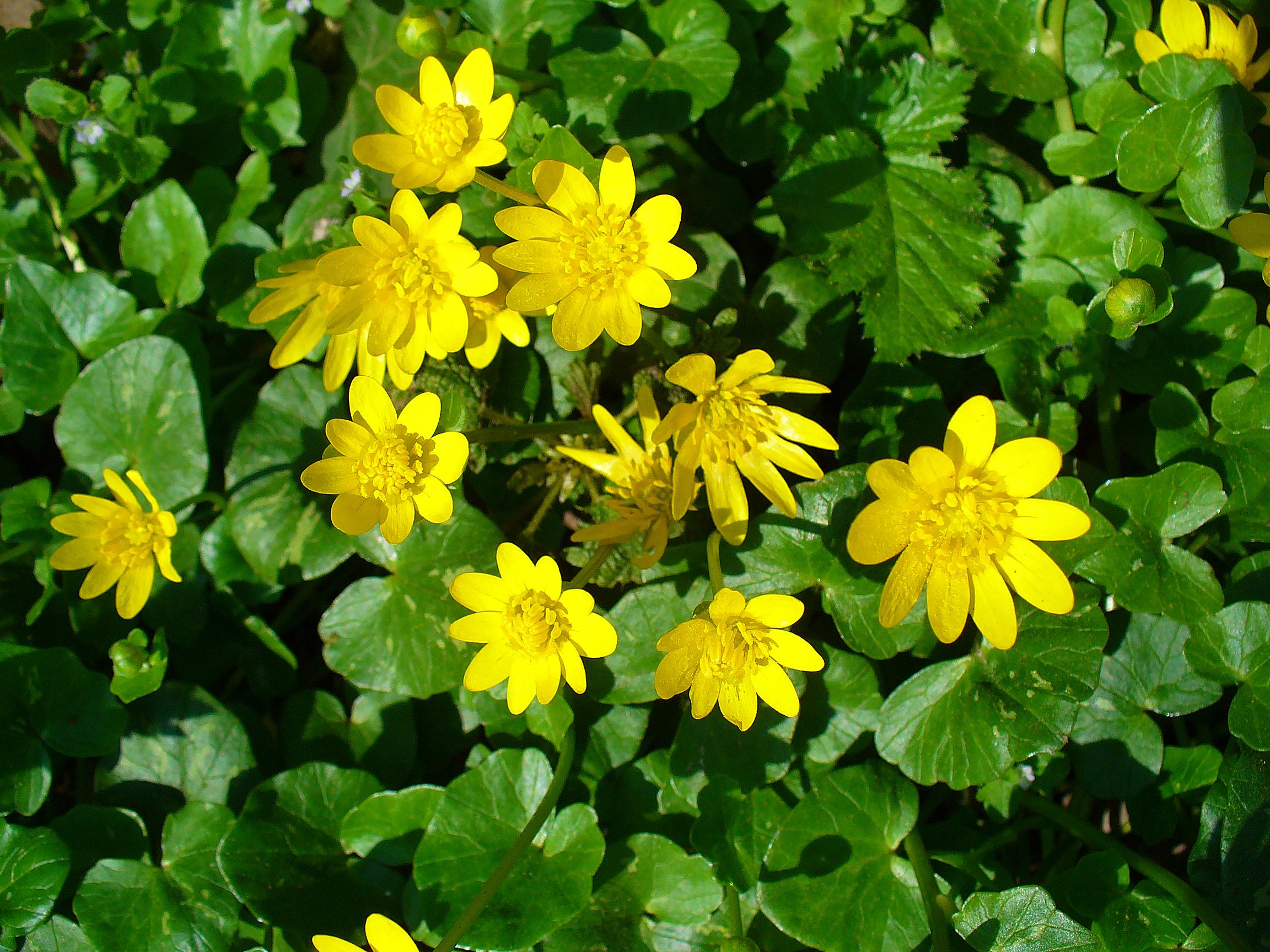
Lesser celandine can grow to a height of 20 cm.
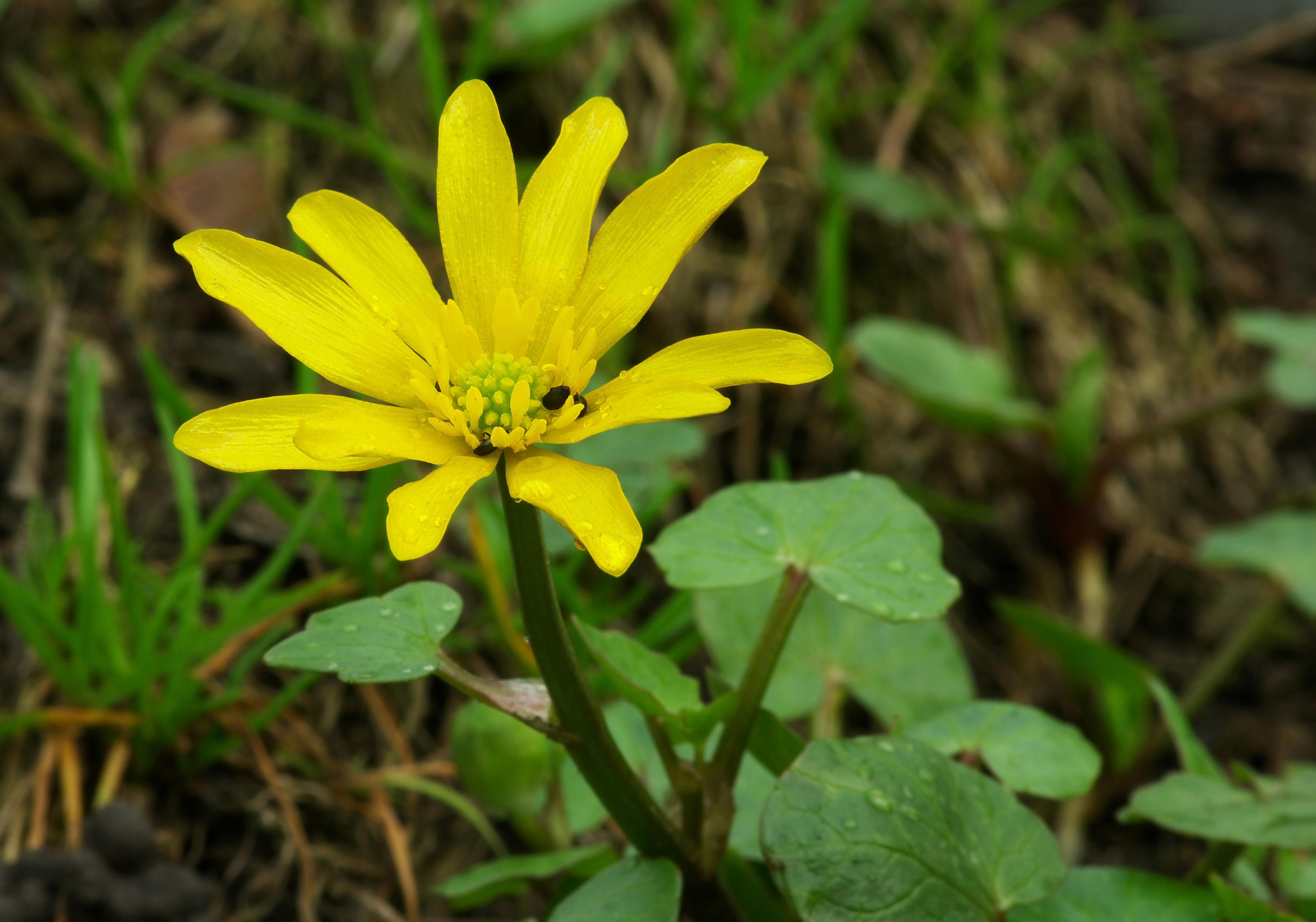
The leaves are round to heart-shaped, with a glossy surface and bluntly serrated margins. They grow alternately on the stem.
The stem is erect to prostrate, hollow and often rooting at the nodes.
The flowers are yellow with numerous stamens at the centre.
Mericarps are arranged in a star pattern and form a globular fruit head.
Features
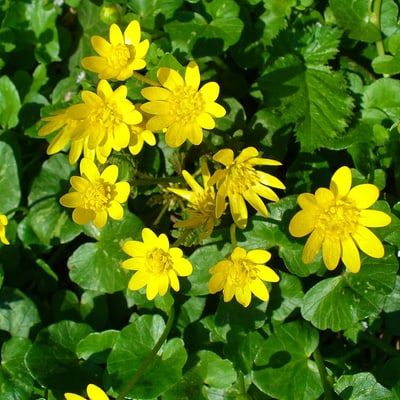
Lesser celandine
Ficaria verna
poisonous
roundish leaves
yellow flowers with numerous stamens
In the city
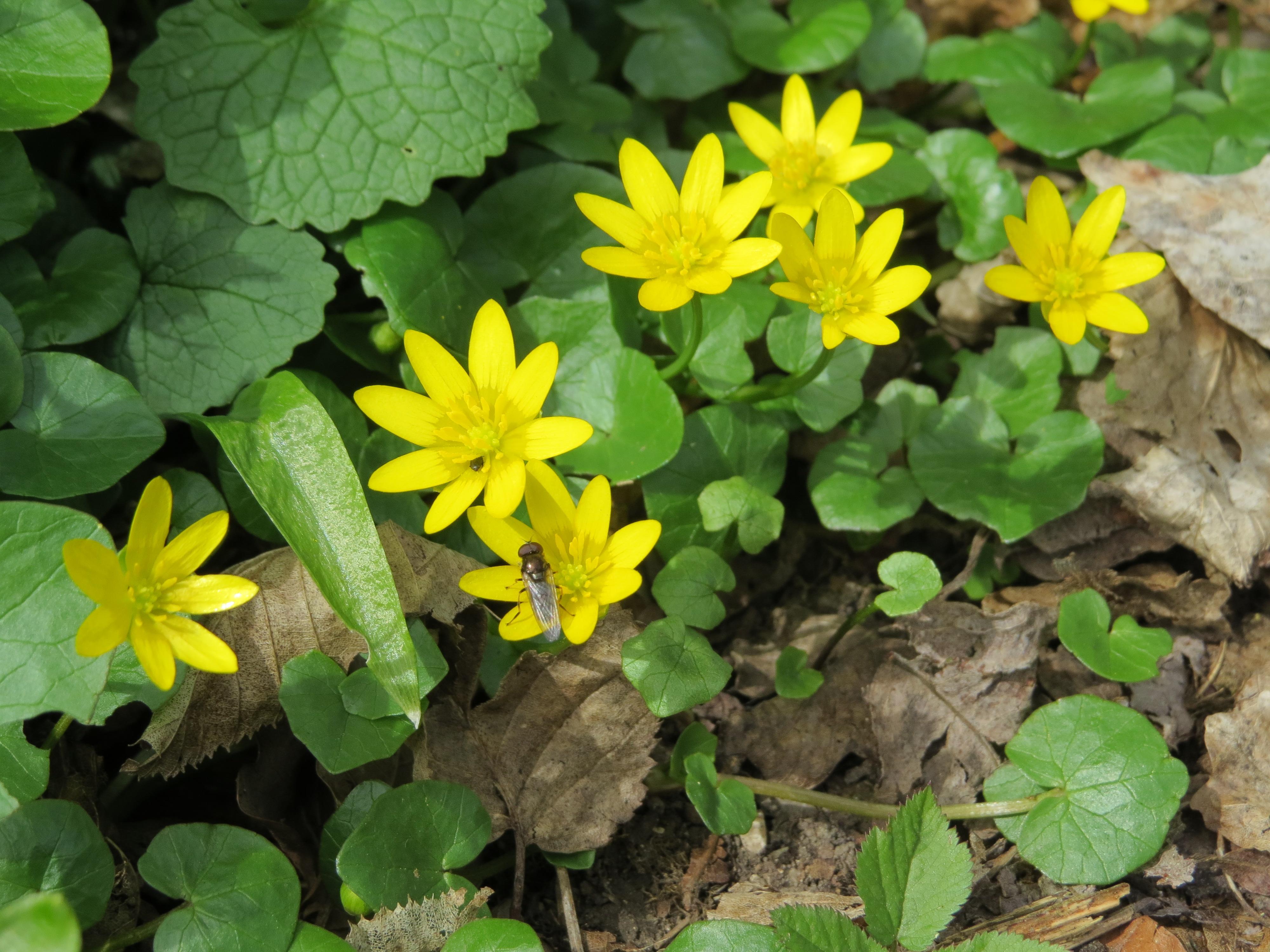
Lesser celandine is often found in urban deciduous woods and shrubberies. It prefers moderately moist to moist sites.
Fun Facts
Lesser celandine used to be part of the provisions for sailors, as it contains a lot of vitamin C and was a good way to prevent scurvy.
The German vernacular Scharbockskraut ("scurvy herb") derives from this use.
It flowers from March to May.
It lives for several years and generally flowers and fruits annually (perennial plant).
The flowers are pollinated by insects.
- Endangerment level Germany: not endangered
All parts of the plant are poisonous. However, the toxin content prior to flowering is said to be very low so that the plant is edible at that point.
Sources
Habitus, H. Zell, CC BY-SA 3.0, https://commons.wikimedia.org/wiki/File:Ficaria_verna_002.JPG

Habitus, GT1976, CC BY-SA 4.0, https://commons.wikimedia.org/wiki/File:2018-04-09_(102)_Brachycera_on_Ficaria_verna_(lesser_celandine)_at_Bichlh%C3%A4usl_at_Haltgraben_in_Frankenfels.jpg
_Brachycera_on_Ficaria_verna_(lesser_celandine)_at_Bichlh%C3%A4usl_at_Haltgraben_in_Frankenfels.jpg)
Blüte, Kruczy89, CC BY-SA 3.0, https://commons.wikimedia.org/wiki/File:Ficaria_verna_01.jpg

Eggenberg, S. & Möhl, A. (2007) Flora Vegetativa: Ein Bestimmungsbuch für Pflanzen der Schweiz im blütenlosen Zustand, Bern, Stuttgart, Wien: Haupt Verlag.
Spohn, M., Golte-Bechtle, M. & Spohn, R. (2015) Was blüht denn da? Stuttgart: Franckh Kosmos Verlag.
Jäger, E. J. (2011) Rothmaler - Exkursionsflora von Deutschland. Gefäßpflanzen: Grundband, Heidelberg: Spektrum Akademischer Verlag.
Kammer, P. M. (2016) Pflanzen einfach bestimmen. Schritt für Schritt einheimische Arten kennenlernen, Bern: Haupt Verlag.
Lippert, W. & Podlech, D. (1993) GU Naturführer. Blumen: die wichtigen Blütenpflanzen Mitteleuropas erkennen und bestimmen, München: Gräfe und Unzer Verlag.
Schauer, T., Caspari, C. & Caspari, S. (2015) Der illustrierte BLV-Pflanzenführer für unterwegs. 1150 Blumen, Gräser, Bäume und Sträucher, München: BLV.
Page „Scharbockskraut“. : Wikipedia, The Free Encyclopedia. Date of last revision: 06.02.2017, 15:26 UTC. URL: https://de.wikipedia.org/w/index.php?title=Scharbockskraut&oldid=162378208 (Accessed: 17.02.2017).
Bundesamt für Naturschutz (n.d.) Artensteckbriefe, URL: http://floraweb.de/pflanzenarten/artenhome.xsql?suchnr=21893& (Accessed: 17.02.2017).