
Short Description
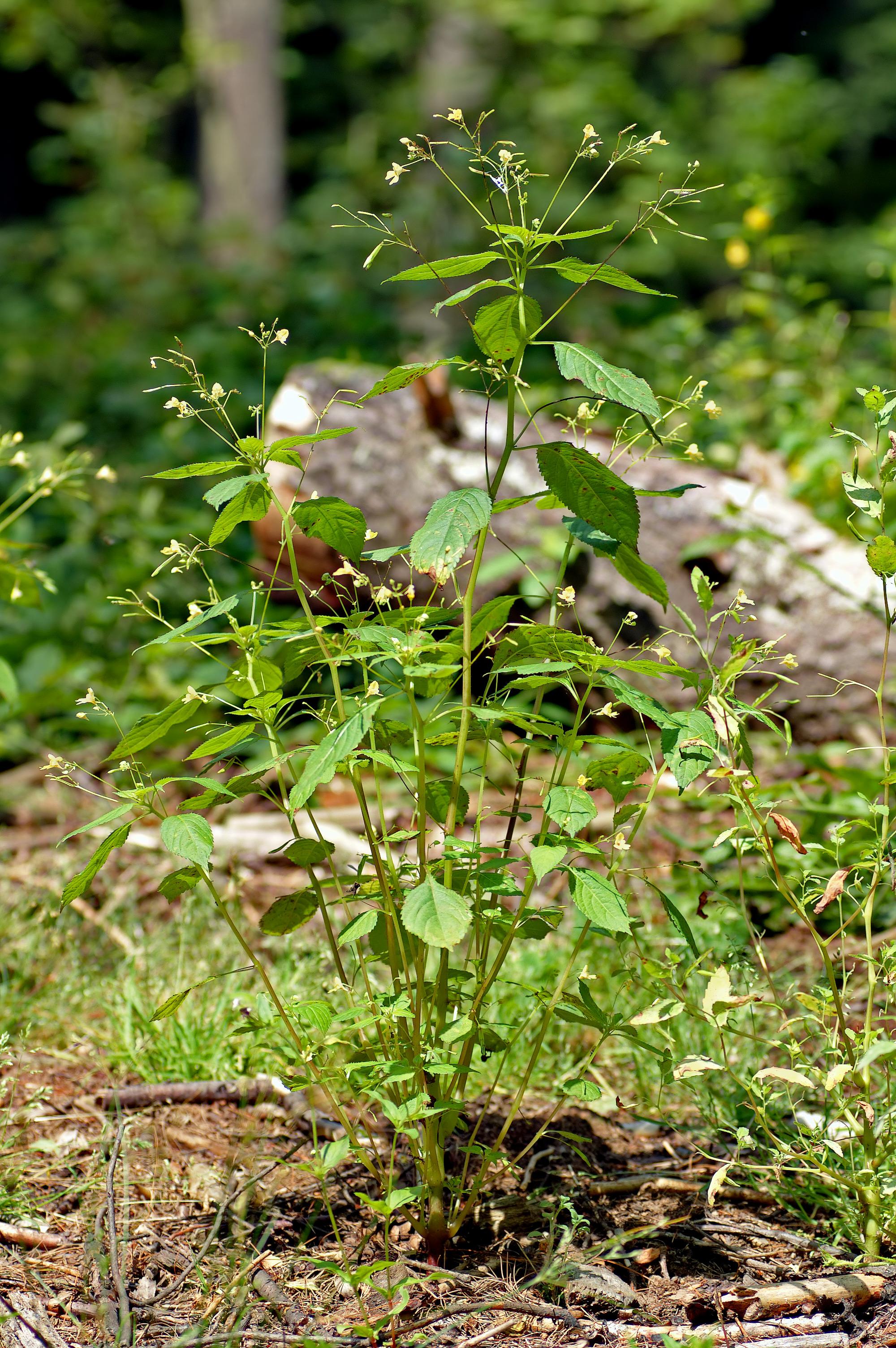
Small balsam can grow to a height of one metre.
The leaves grow alternately on the stem. They are oval to elongated (ovo-lanceolate) and sharply serrated.
The stem is highly branched, reddish and glassy translucent. It is thickened at the nodes.
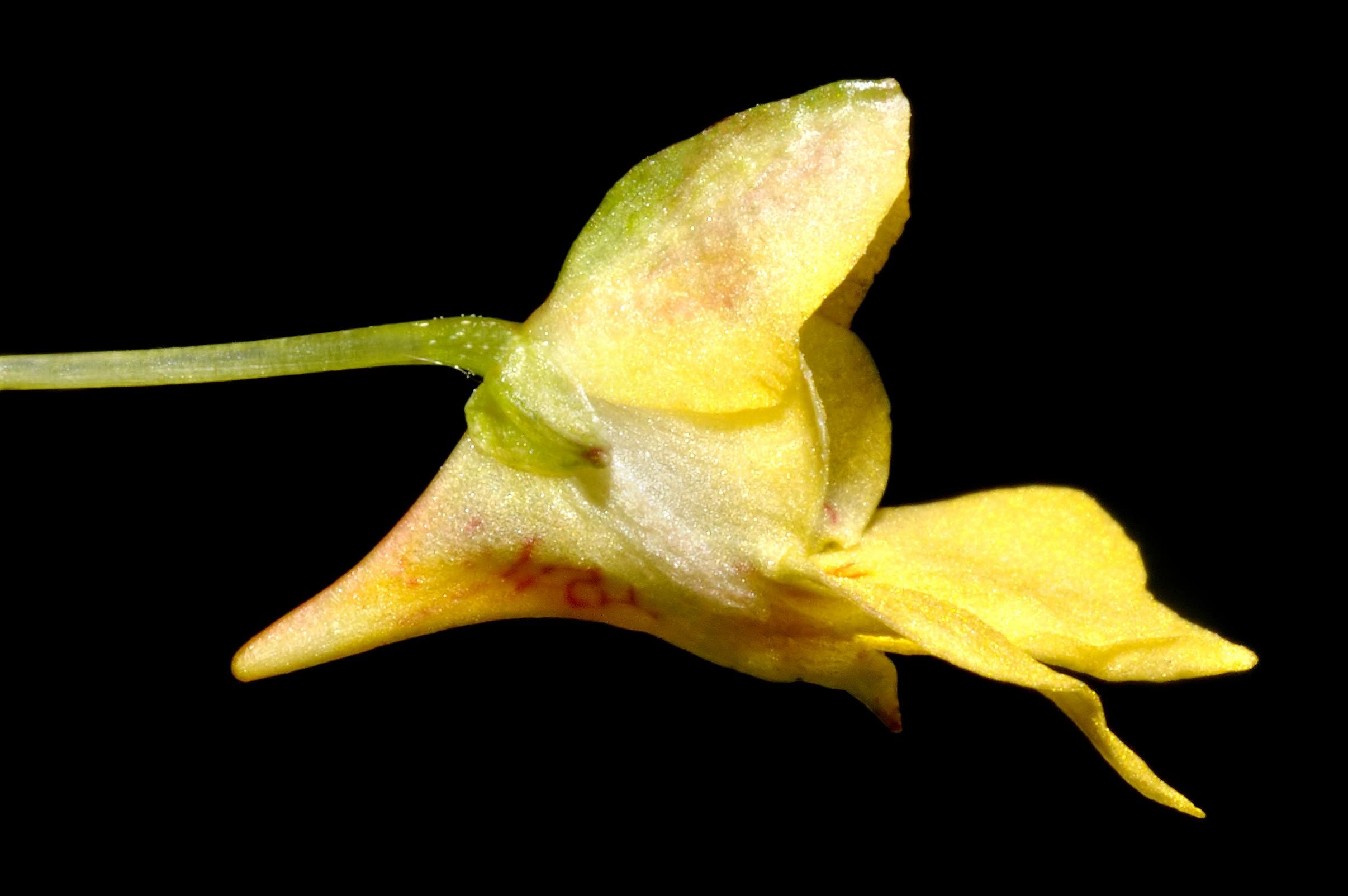
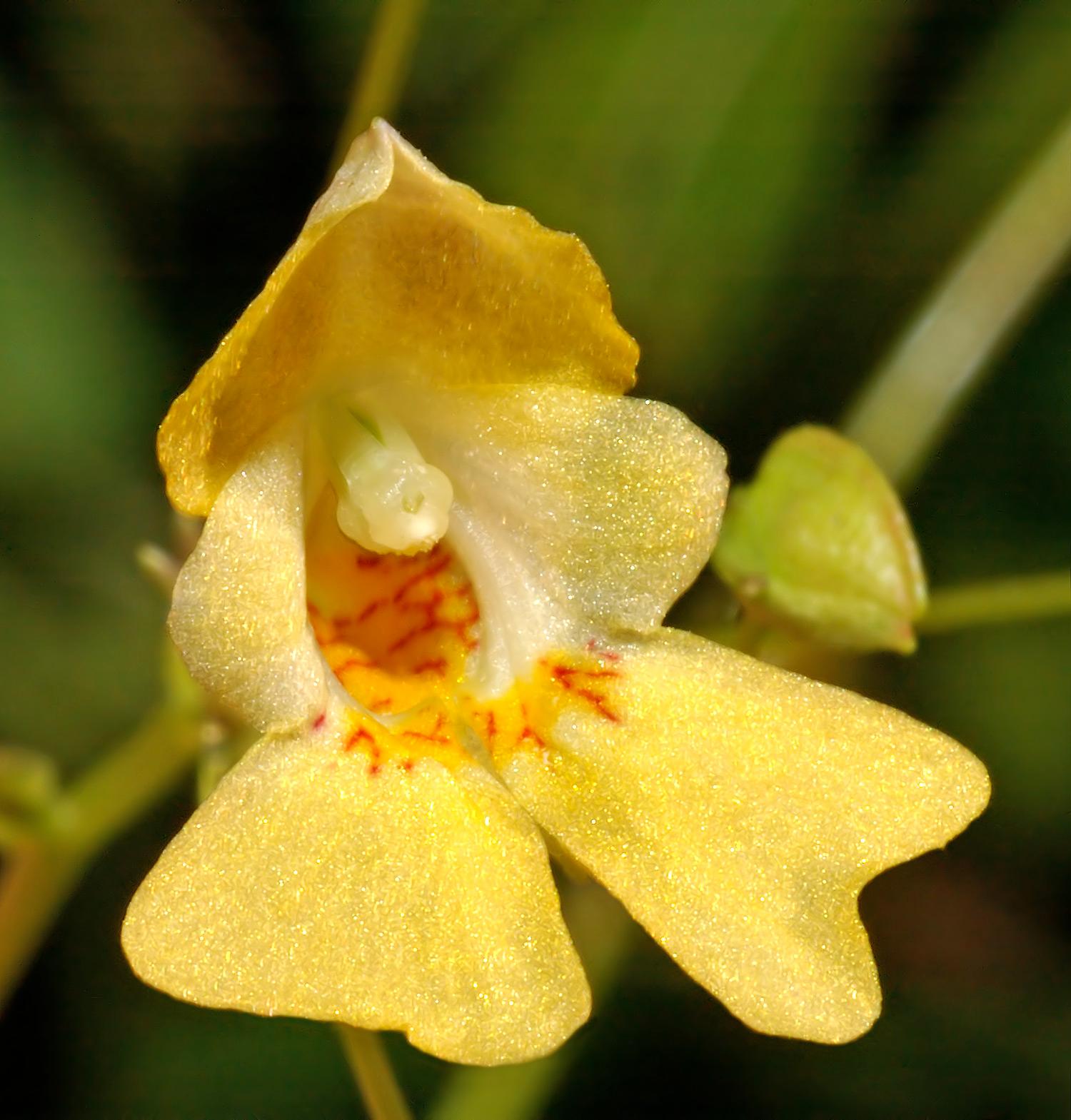
The flowers are yellow to whitish and are clustered in large panicles. They are helmet-shaped and mirror-symmetric (zygomorphic). They have a flower funnel (figworts) with a detailed red pattern and a small straight spur.
The fruits are oblong capsules that burst open when the fruit is ripe and eject the seeds (dehiscent).
Features
Small balsam
Impatiens parviflora
yellow flowers with a spur
dehiscent fruit capsule
In the city
In the city, the common balsam is common. It occurs in parks, along roadsides, in gardens and on fallow land. It prefers fresh to moist and shady locations with soils that are poor in lime and rich in nutrients.
Fun Facts
In some places, common balm is regarded as an invasive neophyte and combated. However, scientists disagree as to whether it actually constitutes a hazard to native plants.
It flowers from June to October.
The scientific genus name “impatiens" (i.e. impatient, sensitive) refers to the fruit of the plant that burst open at the slightest touch.
It is an annual plant. This means that the plant lives for one year, flowers and dies after the seeds have ripened.
- Endangerment level Germany: not evaluated
Common balsam was introduced from Asia in the early 19th century. It quickly spread across large areas of Central Europe. It belongs to the non-native plants (neophytes).
Sources
Habitus, André Karwath aka Aka, CC BY-SA 2.5, https://commons.wikimedia.org/wiki/File:Impatiens_parviflora_-_plant_(aka).jpg
.jpg)
Blüte, André Karwath, CC BY-SA 2.5, https://commons.wikimedia.org/wiki/File:Impatiens_parviflora_-_blossom_side_(aka).jpg
.jpg)
Blüte, André Karwath, CC BY-SA 2.5, https://commons.wikimedia.org/wiki/File:Impatiens_parviflora_-_blossom_front_(aka).jpg
.jpg)
Eggenberg, S. & Möhl, A. (2007) Flora Vegetativa: Ein Bestimmungsbuch für Pflanzen der Schweiz im blütenlosen Zustand, Bern, Stuttgart, Wien: Haupt Verlag.
Spohn, M., Golte-Bechtle, M. & Spohn, R. (2015) Was blüht denn da? Stuttgart: Franckh Kosmos Verlag.
Jäger, E. J. (2011) Rothmaler - Exkursionsflora von Deutschland. Gefäßpflanzen: Grundband, Heidelberg: Spektrum Akademischer Verlag.
Kammer, P. M. (2016) Pflanzen einfach bestimmen. Schritt für Schritt einheimische Arten kennenlernen, Bern: Haupt Verlag.
Schauer, T., Caspari, C. & Caspari, S. (2015) Der illustrierte BLV-Pflanzenführer für unterwegs. 1150 Blumen, Gräser, Bäume und Sträucher, München: BLV.
Page „Kleines Springkraut“. : Wikipedia, The Free Encyclopedia. Date of last revision: 05.01.2017, 22:00 UTC. URL: https://de.wikipedia.org/w/index.php?title=Kleines_Springkraut&oldid=161334518 (Accessed: 21.03.2017).
Bundesamt für Naturschutz (n.d.) Artensteckbriefe, URL: http://floraweb.de/pflanzenarten/artenhome.xsql?suchnr=3065& (Accessed: 21.03.2017).