
Short Description
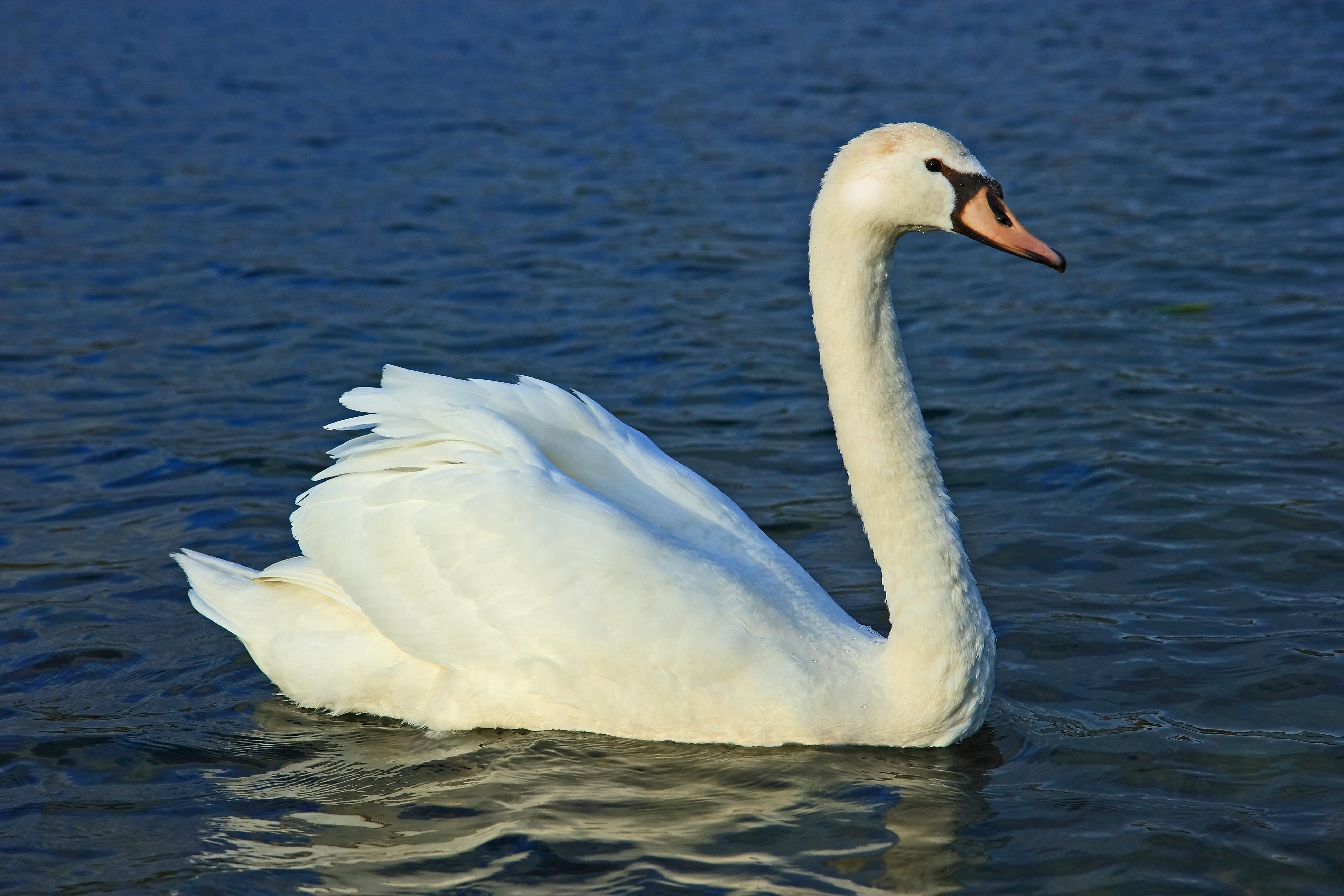
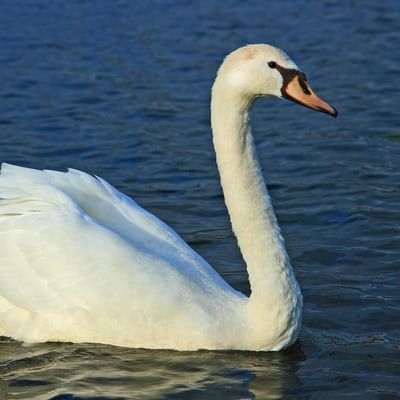
The large, pure white mute swan with its long curved neck is an imposing waterfowl. Its characteristic bill is orange-red with a black knob.
Features
Mute swan
Cygnus olor
curved neck
black knob on top of its bill
Rufe und Fluggeräusch
Frommolt (CC BY-SA 3.0)

Similar species
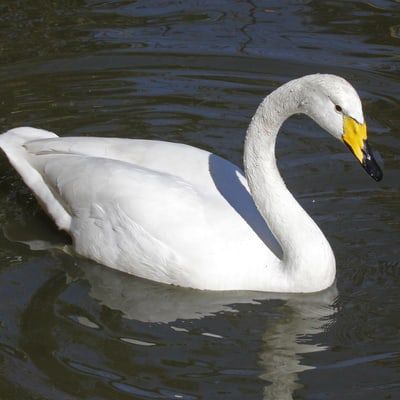
Whooper swan
Cygnus cygnus
In the city
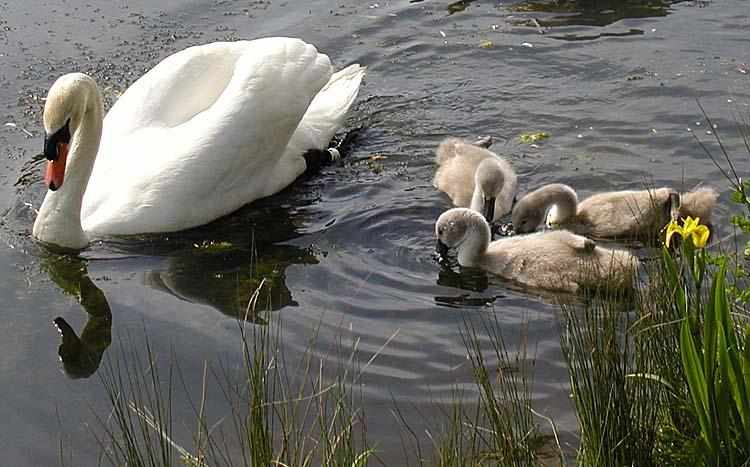
Mute swans have often been settled on lakes in parks.
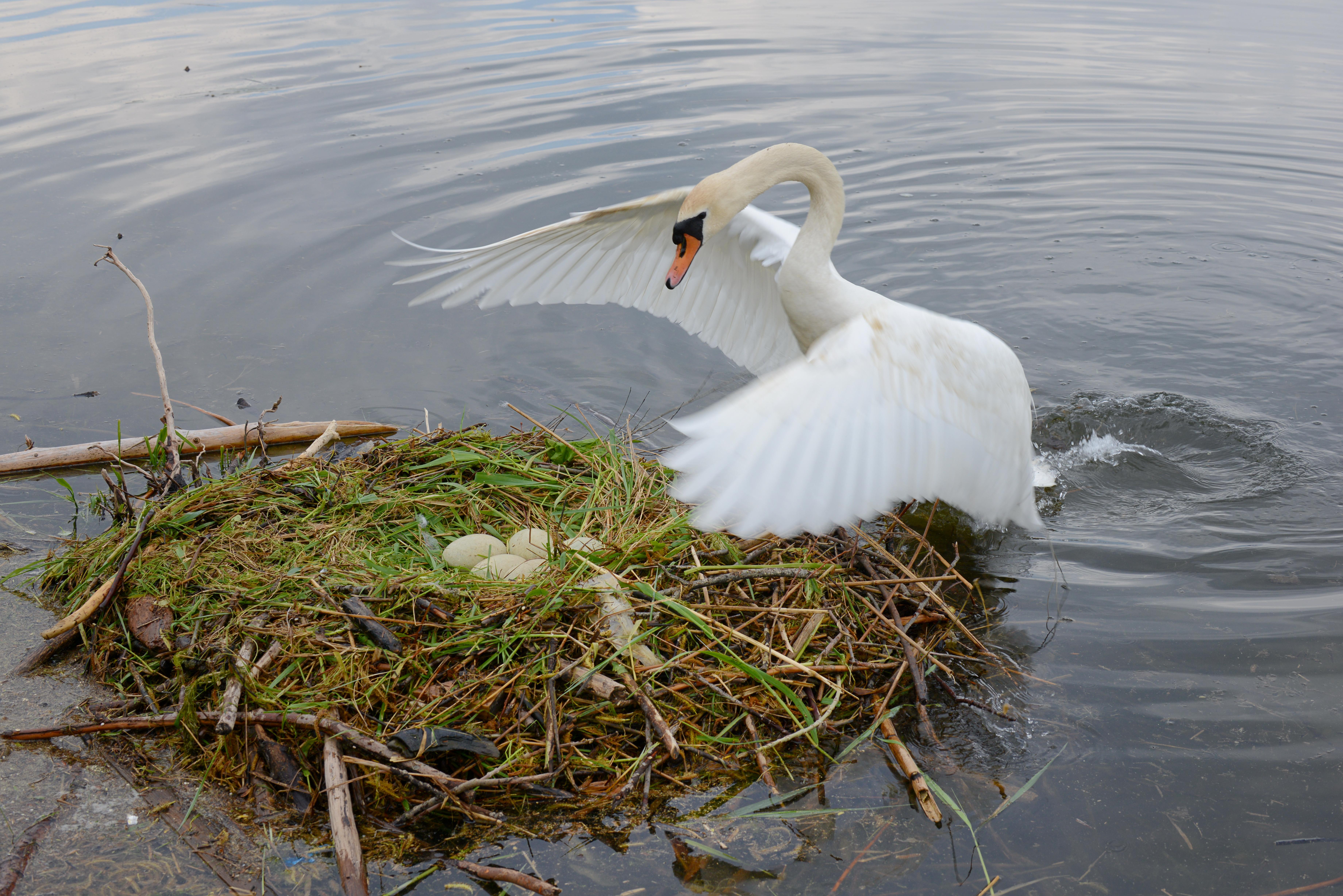
When threatened, they rear up with their wings extended and hiss.
Fun Facts
Together with the great bustard, mute swans are the heaviest birds in Germany capable of flight.
Feeding wild fowl with bread or similar poses a great risk to animals and water. For that reason, feeding the animals is strictly forbidden.
Because of their long neck and pure white plumage, swans are regarded as particularly graceful animals. They have thus found a place in numerous fairy tales and myths.
In medieval Europe, keeping swans on open waters was a royal prerogative.
Mute swans can be seen in Germany all year round.
- Endangerment level Germany: not endangered
Sources
Habitus , Sanchezn, CC BY-SA 3.0, https://commons.wikimedia.org/wiki/File:CygneVaires.jpg

Elterntier mit Küken, Adrian Pingstone, gemeinfrei, https://commons.wikimedia.org/wiki/File:Mute.swan.cygnets.750pix.jpg

Elterntier am Nest, Böhringer Friedrich, CC BY-SA 3.0, https://commons.wikimedia.org/wiki/File:Cygnus_olor,_nests_with_eggs,_H%C3%B6ckerschwan_mit_Nest_4.JPG

Witt, K. & Steiof, K. (2013) Rote Liste und Liste der Brutvögel von Berlin, 3. version, 15.11.2013. : Berliner Ornithologische Arbeitsgemeinschaft e.V. (eds.) Berliner Ornithologischer Bericht, volume 23, Berlin: Berliner Ornithologische Arbeitsgemeinschaft e.V., 1-23.
Page „Höckerschwan“. : Wikipedia, The Free Encyclopedia. Date of last revision: 20.12.2015, 20:55 UTC. URL: https://de.wikipedia.org/w/index.php?title=H%C3%B6ckerschwan&oldid=149253717 (Accessed: 11.02.2016).
Fiedler, W. (2015) Die Vögel Mitteleuropas sicher bestimmen - Schlüssel zur Art-, Alters- und Geschlechtsbestimmung, Wiebelsheim: Quelle & Meyer Verlag.
Makatsch, W. (1989) Wir bestimmen die Vögel Europas, Leipzig: Neumann Verlag.
Voigt, A. (2006) Exkursionsbuch zum Studium der Vogelstimmen, Heidelberg: Quelle & Meyer Verlag.
Svensson, L. (2011) Der Kosmos Vogelführer - Alle Arten Europas, Nordafrikas und Vorderasiens, Stuttgart: Franckh Kosmos Verlag.
Harrison, C. (1975) Jungvögel, Eier und Nester aller Vögel Europas, Nordafrikas und des Mittleren Ostens - Ein Naturführer zur Fortpflanzungsbiologie, Hamburg und Berlin: Verlag Paul Parey.
Artenfinder (2016) Cygnus olor (Höckerschwan), URL: https://arteninfo.net/elearning/voegel/speciesportrait/2879 (Accessed: 19.04.2016).
Weitzel, C. (n.d.) Wissenswertes über den Höckerschwan, URL: http://www.schwanenschutz-komitee.de/wissenswertes-%C3%BCber-den-h%C3%B6ckerschwan/ (Accessed: 11.02.2021).