
Short Description
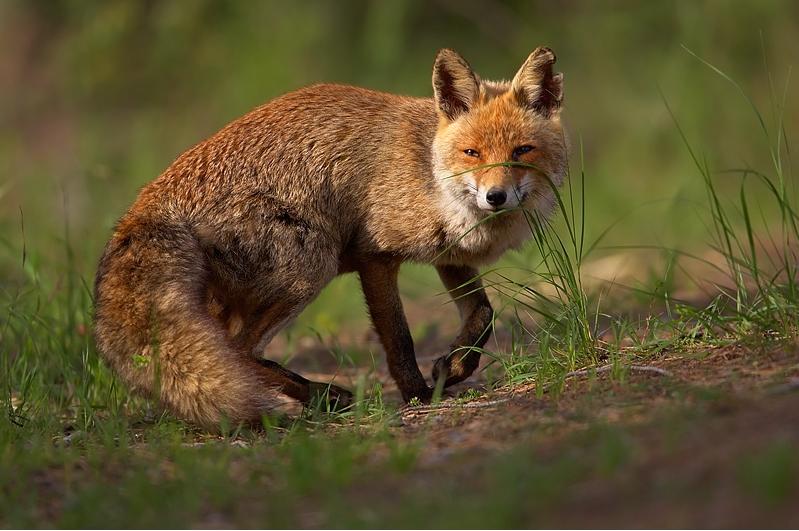
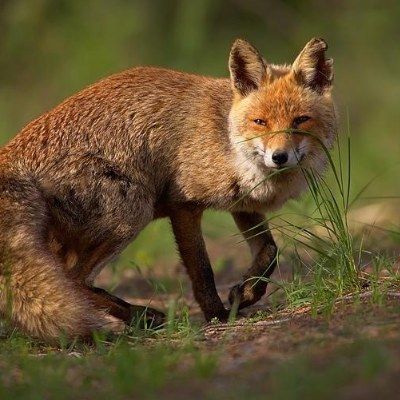
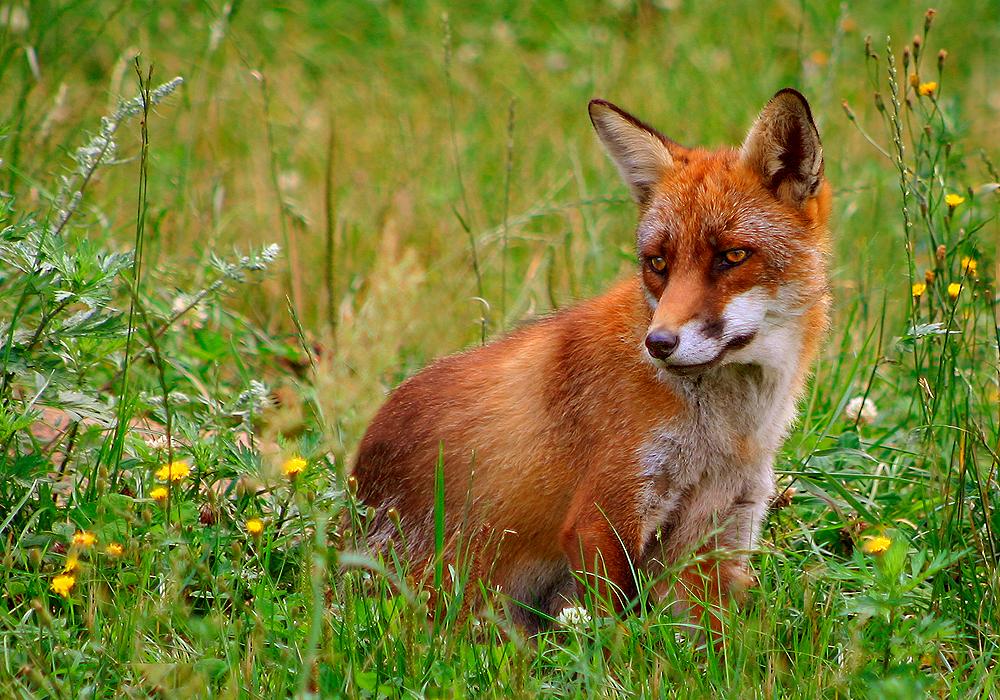
The fur of the red fox is generally reddish-rusty in colour. Throat, chest and belly are paler, almost white. However, the fur can also be pale- to dark-grey with a light underside. Its bushy tail generally has a white tip. Its oval paw prints are generally aligned in a row, like pearls on a string. The four toe pads and the long, thin, pointed claws can be easily distinguished.
Features
Red fox
Vulpes vulpes
bushy tail, generally with a white tip
Laute während der Ranzzeit
Gnensch, CC BY-SA 3.0

Similar species

Cat
Felis catus
Wolf
Canis lupus
In the city
Increasing numbers of red foxes live in towns. With their gardens, parks, cemeteries and railway tracks, towns offer many richly structured areas and places to retreat. Close to human habitation, it is protected from being hunted and also has access to a plentiful food supply. As a result, five times more foxes per square kilometre live in Berlin than in the same area in a forest.
Fun Facts
The fox is the most widely distributed predatory animal. Foxes can live north of the Polar circle as well as in near-tropical regions.
Foxes produce around 40 different sounds, some of which reminiscent of hoarse shouts or dogs barking.
Foxes hunt earthworms.
In addition to rabies (Lyssa virus), foxes are also carriers of the fox tapeworm (Echinococcus multilocularis). For that reason, it is recommended to wash windfall fruit and wild herbs picked close to the ground prior to consumption and to avoid contact with dead animals.
Foxes and badgers sometimes raise their young in the same burrow.
In the city, foxes and domestic cats often meet, but in most cases they pay little attention to each other. In case of conflict, the fox usually flees.
- Endangerment level Germany: not endangered
Sources
Habitus, Martin Mecnarowski, CC BY-SA 3.0, https://commons.wikimedia.org/wiki/File:Vulpes_vulpes_1_%28Martin_Mecnarowski%29.jpg
.jpg)
Jungtier, Hans-Jörg Hellwig, CC BY-SA 3.0, https://commons.wikimedia.org/wiki/File:Co-sfuw-08-022.jpg

Habitus, Malene, CC BY-SA 2.5, https://commons.wikimedia.org/wiki/File:R%C3%B8d_r%C3%A6v_(Vulpes_vulpes).jpg
.jpg)
Leibniz-Institut für Zoo- und Wildtierforschung (n.d.) Rotfuchs, URL: http://www.izw-berlin.de/rotfuchs.html (Accessed: 06.05.2016).
Page „Rotfuchs“. : Wikipedia, The Free Encyclopedia. Date of last revision: 08.04.2016, 09:05 UTC. URL: https://de.wikipedia.org/w/index.php?title=Rotfuchs&oldid=153282196 (Accessed: 06.05.2016).
Landesforstamt Berlin (n.d.) Fuchs, URL: http://www.stadtentwicklung.berlin.de/forsten/wildtiere/de/fuchs.shtml (Accessed: 29.05.2016).
Wildtierportal Baden-Württemberg (n.d.) Steckbrief Fuchs, URL: http://wildtiere-stadt.wildtiere-bw.de/tierarten/fuchs_in_baden-wuerttemberg/steckbrief.html (Accessed: 29.05.2016).
Frommhold, D. (n.d.) 4.1 Allgemeines über Stadtfüchse, URL: http://fuechse.info/index.php?navTarget=faq/41_stadtfuechse.html (Accessed: 29.05.2016).
Grand-Duché de Luxembourg Région wallonne (2007) Spuren/Trittsiegel erkennen. Spurensucherschulung: Europa LIFE, URL: http://www.loutres.be/IMG/pdf/Spurensucherschulung.pdf (Accessed: 01.12.2016).
Haupt, H., Ludwig, G., Gruttke, H., Binot-Hafke, M., Otto C. & Pauly, A. (2009) Rote Liste gefährdeter Tiere, Pflanzen und Pilze Deutschlands. volume 1: Wirbeltiere, Bonn-Bad Godesberg: Bundesamt für Naturschutz.
Klawitter, J., Altenkamp, R., Kallasch, C., Köhler, D., Krauß, M., Rosenau, S. & Teige, T. (2005) Rote Liste und Gesamtartenliste der Säugetiere (Mammalia) von Berlin. : Der Landesbeauftragte für Naturschutz und Landschaftspflege / Senatsverwaltung für Stadtentwicklung (eds.) Rote Listen der gefährdeten Pflanzen und Tiere von Berlin, URL: https://www.berlin.de/sen/uvk/natur-und-gruen/naturschutz/artenschutz/artenlisten-rote-listen/saeugetiere/ (Accessed: 30.03.2021).
Boye, P. (1993) Heimische Säugetiere. Ein Bestimmungsschlüssel für die in der Bundesrepublik Deutschland wildlebenden Säugetiere, ausser den Ordnungen Robben, Paarhufer und Wale, Hamburg: Deutscher Jugendbund für Naturbeobachtungen.