
Short Description
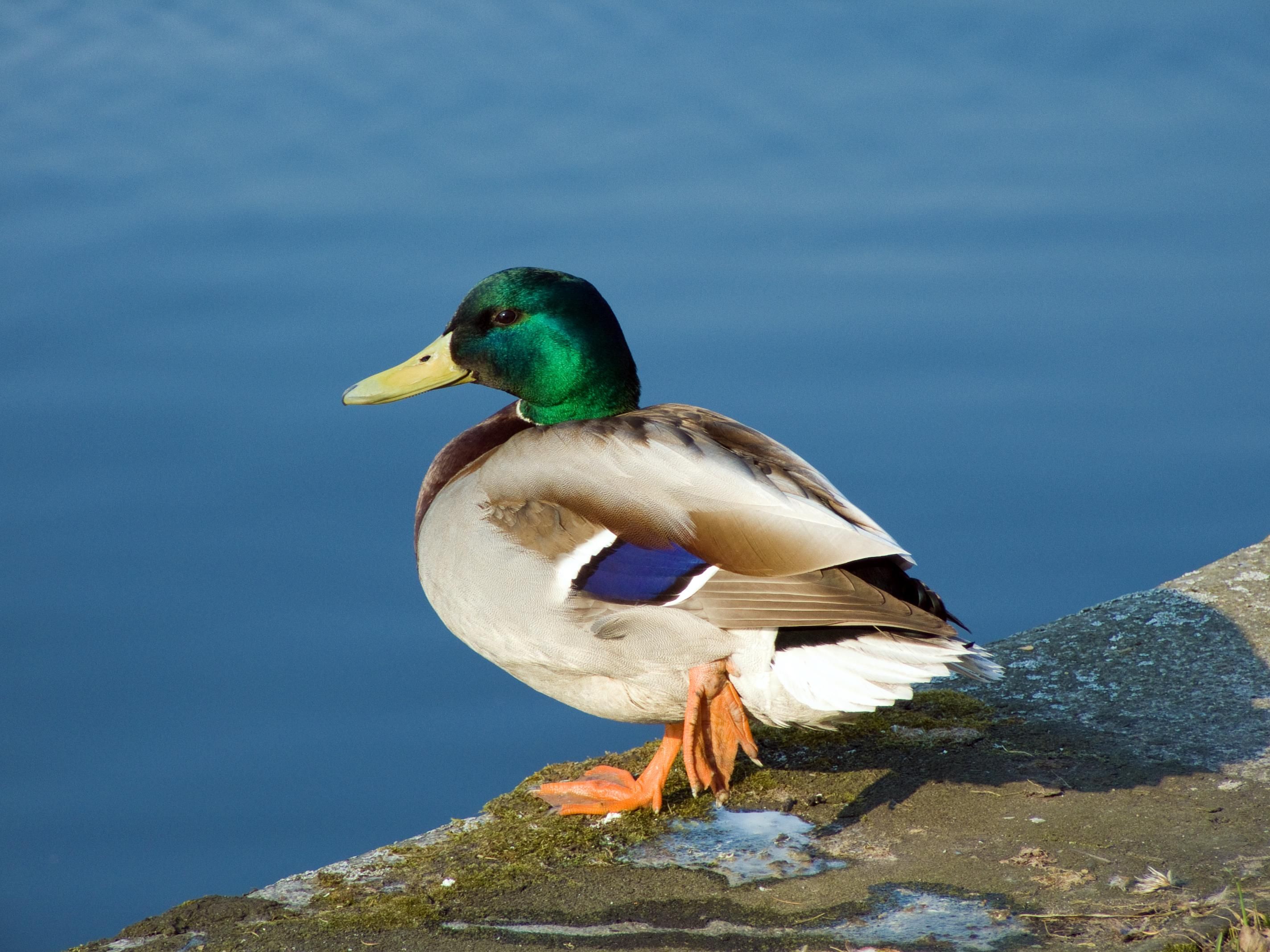
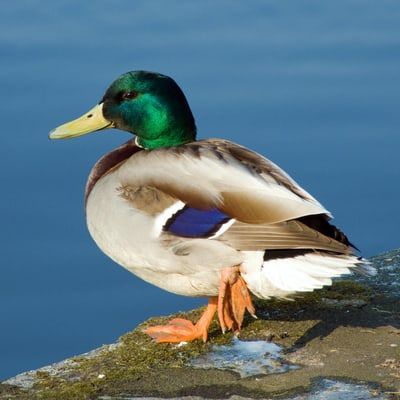
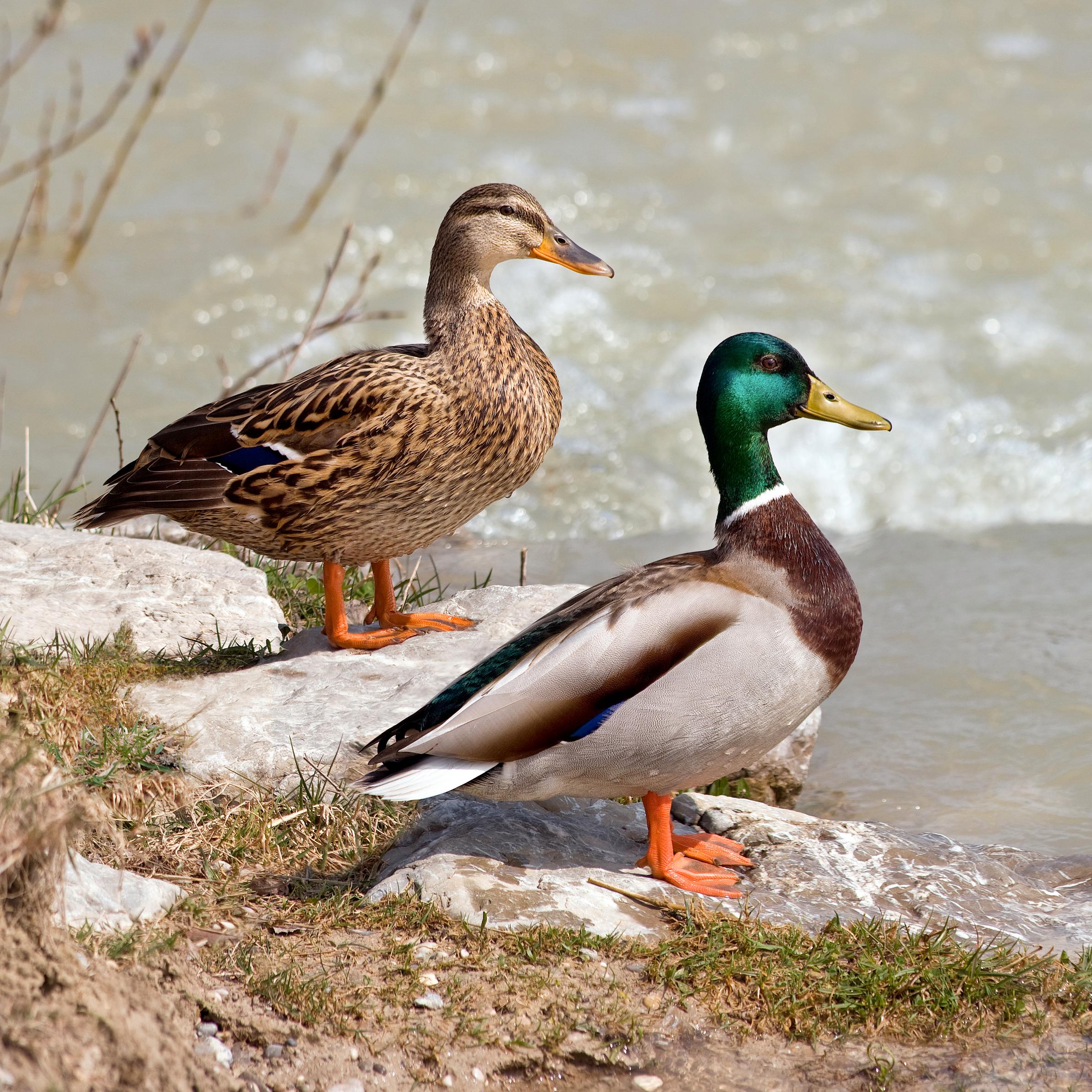
Mallards can be recognised by the metallic dark-blue, white-bordered bar on their wings. In their basic plumage, males (drakes) and females are inconspicuously light-brown with dark-brown patches and orange webbed feet.
In their nuptial plumage, drakes can be recognised by their metallic black-green heads and necks with a white collar; the body is pale grey and brown. In their basic plumage, they can be recognised by their uniformly yellow bill.
Females have a brown bill.
Features
Mallard
Anas platyrhynchos
dark-blue metallic wing bar
males during the breeding season with a metallic-green head
mehrere Weibchen: Lange Lautfolgen
Tembrock (CC BY-SA 3.0)

Similar species
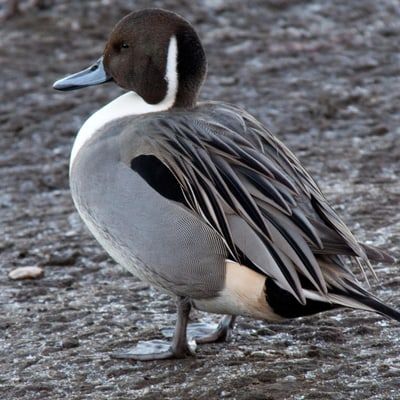
Northern pintail
Anas acuta
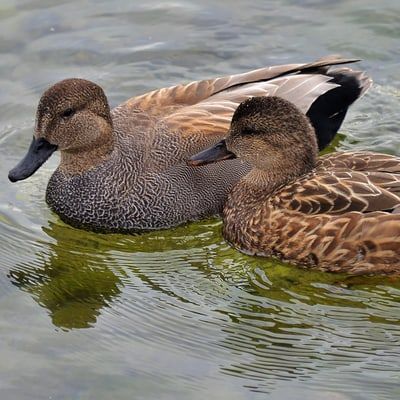
Gadwall
Mareca strepera
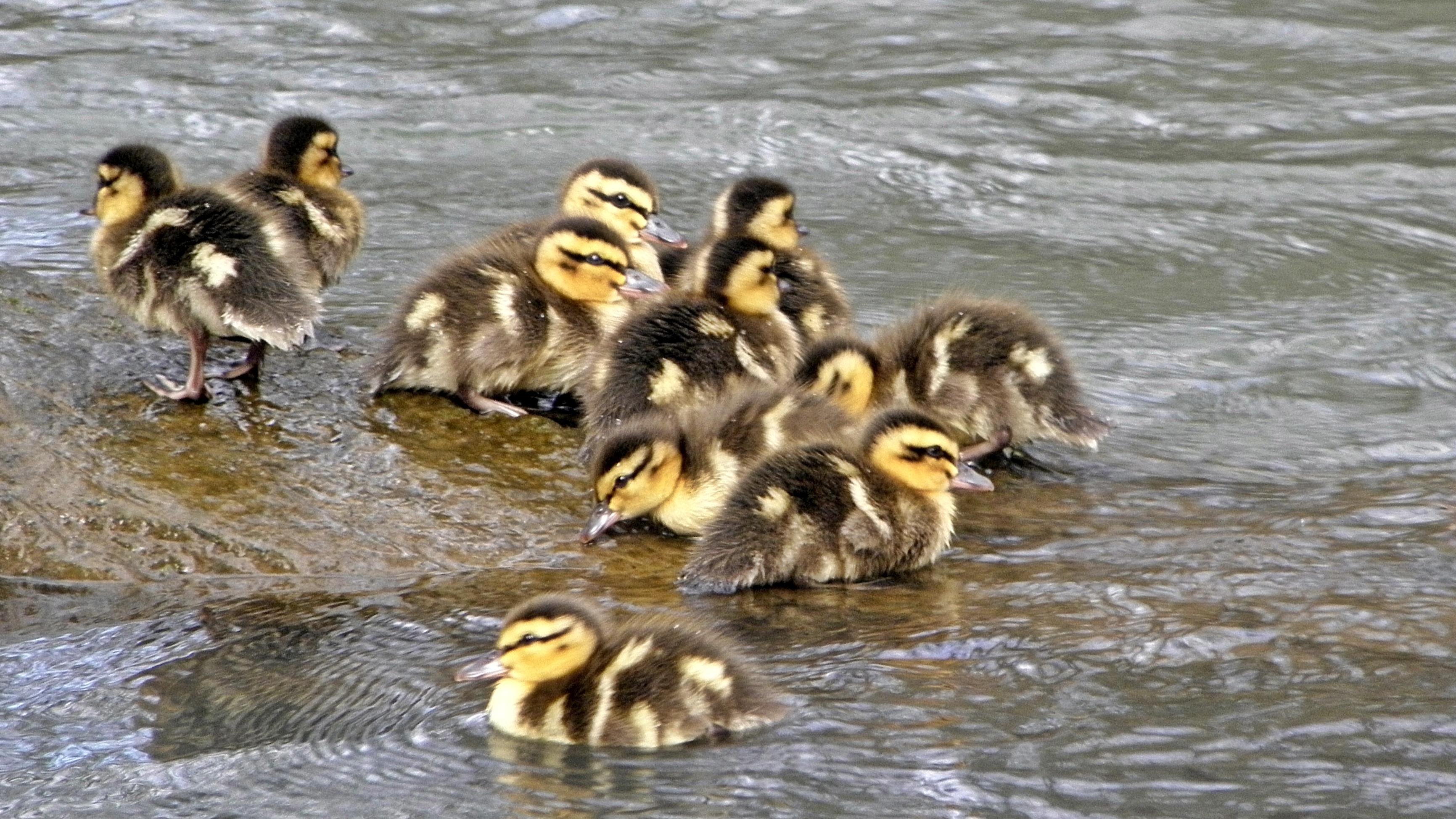
In the city
In an urban environment, mallards are often seen on waters such as ponds, rivers or even artificial water features. Sometimes, they build their nests on balconies, flat roofs or sheds. In urban settings, mallards often tend to hibernate and not migrate south.
They are generally quite tame and come quite close to humans, especially in public parks.
Fun Facts
Mallards are the most common and most tame duck species in central Europe.
Mallards are the parent form of domestic ducks that are bred in a wide range of colour and phenotype variations.
Feeding wild fowl with bread or similar poses a great risk to animals and water. For that reason, feeding is forbidden.
In urban areas, mallards can generally be observed all year round. Some mallards migrate to southern Europe or Africa in September and return to Germany in the middle of March.
- Endangerment level Germany: not endangered
Sources
Männchen, ViseMoD, CC BY-SA 3.0, https://commons.wikimedia.org/wiki/File:Male_mallard_standing.jpg

Jungtier, HomeinSalem, CC BY-SA 3.0, https://commons.wikimedia.org/wiki/File:Duck_-_Mallard_(Anas_platyrhynchos)_-_Chicks_7_(cr).JPG
_-_Chicks_7_(cr).JPG)
Paar, Richard Bartz, CC BY-SA 2.5, https://commons.wikimedia.org/wiki/File:Anas_platyrhynchos_male_female_quadrat.jpg

Svensson, L. (2011) Der Kosmos Vogelführer - Alle Arten Europas, Nordafrikas und Vorderasiens, Stuttgart: Franckh Kosmos Verlag.
Harrison, C. (1975) Jungvögel, Eier und Nester aller Vögel Europas, Nordafrikas und des Mittleren Ostens - Ein Naturführer zur Fortpflanzungsbiologie, Hamburg und Berlin: Verlag Paul Parey.
Bejcek, V. (1988) Zugvögel, Hanau/Main: Verlag Werner Dausien.
Witt, K. & Steiof, K. (2013) Rote Liste und Liste der Brutvögel von Berlin, 3. version, 15.11.2013. : Berliner Ornithologische Arbeitsgemeinschaft e.V. (eds.) Berliner Ornithologischer Bericht, volume 23, Berlin: Berliner Ornithologische Arbeitsgemeinschaft e.V., 1-23.
Page „Stockente“. : Wikipedia, The Free Encyclopedia. Date of last revision: 09.11.2015, 15:18 UTC. URL: https://de.wikipedia.org/w/index.php?title=Stockente&oldid=147870139 (Accessed: 17.02.2016).
Artenfinder (2016) Anas platyrhynchos (Stockente), URL: https://arteninfo.net/elearning/voegel/speciesportrait/2848 (Accessed: 15.04.2016).
NABU Landesverband Berlin (n.d.) Was tun wenn, URL: https://berlin.nabu.de/tiere-und-pflanzen/was-tun-wenn/13076.html (Accessed: 16.09.2016).