
Short Description
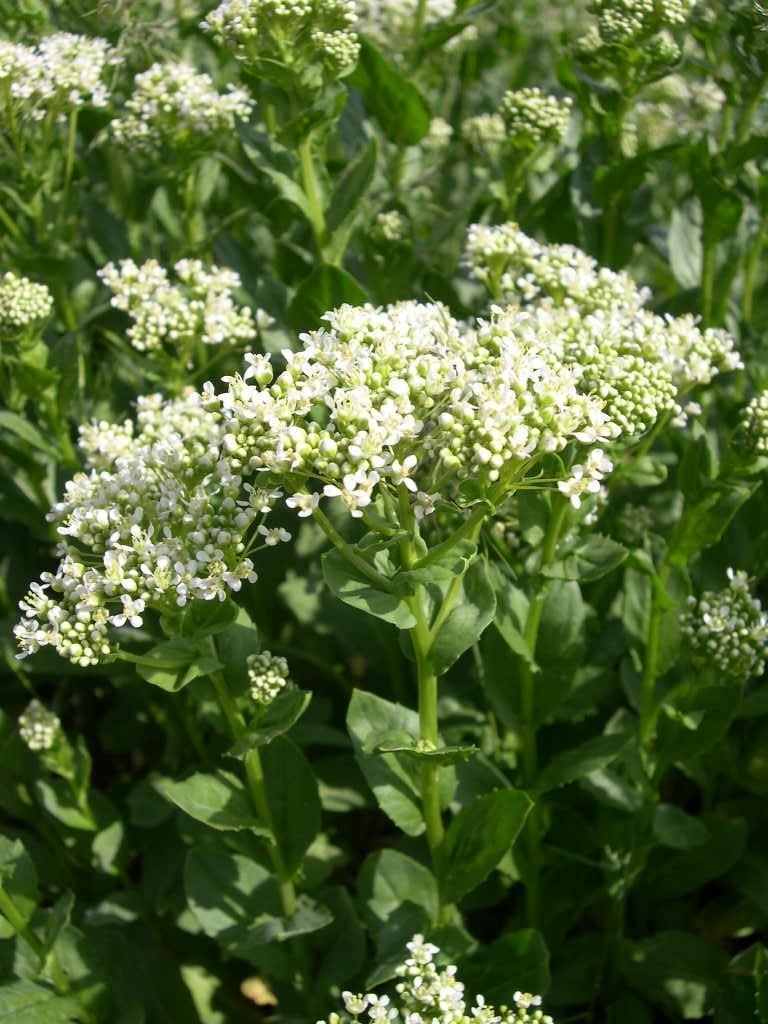
The heart-podded hoary cress can grow over half a metre tall.
At the base of the plant are elongated-ovate, partly toothed and more or less densely hairy stem leaves. The upper leaves have a heart- to arrow-shaped base and enclose the stem.
The stem usually grows upright and vigorous. It is grey-haired at the base, glabrous above and richly branched in the inflorescence area.
The white flowers are relatively small and grow in dense racemes.
The fruits are small, heart-shaped pods.
Features
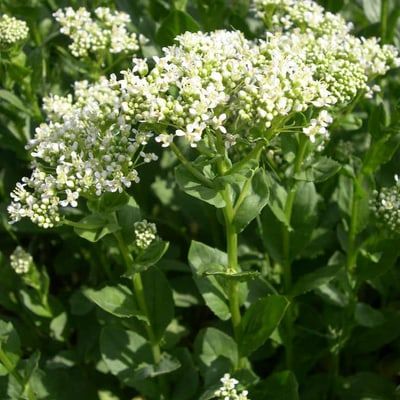
Heart-podded hoary cress
Lepidium draba
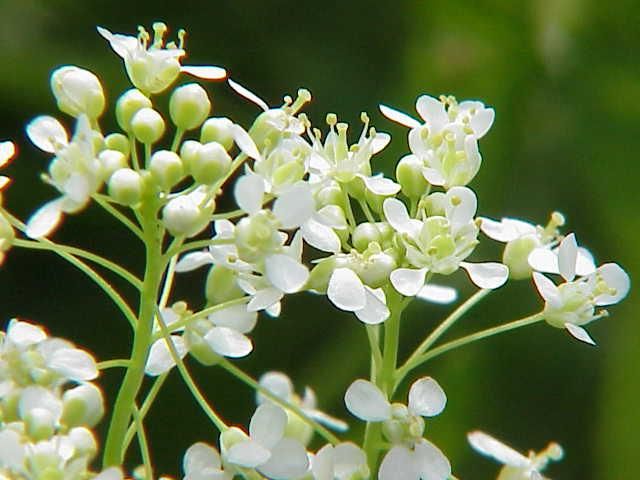
white flowers in dense racemes
small, heart-shaped pods
In the city
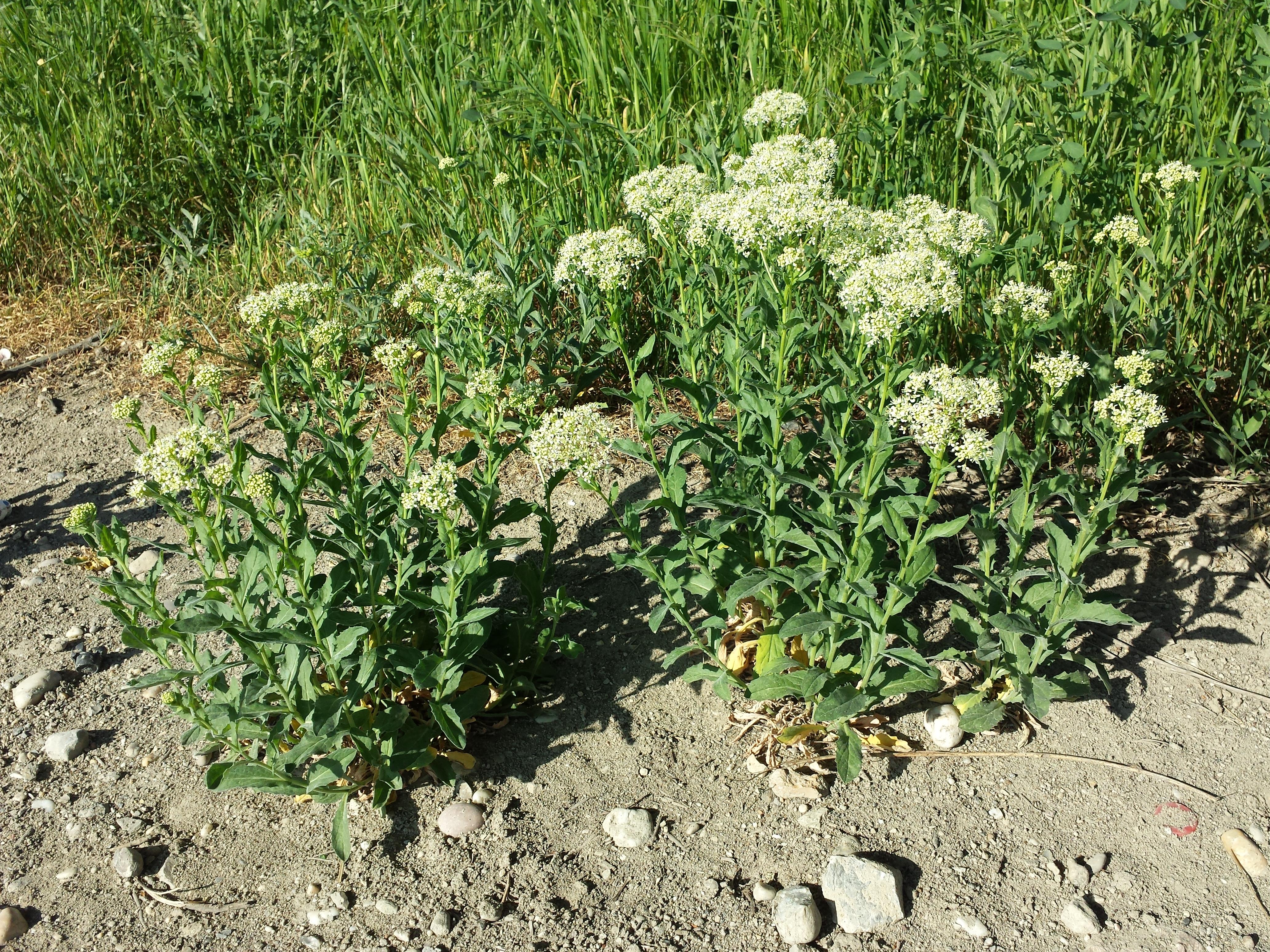
Heart-podded hoary cress grows along paths and embankments as well as on vineyards and rubble. It also often grows along railway tracks, as its fruits are carried away by the air draft of the trains.
It has an extensive and widely branching root system and is therefore occasionally sown to stabilise newly created embankments.
Fun Facts
It lives for several years and generally flowers and fruits annually (perennial plant).
It flowers from May to July.
- Endangerment level Germany: not evaluated
It is not native to Germany and has been naturalised. It is therefore called a neophyte.
The seeds contain mustard seed oil, which makes them taste pungent. In the past, they were used as a seasoning instead of pepper.
Sources
Habitus, Thayne Tuason, CC BY-SA 4.0, https://commons.wikimedia.org/wiki/File:Cardaria_draba-5-01-05.jpg

Blütenstand, Sony Mavica, CC BY-SA 3.0, https://commons.wikimedia.org/wiki/File:Cardaria_draba0.jpg

Habitus, Stefan.lefnaer, CC BY-SA 4.0, https://commons.wikimedia.org/wiki/File:Lepidium_draba_(subsp._draba)_sl5.jpg
_sl5.jpg)
Bundesamt für Naturschutz (n.d.) Artensteckbriefe, URL: http://floraweb.de/pflanzenarten/artenhome.xsql?suchnr=22436& (Accessed: 13.08.2018).
Seitz, B., Ristow, M., Meißner, J., Machatzi, B. & Sukopp, H. (2018) Rote Liste und Gesamtartenliste der etablierten Farn- und Blütenpflanzen von Berlin. : Der Landesbeauftragte für Naturschutz und Landschaftspflege / Senatsverwaltung für Umwelt, Klima und Verkehr (eds.) Rote Listen der gefährdeten Pflanzen, Pilze und Tiere von Berlin, URL: https://www.berlin.de/sen/uvk/natur-und-gruen/naturschutz/artenschutz/artenlisten-rote-listen/farn-und-bluetenpflanzen/ (Accessed: 26.03.2021).
Schauer, T., Caspari, C. & Caspari, S. (2015) Der illustrierte BLV-Pflanzenführer für unterwegs. 1150 Blumen, Gräser, Bäume und Sträucher, München: BLV.