
Short Description
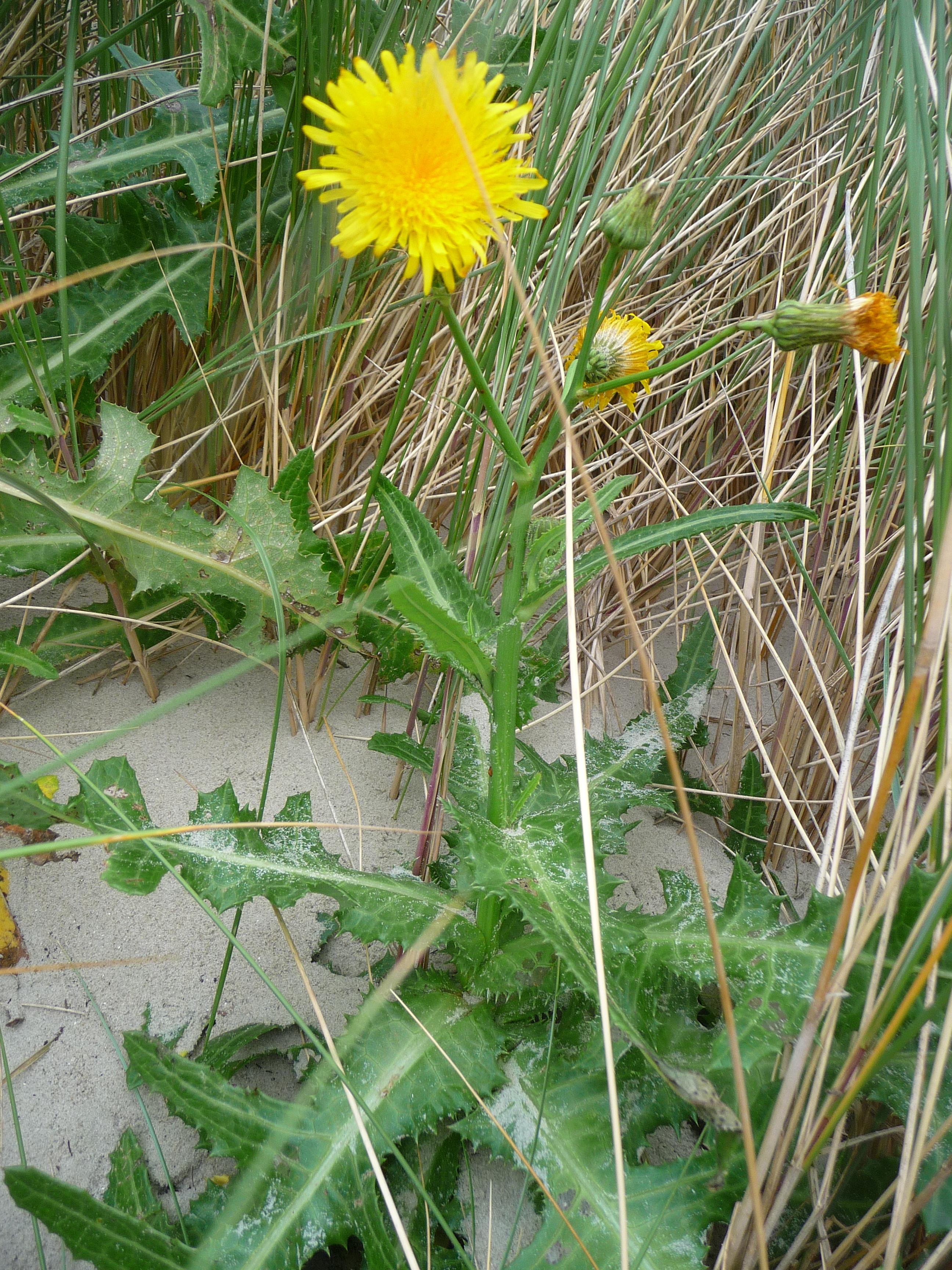
The field milk thistle can grow up to one and a half meters high.
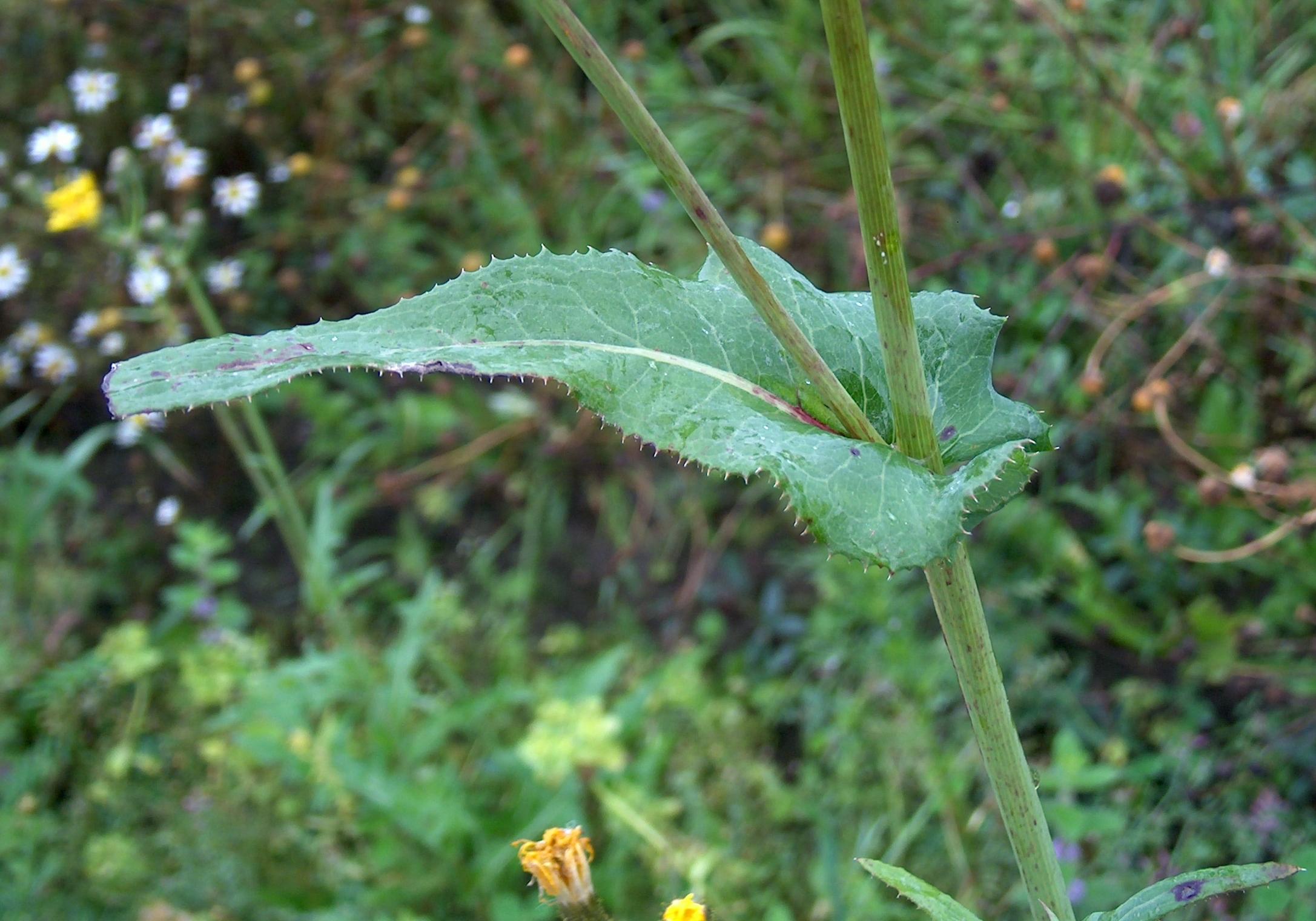
The leaves are glossy green on top. The underside is lighter green. The leaf blade is coarse-saw shaped, the leaf margin is incised to varying depths and has spiny serrations.
The stem is hollow and contains whitish milky juice.
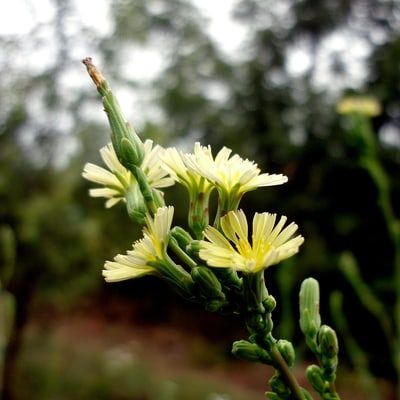
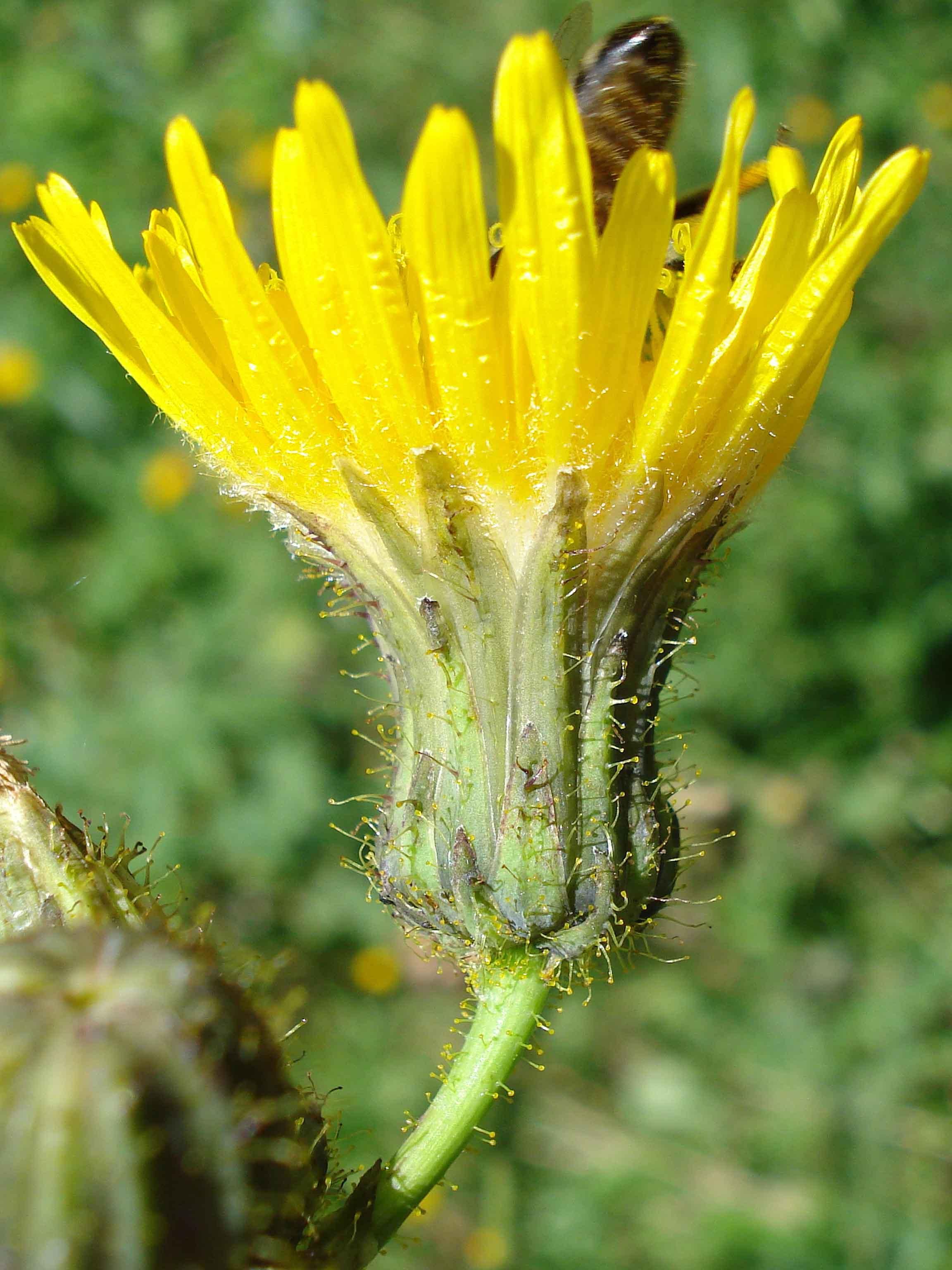
At first glance, the flower head can be mistaken for the flower itself. The pseudanthium (“false flower”) consists of numerous, single, golden-yellow ray florets.
The field milk thistle produces small, brown, ribbed and nut-like fruits (achenes) with a white ring of hairs (pappus).
Features
Field milk thistle
Sonchus arvensis
serrated leaf margins
In the city
The field milk thistle, as its name suggests, grows in fields. It can also be found on rubble sites, banks, roadsides and ditches. It prefers moist, nutrient-rich saddle places and also grows on saline soils.
It has one earth shoot. From fragments can grow new plants. Therefore, the plant is considered difficult to remove from the garden.
Fun Facts
The inflorescences open only in the morning in sunny weather. Already opened capitula in the evening can be recognized by the fact that they nod.
On sunny days, the leaves can face north and south with their surface perpendicular to the ground.
The perianths and pedicels have conspicuous yellow stalked glands. They serve as protection against evaporation and the rise of unwanted visitors.
The flowering period is from July to October.
- Endangerment level Germany: not endangered
Sources
Habitus, 4028mdk09, CC BY-SA 3.0 , https://commons.wikimedia.org/wiki/File:Bl%C3%BChende_Acker-G%C3%A4nsedistel.JPG

Blatt, Anneli Salo, CC BY-SA 3.0 , https://commons.wikimedia.org/wiki/File:Sonchus_arvensis_Peltovalvatti_C_H8939.jpg

Blütenstand, Fornax, CC BY-SA 3.0 , https://commons.wikimedia.org/wiki/File:Sonchus_arvensis_Unterfranken.jpg

Spohn, M., Golte-Bechtle, M. & Spohn, R. (2015) Was blüht denn da? Stuttgart: Franckh Kosmos Verlag.
Schauer, T., Caspari, C. & Caspari, S. (2015) Der illustrierte BLV-Pflanzenführer für unterwegs. 1150 Blumen, Gräser, Bäume und Sträucher, München: BLV.
Bundesamt für Naturschutz (n.d.) Artensteckbriefe, URL: http://floraweb.de/pflanzenarten/artenhome.xsql?suchnr=5687& (Accessed: 10.09.2018).
Kammer, P. M. (2016) Pflanzen einfach bestimmen. Schritt für Schritt einheimische Arten kennenlernen, Bern: Haupt Verlag.
Seitz, B., Ristow, M., Meißner, J., Machatzi, B. & Sukopp, H. (2018) Rote Liste und Gesamtartenliste der etablierten Farn- und Blütenpflanzen von Berlin. : Der Landesbeauftragte für Naturschutz und Landschaftspflege / Senatsverwaltung für Umwelt, Klima und Verkehr (eds.) Rote Listen der gefährdeten Pflanzen, Pilze und Tiere von Berlin, URL: https://www.berlin.de/sen/uvk/natur-und-gruen/naturschutz/artenschutz/artenlisten-rote-listen/farn-und-bluetenpflanzen/ (Accessed: 26.03.2021).
Page „Acker-Gänsedistel“. : Wikipedia, The Free Encyclopedia. Date of last revision: 08.04.2018, 09:00 UTC. URL: https://de.wikipedia.org/w/index.php?title=Acker-G%C3%A4nsedistel&oldid=176256919 (Accessed: 10.09.2018).