
Short Description
Field chickweed can reach heights of between five and 30 centimetres.
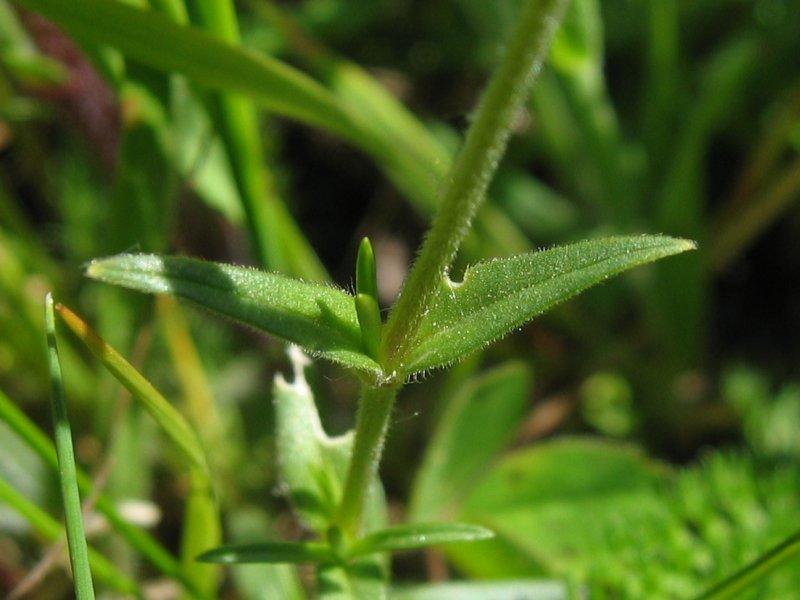
The elongated, narrow leaves sit opposite each other on the stem. They are softly hairy on their upper side. The upper leaves have a pale margin. Tufts of leaves often grow in the axils of the leaves.
The stem grows upright and is round. It is slightly hairy.
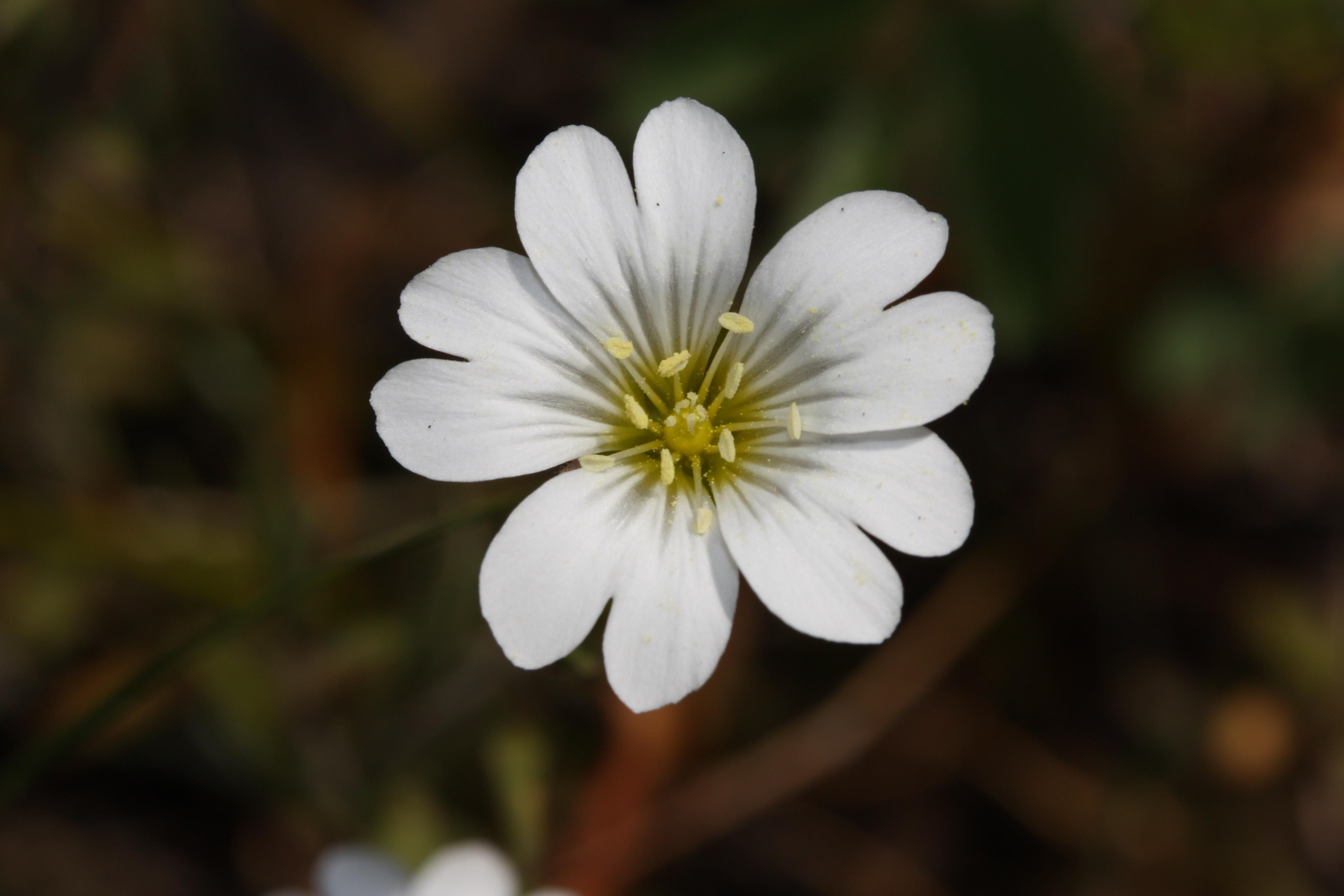
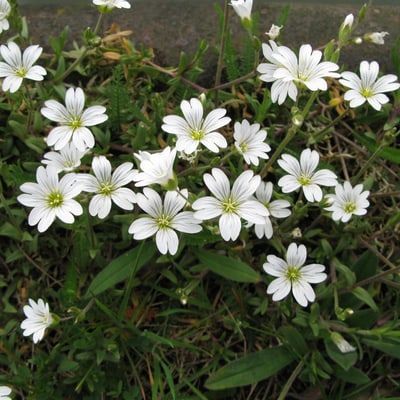
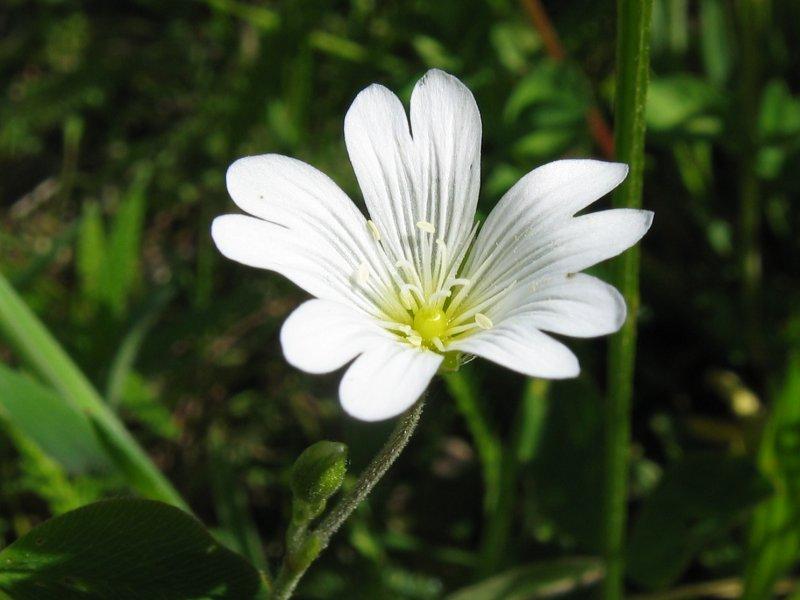
The flowers have five white petals (corollas) that are split at the upper edge. They are larger than the flowers of all other chickweed species.
The fruit is a small, curved denticle capsule.
Features
Field chickweed
Cerastium arvense
large flowers
leaf tufts in leaf axils
round stem
In the city
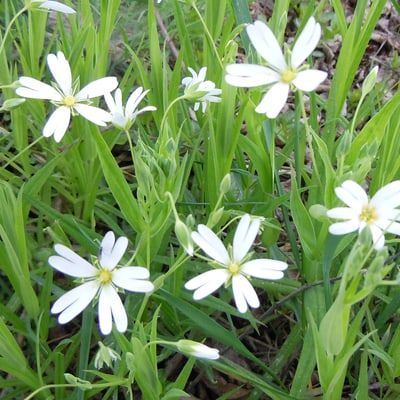
Field chickweed is not very demanding and therefore often grows in the city along roadsides, embankments and on patchy lawns. However, it can also occur on and along walls.
Fun Facts
In dry conditions, the teeth of the capsule fruit spread apart and the seeds can be scattered by the wind.
The plant often grows on ant hills.
The flowering period is from April to July.
It is a perennial, wintergreen plant.
It is pollinated by insects, especially bees and flies.
- Endangerment level Germany: not endangered
Field chickweed is native and widespread in Europe.
The variety 'Compactum' forms dense cushions and is planted as an ornamental.
Sources
Blüte, Walter Siegmund, CC BY-SA 3.0, https://commons.wikimedia.org/wiki/File:Cerastium_arvense_6363.JPG

Blätter, Kristian Peters, CC BY-SA 3.0, https://commons.wikimedia.org/wiki/File:Cerastium_arvense_blatt.jpeg

Blüte, Kristian Peters, CC BY-SA 3.0, https://commons.wikimedia.org/wiki/File:Cerastium_arvense.jpeg

Kammer, P. M. (2016) Pflanzen einfach bestimmen. Schritt für Schritt einheimische Arten kennenlernen, Bern: Haupt Verlag.
Schauer, T., Caspari, C. & Caspari, S. (2015) Der illustrierte BLV-Pflanzenführer für unterwegs. 1150 Blumen, Gräser, Bäume und Sträucher, München: BLV.
Spohn, M., Golte-Bechtle, M. & Spohn, R. (2015) Was blüht denn da? Stuttgart: Franckh Kosmos Verlag.
Page „Acker-Hornkraut“. : Wikipedia, The Free Encyclopedia. Date of last revision: 26.08.2017, 15:22 UTC. URL: https://de.wikipedia.org/w/index.php?title=Acker-Hornkraut&oldid=168500079 (Accessed: 04.01.2018).