
Short Description
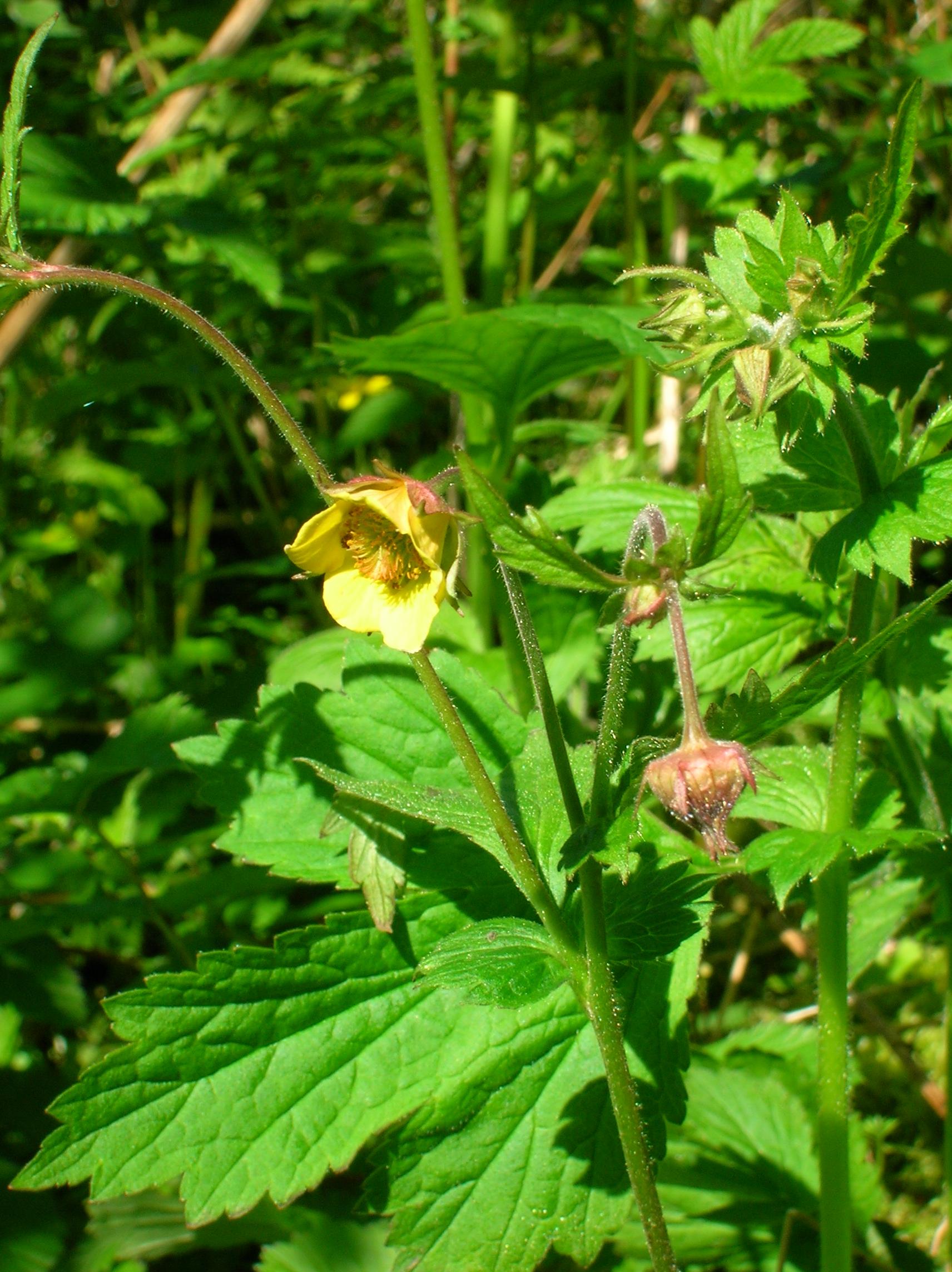
The wood avens can grow up to 120 centimetres high.
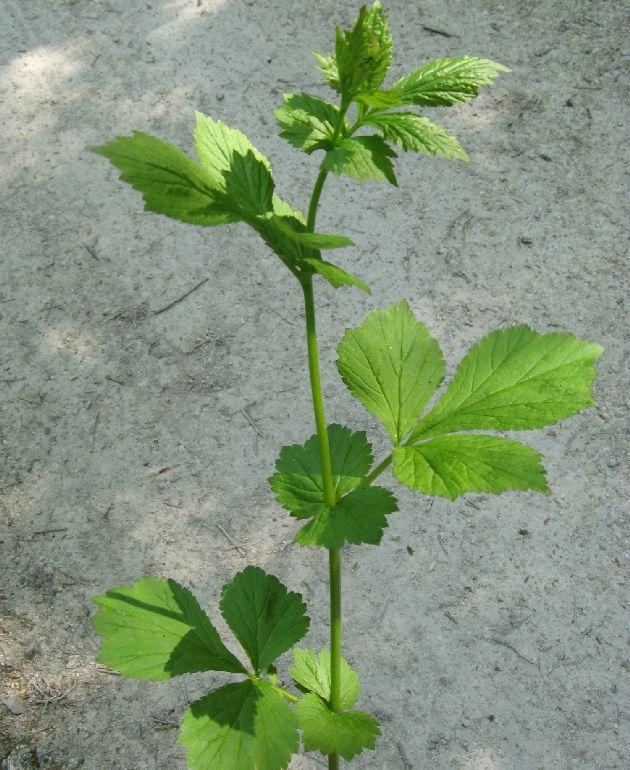
The leaves appear to come directly from the ground and are arranged in a rosette. They are long-stalked and divided into several partial leaves and a terminal leaf (imparipinnate). The leaves along the stem are three-divided or incised. They sit singly and alternately on the stem. All leaves have a toothed (dentate) margin.
The stem grows erect and usually bears several flowers in a loose inflorescence. It is softly hairy.
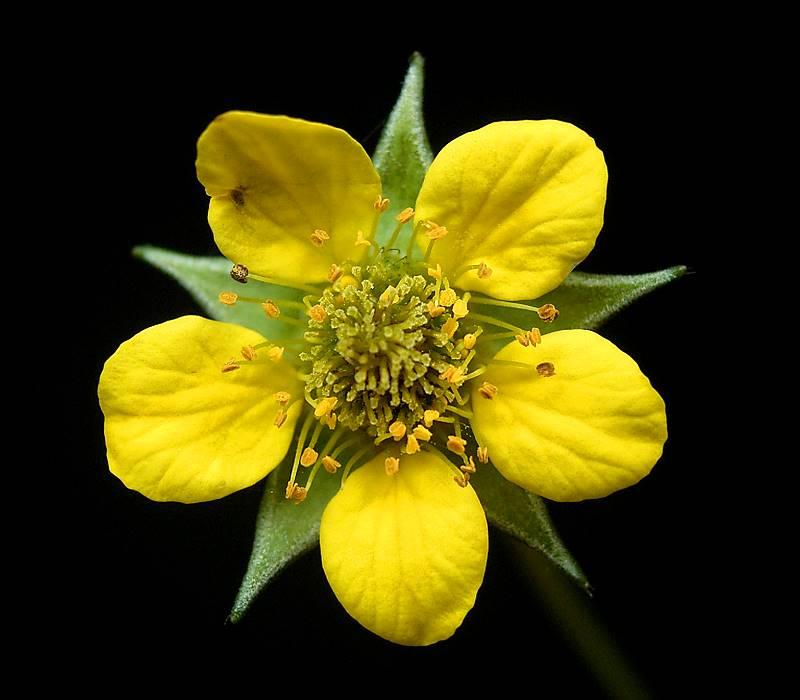
The flowers have five yellow petals arranged in a round shape.
The fruits are nutlets with a bent and hairy bristle , built from the main parts of the pistil. Numerous fruits are produced per flower.
Features
Wood avens
Geum urbanum
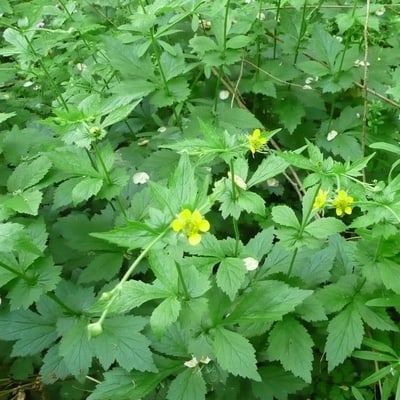
five yellow petals
roots smell like cloves
In the city
The wood avens is a very common plant in the city. It grows on nutrient-rich soils in woods, along fences and walls and on fallow land. It grows both in moist, light places and in shady places.
Fun Facts
The fruits stick to animal skins and clothing with the help of the curved pistils and are thus spread.
The flowering period is from May to October.
The plant lives for several years and generally flowers and fruits annually (perennial plant).
- Endangerment level Germany: not endangered
- Usage:
Root extracts are suitable as an additive for toothpaste and liqueur.
The wood avens is native to Europe, North Africa and the temperate regions of Asia. It has been naturalised in Australia and New Zealand.
The species name urbanum means urban and indicates frequent occurrences of the wood avens in the city.
Tea from the dried root helps with stomach and intestinal complaints and gum inflammation.
Sources
Habitus, Rosser1954, PD, https://commons.wikimedia.org/wiki/File:Geum_urbanum_x_rivale_(G._intermedium).JPG
.JPG)
Blüte, Frank Vincentz, CC BY-SA 3.0, https://commons.wikimedia.org/wiki/File:Geum_urbanum_ies.jpg

Blätter, Gerhard Nitter, CC BY-SA 3.0, https://species-id.net/openmedia/File:Geum_urbanum_0_(G._Nitter).jpg
.jpg)
Kammer, P. M. (2016) Pflanzen einfach bestimmen. Schritt für Schritt einheimische Arten kennenlernen, Bern: Haupt Verlag.
Schauer, T., Caspari, C. & Caspari, S. (2015) Der illustrierte BLV-Pflanzenführer für unterwegs. 1150 Blumen, Gräser, Bäume und Sträucher, München: BLV.
Spohn, M., Golte-Bechtle, M. & Spohn, R. (2015) Was blüht denn da? Stuttgart: Franckh Kosmos Verlag.
Page „Echte Nelkenwurz“. : Wikipedia, The Free Encyclopedia. Date of last revision: 28.12.2017, 17:57 UTC. URL: https://de.wikipedia.org/w/index.php?title=Echte_Nelkenwurz&oldid=172363656 (Accessed: 08.03.2018).
Bundesamt für Naturschutz (n.d.) Artensteckbriefe, URL: http://floraweb.de/pflanzenarten/artenhome.xsql?suchnr=2701& (Accessed: 08.03.2018).