
Short Description
Miner's lettuce can grow up to 30 centimetres high.
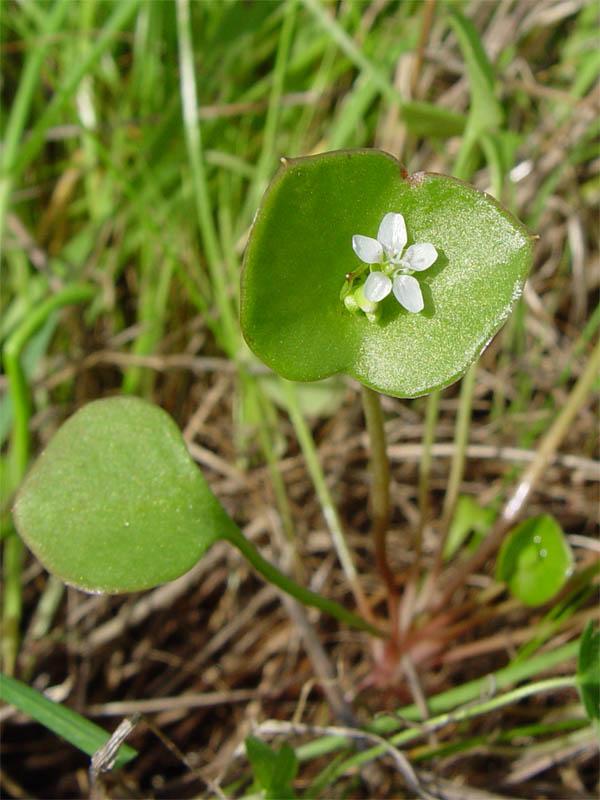
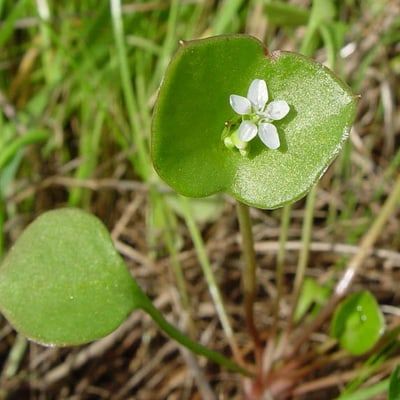
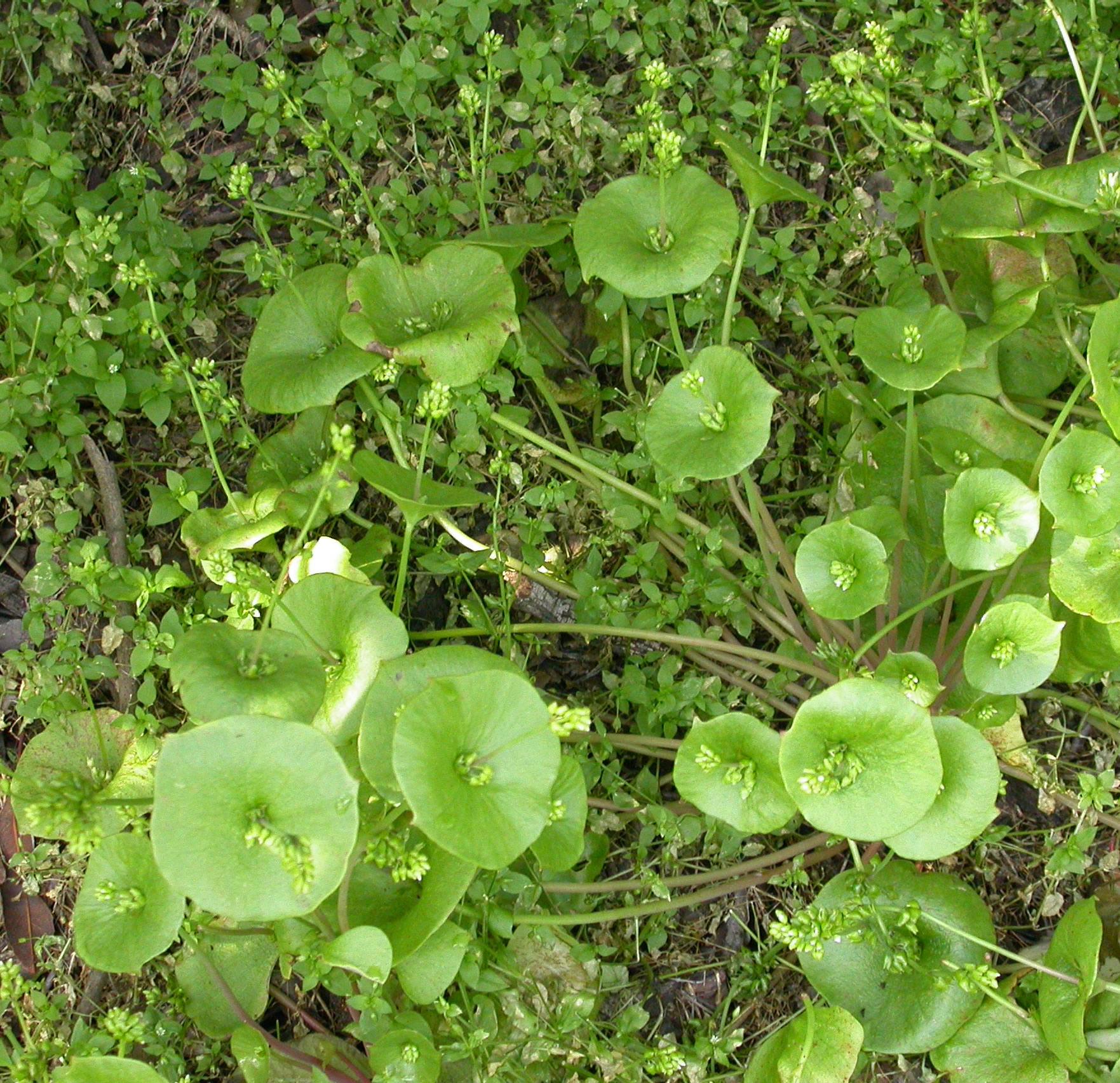
The lower, ovate leaves are fleshy, long-stalked and grow as a basal rosette. On the stem, two leaves are connected together around the stem so as to appear as a single circular leaf.
The basal rosette has several stems growing upright or lying down, each with an inflorescence at the end.
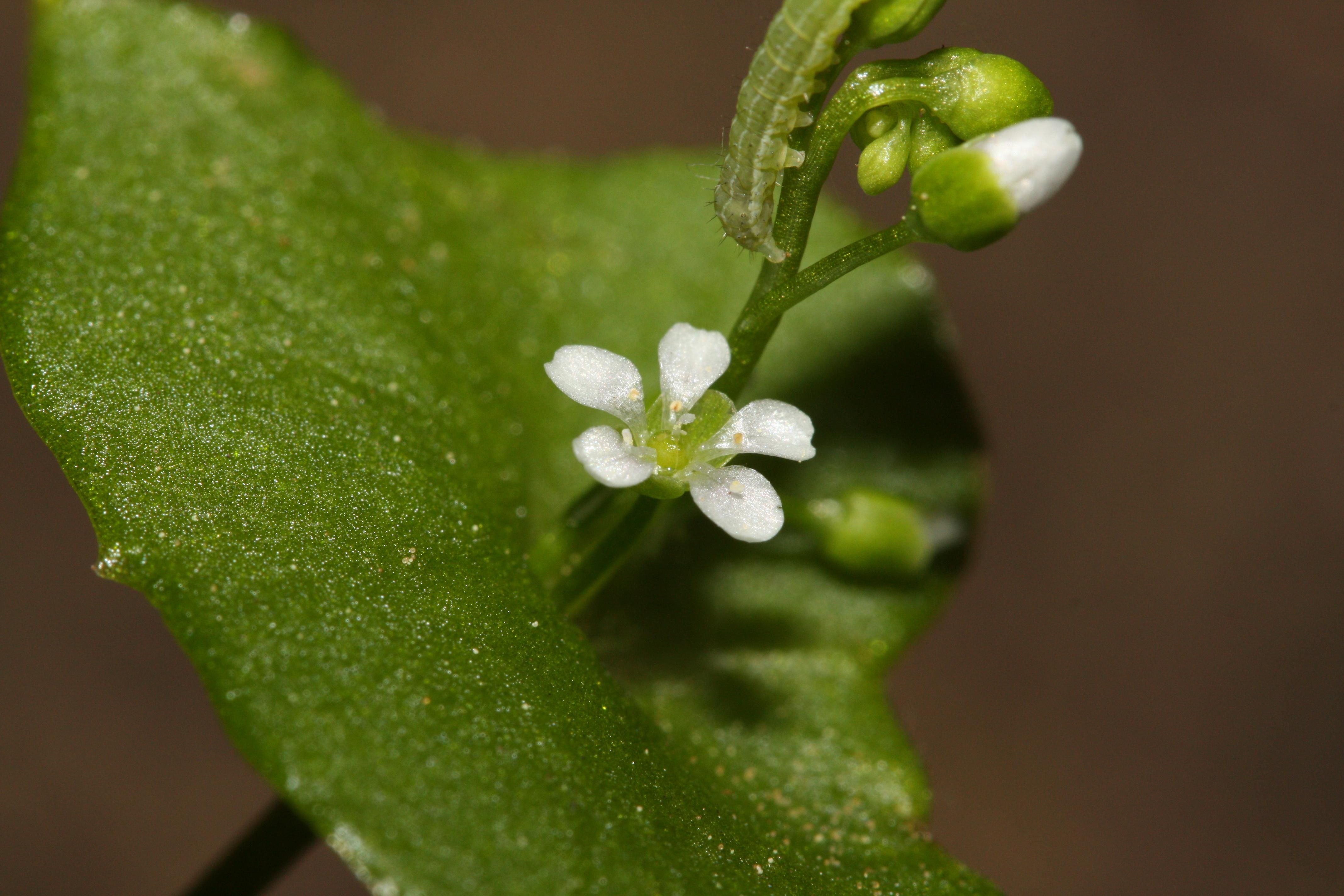
The small flowers grow together in groups of five to forty. They have five, white or pink petals.
The fruits are lenticular, black and shiny.
Features
Miner's lettuce
Claytonia perfoliata
circular fused leaves
In the city
Miner's lettuce is cultivated in Europe as a salad plant and occasionally runs wild. It therefore often grows wild in the city in nurseries and parks. However, it can also be found on walls.
Fun Facts
In North America the plant was used as a medicine and food.
The flowering period is from April to June.
- Endangerment level Germany: not evaluated
It originates from North America. It was introduced to Germany as a salad plant and occasionally runs wild. It belongs to the non-native plants (neophyte).
The species name perfoliata refers to the upper leaves, which are fused together and enclose the stem.
All parts of the plant are edible raw or cooked. The leaves contain a lot of vitamin C, magnesium, calcium and iron.
Sources
Habitus, Franco Folini, CC BY 2.5 , https://commons.wikimedia.org/wiki/File:Claytonia_perfoliata_001.jpg

Blüte, Walter Siegmund, CC BY-SA 3.0, https://commons.wikimedia.org/wiki/File:Claytonia_perfoliata_6633.JPG

Blätter, Curtis Clark, CC BY-SA 2.5, https://commons.wikimedia.org/wiki/File:Claytonia_perfoliata_2003-05-19.jpg

Spohn, M., Golte-Bechtle, M. & Spohn, R. (2015) Was blüht denn da? Stuttgart: Franckh Kosmos Verlag.
Page „Gewöhnliches Tellerkraut“. : Wikipedia, The Free Encyclopedia. Date of last revision: 21.09.2017, 05:08 UTC. URL: https://de.wikipedia.org/w/index.php?title=Gew%C3%B6hnliches_Tellerkraut&oldid=169294358 (Accessed: 18.01.2018).
Bundesamt für Naturschutz (n.d.) Artensteckbriefe, URL: http://floraweb.de/pflanzenarten/artenhome.xsql?suchnr=1585& (Accessed: 18.01.2018).