
Short Description
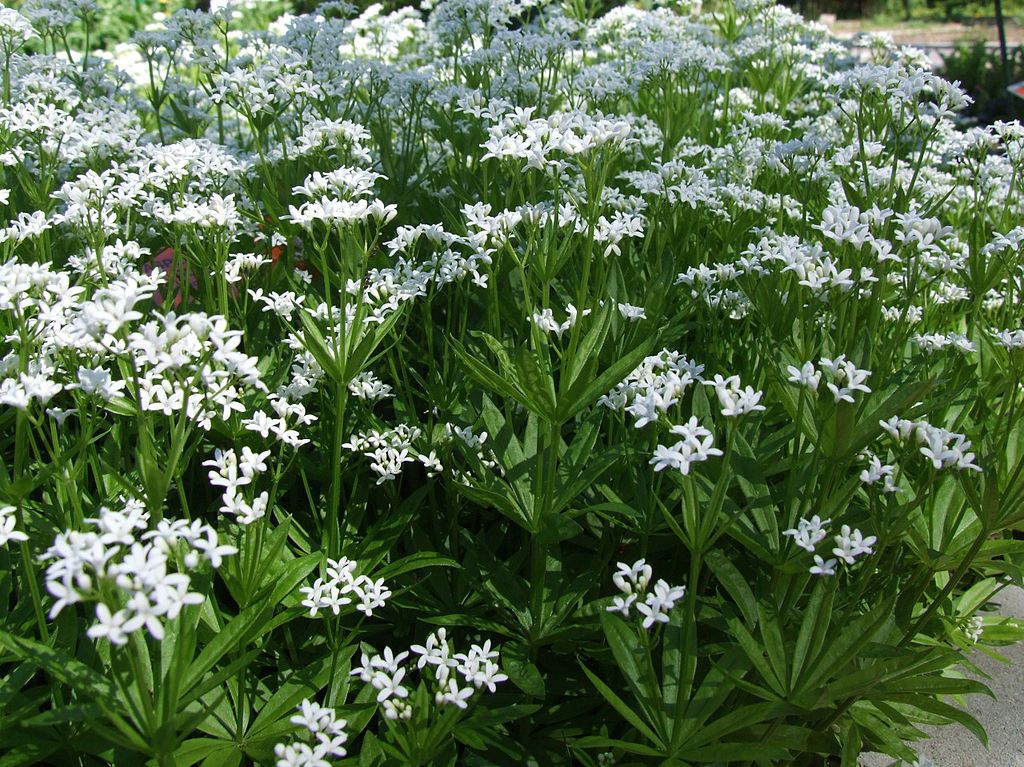
Woodruff can grow to a height of 50 cm.
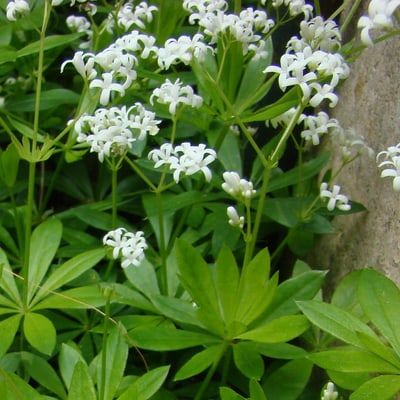
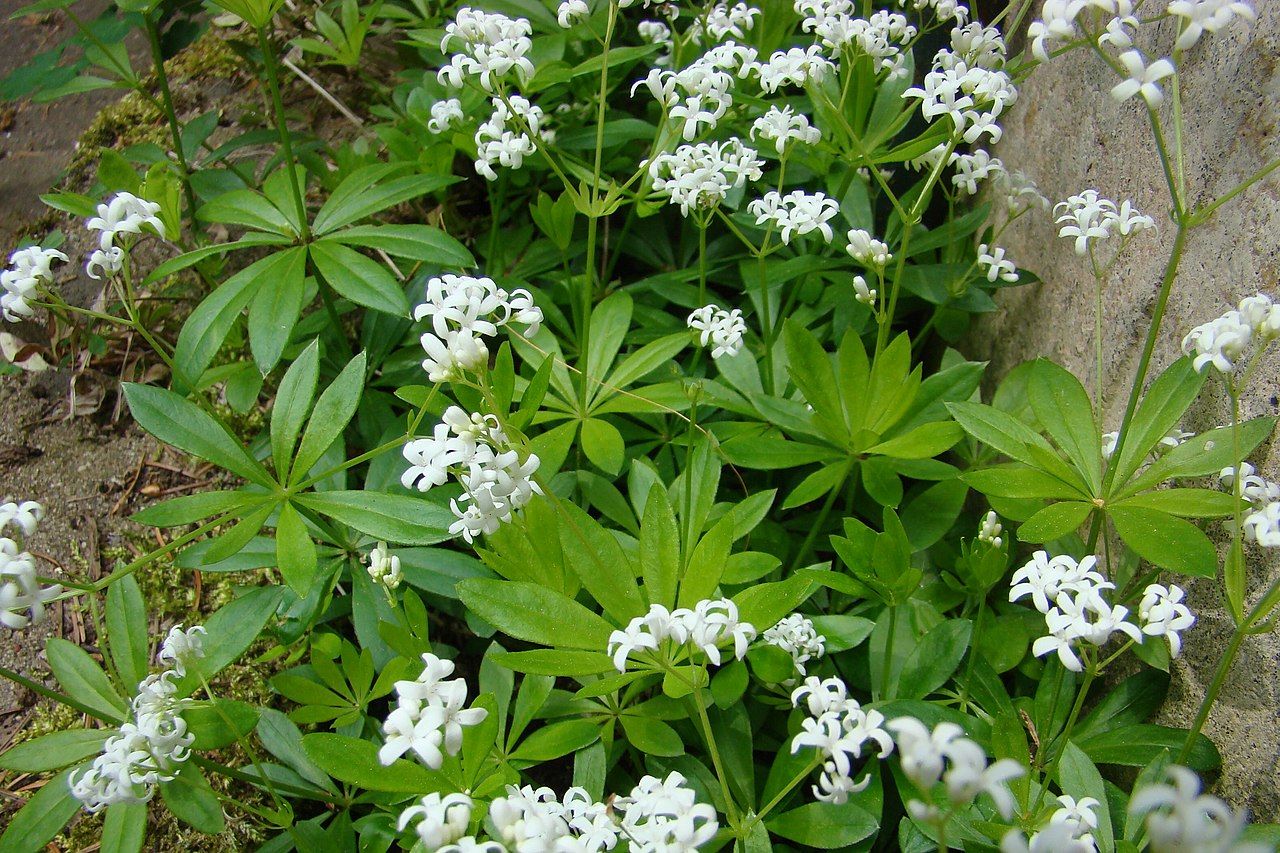
The leaves grow in whorls of six to eight around the stem. They are elongated and lance-shaped or narrow and elliptical.
The stem is upright, unbranched and square. The plant develops underground runners allowing it to reproduce asexually (vegetative reproduction).
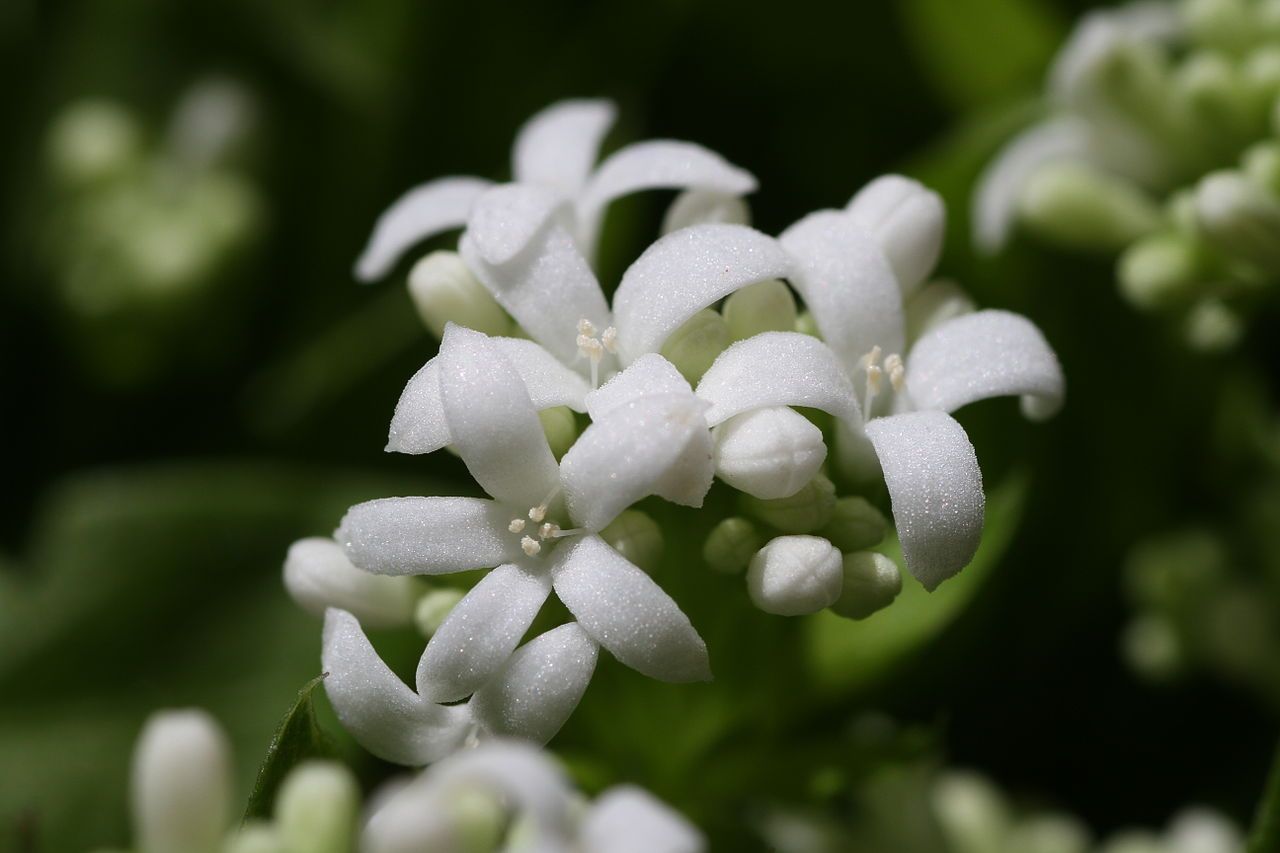
The flowers are white and numerously clustered in flower heads. The individual florets generally have four petals and a funnel-shaped crown. The individual petals are fused to the middle.
The fruit is a bristly haired schizocarp, i.e. breaks into two single-seeded parts when ripe.
Features
Sweet woodruff
Galium odoratum
leaves in whorls
typical smell of withered leaves
In the city
In an urban environment, woodruff can often be found in shady beech woods. It prefers fresh sites, rich in nutrients and alkalines with loose loamy soil.
Fun Facts
Woodruff should ideally be picked prior to flowering, before the coumarin content of the plant increases.
The once popular and widespread flavouring with woodruff has been forbidden in Germany since the 1970s. The typical woodruff aroma of foods is now chemically reproduced.
Woodruff is used in folk medicine. It is said to be vaso-dilating, anti-inflammatory and anti-spasmodic. In addition, it is used to deter moths.
No more than 3 g of woodruff leaves per litre of liquid should be used.
It flowers from April to June.
It lives for several years and generally flowers and fruits annually (perennial plant).
- Endangerment level Germany: not endangered
Coumarin, responsible for the typical woodruff smell, is only released when the leaves are withered and dry. In excessive doses, this aromatic substance is poisonous and can cause headache, dizziness and vomiting.
Sources
Habitus, Jerzy Opioła, CC BY-SA 4.0, https://de.wikipedia.org/wiki/Waldmeister#/media/Datei:Asperula_odorata_a1.jpg

Blüten, Björn Traeger , CC BY-SA 3.0, https://de.wikipedia.org/wiki/Waldmeister#/media/Datei:Galium_odoratum_Flower.JPG

Habitus, Hajotthu, CC BY-SA 3.0, https://de.wikipedia.org/wiki/Waldmeister#/media/Datei:Waldmeister(Mai).JPG
.JPG)
Eggenberg, S. & Möhl, A. (2007) Flora Vegetativa: Ein Bestimmungsbuch für Pflanzen der Schweiz im blütenlosen Zustand, Bern, Stuttgart, Wien: Haupt Verlag.
Spohn, M., Golte-Bechtle, M. & Spohn, R. (2015) Was blüht denn da? Stuttgart: Franckh Kosmos Verlag.
Jäger, E. J. (2011) Rothmaler - Exkursionsflora von Deutschland. Gefäßpflanzen: Grundband, Heidelberg: Spektrum Akademischer Verlag.
Kammer, P. M. (2016) Pflanzen einfach bestimmen. Schritt für Schritt einheimische Arten kennenlernen, Bern: Haupt Verlag.
Lippert, W. & Podlech, D. (1993) GU Naturführer. Blumen: die wichtigen Blütenpflanzen Mitteleuropas erkennen und bestimmen, München: Gräfe und Unzer Verlag.
Schauer, T., Caspari, C. & Caspari, S. (2015) Der illustrierte BLV-Pflanzenführer für unterwegs. 1150 Blumen, Gräser, Bäume und Sträucher, München: BLV.
Page „Waldmeister“. : Wikipedia, The Free Encyclopedia. Date of last revision: 18.12.2016, 10:35 UTC. URL: https://de.wikipedia.org/w/index.php?title=Waldmeister&oldid=160763373 (Accessed: 05.01.2017).