
Short Description
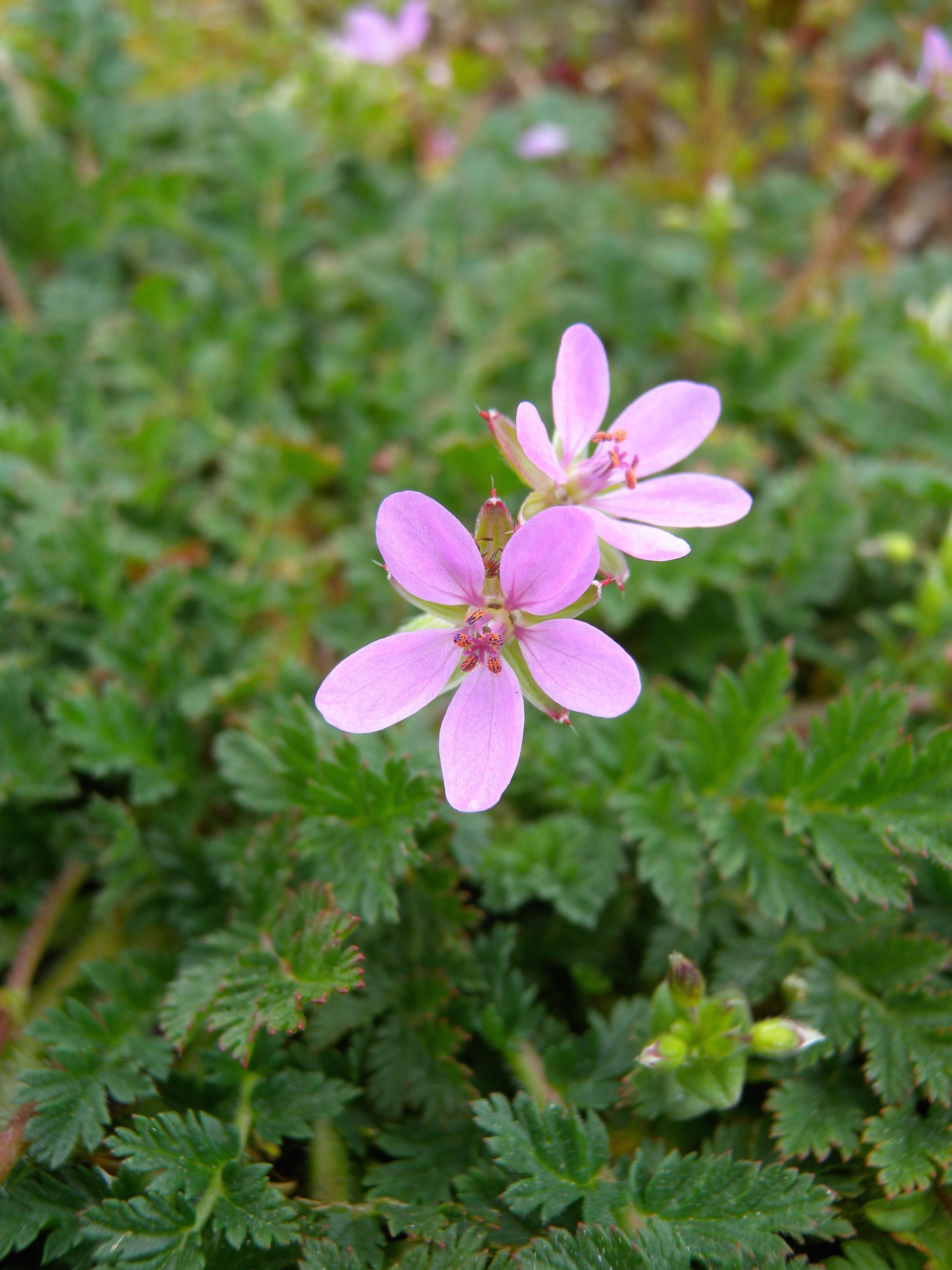
The common stork's-bill can grow up to 40 centimetres high.
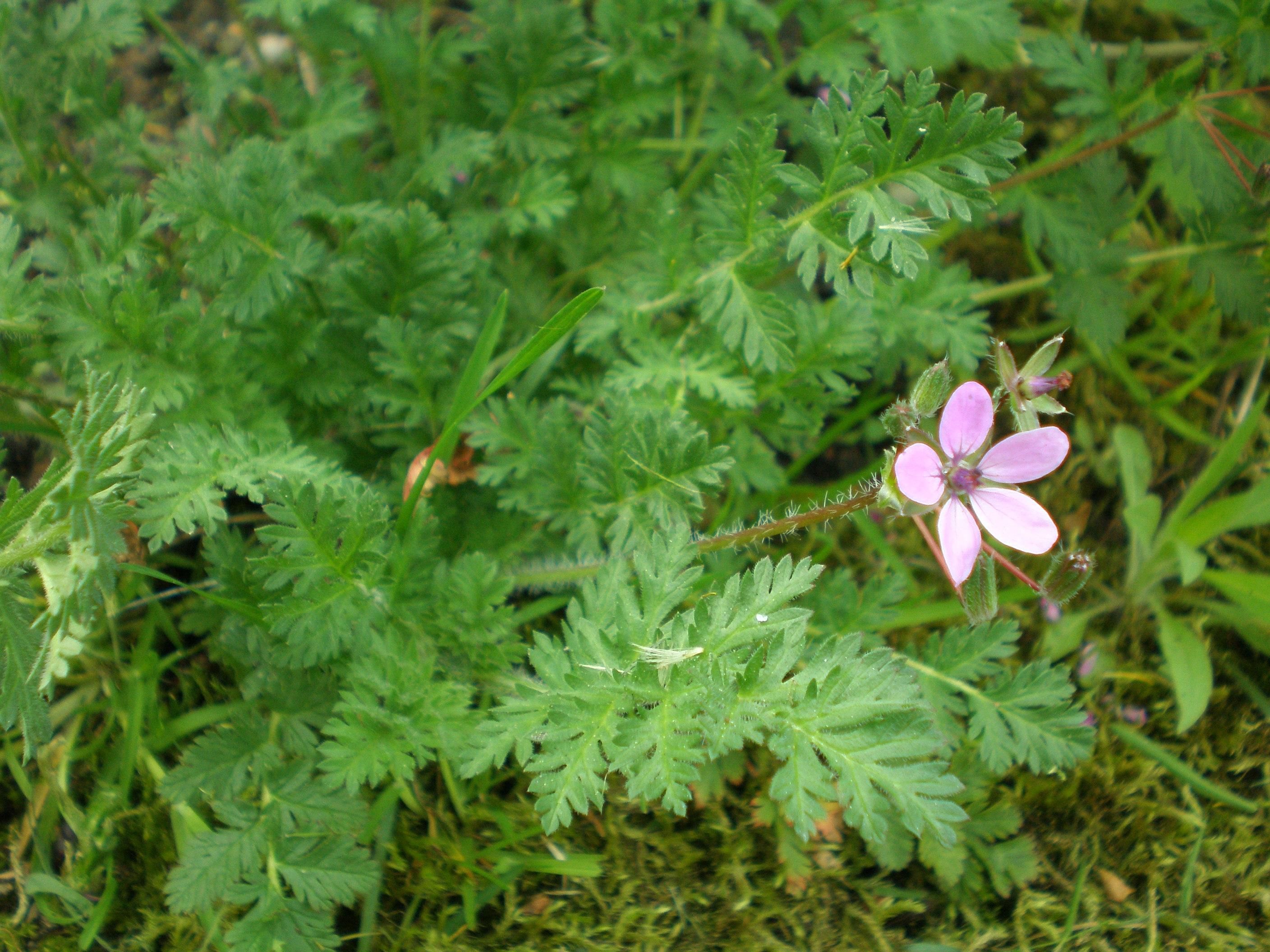
The leaves are hairy and divided into subleaves. The margin of the partial leaves is serrated to slightly incised.
The plant initially grows as a rosette of leaves. Later the stem grows horizontally or ascending. It is hairy.
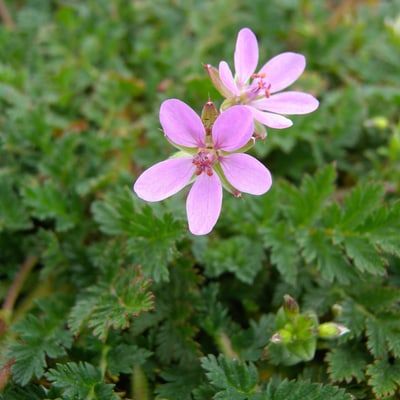
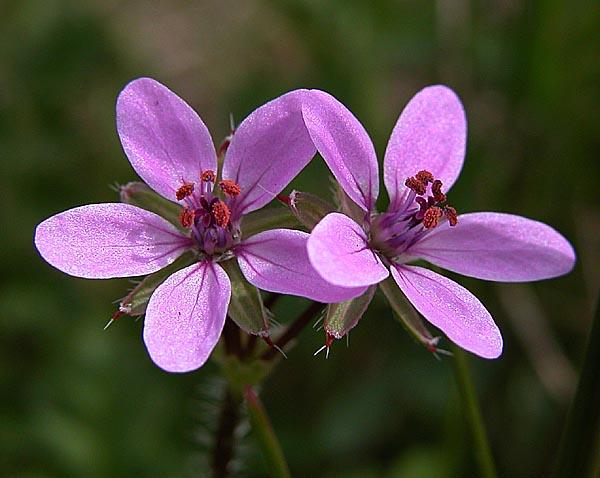
The flowers have five pink, radially arranged petals, five rust-coloured stamens and a star-shaped stigma. Two to ten flowers sit together in inflorescences.
The fruits are long beaked schizocarps that split into five partial fruits (mericarps). The partial fruits wind up like a corkscrew.
Features
Common stork's-bill
Erodium cicutarium
beaked fruit
rough-haired
In the city
The common stork's-bill is often found on warm, dry areas with soils poor in lime. It is a sand indicator and a pioneer plant. It prefers to grow on open sandy areas, roadsides or fallow land.
Fun Facts
Each flower opens for only one day.
When dry, the beak of the partial fruit is curled up. When wet, it is elongated. By rolling out when wet, the seed can bore into the ground or an animal fur.
The flowering period is from April to September.
The plant can live for several years. However, it only flowers once and dies after the seeds have ripened.
Most of the time self-pollination takes place.
- Endangerment level Germany: not endangered
The common stork's-bill is native and widespread in Germany.
The common name stork's-bill refers to the long, beak-like fruits and the curvature of the flower stems.
Sources
Habitus, MurielBendel, CC BY-SA 4.0, https://commons.wikimedia.org/wiki/File:Erodium_cicutarium_Bahnstrasse_Bern_6.JPG

Blüten, Michael H. Lemmer, CC BY-SA 2.5, https://commons.wikimedia.org/wiki/File:Erodium-cicutarium-250404.jpg

Habitus, Hugo.arg, CC BY-SA 3.0, https://commons.wikimedia.org/wiki/File:Erodium_cicutarium001.JPG

Kammer, P. M. (2016) Pflanzen einfach bestimmen. Schritt für Schritt einheimische Arten kennenlernen, Bern: Haupt Verlag.
Schauer, T., Caspari, C. & Caspari, S. (2015) Der illustrierte BLV-Pflanzenführer für unterwegs. 1150 Blumen, Gräser, Bäume und Sträucher, München: BLV.
Spohn, M., Golte-Bechtle, M. & Spohn, R. (2015) Was blüht denn da? Stuttgart: Franckh Kosmos Verlag.
Page „Gewöhnlicher Reiherschnabel“. : Wikipedia, The Free Encyclopedia. Date of last revision: 23.09.2017, 13:52 UTC. URL: https://de.wikipedia.org/w/index.php?title=Gew%C3%B6hnlicher_Reiherschnabel&oldid=169361083 (Accessed: 01.02.2018).
Bundesamt für Naturschutz (n.d.) Artensteckbriefe, URL: http://floraweb.de/pflanzenarten/artenhome.xsql?suchnr=2199& (Accessed: 01.02.2018).