
Short Description
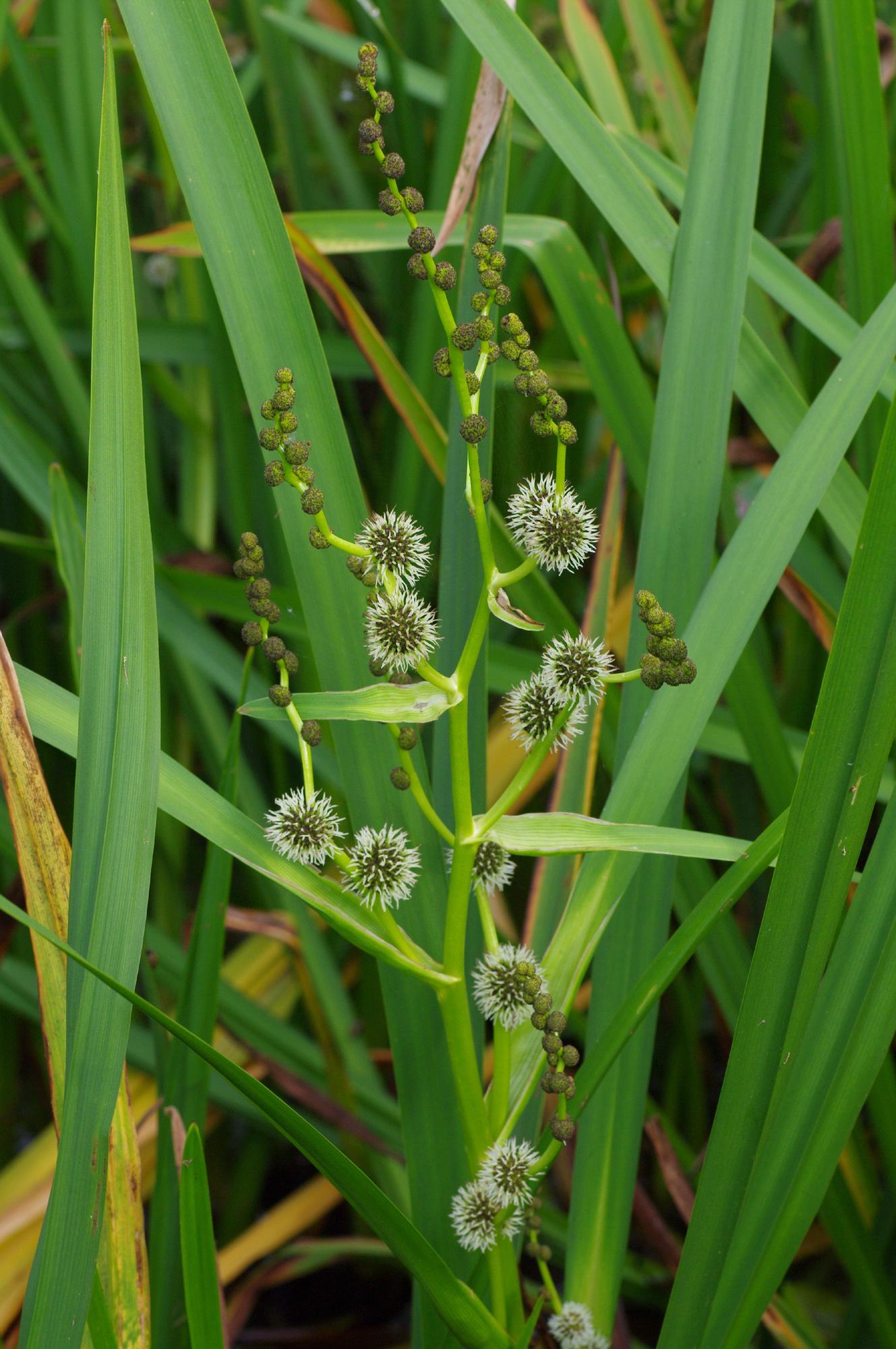
The branched bur-reed is a robust plant that can grow over one and a half metres high.
The long leaves are dark green, sword-shaped and triangular in the lower part. They are hard and grow erect ascending.
The stem is branched and grows erect.
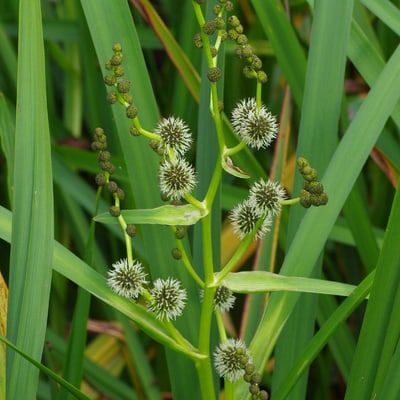
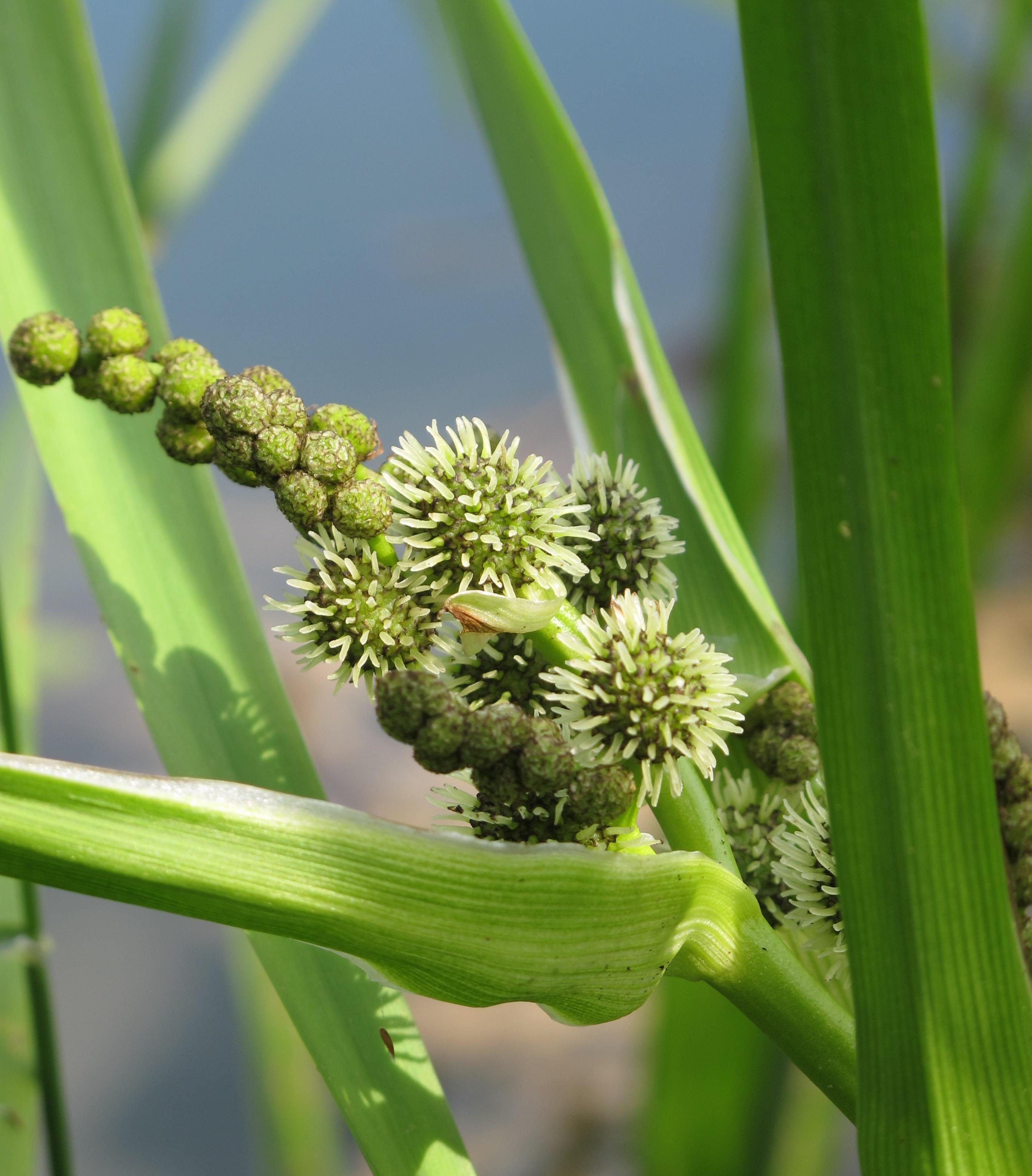
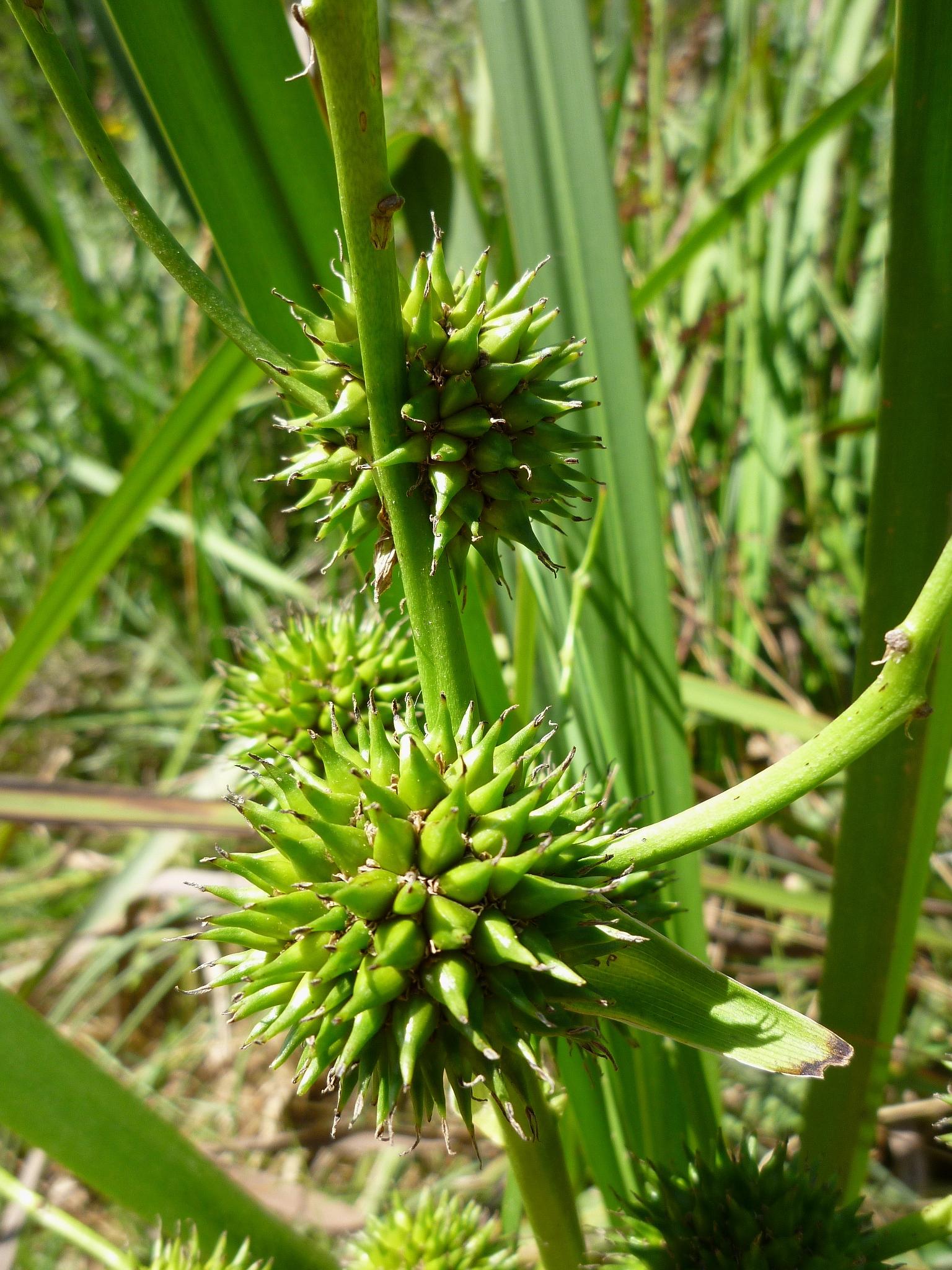
There are male and female flowers, each of which unites to form spherical heads. These heads sit loosely in elongated, branched inflorescences.
The small, spongy drupes are brownish and taper to a point.
Features
Branched bur-reed
Sparganium erectum
slightly toxic
branched inflorescences
long, sword-shaped leaves
Similar species
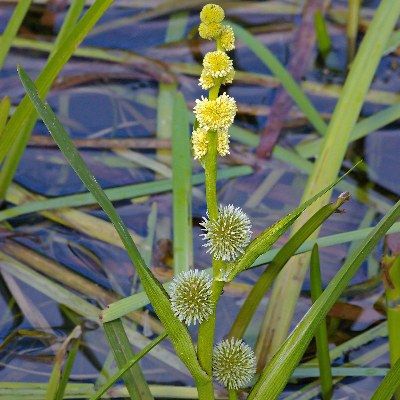
Unbranched bur-reed
Sparganium emersum
In the city
The branched bur-reed grows on standing water, banks and ditches. It prefers nutrient-rich waters up to half a metre deep and muddy soils. It also colonises disturbed sites and new locations and tolerates heavier water pollution.
Fun Facts
The flowering period is from June to August.
The ripe fruits can float in the water for up to twelve months before they sprout.
The green parts of the branched bur-reed are full of oxalic acid crystals, which serve as an antifeedant.
It lives for several years and generally flowers and fruits annually (perennial plant).
- Endangerment level Germany: not endangered
The branched bur-reed mace is slightly poisonous.
Sources
Habitus, Christian Fischer, CC BY-SA 3.0, https://commons.wikimedia.org/wiki/File:SparganiumErectum.jpg

Blütenstand, Huhulenik, CC BY 3.0, https://commons.wikimedia.org/wiki/File:Pond_in_Jince_(2).jpg
.jpg)
Früchte, Isidre blanc, CC BY-SA 4.0, https://commons.wikimedia.org/wiki/File:SPARGANIUM_ERECTUM_-_LLANERA_-_IB-170_(Espargany).JPG
.JPG)
Spohn, M., Golte-Bechtle, M. & Spohn, R. (2015) Was blüht denn da? Stuttgart: Franckh Kosmos Verlag.
Schauer, T., Caspari, C. & Caspari, S. (2015) Der illustrierte BLV-Pflanzenführer für unterwegs. 1150 Blumen, Gräser, Bäume und Sträucher, München: BLV.
Kammer, P. M. (2016) Pflanzen einfach bestimmen. Schritt für Schritt einheimische Arten kennenlernen, Bern: Haupt Verlag.
Seitz, B., Ristow, M., Meißner, J., Machatzi, B. & Sukopp, H. (2018) Rote Liste und Gesamtartenliste der etablierten Farn- und Blütenpflanzen von Berlin. : Der Landesbeauftragte für Naturschutz und Landschaftspflege / Senatsverwaltung für Umwelt, Klima und Verkehr (eds.) Rote Listen der gefährdeten Pflanzen, Pilze und Tiere von Berlin, URL: https://www.berlin.de/sen/uvk/natur-und-gruen/naturschutz/artenschutz/artenlisten-rote-listen/farn-und-bluetenpflanzen/ (Accessed: 26.03.2021).
Bundesamt für Naturschutz (n.d.) Artensteckbriefe, URL: http://floraweb.de/pflanzenarten/artenhome.xsql?suchnr=5717& (Accessed: 10.09.2018).
Page „Ästiger Igelkolben“. : Wikipedia, The Free Encyclopedia. Date of last revision: 25.03.2018, 12:12 UTC. URL: https://de.wikipedia.org/w/index.php?title=%C3%84stiger_Igelkolben&oldid=175378970 (Accessed: 10.09.2018).