
Short Description
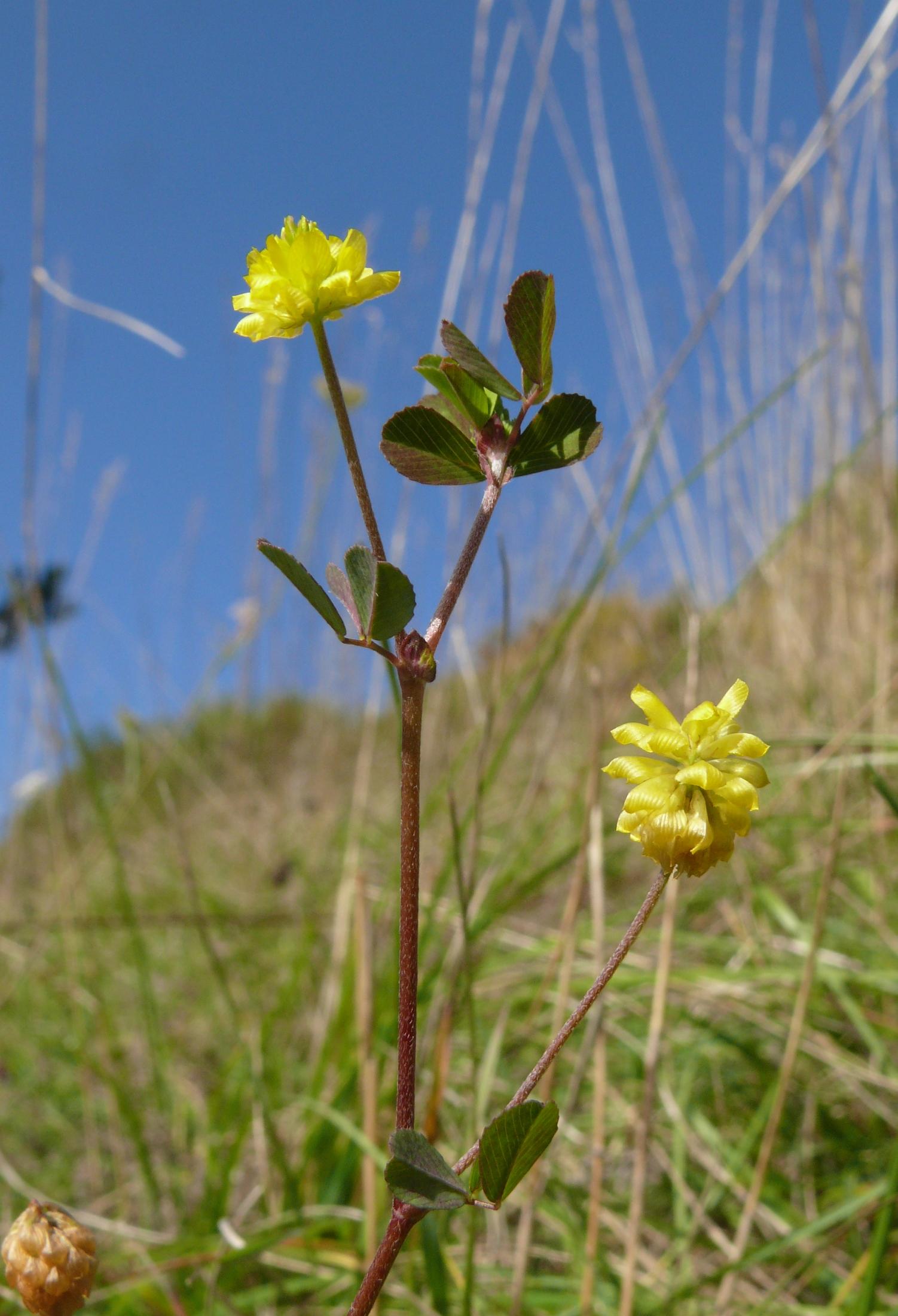
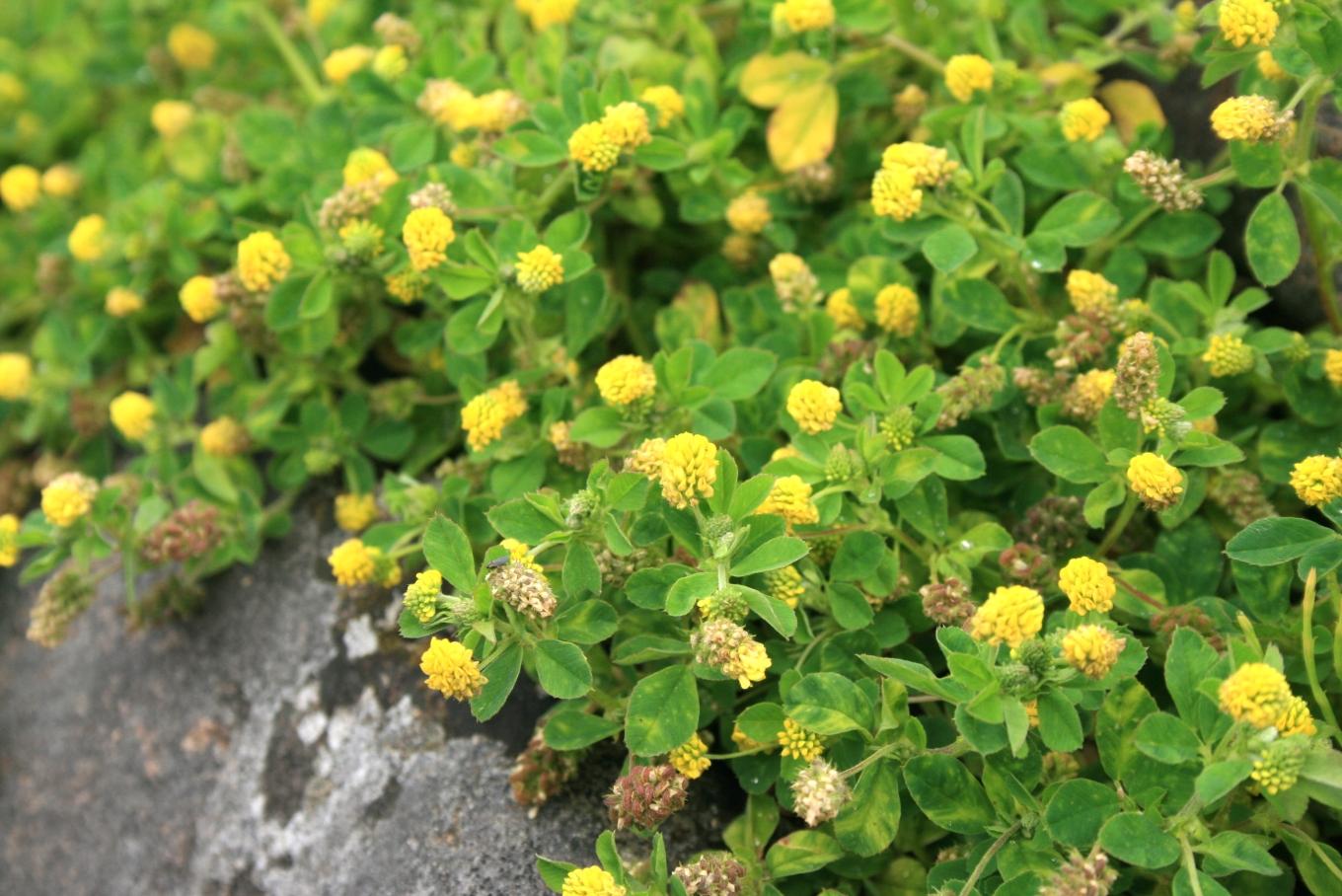
Hop trefoil can grow up to 30 centimetres high.
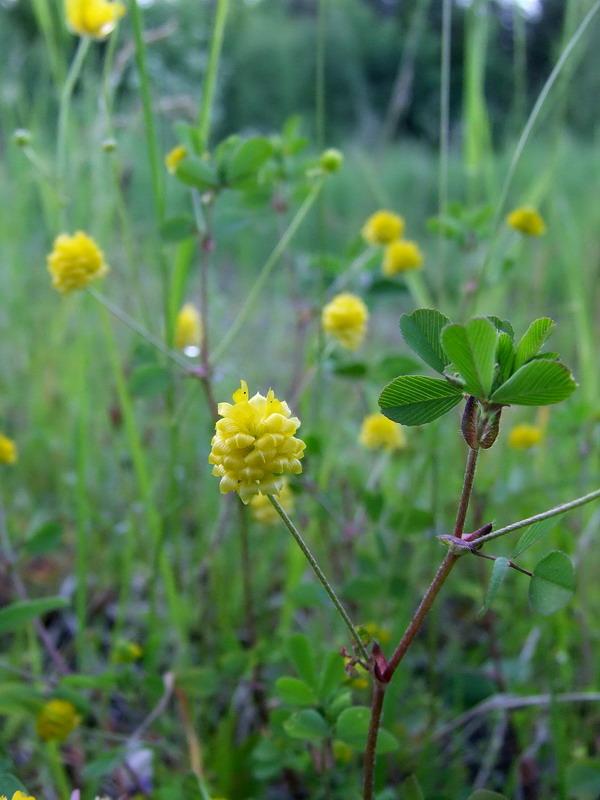
The leaves consist of three leaflets (tripinnate). The leaflets are ovate. They are toothed at the front edge but have no tip. The middle leaflet is longer stalked than the lateral leaflets.
The stem grows erect or lying down. It is often reddish or brownish in colour.
The flowers stand numerously in spherical inflorescences. The individual flowers are light yellow. They consist of five petals. The large upper petal protrudes upwards. The two lower petals form a hollow boat that surrounds the anthers and pistils.
The fruits are legumes. They remain enclosed by the wilted and dried flower, which does not fall off.
Features
Hop trefoil
Trifolium campestre
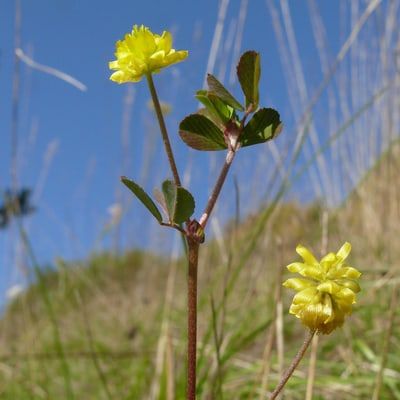
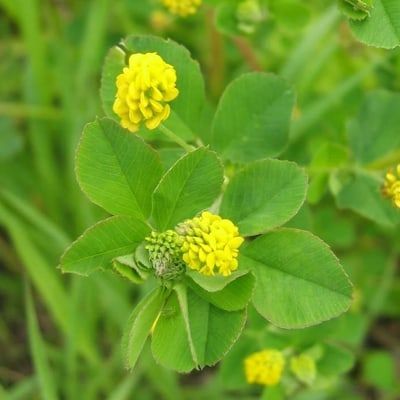
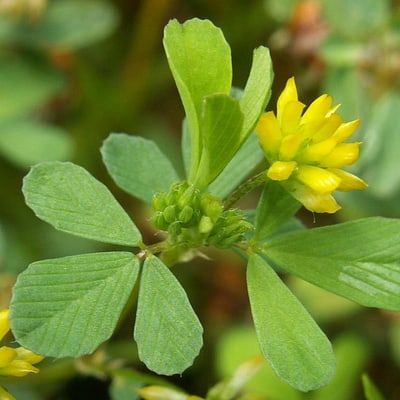
trifoliate leaves
roundish, yellow flower heads
leaflets without tip
In the city
Hop trefoil prefers warm, rather dry sites with low-nitrogen, sandy or stony soils. In the city it grows on neglected grasslands, sandy areas, along paths and embankments and on railway ballast. Occasionally it is also included in seed mixtures for park and garden lawns.
Fun Facts
The flowers have areas that absorb UV light and those that reflect it. This makes them appear two-coloured to bees.
The withered, dried-out flowers form a loose sheath around the fruits, which serve as a flight organ to spread the fruits.
Living together with root nodule bacteria is typical for the legume family. The bacteria supply the plant with nitrogen. Since the bacteria need a plant for nitrogen fixation, this coexistence has a positive effect on both species (symbiosis).
The flowering period is from June to September.
It is an annual plant, i.e. it flowers for only one summer and dies after the seeds have ripened.
The pollinators are bees, flies and butterflies. Spontaneous self-pollination is also successful. After pollination, the large upper petal lowers and closes the flower entrance.
- Endangerment level Germany: not endangered
Hop trefoil is native to Central Europe.
It is occasionally grown as a fodder plant.
Sources
Habitus, Bernd Haynold, CC BY-SA 3.0 , https://commons.wikimedia.org/wiki/File:Trifolium_campestre_300907.jpg

Habitus, Sten Porse, CC BY-SA 3.0, https://commons.wikimedia.org/wiki/File:Trifolium-campestre-flowering.jpg

Blüte und Blatt, Tocekas, CC BY-SA 3.0, https://commons.wikimedia.org/wiki/File:Trifolium_campestre_4.jpg

Kammer, P. M. (2016) Pflanzen einfach bestimmen. Schritt für Schritt einheimische Arten kennenlernen, Bern: Haupt Verlag.
Roth, L., Daunderer, M. & Kormann, K. (2008) Giftpflanzen - Pflanzengifte. Vorkommen, Wirkung, Therapie. Allergische und phototoxische Reaktionen, Hamburg: Nikol Verlag.
Spohn, M., Golte-Bechtle, M. & Spohn, R. (2015) Was blüht denn da? Stuttgart: Franckh Kosmos Verlag.
Page „Feld-Klee“. : Wikipedia, The Free Encyclopedia. Date of last revision: 20.04.2017, 22:52 UTC. URL: https://de.wikipedia.org/w/index.php?title=Feld-Klee&oldid=164768593 (Accessed: 20.03.2018).
Bundesamt für Naturschutz (n.d.) Artensteckbriefe, URL: http://floraweb.de/pflanzenarten/artenhome.xsql?suchnr=6025& (Accessed: 20.03.2018).