
Short Description
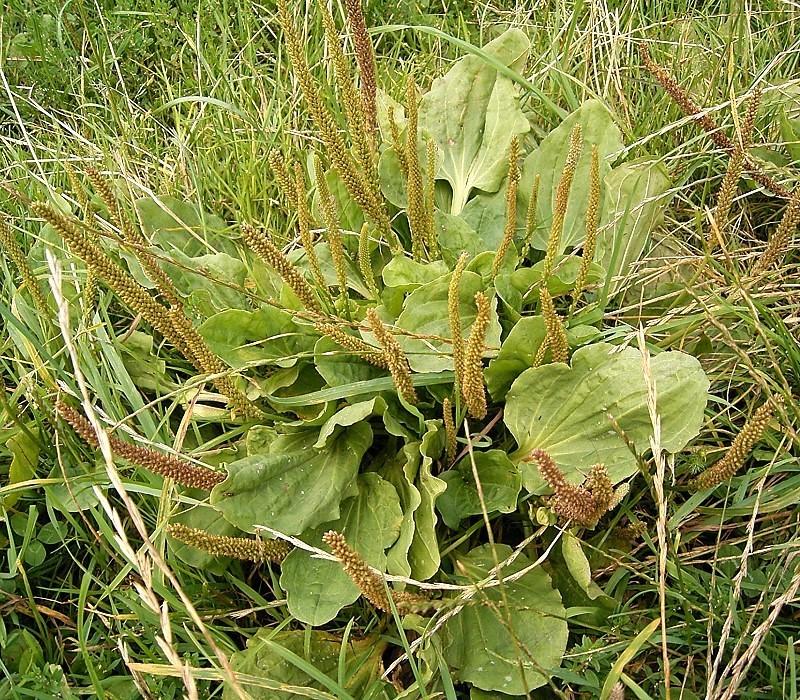
The broadleaf plantain can reach a growth height of between three to 25 cm.
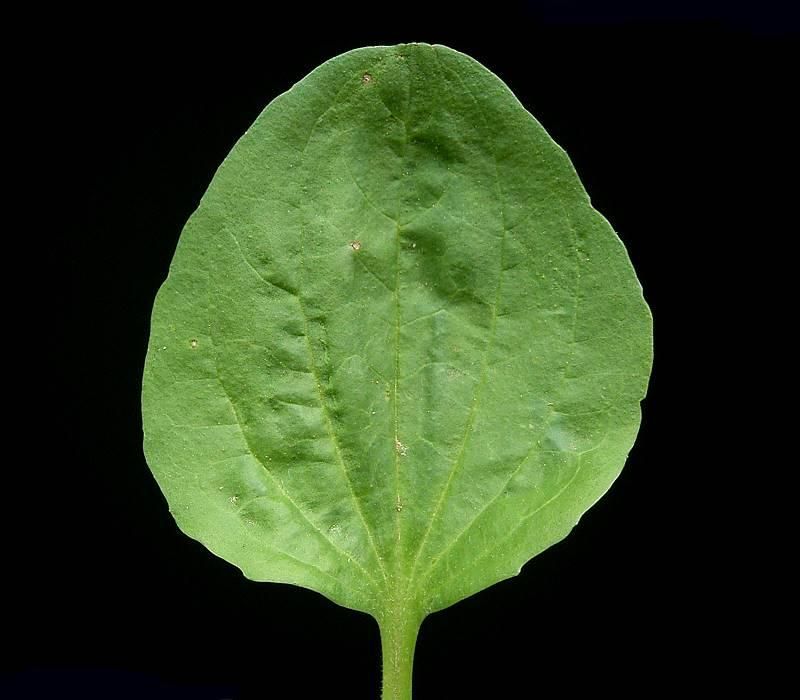
Its leaves are arranged in a large flat rosette. They are roundish with smooth margins and a stalk.
The leafless stem is surrounded at the bottom by basal leaves and terminates in a long narrow flower head.
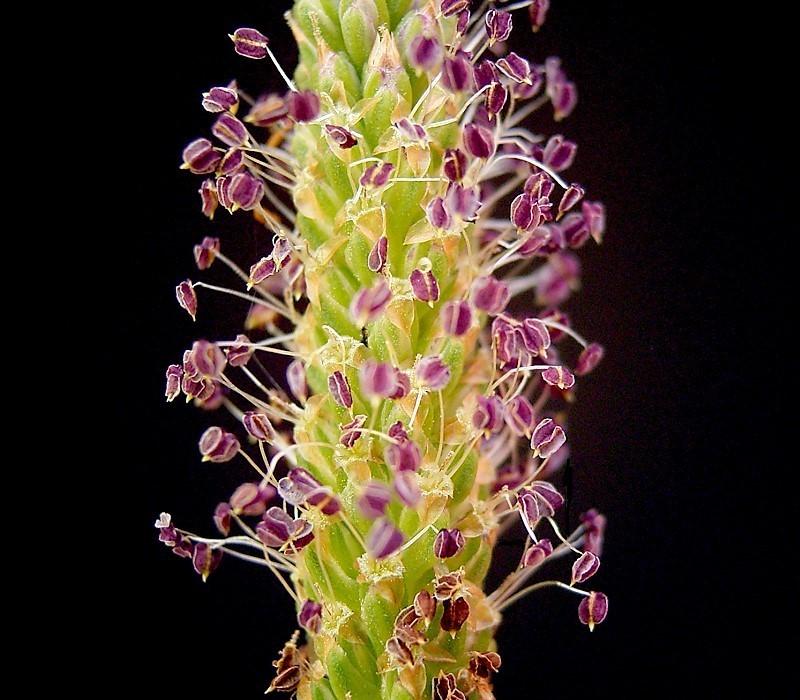
The flowers are quite small and inconspicuous. They stand in long narrow spikes that can be upright or prostrate.
The seeds are greyish, elongated smooth capsules that open like a lid. The seed capsules split off the upper part like a cone and release the seeds.
Features
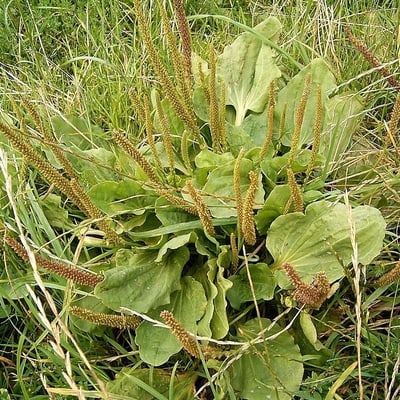
Broadleaf plantain
Plantago major
long, spiky flower head
basal rosette of leaves
In the city
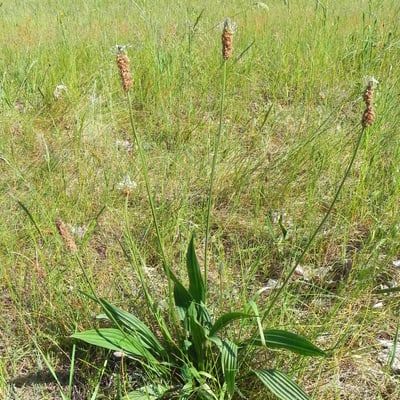
The broadleaf plantain is a robust plant that can survive repeated trampling. It grows in gaps in the turf caused by trampling or vehicles, often in the entry areas to meadows and pastures. It cannot survive in well-maintained grasslands.
In humid conditions, the small seeds become sticky and thus adhere easier to the feet of humans and animals.
Fun Facts
Young tender leaves can be eaten as salat.
As the plants are wind-pollinated, they can do without conspicuous flowers or scent.
It flowers from May to November.
It lives for several years and generally flowers and fruits annually (perennial plant).
The seeds are spread by animals to which they stick.
- Endangerment level Germany: not endangered
It came to North America with the European settlers. It was therefore called "the white man's footsteps" by the Indians.
Broadleaf plantain is widely used as a medicinal plant in natural medicine. Its fresh leaves have an anti-inflammatory effect and promote wound healing when placed on the affected areas.
Sources
Habitus, Frank Vincentz, CC BY-SA 3.0, https://commons.wikimedia.org/wiki/File:Plantago_major_02_ies.jpg

Blütenstand, Frank Vincentz, CC BY-SA 3.0, https://commons.wikimedia.org/wiki/File:Plantago_major_04_ies.jpg

Blatt, Frank Vincentz, CC BY-SA 3.0, https://commons.wikimedia.org/wiki/File:Plantago_major_ies.jpg

Wohlers, W. (2016) Plantago major – Großer Wegerich (JKI-Pflanzenportraits), URL: https://offene-naturfuehrer.de/web/Plantago_major_%E2%80%93_Gro%C3%9Fer_Wegerich_(JKI-Pflanzenportraits) (Accessed: 03.06.2016).
Page „Breitwegerich“. : Wikipedia, The Free Encyclopedia. Date of last revision: 27.03.2016, 23:18 UTC. URL: https://de.wikipedia.org/w/index.php?title=Breitwegerich&oldid=152925927 (Accessed: 03.06.2016).
Fleischhauer, S. G., Guthmann, J. & Spiegelberger, R. (2007) Essbare Wildpflanzen. 200 Arten bestimmen und verwenden, Baden und München: AT Verlag.
Lippert, W. & Podlech, D. (1993) GU Naturführer. Blumen: die wichtigen Blütenpflanzen Mitteleuropas erkennen und bestimmen, München: Gräfe und Unzer Verlag.
Needon, C. & Petermann, J. (1991) Urania-Naturführer Pflanzen, Leipzig, Jena, Berlin: Urania-Verlag.
Scherf, G. (2006) Wildpflanzen neu entdecken, München: BLV.