
Short Description
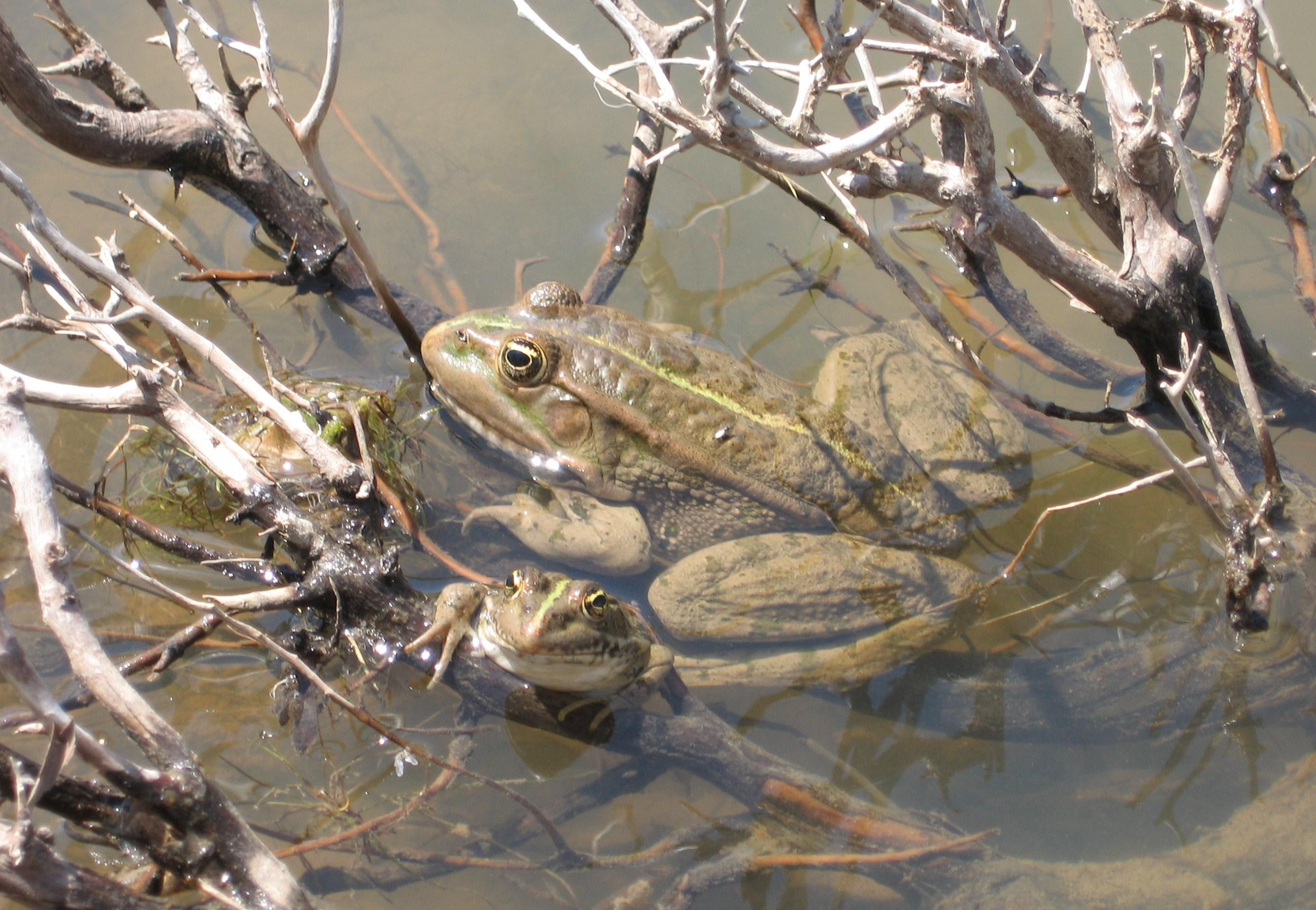
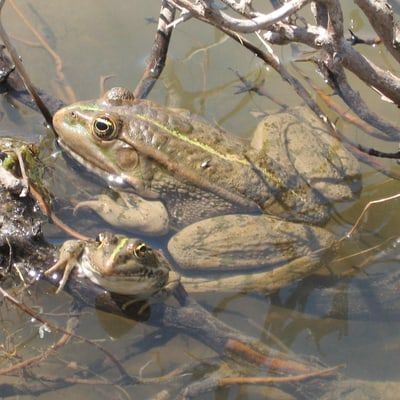
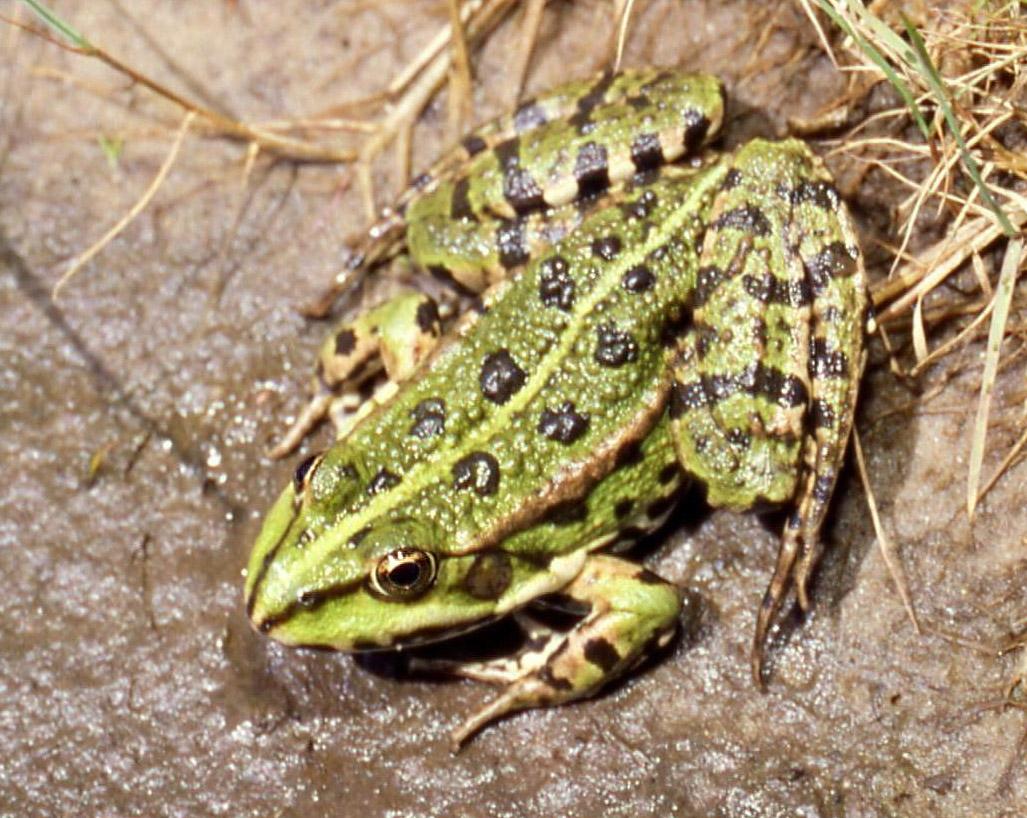
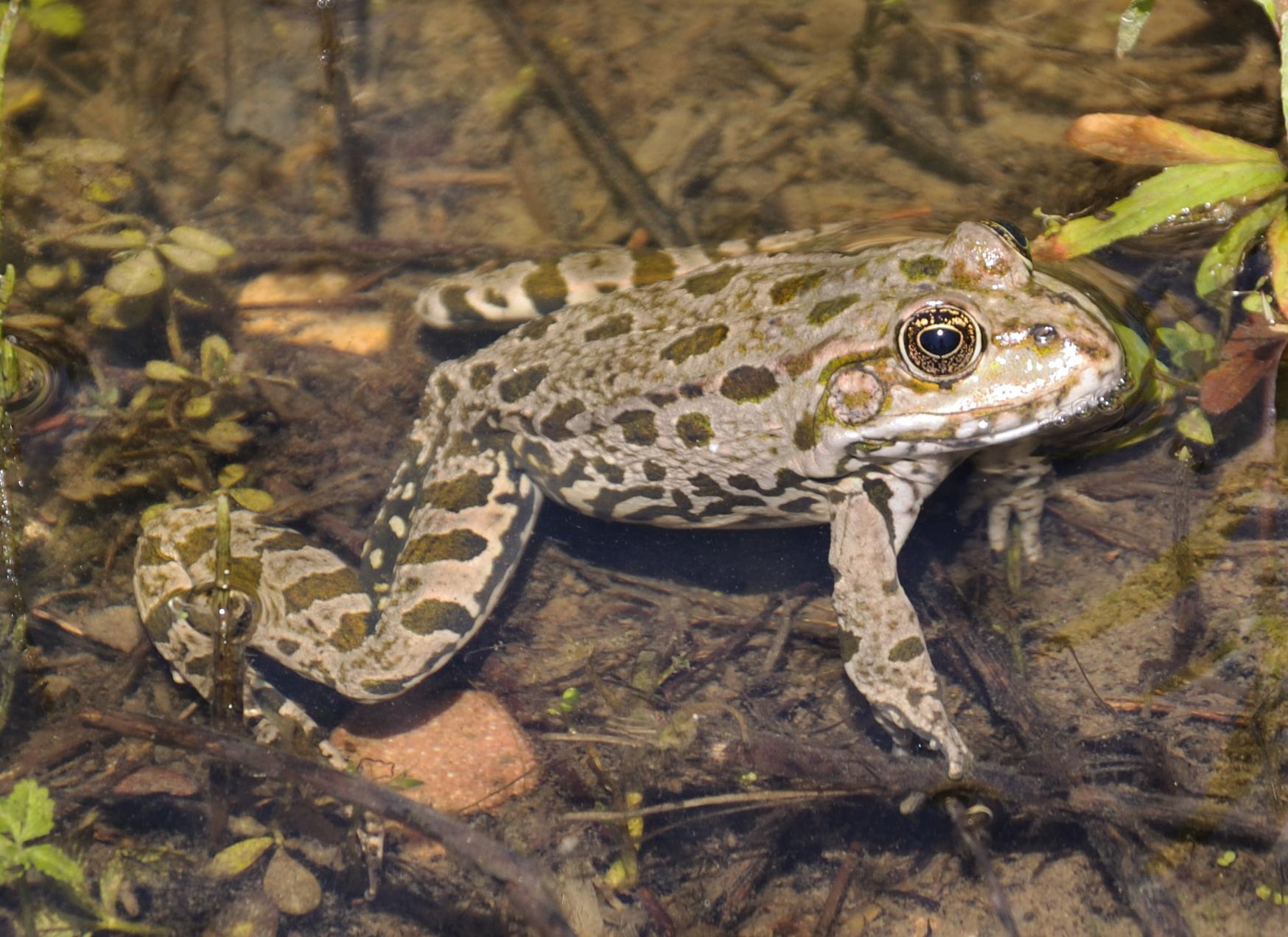
Marsh frogs are comparatively large and have a warty skin. Their backs are olive-green to brown with dark irregular patches. They are marked with a yellow-green longitudinal stripe. Their hind legs are comparatively long.
The males’ vocal sacs are dark-grey. During the mating season, they develop nuptial pads on their thumbs.
Females tend to be larger.
Features
Marsh frog
Pelophylax ridibundus
dark-grey vocal sacs
Einzelrufe
Frommolt, CC BY-SA 3.0

In the city
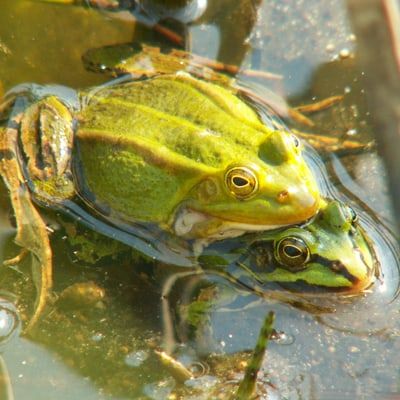
Marsh frogs can be observed sunbathing at the edges of flooded gravel pits, near-natural canal banks or even fish ponds. At the first sign of danger or threat, they disappear into the water. They prefer deeper, not very shaded waters that do not freeze completely in winter.
Fun Facts
The pool frog and the marsh frog are the parent species of the hybrid common water frog (Pelophylax esculentus). The common water frog exhibits characteristics and behavioral patterns (habitat, hibernation) of both species
Their exact taxonomic classification is as yet unclear. One of the reasons for this is the frequent crossbreeding with other frog species (hybridisation).
The mating call of the marsh frog sounds like chuckling laughter.
Warmth-loving marsh frogs are amongst the late spawners and only procreate in May to June.
In its behaviour, a marsh frog is comparatively stationary. Juveniles move only a few metres from the water. To hibernate, marsh frogs dig into the mud at the bottom of bodies of water.
All European amphibians are specially protected and must not be captured, injured or killed.
- Endangerment level Germany: not endangered
Sources
Habitus, Sebaho, PD, https://commons.wikimedia.org/wiki/File:Seefrosch.JPG

Weibchen, Christian Fischer, CC BY-SA 3.0, https://de.wikipedia.org/wiki/Datei:RanaRidibundaFemale.jpg

Habitus, Quartl, CC BY-SA 3.0, https://de.wikipedia.org/wiki/Datei:Pelophylax_ridibundus_qtl1.JPG

Page „Seefrosch“. : Wikipedia, The Free Encyclopedia. Date of last revision: 21.04.2015, 12:19 UTC. URL: https://de.wikipedia.org/w/index.php?title=Seefrosch&oldid=141212495 (Accessed: 10.05.2016).
Kwet, A. (2015) Reptilien und Amphibien Europas. 250 Arten mit Verbreitungskarten, Stuttgart: Franckh Kosmos Verlag.
Blab, J. & Vogel, H. (2002) Amphibien und Reptilien erkennen und schützen, München: BLV.
Glandt, D. (2008) Heimische Amphibien: Bestimmen – Beobachten – Schützen, Wiebelsheim: AULA-Verlag.
Glandt, D. (2015) Die Amphibien und Reptilien Europas, Wiebelsheim: Quelle & Meyer Verlag.
Bundesfachausschuss Feldherpetologie/Ichthyofaunistik im NABU (n.d.) Rote Listen, URL: http://www.amphibienschutz.de/schutz/artenschutz/roteliste/deutschland.htm (Accessed: 26.07.2016).
Schulte, U. (2013) (2013) Artensteckbrief Seefrosch (Pelophylax ridibundus), URL: https://feldherpetologie.de/heimische-amphibien-artensteckbrief/artensteckbrief-seefrosch-pelophylax-ridibundus/ (Accessed: 10.08.2016).
NABU – Naturschutzbund Deutschland e.V. (n.d.) Lautes Lachen am Flussufer. Der Seefrosch (Rana ridibunda), URL: https://www.nabu.de/tiere-und-pflanzen/amphibien-und-reptilien/amphibien/artenportraets/10686.html (Accessed: 10.08.2016).