
Short Description
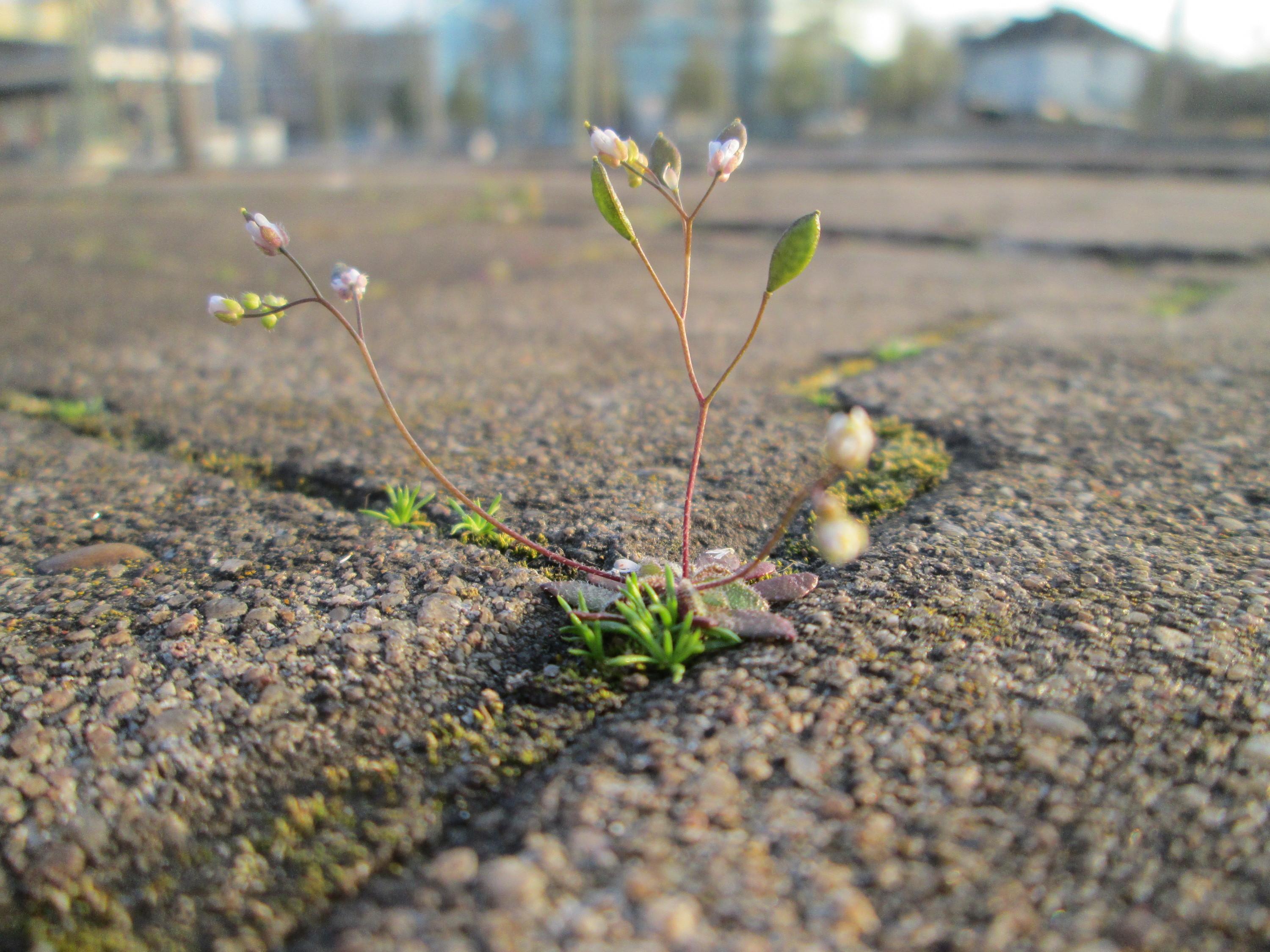
The common whitlowgrass can grow up to 25 centimetres high.
The leaves are elongated to oval and have a smooth or slightly toothed margin. They have branched hairs (stellate hairs). All leaves grow as a rosette on the ground.
The stem is erect, leafless and unbranched. The lower part is often reddish and hairy.
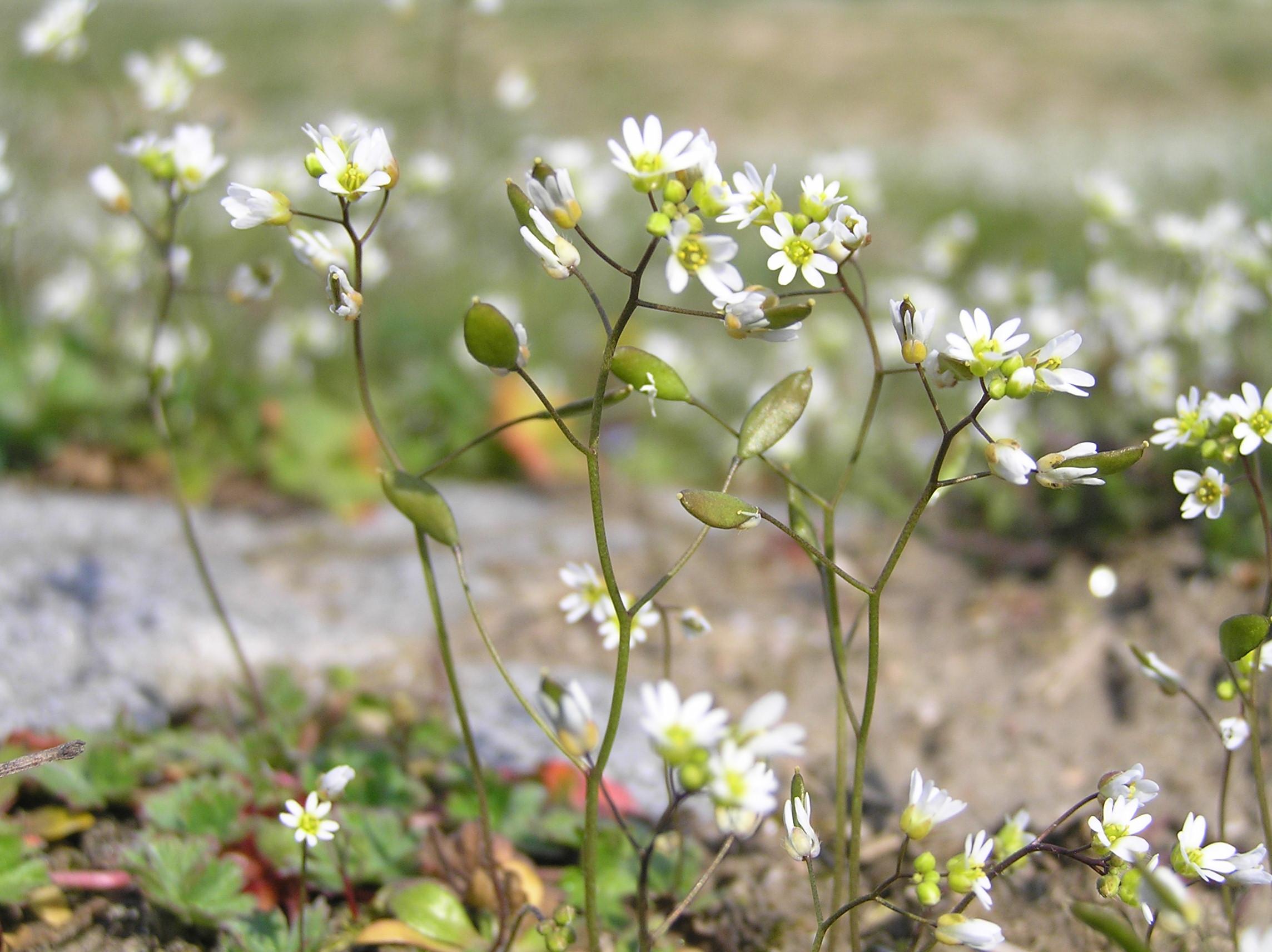
The flower has four white, rarely also reddish, petals. In the middle, the petals are cut about halfway.
The fruit is an oval and flattened pod. It is green and glabrous.
Features
Common whitlowgrass
Draba verna
four split petals
branched hairs on the leaves
In the city
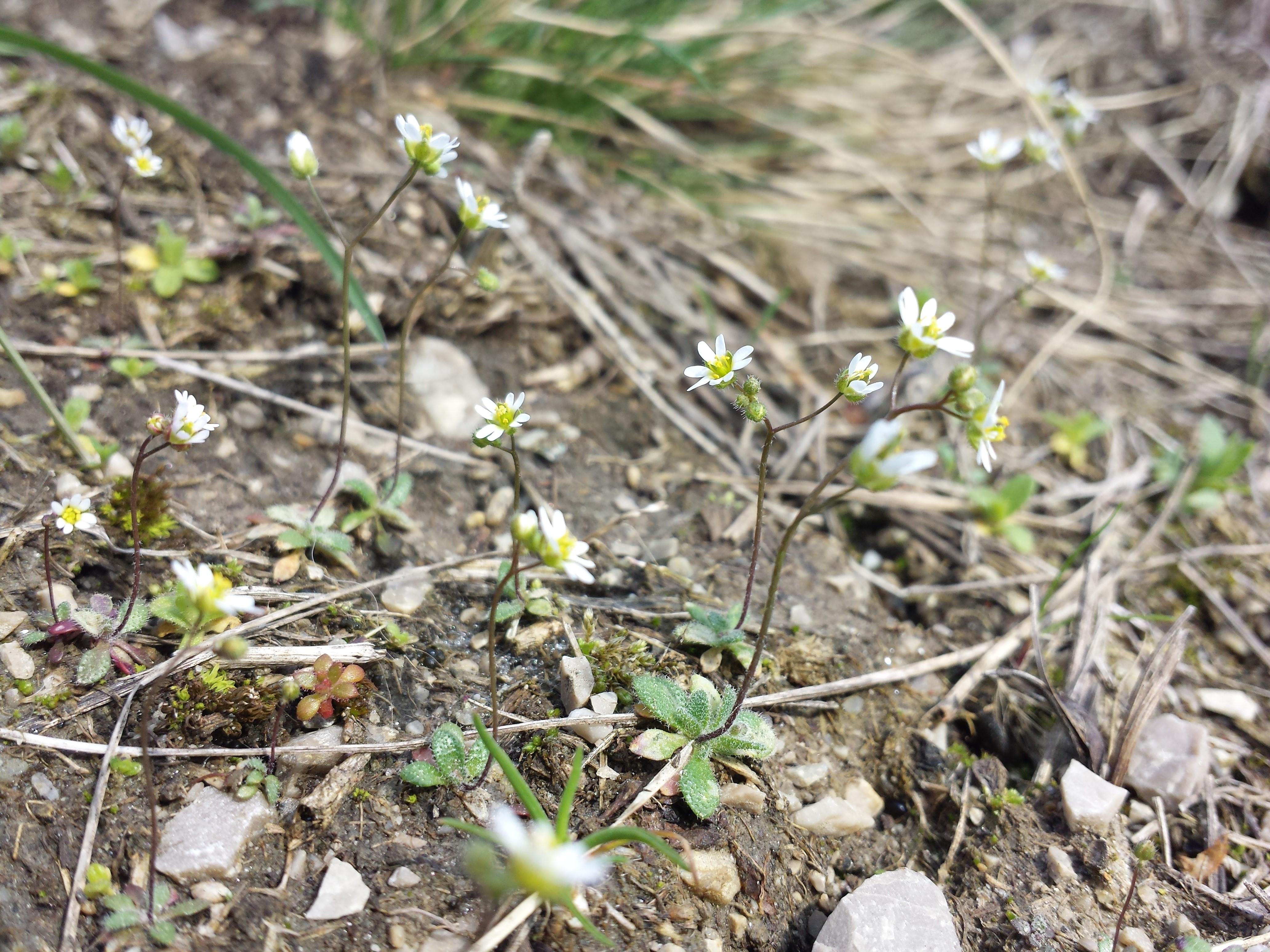
The common whitlowgrass prefers sandy or gravelly, open soils. Therefore, it often grows on fallow land and railway tracks, along paths, on walls and in pavement cracks. If the space is available, often numerous plants grow next to each other. It is light-loving.
Fun Facts
The seeds usually germinate only in winter.
The leaves wither before the fruits are ripe. However, the green fruits can photosynthesise themselves and thus form the seeds.
The flowering period is from March to May.
It is an annual plant, i.e. it flowers for only one summer and dies after the seeds have ripened.
The flowers are rarely visited by insects. Self-pollination, on the other hand, is frequent and is encouraged by closing the flowers during the night and when it rains.
- Endangerment level Germany: not endangered
The common whitlowgrass originates from Europe and Asia.
Sources
Habitus, AnRo0002, CC0 1.0, https://commons.wikimedia.org/wiki/File:20190401Draba_verna6.jpg

Habitus, Stefan.lefnaer, CC BY-SA 4.0, https://commons.wikimedia.org/wiki/File:Draba_verna_s._lat._sl19.jpg

Blüten und Früchte, Petr Filippov, CC BY-SA 3.0, https://commons.wikimedia.org/wiki/File:Erophila_verna1.JPG

Kammer, P. M. (2016) Pflanzen einfach bestimmen. Schritt für Schritt einheimische Arten kennenlernen, Bern: Haupt Verlag.
Schauer, T., Caspari, C. & Caspari, S. (2015) Der illustrierte BLV-Pflanzenführer für unterwegs. 1150 Blumen, Gräser, Bäume und Sträucher, München: BLV.
Spohn, M., Golte-Bechtle, M. & Spohn, R. (2015) Was blüht denn da? Stuttgart: Franckh Kosmos Verlag.
Page „Frühlings-Hungerblümchen“. : Wikipedia, The Free Encyclopedia. Date of last revision: 12.07.2017, 20:11 UTC. URL: https://de.wikipedia.org/w/index.php?title=Fr%C3%BChlings-Hungerbl%C3%BCmchen&oldid=167214957 (Accessed: 01.02.2018).
Bundesamt für Naturschutz (n.d.) Artensteckbriefe, URL: http://floraweb.de/pflanzenarten/artenhome.xsql?suchnr=32168& (Accessed: 01.02.2018).