
Short Description
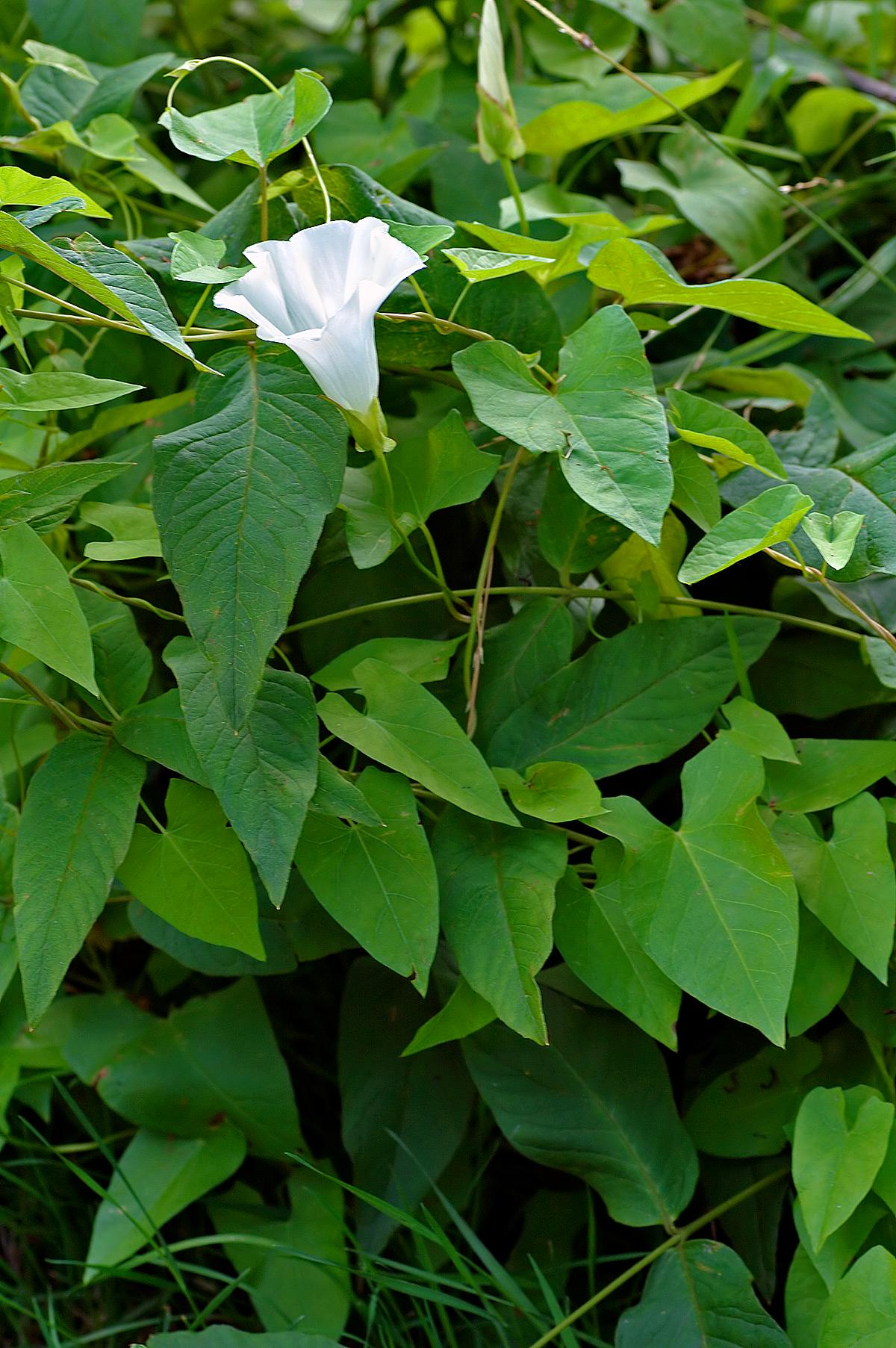
The hedge bindweed can grow to three metres long.
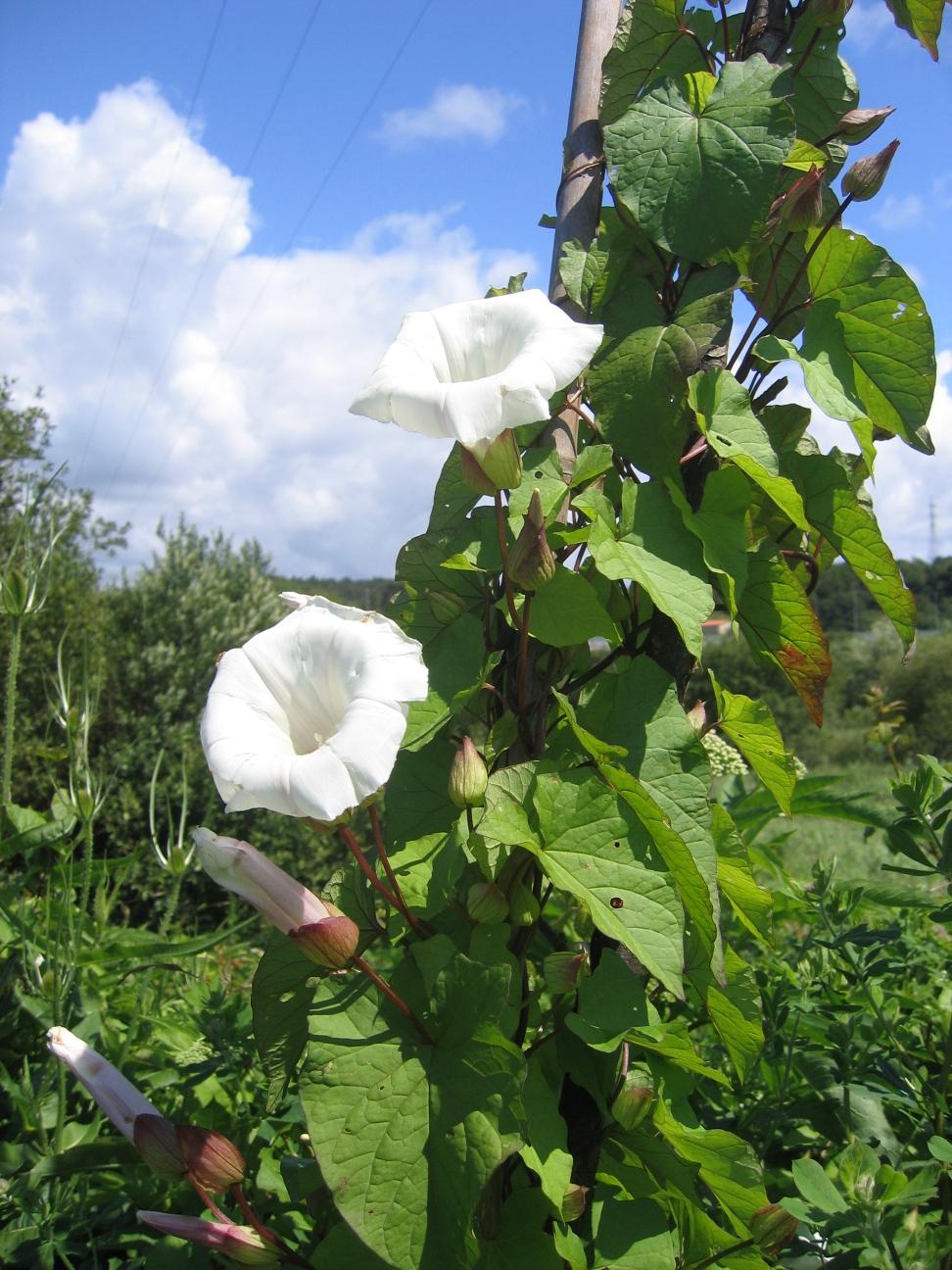
The leaves grow singly and successively on the stem (alternate). They are heart-shaped to arrow-shaped. The flower arises at its base from two large bracts.
The stem is close to the ground and creeping or winding. It can entwine other plants.
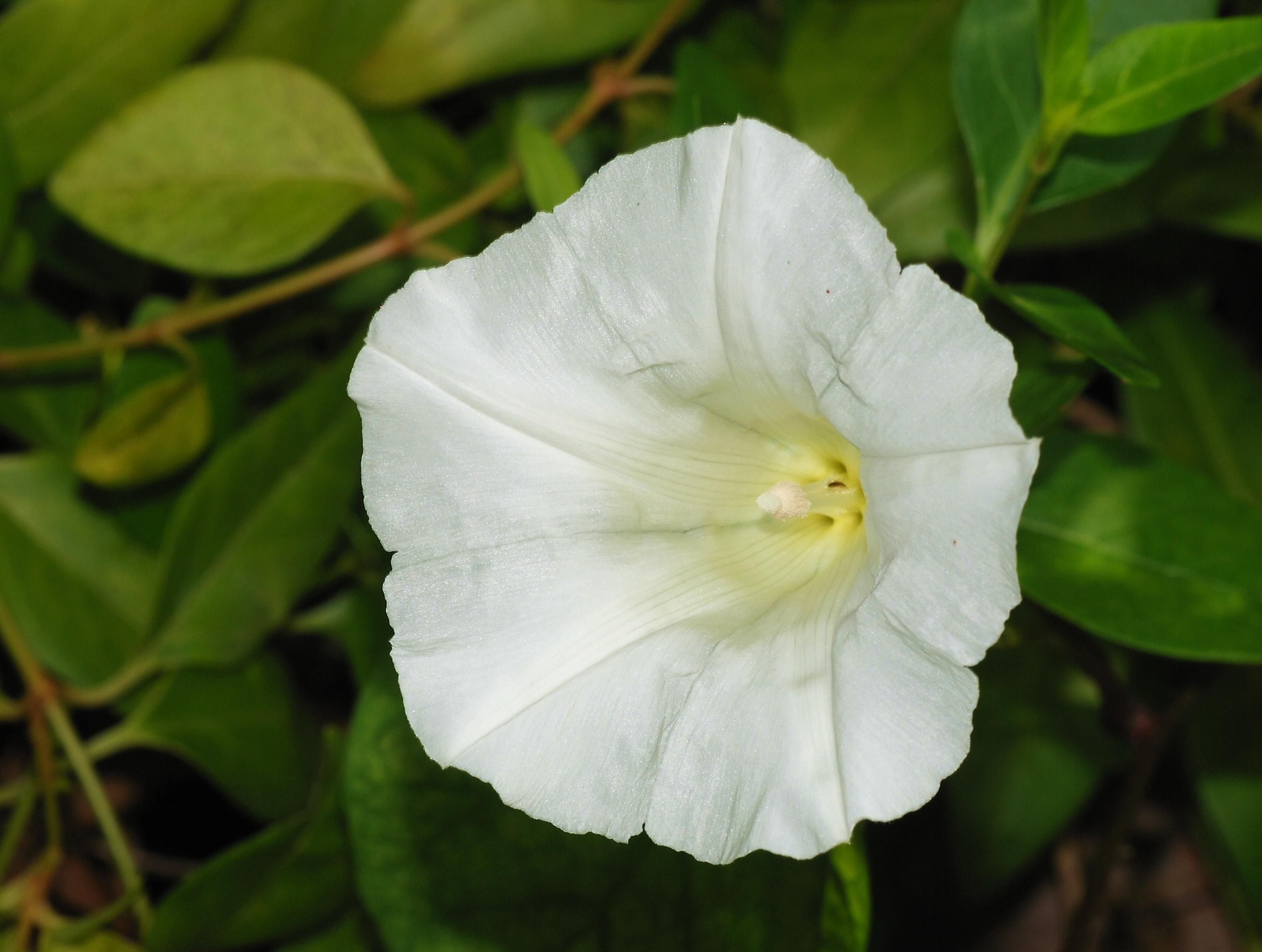
The flowers are trumpet-shaped and pure white.
The fruit is a capsule.
Features
Hedge bindweed
Calystegia sepium
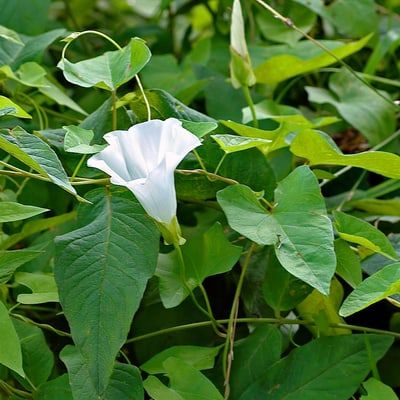
trumpet-shaped, pure white flowers
two leaves (bracts) at the flower base
In the city
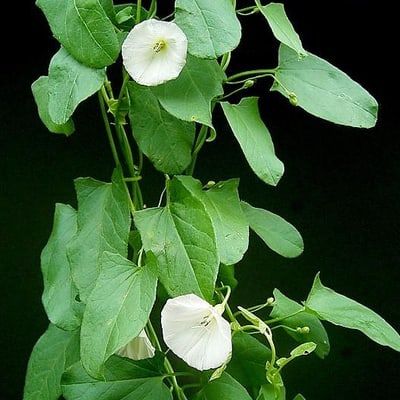
In an urban environment, hedge bindweed is often found along banks or in hedges. It prefers fresh to moist, nutrient-rich sites with clay and loam soils.
In gardens, it is either planted as an ornamental plant or desperately combatted as a persistent weed.
Fun Facts
Its flowers are closed in bad weather. For that reason, they are regarded as weather prophets.
It flowers from May to September.
The plant performs circular search movements and can thus entwine their supports. However, these movements are too slow to be detected by the human eye. One revolution takes approx. two hours.
It lives for several years and generally flowers and fruits annually (perennial plant).
The flowers are open at night, because they are pollinated by nocturnal insects.
- Endangerment level Germany: not endangered
Hedge bindweed is a medicinal plant. Its resin contains substances with a laxative effect..
Sources
Habitus, André Karwath aka Aka, CC BY-SA 2.5, https://commons.wikimedia.org/wiki/File:Calystegia_sepium_sepium_(aka).jpg
.jpg)
Blüte, Alvesgaspar, CC BY-SA 3.0, https://commons.wikimedia.org/wiki/File:Calystegia_April_2008-1.jpg

Habitus, Jon Peli Oleaga, CC BY-SA 3.0, https://commons.wikimedia.org/wiki/File:Calystegia_sepium_20080607_161832_Bizkaia_43p3460N_2p9968W.jpg

Spohn, M., Golte-Bechtle, M. & Spohn, R. (2015) Was blüht denn da? Stuttgart: Franckh Kosmos Verlag.
Needon, C. & Petermann, J. (1991) Urania-Naturführer Pflanzen, Leipzig, Jena, Berlin: Urania-Verlag.
Schauer, T., Caspari, C. & Caspari, S. (2015) Der illustrierte BLV-Pflanzenführer für unterwegs. 1150 Blumen, Gräser, Bäume und Sträucher, München: BLV.
Page „Echte Zaunwinde“. : Wikipedia, The Free Encyclopedia. Date of last revision: 07.03.2016, 15:15 UTC. URL: https://de.wikipedia.org/w/index.php?title=Echte_Zaunwinde&oldid=152271206 (Accessed: 06.12.2016).
Bundesamt für Naturschutz (n.d.) Artensteckbriefe, URL: http://floraweb.de/pflanzenarten/artenhome.xsql?suchnr=1012& (Accessed: 06.12.2016).