
Short Description
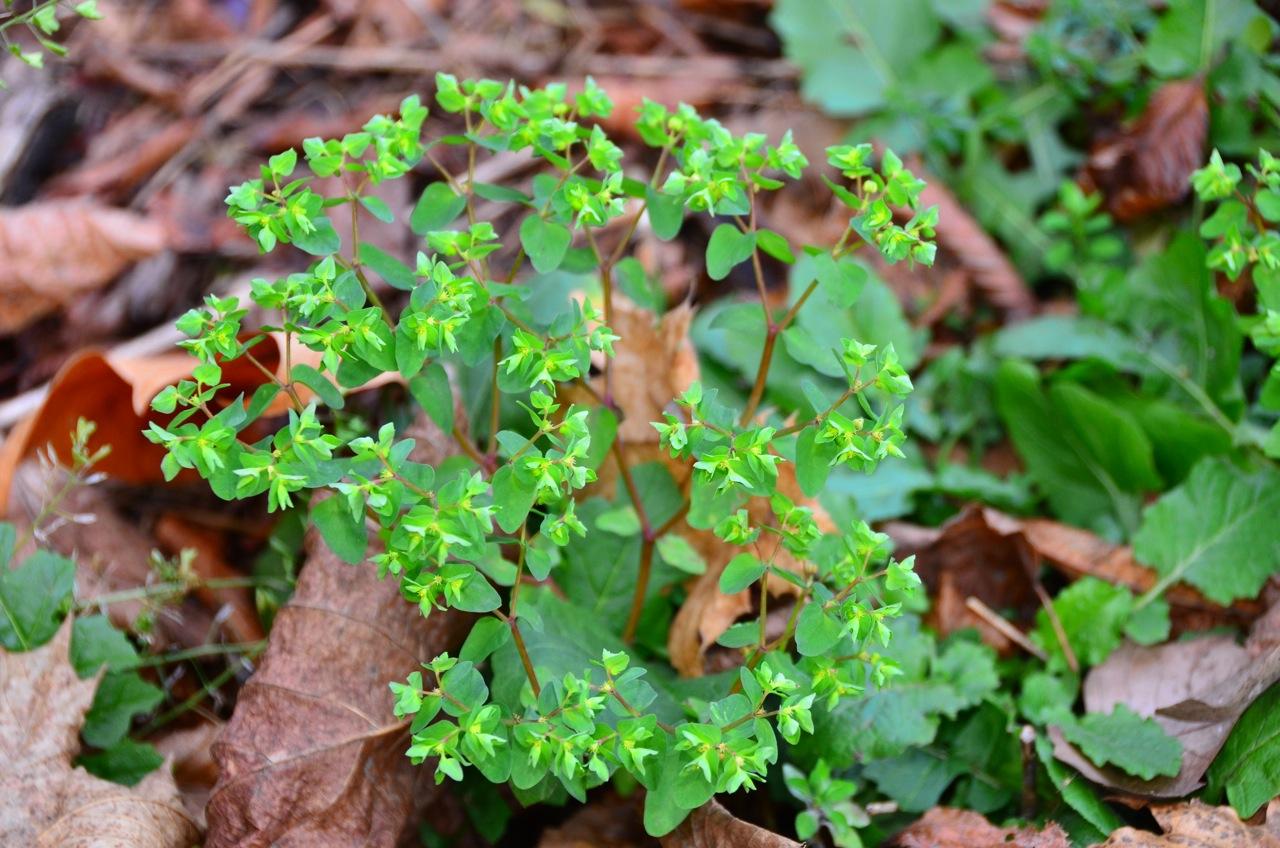
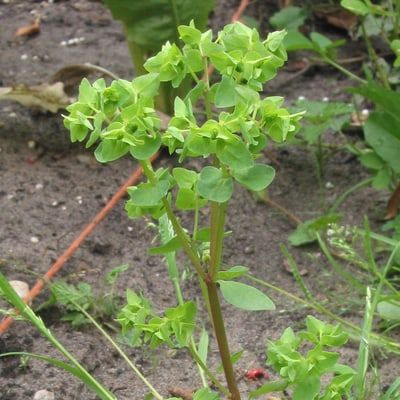
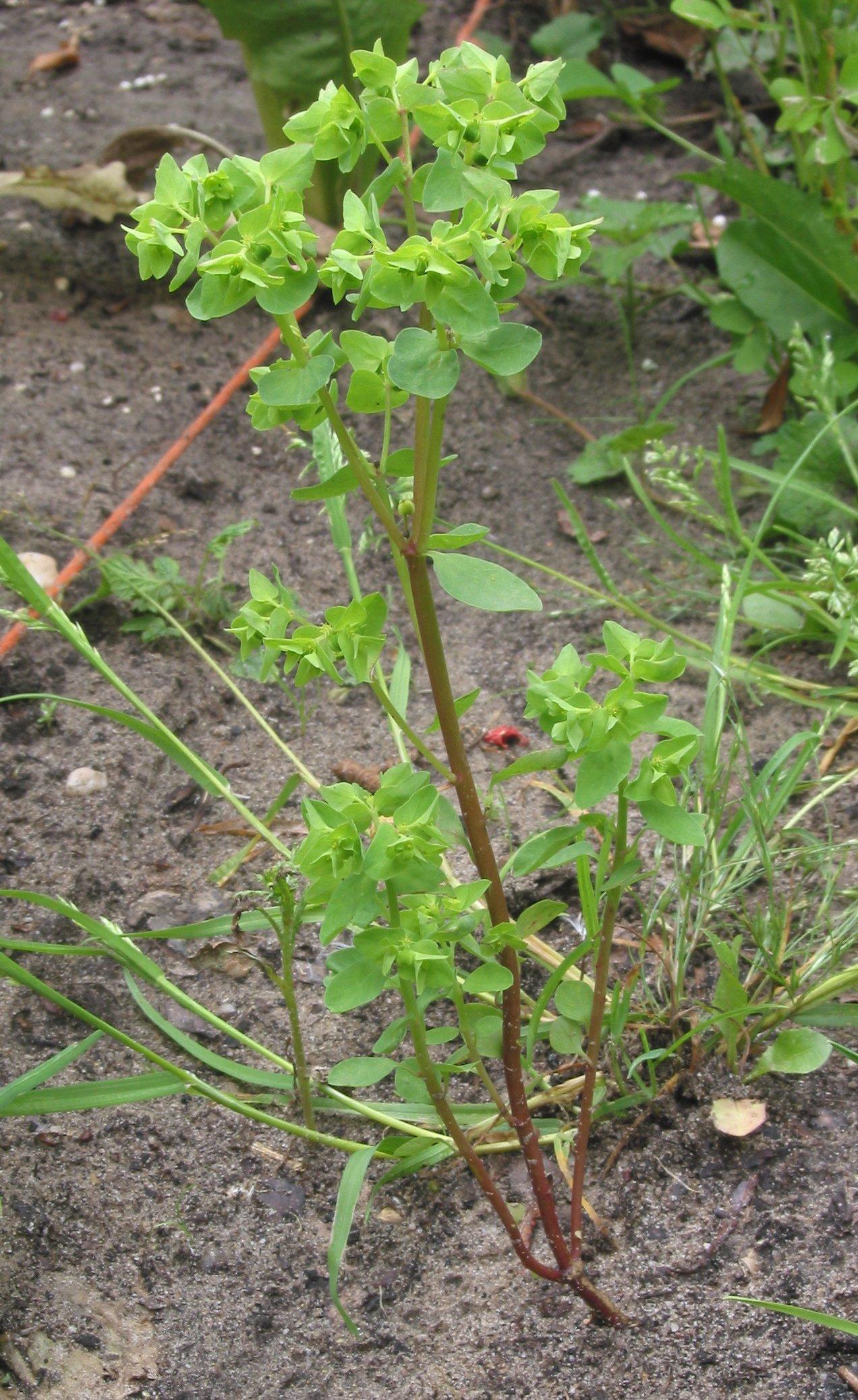
The petty spurge can grow up to 20 centimetres tall.
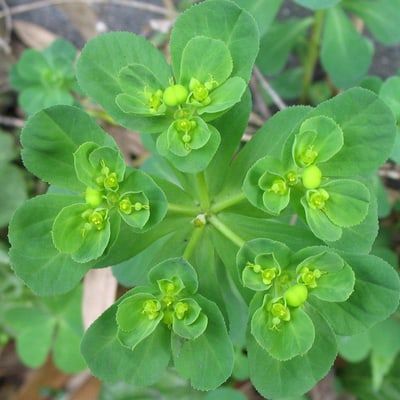
The light green leaves are obovate to round and have entire margins. The stem leaves fall off early so that only leaves remain below the false flowers.
The stem grows erect and often branched. At the end of the stem stand three leaves above which the inflorescence appears.
The inflorescence is an irregularly branched false umbel with three to five rays. The false flowers are tiny and green.
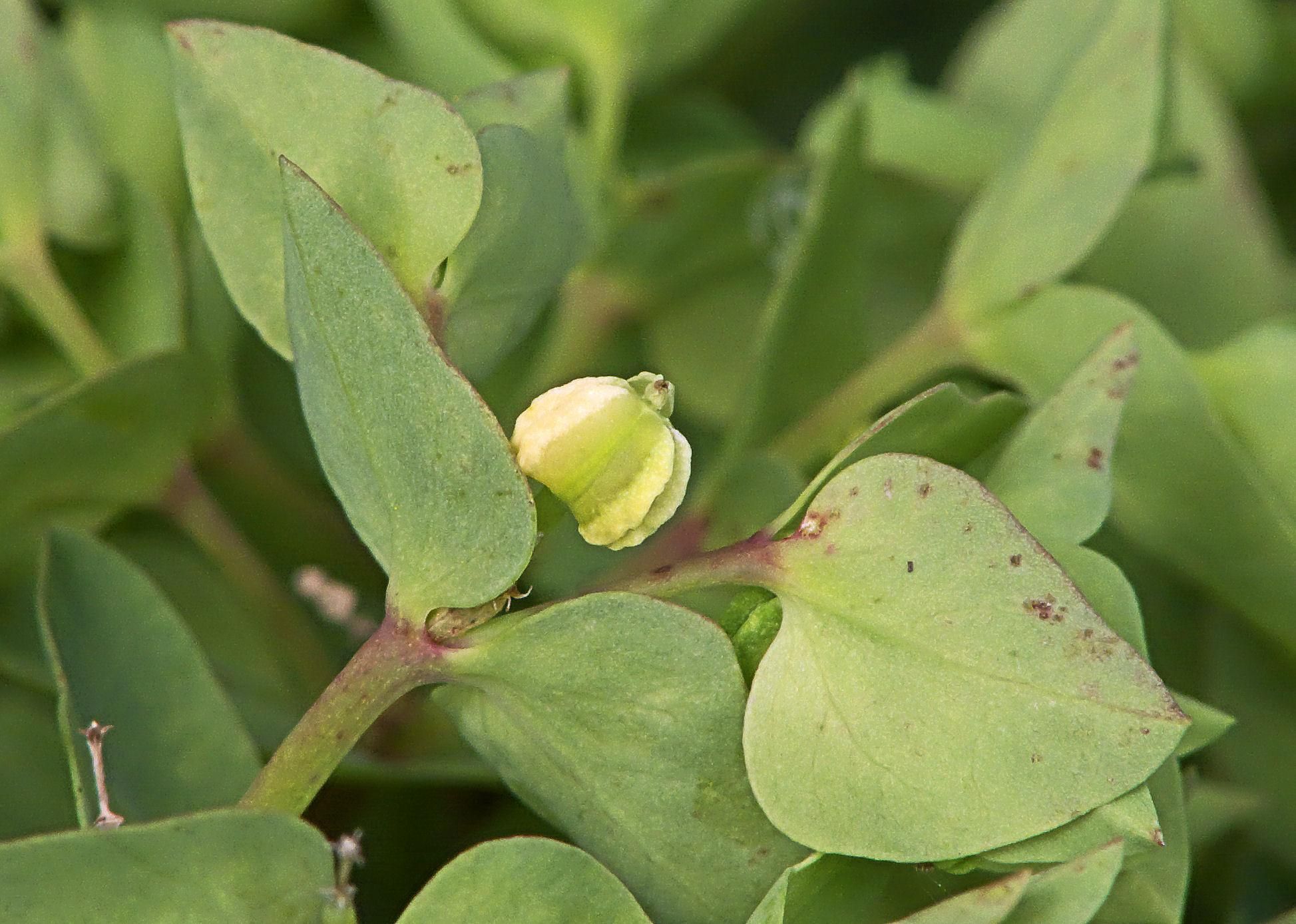
The fruit is a round capsule with three winged bars. It hangs out of the false flower on a long stalk.
Features
Petty spurge
Euphorbia peplus
very poisonous
entire leaves
round capsule fruit with winged bars
In the city
The petty spurge thrives best in moist, nutrient-rich loamy soils in semi-shady locations. In the city it can be found in gardens, fields, cemeteries and ruderal areas.
Fun Facts
Ripe fruits detach as three partial fruits when they dry out. They open explosively and push the seeds away.
The seeds bear a nutritious oil body, so they are carried off and spread by ants.
The flowering period is from July to October.
It is an annual plant, i.e. it flowers for only one summer and dies after the seeds have ripened.
- Endangerment level Germany: not endangered
Thepetty spurge is native to Europe and North Africa, but occurs almost worldwide as a non-native plant (neophyte).
- Usage:
The plant's sap is toxic to rapidly replicating human tissue, and has long been used as a traditional remedy for common skin lesions.
The petty spurge, like all spurge species, is very poisonous.
Sources
Habitus, Radio Tonreg, CC BY-SA 2.0, https://commons.wikimedia.org/wiki/File:Euphorbia_peplus_(8345442913).jpg
.jpg)
Frucht, Rasbak, CC BY-SA 3.0, https://commons.wikimedia.org/wiki/File:Euphorbia_peplus_fruit,_Tuinwolfsmelk_vrucht.jpg

Habitus, Rasbak, CC BY-SA 3.0, https://commons.wikimedia.org/wiki/File:Tuinwolfsmelk_Euphorbia_peplus.jpg

Spohn, M., Golte-Bechtle, M. & Spohn, R. (2015) Was blüht denn da? Stuttgart: Franckh Kosmos Verlag.
Seitz, B., Ristow, M., Meißner, J., Machatzi, B. & Sukopp, H. (2018) Rote Liste und Gesamtartenliste der etablierten Farn- und Blütenpflanzen von Berlin. : Der Landesbeauftragte für Naturschutz und Landschaftspflege / Senatsverwaltung für Umwelt, Klima und Verkehr (eds.) Rote Listen der gefährdeten Pflanzen, Pilze und Tiere von Berlin, URL: https://www.berlin.de/sen/uvk/natur-und-gruen/naturschutz/artenschutz/artenlisten-rote-listen/farn-und-bluetenpflanzen/ (Accessed: 26.03.2021).
Page „Garten-Wolfsmilch“. : Wikipedia, The Free Encyclopedia. Date of last revision: 19.05.2017, 18:46 UTC. URL: https://de.wikipedia.org/w/index.php?title=Garten-Wolfsmilch&oldid=165653701 (Accessed: 26.07.2018).