
Short Description
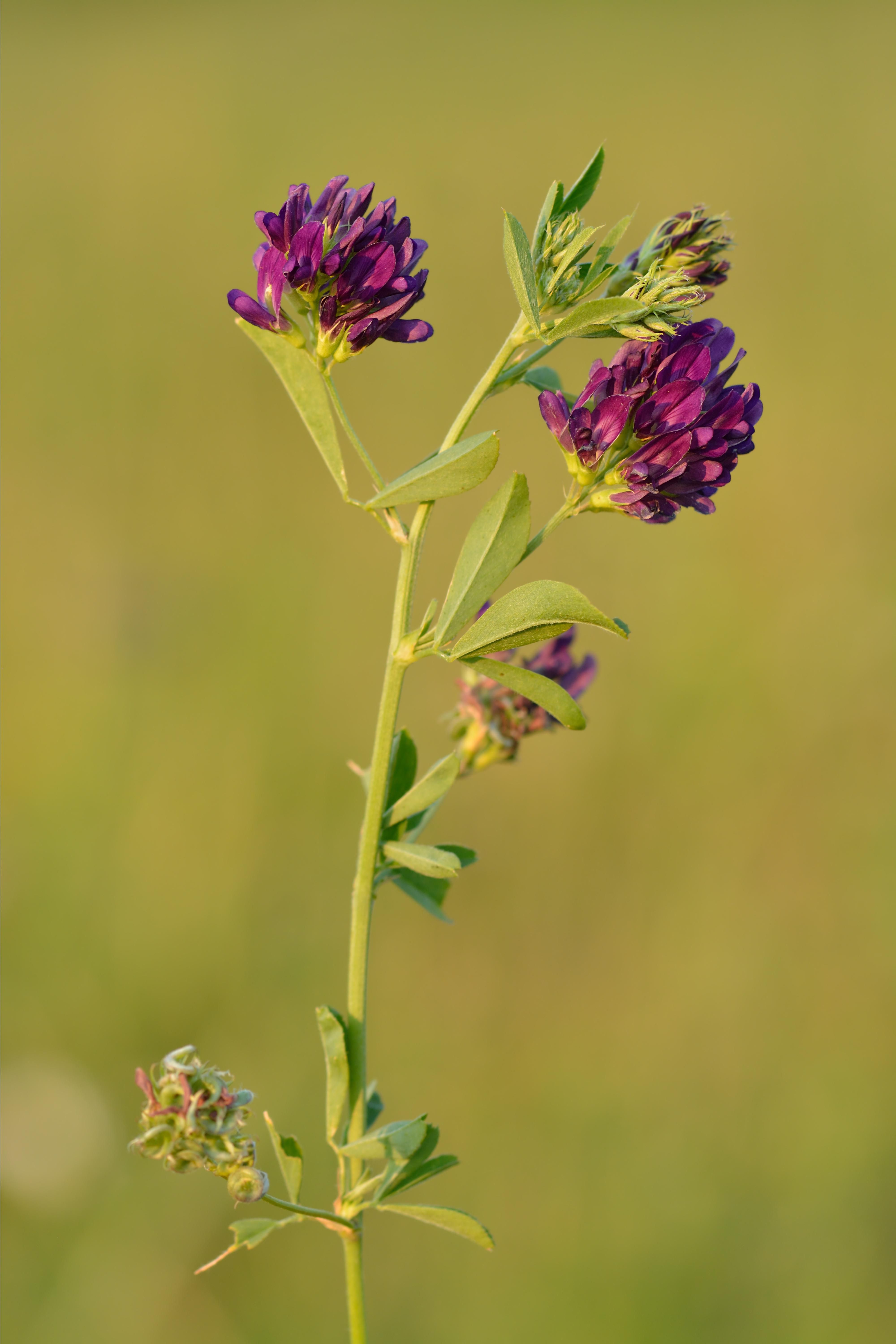
Alfalfa is an overwintering herbaceous plant. It can grow up to one metre high.
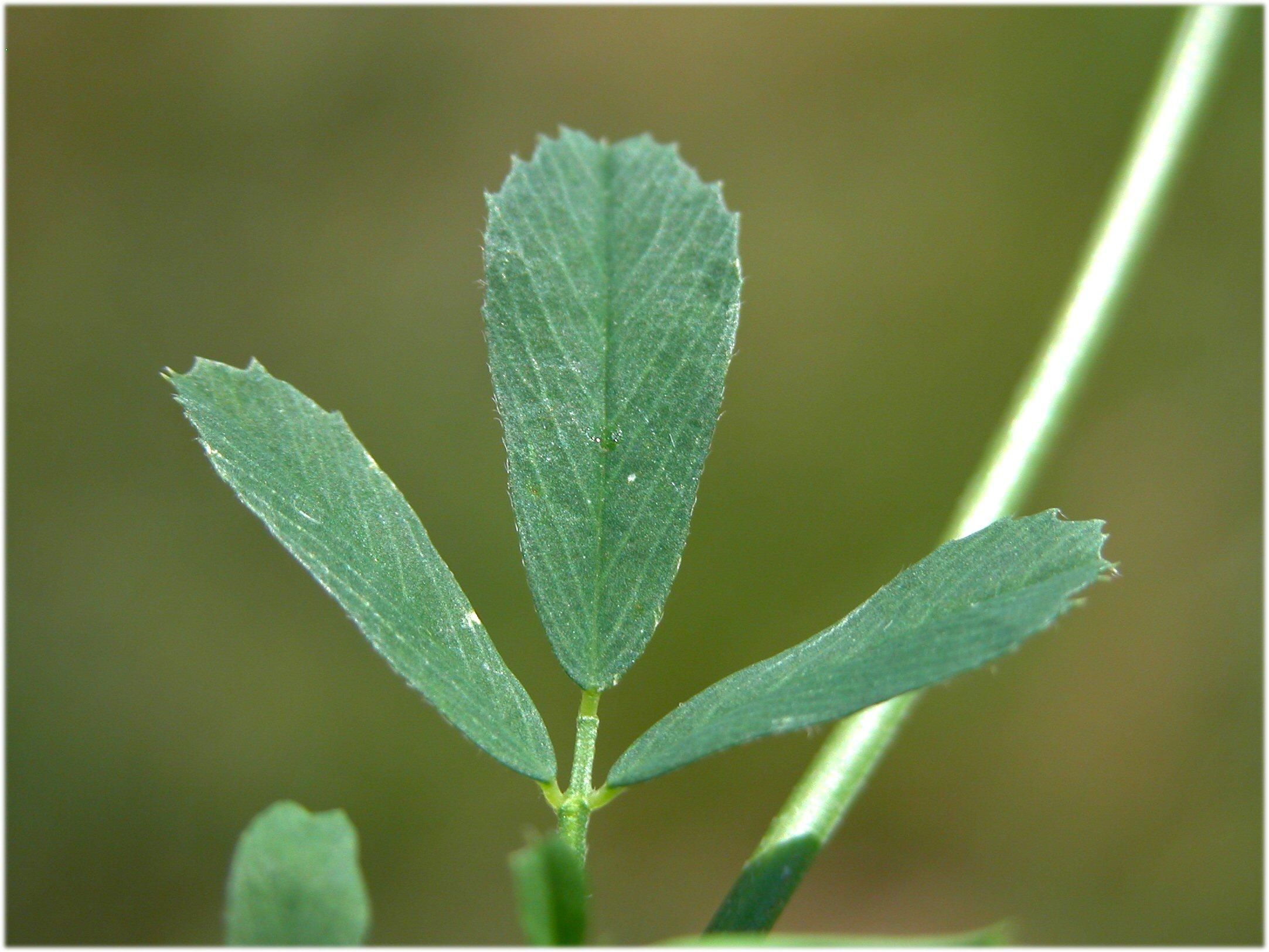
A leaf consists of three leaflets (three-pinnate). At the front they are toothed and pointed.
The stem grows upright.
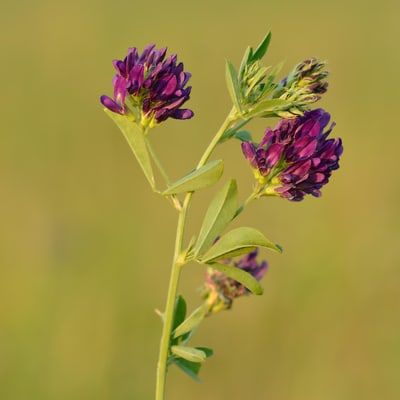
The flowers are clustered together in a dense raceme. The flower colour is blue to violet. The single flower has only one mirror axis (mirror-symmetrical). It consists of five petals. The large upper petal protrudes upwards. The two lower petals form a hollow boat that surrounds the anthers and pistil.
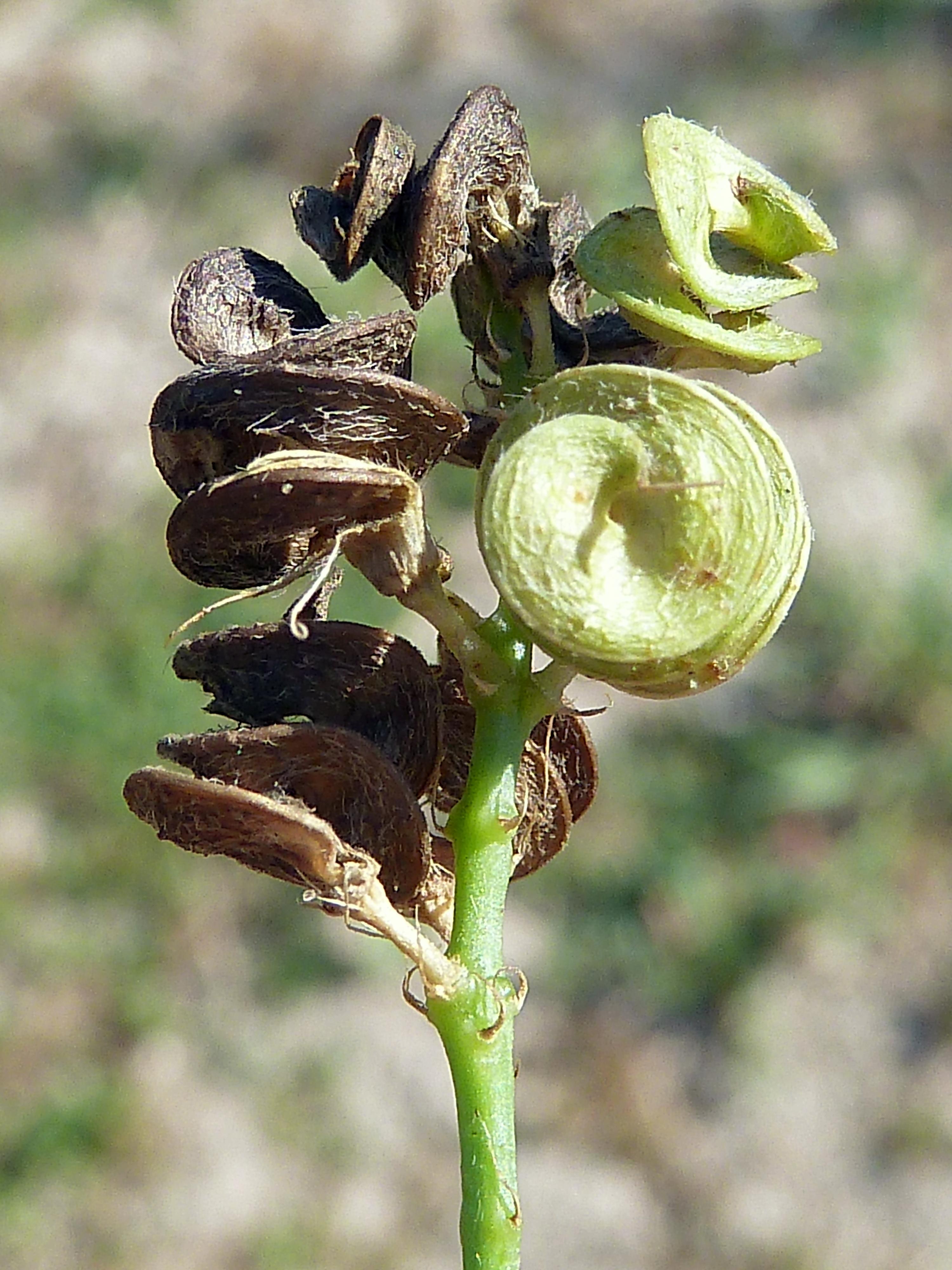
The legumes are twisted in a spiral shape.
Features
Alfalfa
Medicago sativa
trifoliate leaves
spirally twisted legumes
In the city
Alfalfa grows on neglected grasslands and along paths and embankments. It prefers warm and calcareous soils.
Fun Facts
The flowering period is from June to September.
It has a deep root system that helps it survive periods of drought.
It lives for several years and generally flowers and fruits annually (perennial plant).
You can buy germinated seeds of alfalfa as a vegetable.
It improves the soil by accumulating nitrogen.
Living together with root nodule bacteria is typical for the legume family. The bacteria supply the plant with nitrogen. Since the bacteria need a plant for nitrogen fixation, this coexistence has a positive effect on both species (symbiosis).
- Endangerment level Germany: not evaluated
It is one of the most important green fodder plants.
Sources
Habitus, var Leidus, CC BY-SA 3.0, https://commons.wikimedia.org/wiki/File:Medicago_sativa_-_harilik_lutsern_Keilas.jpg?uselang=de

Blatt, Andrea Moro, CC BY-SA 3.0, https://species-id.net/openmedia/File:Dryades_TSB12664.jpg

Frucht, Philmarin, CC BY-SA 3.0, https://commons.wikimedia.org/wiki/File:Alfalfa-12.JPG

Seitz, B., Ristow, M., Meißner, J., Machatzi, B. & Sukopp, H. (2018) Rote Liste und Gesamtartenliste der etablierten Farn- und Blütenpflanzen von Berlin. : Der Landesbeauftragte für Naturschutz und Landschaftspflege / Senatsverwaltung für Umwelt, Klima und Verkehr (eds.) Rote Listen der gefährdeten Pflanzen, Pilze und Tiere von Berlin, URL: https://www.berlin.de/sen/uvk/natur-und-gruen/naturschutz/artenschutz/artenlisten-rote-listen/farn-und-bluetenpflanzen/ (Accessed: 26.03.2021).
Spohn, M., Golte-Bechtle, M. & Spohn, R. (2015) Was blüht denn da? Stuttgart: Franckh Kosmos Verlag.
Schauer, T., Caspari, C. & Caspari, S. (2015) Der illustrierte BLV-Pflanzenführer für unterwegs. 1150 Blumen, Gräser, Bäume und Sträucher, München: BLV.
Bundesamt für Naturschutz (n.d.) Artensteckbriefe, URL: http://floraweb.de/pflanzenarten/artenhome.xsql?suchnr=3616& (Accessed: 14.08.2018).
Page „Luzerne“. : Wikipedia, The Free Encyclopedia. Date of last revision: 07.07.2018, 23:15 UTC. URL: https://de.wikipedia.org/w/index.php?title=Luzerne&oldid=178959446 (Accessed: 14.08.2018).