

Short Description
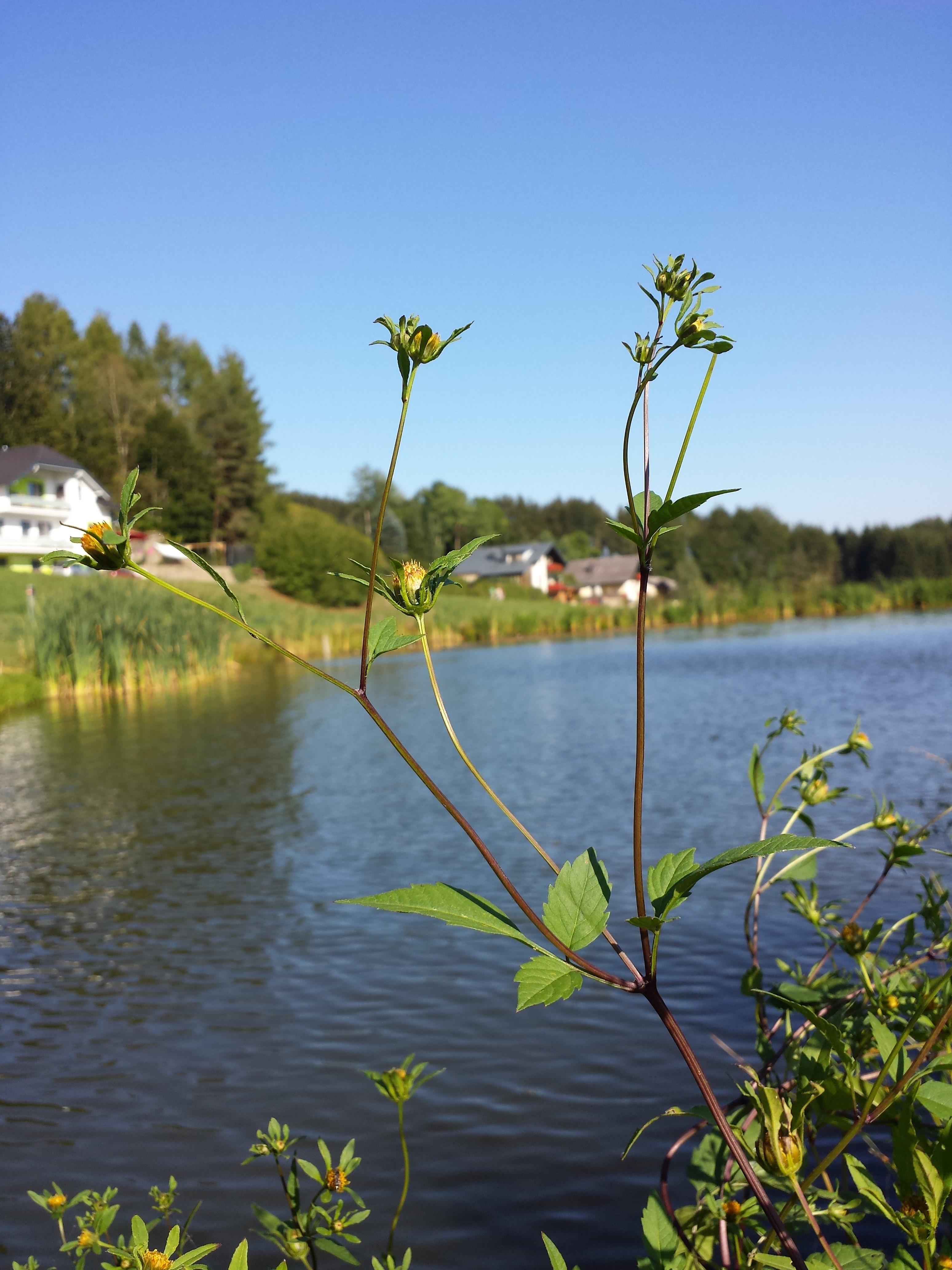
The devil's beggarticks can grow up to 120 centimeters high.
The long-stalked leaves are divided into three separate leaves. The partial leaves are narrow and elongated. The leaf margin is serrated.
The erect stem is strongly branched and often purple in color.
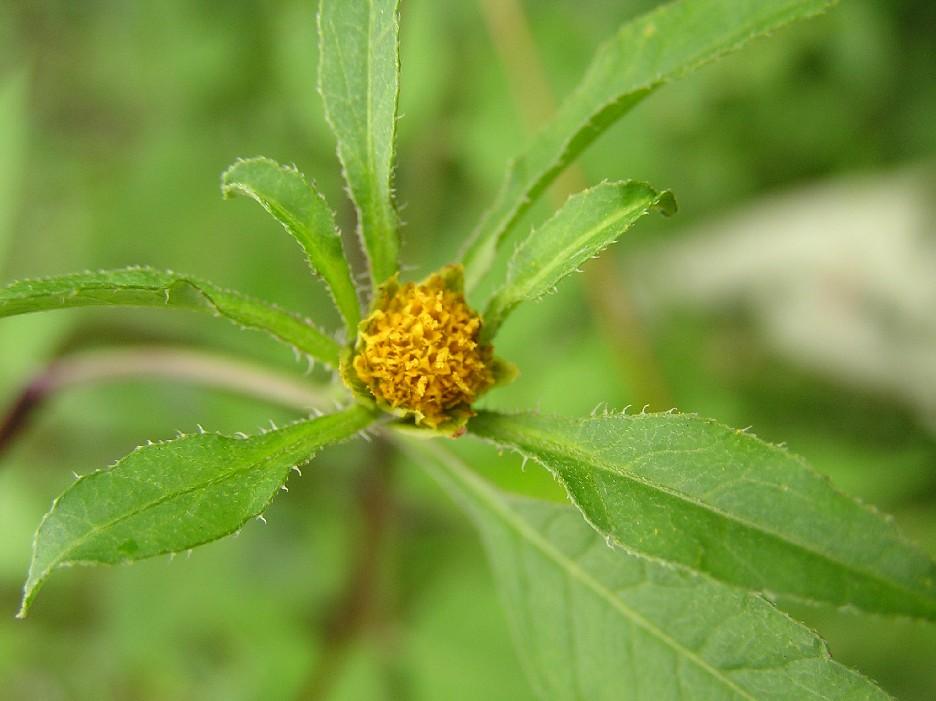
Numerous small, yellow tubular flowers stand together in a flower head, which at first glance can be mistaken for the flower. The flower head is surrounded by five to eight green bracts, which look like petals.
The plant develops small nut-like fruits. They are bumpy and have two bristles on top, which are covered with backward hooks.

Features
Devil's beggarticks
Bidens frondosa
three leaflets
only yellow tubular flowers

In the city
It prefers moist, nutrient- and nitrogen-rich sites. In the city, it is found mainly along shorelines, rivers, ditches, ponds and lakes. However, it also grows in dry ruderal places such as roadsides.
Many species from the genus are offered as ornamental plants for balconies.
Fun Facts
The fruits get hooked in the fur of animals with the help of the backward spines of the bristles and are thus spread.
The flowers are pollinated by insects.
The flowering period is from August to September.
It is an annual plant. This means the plant dies in the first year after the maturation of the seeds.
- Endangerment level Germany: not evaluated
It originates from North America. In Germany, it was introduced by humans and is a non-native plant (neophyte).
Sources
Habitus, Dalgial, CC BY-SA 3.0, https://commons.wikimedia.org/wiki/File:%EB%AF%B8%EA%B5%AD%EA%B0%80%EB%A7%89%EC%82%AC%EB%A6%AC.JPG

Blütenstand, Michael Becker, CC BY-SA 3.0 , https://commons.wikimedia.org/wiki/File:Bidens_frondosa_2005.08.21_15.08.04-p8210033.jpg

Habitus, Stefan.lefnaer, CC BY-SA 4.0, https://commons.wikimedia.org/wiki/File:Bidens_frondosa_sl10.jpg

Spohn, M., Golte-Bechtle, M. & Spohn, R. (2015) Was blüht denn da? Stuttgart: Franckh Kosmos Verlag.
Page „Schwarzfrüchtiger Zweizahn“. : Wikipedia, The Free Encyclopedia. Date of last revision: 13.03.2018, 21:00 UTC. URL: https://de.wikipedia.org/w/index.php?title=Schwarzfr%C3%BCchtiger_Zweizahn&oldid=174987269 (Accessed: 17.05.2018).