
Short Description
The cow vetch can grow to a height of 1.2 m.
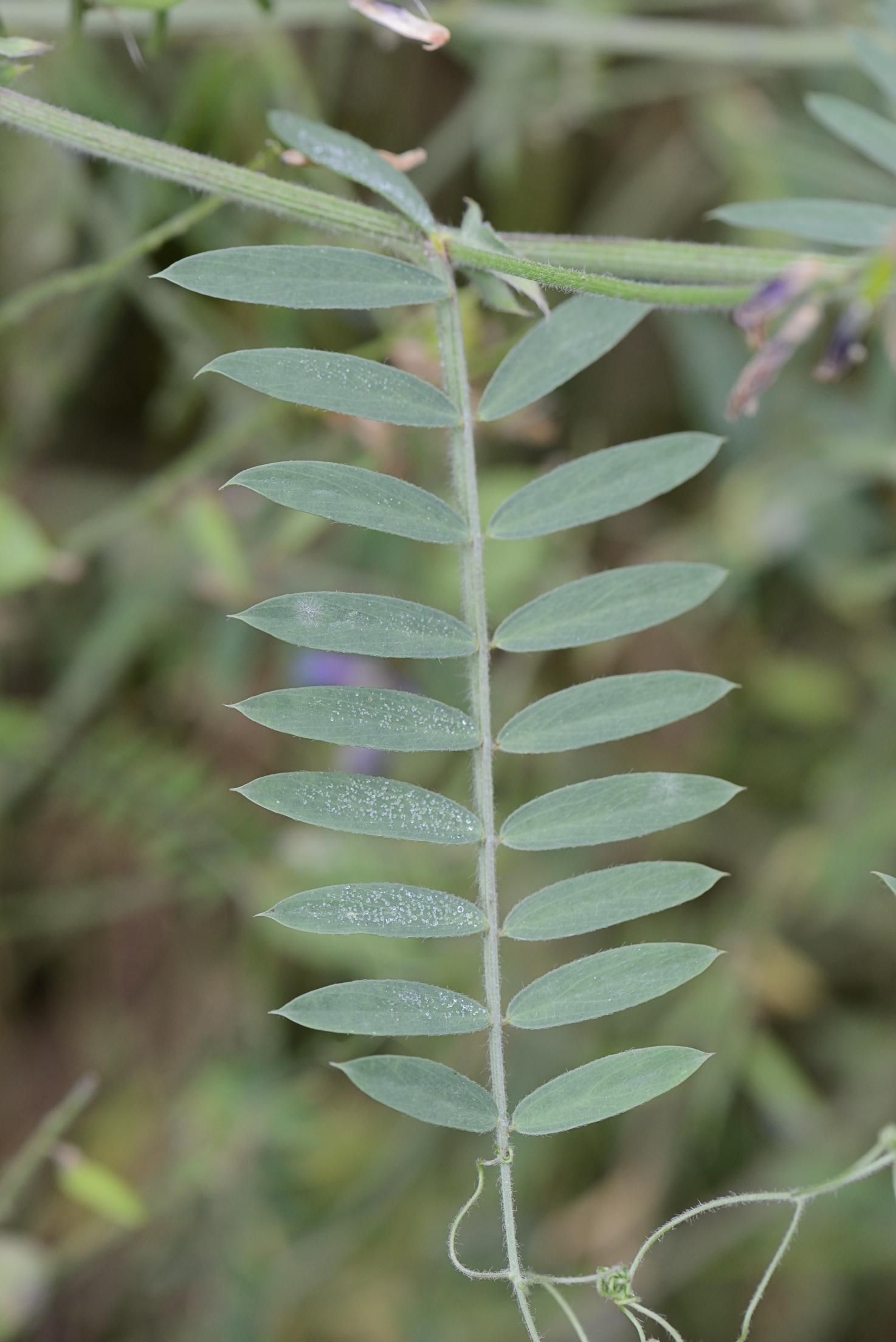
The leaves consist of numerous (feather-like) leaflets. They grow alternately on the stem. Its pinnate leaves are lance-shaped and pointed. Most leaves terminate in a generally branched tendril.
The plant often has adpressed hairs. The stem is generally prostrate (lying flat on the ground) or climbing and can have underground branches. It is markedly grooved.
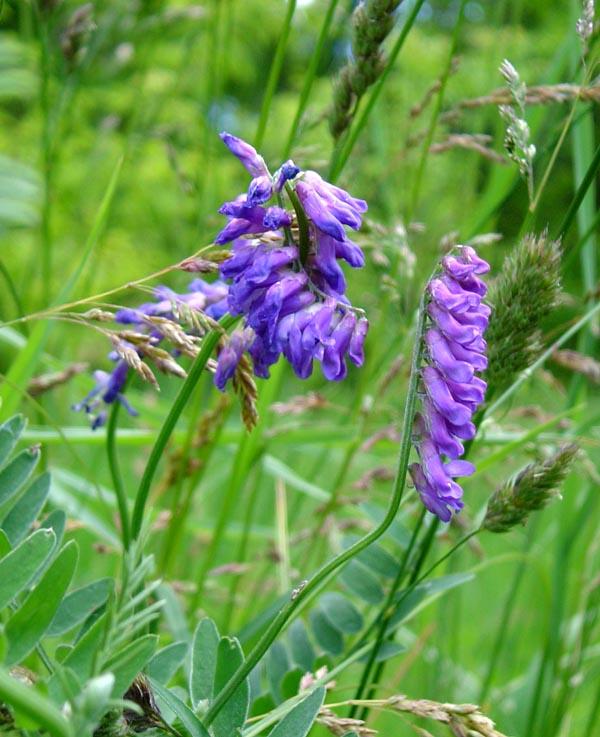
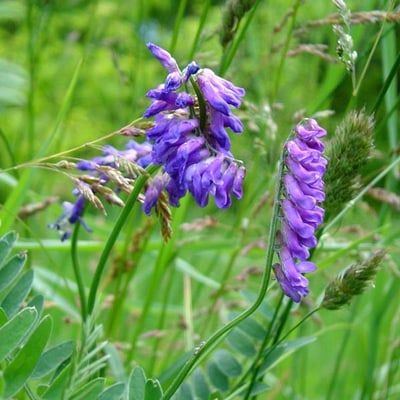
The flowers are clustered in flower heads, mostly pointing in the same direction. The individual florets are elongated and narrow and blue to purple in colour. They have only a single mirror axis (mirror-symmetric). The flower consists of five petals. The large upper petal protrudes upwards. The two lower petals form a hollow boat that surrounds the anthers and pistil.
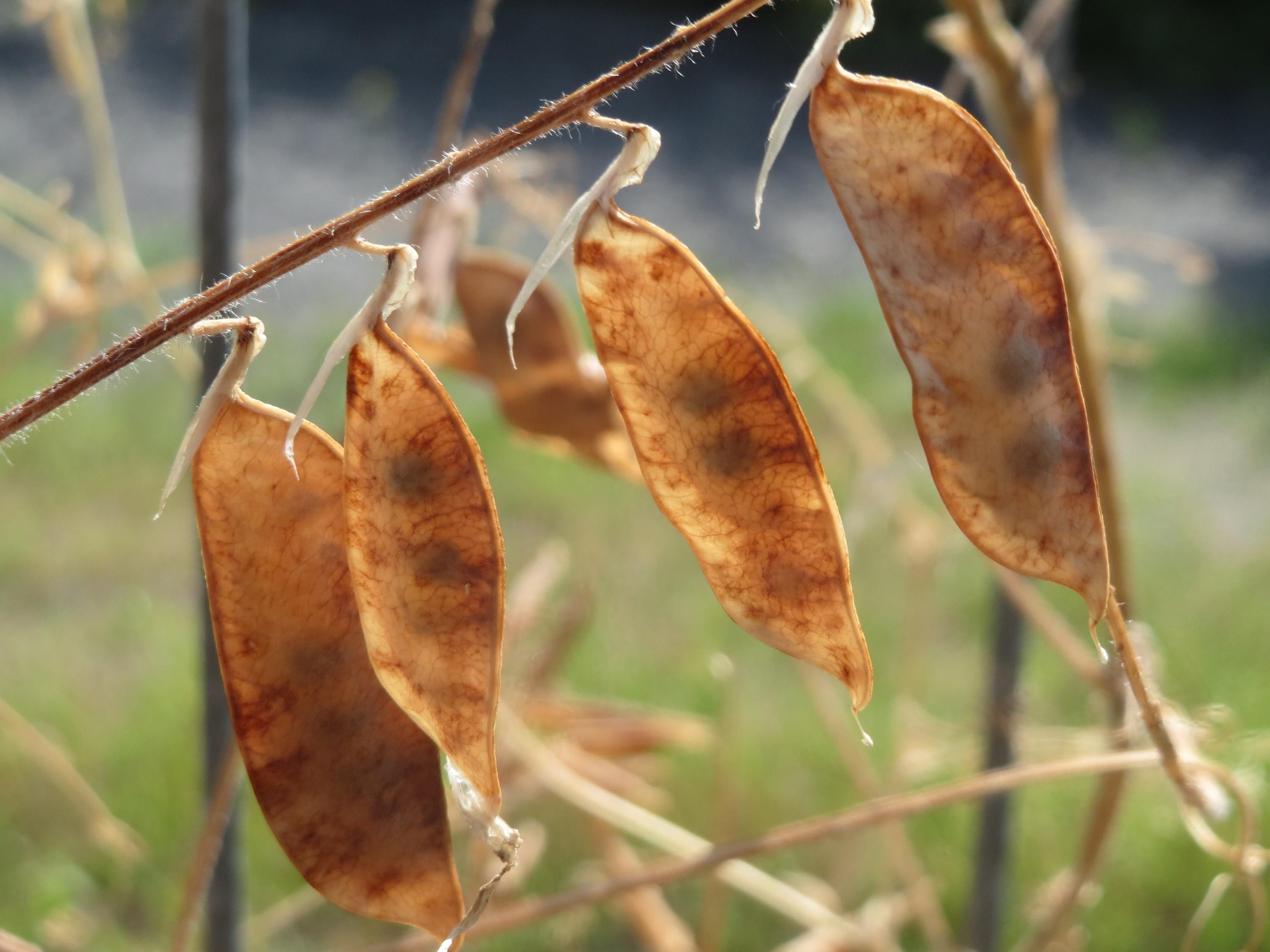
The fruits are small pods with few seeds.
Features
Cow vetch
Vicia cracca
narrow blue to purple flowers
leaves with tendrils
In the city
In the city, cow vetch can be found in meadows, along forest edges and near banks. It prefers near-natural habitats, which is why it is increasingly rare in the city. It prefers moderately dry sites with clay and loam soils.
Fun Facts
Cow vetch tendrils perform circular searching movements and react to touch stimulation. However, these movements are very slow and thus cannot be directly perceived by the human eye.
The tendrils at the end of the pinnate leaves have developed over the course of evolution.
It is poisonous to cattle but can be eaten by birds.
It flowers from June to August.
It lives for several years and generally flowers and fruits annually (perennial plant).
- Endangerment level Germany: not endangered
Cow vetch is a synanthrope (ecologically associated with humans) and has spread across many parts of Europe and North America as a field weed in the wake of arable farming.
Young shoots and pods can be prepared as a vegetable. The flower can be used in tea blends.
Sources
Blütenstand, Hadal, CC BY-SA 3.0, https://commons.wikimedia.org/wiki/File:Cow_vetch2.jpg

Laubblatt, Rasbak, CC BY-SA 3.0, https://commons.wikimedia.org/wiki/File:Vicia_cracca_leaf,_vogelwikke_blad_(1),_Lunteren.jpg
,_Lunteren.jpg)
Früchte, AnRo0002, CC0, https://commons.wikimedia.org/wiki/File:20160721Vicia_cracca3.jpg

Spohn, M., Golte-Bechtle, M. & Spohn, R. (2015) Was blüht denn da? Stuttgart: Franckh Kosmos Verlag.
Schauer, T., Caspari, C. & Caspari, S. (2015) Der illustrierte BLV-Pflanzenführer für unterwegs. 1150 Blumen, Gräser, Bäume und Sträucher, München: BLV.
Page „Vogel-Wicke“. : Wikipedia, The Free Encyclopedia. Date of last revision: 17.06.2016, 06:52 UTC. URL: https://de.wikipedia.org/w/index.php?title=Vogel-Wicke&oldid=155372406 (Accessed: 22.11.2016).