
Short Description
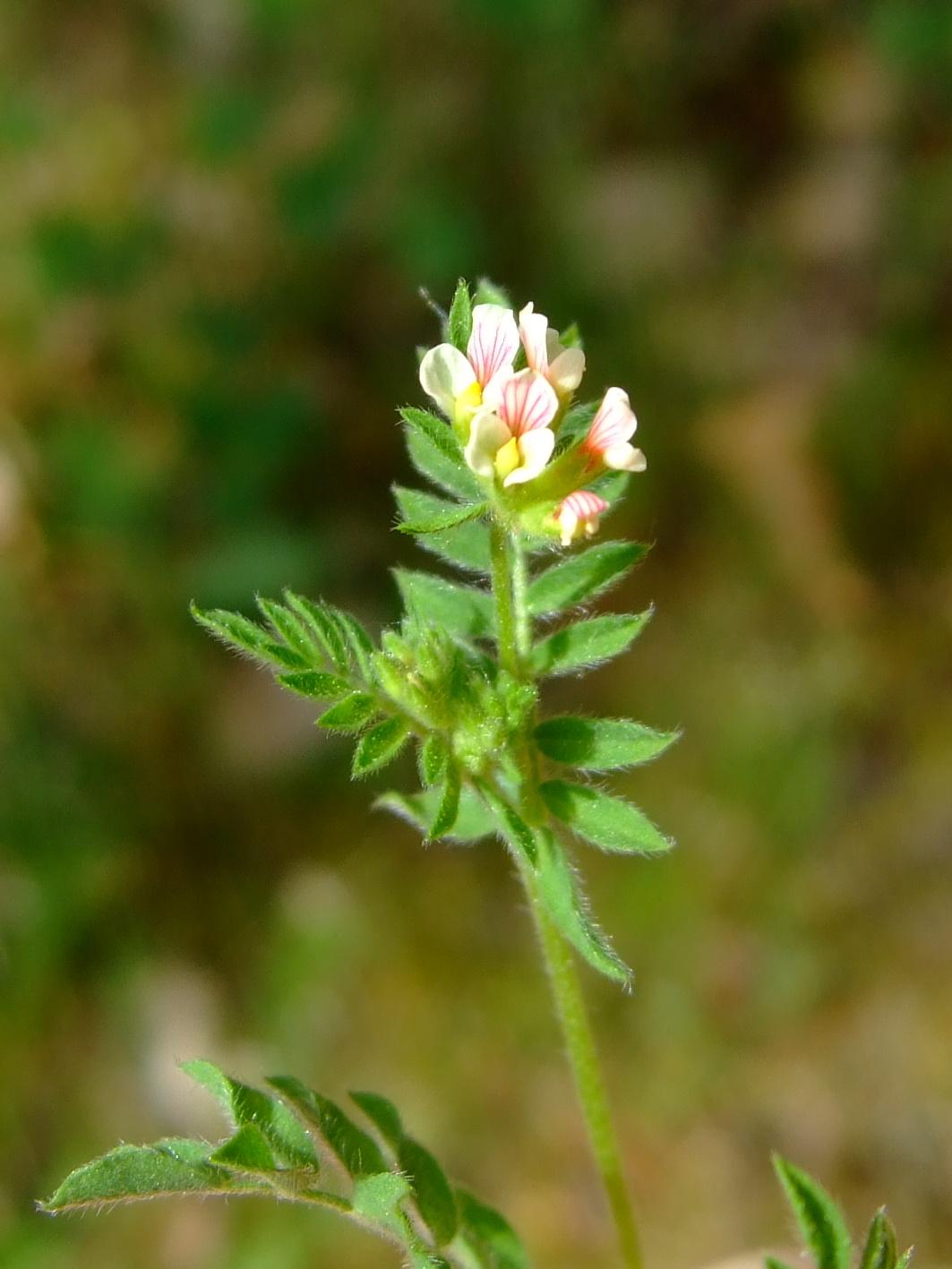
Little white bird’s-foot can grow to a height of 30 cm.
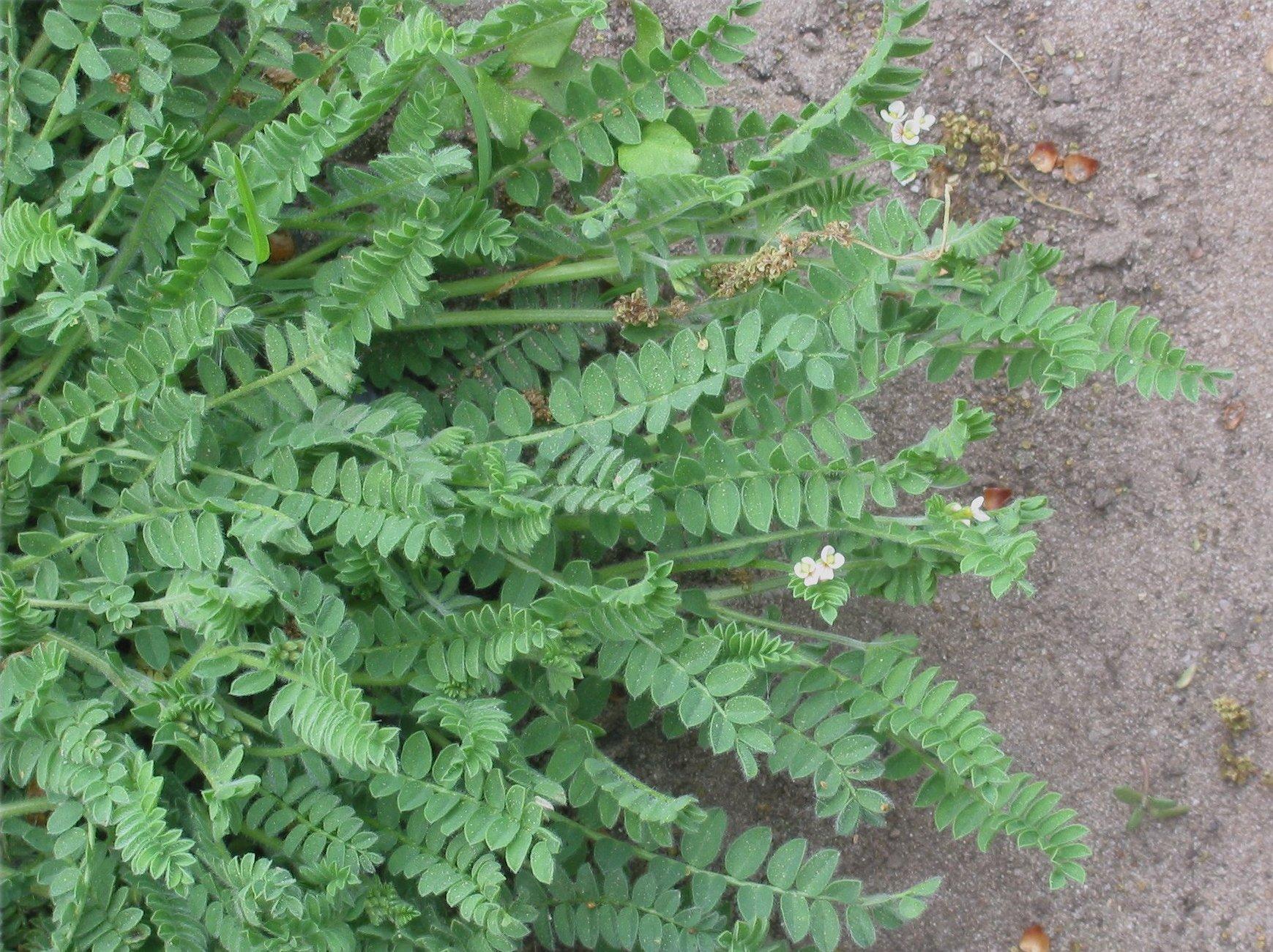
The leaves consist of numerous leaflets and grow alternately on the stem. The individual leaflets are oval and pointed.
The stem is generally prostrate to upward.
The flowers are clustered in flower heads. The individual florets are white with pink veins and a yellowish tip. They have only a single mirror axis (mirror-symmetric). The flower consists of five petals. The large upper petal protrudes upwards. The two lower petals form a hollow boat that surrounds the anthers and pistil.
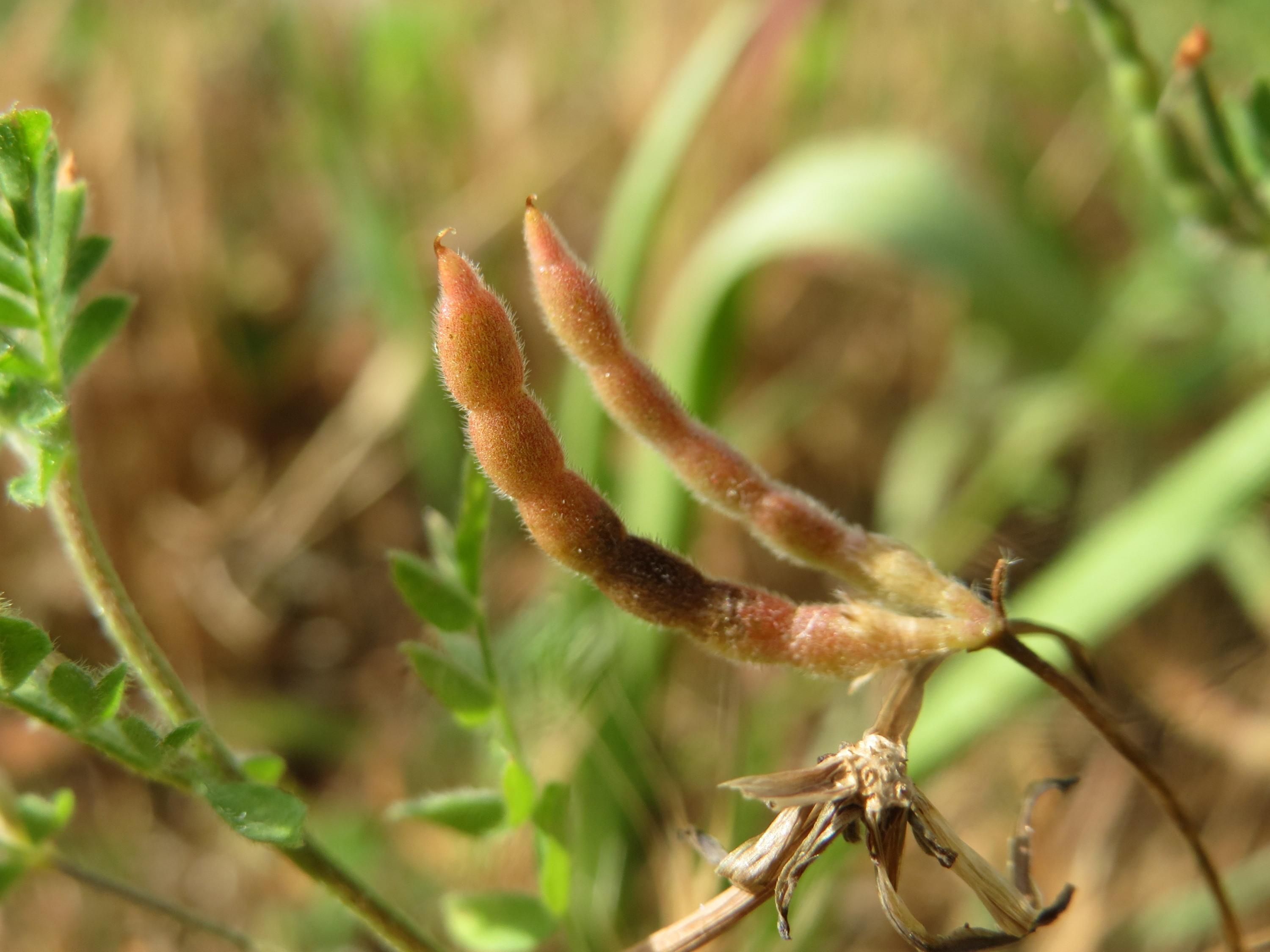
The fruit is a curved elongated pod with constriction between individual seeds. When ripe, it splits into several parts, each containing one seed.
Features
Little white bird’s-foot
Ornithopus perpusillus
white flowers with pink veins
seeds pods with constrictions along the length
In the city
Little white bird’s-foot can be found in sandy areas, fields as well as airfields and sports fields. It prefers nutrient-poor dry sites with sandy soil. Most soils influenced by humans tend to have a high nutrient content and thus are unsuitable for this plant. For that reason, hare’s-foot clover is becoming increasingly rare in towns.
Fun Facts
Symbiosis with root-nodulation bacteria is typical for members of the papilionaceae family. The bacteria supply the plant with nitrogen. As the bacteria require a plant to fix nitrogen, this biological interaction is beneficial to both species (symbiosis).
A papilionaceous flower is a form of flower typical for most members of the legume family.
It flowers from May to June.
- Endangerment level Germany: not endangered
Sources
Blüten, Aiwok, CC BY-SA 3.0, https://commons.wikimedia.org/wiki/File:Ornithopus_perpusillus.jpg

Habitus, Rasbak, CC BY-SA 3.0, https://commons.wikimedia.org/wiki/File:Klein_vogelpootje_closeup_plant_(Ornithopus_perpusillus_).jpg
.jpg)
Früchte, AnRo0002, CC0, https://commons.wikimedia.org/wiki/File:20160715Ornithopus_perpusillus07.jpg

Spohn, M., Golte-Bechtle, M. & Spohn, R. (2015) Was blüht denn da? Stuttgart: Franckh Kosmos Verlag.
Schauer, T., Caspari, C. & Caspari, S. (2015) Der illustrierte BLV-Pflanzenführer für unterwegs. 1150 Blumen, Gräser, Bäume und Sträucher, München: BLV.
Page „Kleiner Vogelfuß“. : Wikipedia, The Free Encyclopedia. Date of last revision: 21.11.2015, 09:52 UTC. URL: https://de.wikipedia.org/w/index.php?title=Kleiner_Vogelfu%C3%9F&oldid=148250784 (Accessed: 17.11.2016).
Bundesamt für Naturschutz (n.d.) Artensteckbriefe, URL: http://floraweb.de/pflanzenarten/artenhome.xsql?suchnr=4017& (Accessed: 17.11.2016).