
Short Description
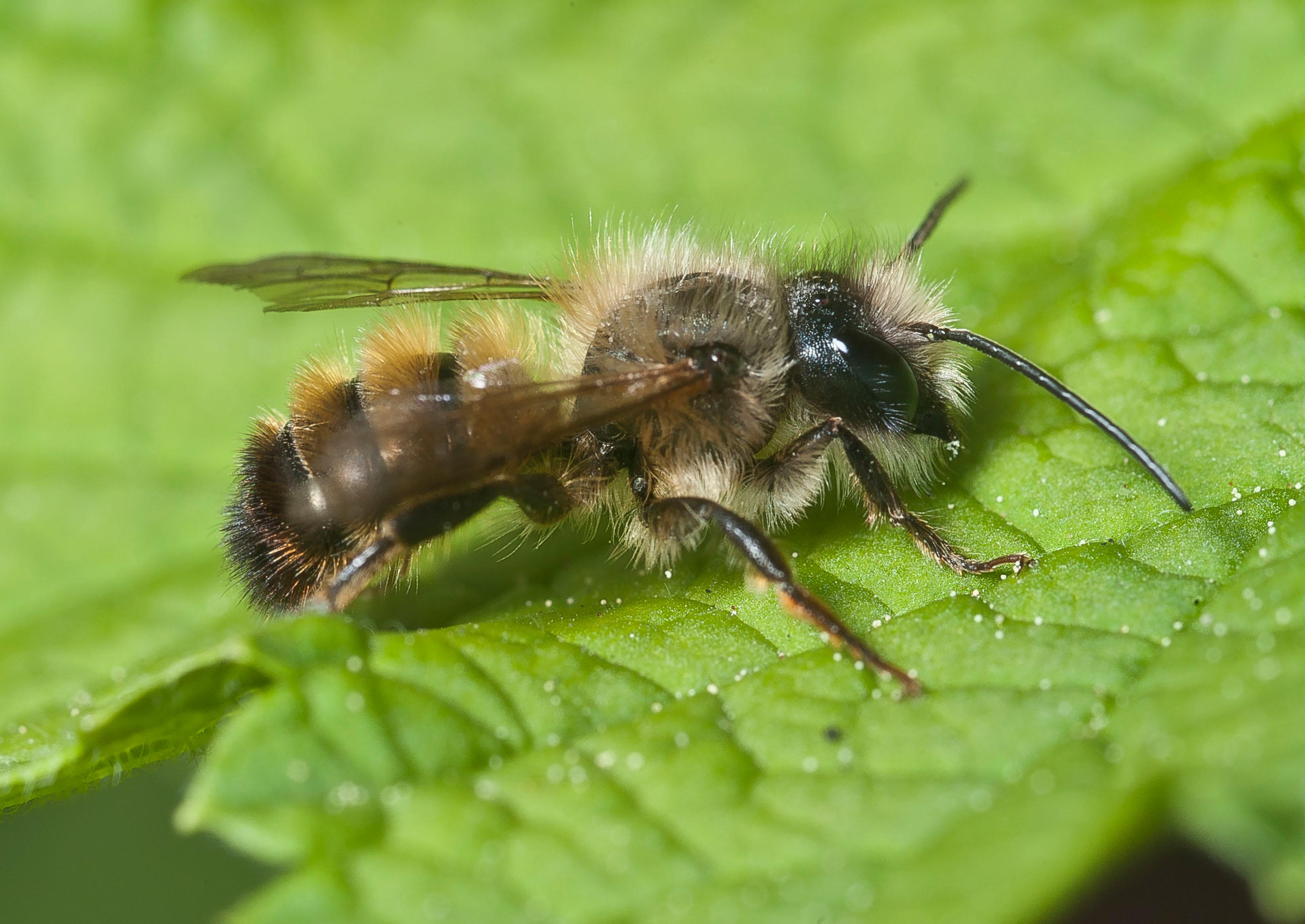
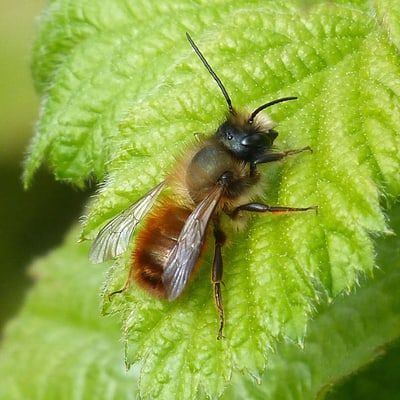
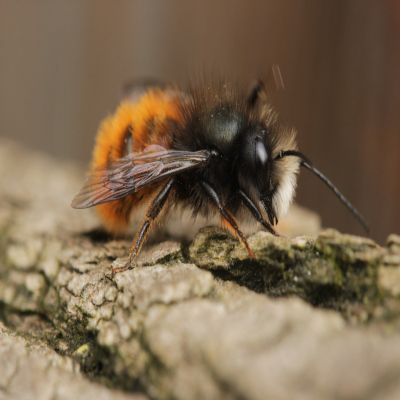
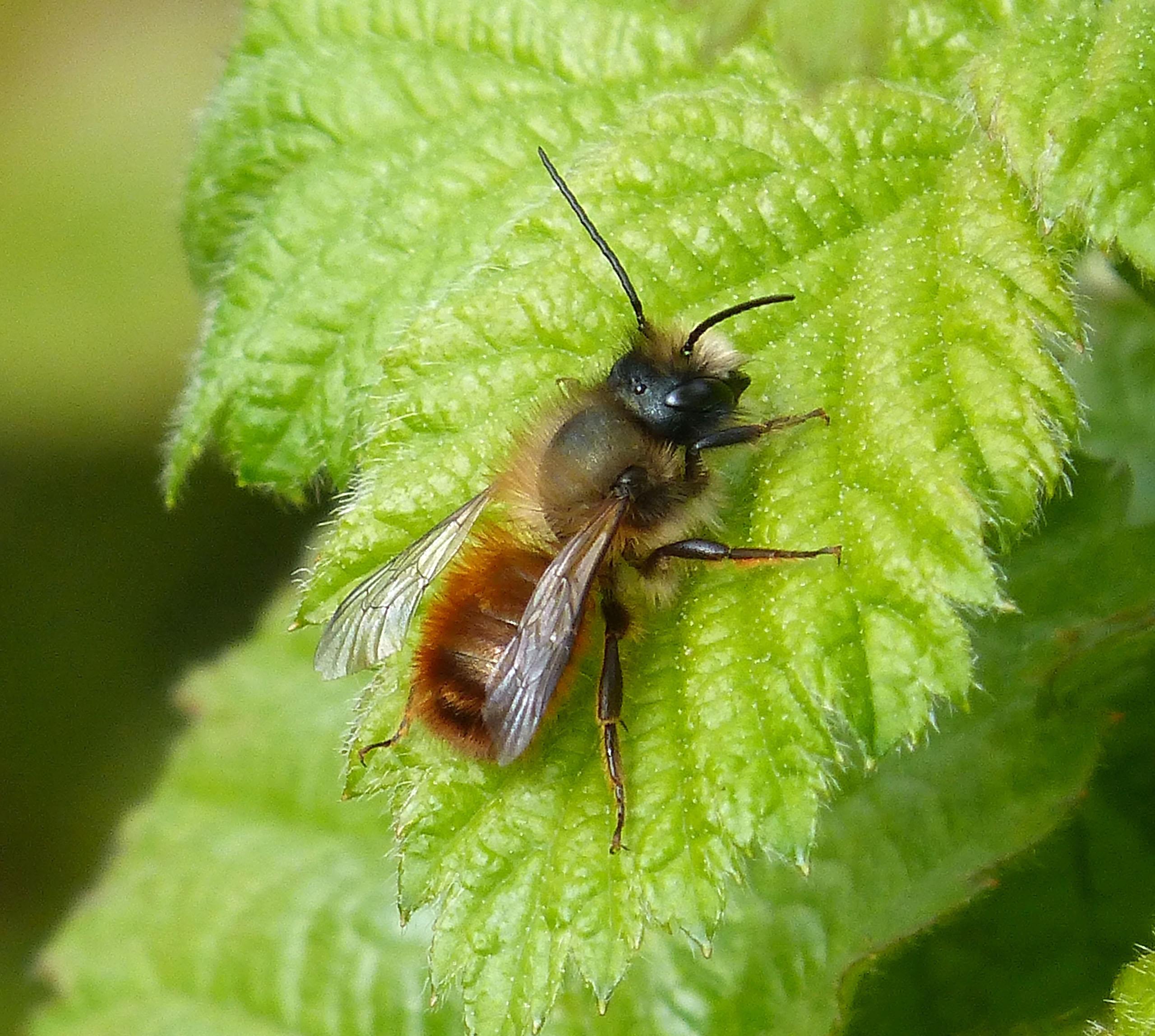
The red mason bee appears broad and stocky. It has a broad abdominal end. It is sand-coloured and altogether sparsely haired. The front three dorsal plates are reddish brown. The head and the end of the abdomen are black haired. The dense, long reddish-brown hairs often fade in older animals. The nest closure consists of rough, light-coloured mortar or clay.
The face and the chest area of the male is covered with white hairs.
The female has two small horns pointing forward.
Features
Red mason bee
Osmia bicornis
three red-brown back plates
In the city
The red mason bee prefers areas where many plants grow, such as forest edges and clearings. However, it can also often be observed in gardens. It is very flexible in accepting nesting sites. It nests in cavities of various kinds, e.g. in hollow stems, cracks in walls or holes drilled in wood. Keyholes or garden hoses are also possible nesting sites.
Fun Facts
It flies from April to June.
It is the first and most frequent coloniser of nest boxes.
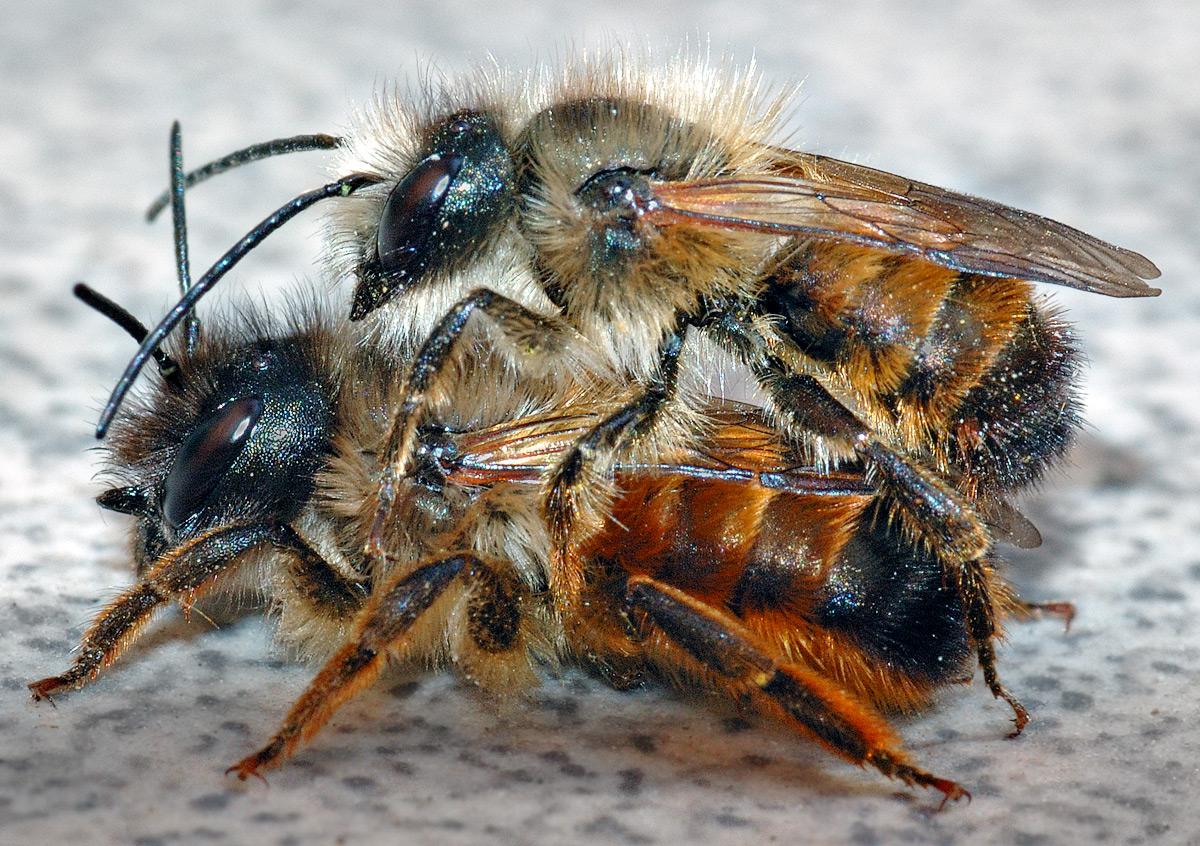
During the nuptial or courtship dance, the males attract females ready for mating with chemical attractants.
It is commercially bred and used for pollination.
- Endangerment level Germany: not endangered
Sources
Habitus, Pjt56, CC BY-SA 4.0, https://commons.wikimedia.org/wiki/File:Osmia_bicornis-pjt.jpg

Paarung, André Karwath, CC BY-SA 2.5, https://commons.wikimedia.org/wiki/File:Osmia_rufa_couple_(aka).jpg
.jpg)
Männchen, gailhampshire, CC BY-SA 2.0, https://commons.wikimedia.org/wiki/File:Male_Osmia_bicornis_(33893102315).jpg
.jpg)
Page „Rote Mauerbiene“. : Wikipedia, The Free Encyclopedia. Date of last revision: 25.10.2017, 18:55 UTC. URL: https://de.wikipedia.org/w/index.php?title=Rote_Mauerbiene&oldid=170323356 (Accessed: 09.02.2018).
Saure, C. (2005) Rote Liste und Gesamtartenliste der Bienen und Wespen (Hymenoptera part.) von Berlin mit Angaben zu den Ameisen. : Der Landesbeauftragte für Naturschutz und Landschaftspflege / Senatsverwaltung für Stadtentwicklung (eds.) Rote Listen der gefährdeten Pflanzen und Tiere von Berlin, URL: https://www.berlin.de/sen/uvk/natur-und-gruen/naturschutz/artenschutz/artenlisten-rote-listen/insekten/ (Accessed: 29.03.2021).
Bellmann, H. (1999) Der neue Kosmos-Insektenführer. Über1400 Fotos, Stuttgart: Franckh Kosmos Verlag.
Bellmann, H. (2005) Bienen, Wespen, Ameisen. Hautflügler Mitteleuropas, Stuttgart: Franckh Kosmos Verlag.
Martin, H.-J. (n.d.) Solitärbienenbestimmung: Bienen (& Wespen) und ihre Nestverschlüsse, URL: http://www.wildbienen.de/download/SBienen2.pdf (Accessed: 24.03.2019).
NABU Landesverband Mecklenburg-Vorpommern (n.d.) Wer nistet überhaupt in Nisthilfen für Wildbienen? Sechs Kurzporträts häufiger Arten an Wildbienen-Nisthilfen, URL: https://mecklenburg-vorpommern.nabu.de/tiere-und-pflanzen/insekten-und-spinnen/bienen-und-co/wildbienen/20983.html (Accessed: 21.03.2019).
Nuß, M. & Fritzsche, M. (2018) Rostrote Mauerbiene (Osmia bicornis (Linnaeus, 1758)), URL: https://www.insekten-sachsen.de/Pages/TaxonomyBrowser.aspx?Id=233244 (Accessed: 09.02.2018).
Binot-Hafke, M., Balzer, S., Becker, N., Gruttke, H., Haupt, H., Hofbauer, N., Ludwig, G., Matzke-Hajek, G. & Strauch, M. (2011) Rote Liste gefährdeter Tiere, Pflanzen und Pilze Deutschlands. volume 3: Wirbellose Tiere (part 1), Bonn-Bad Godesberg: Bundesamt für Naturschutz.