

Short Description
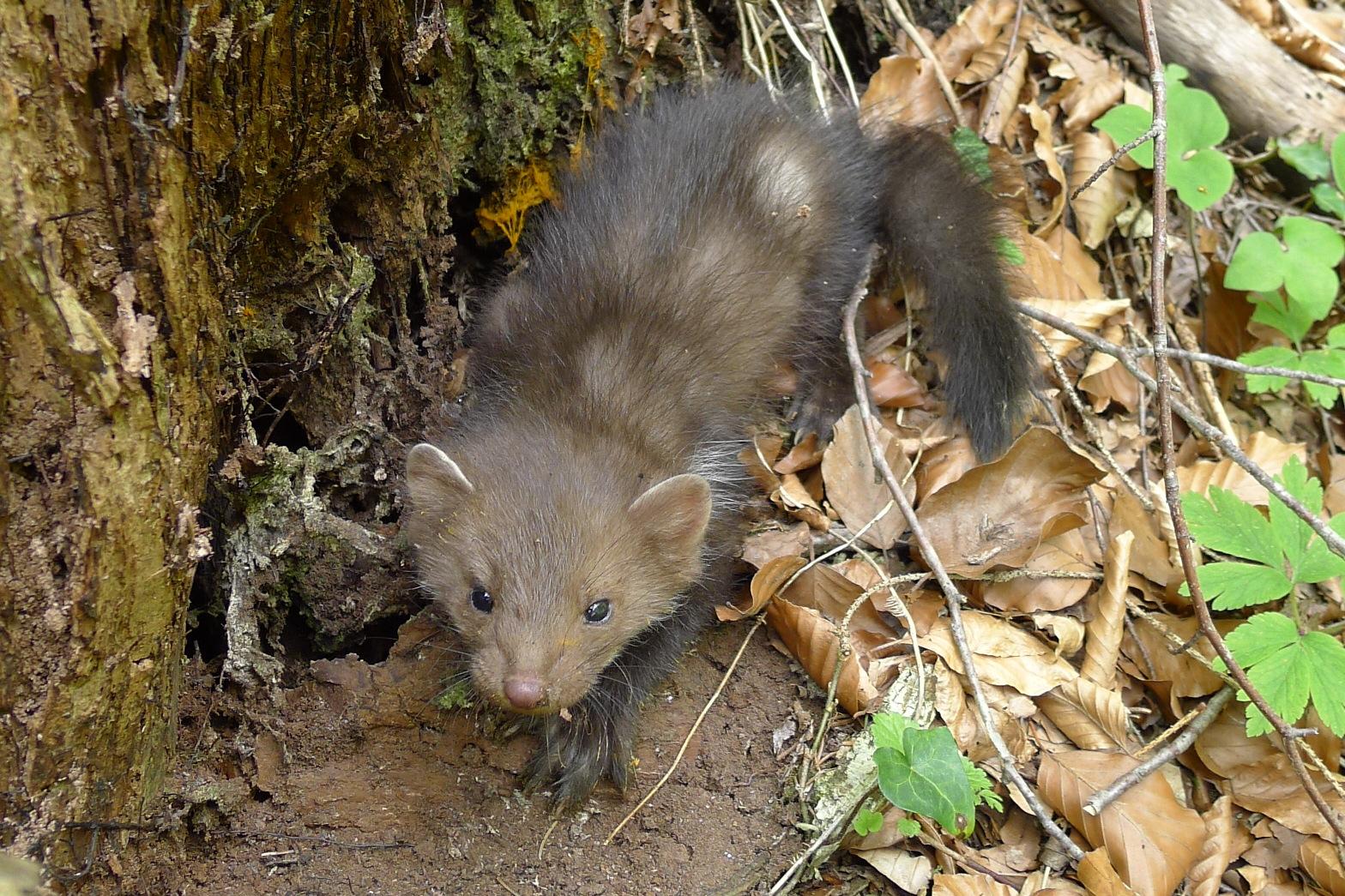
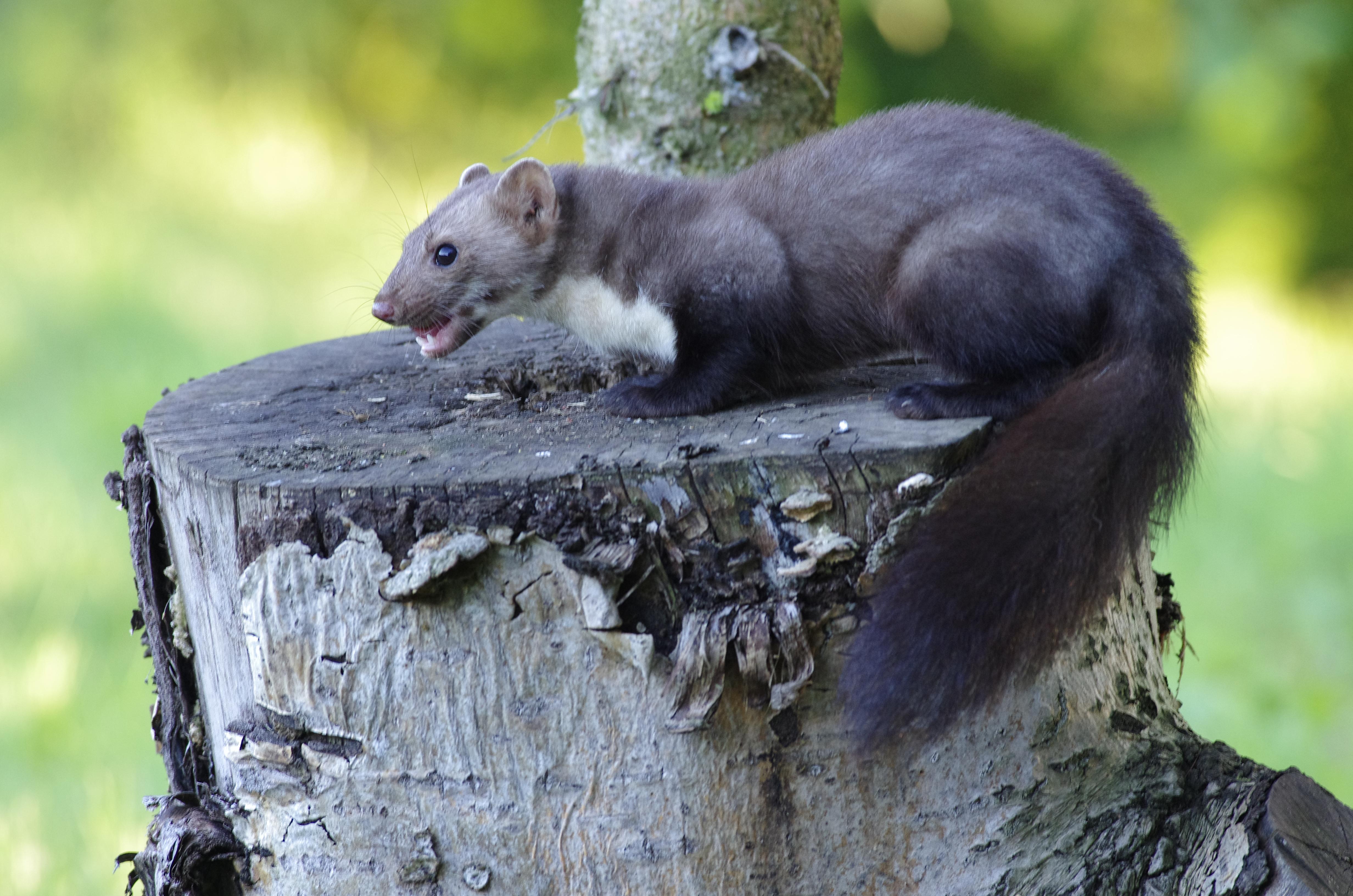
The house marten is brown to greyish with a white chest. Its nose is pink. Its body is elongated and slender with a bushy tail and comparatively short legs. Its tracks show five toe pads. The claws can generally be clearly seen.

Features
Beech marten
Martes foina
white throat
pink nose
Paarungsrufe
Gnensch, CC BY-SA 3.0

Similar species

European pine marten
Martes martes

Stoat
Mustela erminea

Weasel
Mustela nivalis
In the city
House martens are synanthropes (ecologically associated with humans) and often found in parks, barns and in attics. These nocturnal animals often hide in buildings during the day. Some of their food may come from waste.
House martens are known for biting through brake cables of cars. This is territorial behaviour, triggered by foreign scent marks. The most common reason is that the car had been parked in another house marten’s territory the previous evening. The rival’s territory may already start in the next street.
Fun Facts
Because house martens often damage cables and pipes in cars, they are sometimes referred to in Germany as “Automarder” (“car martens”).
The presence of a house marten can be detected quite easily from its tracks. Its paw print is similar to that of a cat, but five toes and claws can be recognised.
- Endangerment level Germany: not endangered
Sources
Habitus , Bohuš Číčel, CC BY-SA 3.0, https://commons.wikimedia.org/wiki/File:Martes_foina_1_(Bohu%C5%A1_%C4%8C%C3%AD%C4%8Del).jpg
.jpg)
Jungtier, eah, CC BY 2.0, https://www.flickr.com/photos/aah-yeah/7639255258/in/photolist-o7KwGF-cD4bry-atDWSv-aBMvzf
Habitus , M.zlinko, CC BY-SA 3.0, https://commons.wikimedia.org/wiki/File:Kuna_domowa,_kamionka_(Martes_foina).JPG
.JPG)
Page „Steinmarder“. : Wikipedia, The Free Encyclopedia. Date of last revision: 13.04.2016, 08:03 UTC. URL: https://de.wikipedia.org/w/index.php?title=Steinmarder&oldid=153430569 (Accessed: 09.05.2016).
Landesforstamt Berlin (n.d.) Steinmarder, URL: http://www.stadtentwicklung.berlin.de/forsten/wildtiere/de/steinmarder.shtml (Accessed: 29.12.2016).
Baake, K.-H. (n.d.) Marder, Frettchen, Iltis, Wiesel, URL: http://www.bio-gaertner.de/Nuetzling/Marder-Frettchen-Iltis-Wiesel (Accessed: 29.12.2016).
Artenfinder (2016) Martes foina (Steinmarder), URL: https://arteninfo.net/elearning/saeugetiere/speciesportrait/3244 (Accessed: 09.05.2016).
Haupt, H., Ludwig, G., Gruttke, H., Binot-Hafke, M., Otto C. & Pauly, A. (2009) Rote Liste gefährdeter Tiere, Pflanzen und Pilze Deutschlands. volume 1: Wirbeltiere, Bonn-Bad Godesberg: Bundesamt für Naturschutz.
Klawitter, J., Altenkamp, R., Kallasch, C., Köhler, D., Krauß, M., Rosenau, S. & Teige, T. (2005) Rote Liste und Gesamtartenliste der Säugetiere (Mammalia) von Berlin. : Der Landesbeauftragte für Naturschutz und Landschaftspflege / Senatsverwaltung für Stadtentwicklung (eds.) Rote Listen der gefährdeten Pflanzen und Tiere von Berlin, URL: https://www.berlin.de/sen/uvk/natur-und-gruen/naturschutz/artenschutz/artenlisten-rote-listen/saeugetiere/ (Accessed: 30.03.2021).