
Short Description
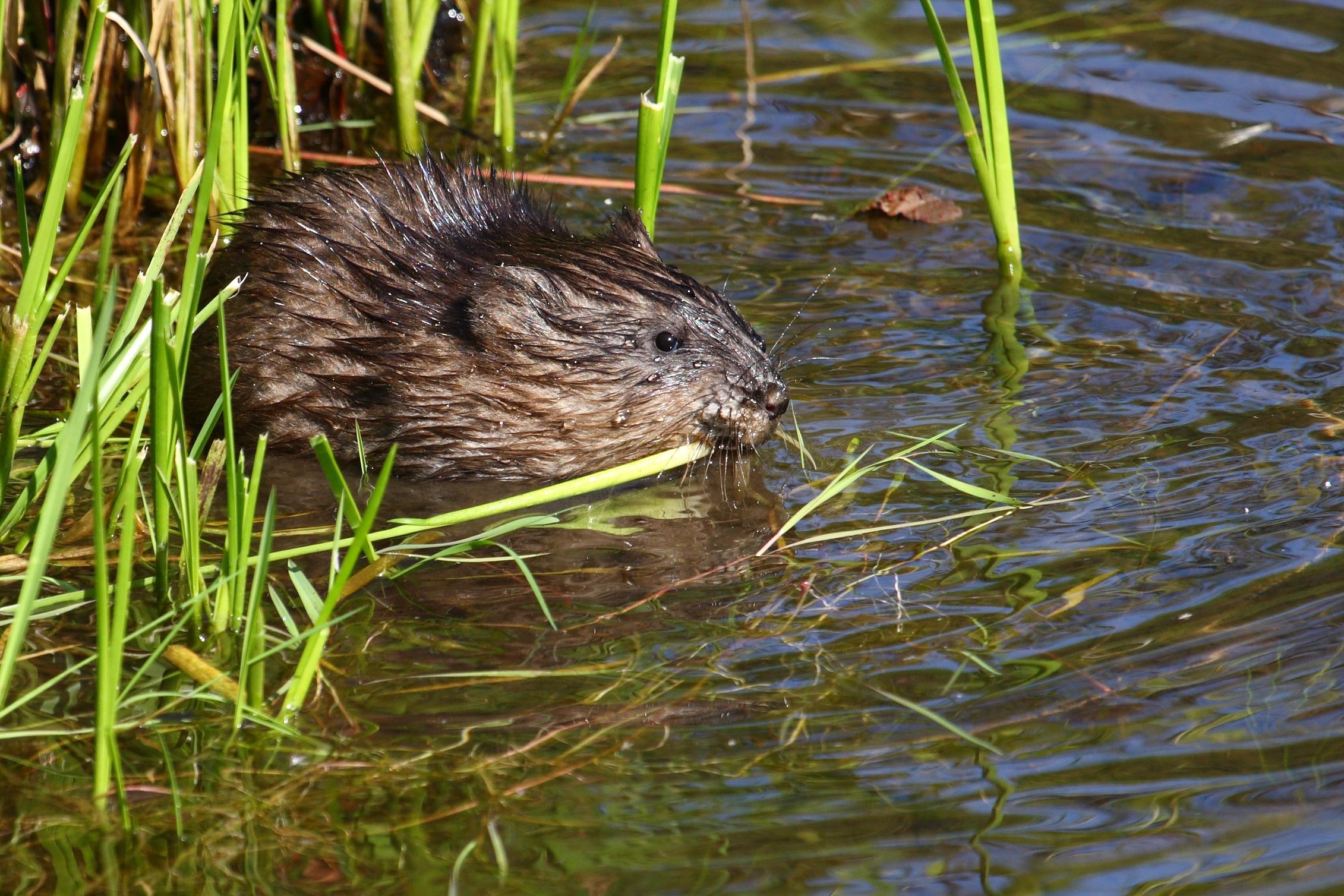
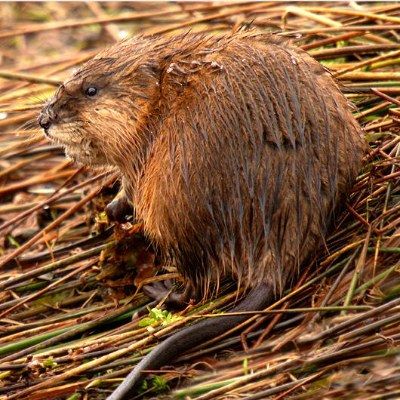
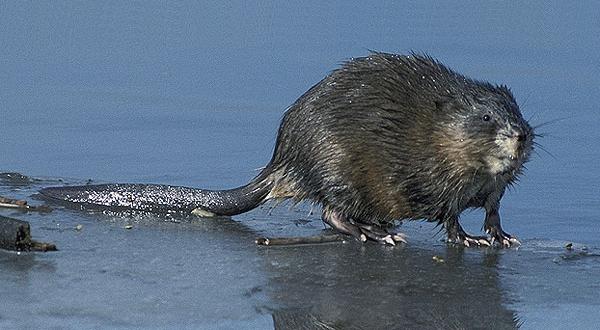
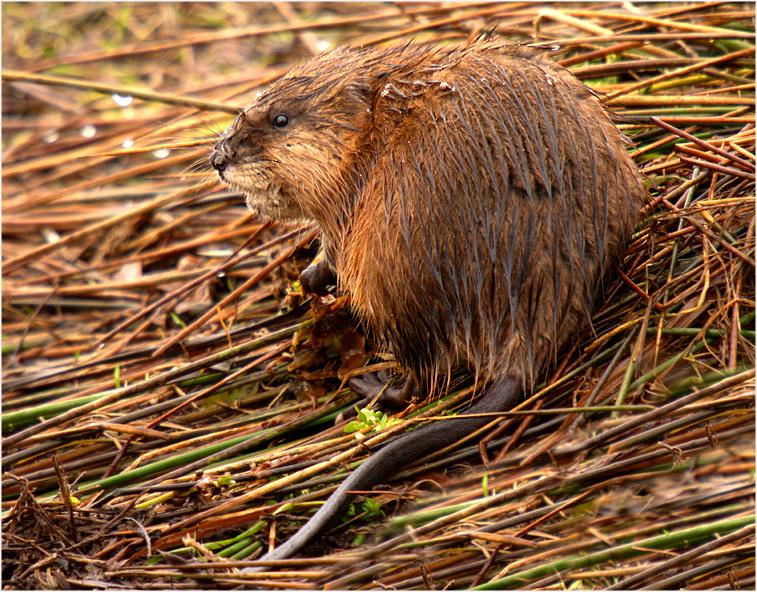
The muskrat has a stocky rat-like body. Its head is rather pointed. Its fur is generally dark-brown to cream. Its tail is almost hairless and laterally flattened. Its ears are hidden in the fur. Its whiskers are dark. Its hind feet are fringed with bristles to assist with swimming. When swimming, head, nape and back are visible out of the water. Its tracks show five slightly splayed claws with the heel pad not always visible.
Features
Muskrat
Ondatra zibethicus
laterally flattened tail
no webbing
Similar species
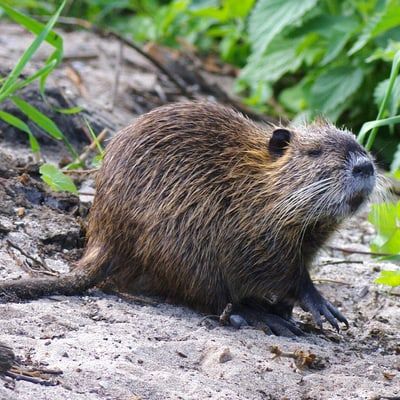
Nutria
Myocastor coypus

European beaver
Castor fiber
In the city
The muskrat depends on habitats with flowing or stagnant water. It can be found near ponds, lakes and rivers.
It is a shy nocturnal animal. In a sheltered environment, it may also be diurnal. It causes damage by digging and feeding and is thus often described as vermin.
Fun Facts
It can dive for up to ten minutes.
In actual fact, it is not a rat but a vole.
It is a good swimmer and uses the swimming bristles on its feet for paddle-like support.
Musk is the name of the intense aromatic substance excreted by males during the mating season. It is also used generically to describe secretions from other animals and plants. Its purpose is to attract females.
One explanation for the great proliferation of the muskrat is that there is little competition in the habitat they occupy.
It can be an intermediate host for the fox tapeworm, as it is a prey of foxes.
- Endangerment level Germany: not evaluated
The muskrat originally comes from North America. Since the beginning of the 20th century, they have also been found in Europe. This makes it a non-native animal (Neozoa).
Sources
Habitus , Cephas, CC BY-SA 3.0, https://commons.wikimedia.org/wiki/File:Ondatra_zibethicus_CT.jpg

Habitus , Dave Menske, PD, https://commons.wikimedia.org/wiki/File:Ondatra_zibethicus_FWS.jpg

Habitus , Stefan Ertl, CC BY-SA 3.0, https://commons.wikimedia.org/wiki/File:Bisamratte.jpg

Page „Bisamratte“. : Wikipedia, The Free Encyclopedia. Date of last revision: 21.09.2016, 09:11 UTC. URL: https://de.wikipedia.org/w/index.php?title=Bisamratte&oldid=158098567 (Accessed: 01.12.2016).
Di Monaco, A. (2014-2016) Unterschied Nutria, Biber & Bisam oder ' wie erkenne ich ein Nutria ', URL: http://www.nutria-info.com/unterschied-nutria-biber-bisam/ (Accessed: 01.12.2016).
Wildnisschule Wildniswissen (n.d.) Herzlich willkommen auf Spurenjagd.de! URL: http://www.spurenjagd.de/ (Accessed: 01.12.2016).
Grand-Duché de Luxembourg Région wallonne (2007) Spuren/Trittsiegel erkennen. Spurensucherschulung: Europa LIFE, URL: http://www.loutres.be/IMG/pdf/Spurensucherschulung.pdf (Accessed: 01.12.2016).
Haupt, H., Ludwig, G., Gruttke, H., Binot-Hafke, M., Otto C. & Pauly, A. (2009) Rote Liste gefährdeter Tiere, Pflanzen und Pilze Deutschlands. volume 1: Wirbeltiere, Bonn-Bad Godesberg: Bundesamt für Naturschutz.
Klawitter, J., Altenkamp, R., Kallasch, C., Köhler, D., Krauß, M., Rosenau, S. & Teige, T. (2005) Rote Liste und Gesamtartenliste der Säugetiere (Mammalia) von Berlin. : Der Landesbeauftragte für Naturschutz und Landschaftspflege / Senatsverwaltung für Stadtentwicklung (eds.) Rote Listen der gefährdeten Pflanzen und Tiere von Berlin, URL: https://www.berlin.de/sen/uvk/natur-und-gruen/naturschutz/artenschutz/artenlisten-rote-listen/saeugetiere/ (Accessed: 30.03.2021).