
Short Description
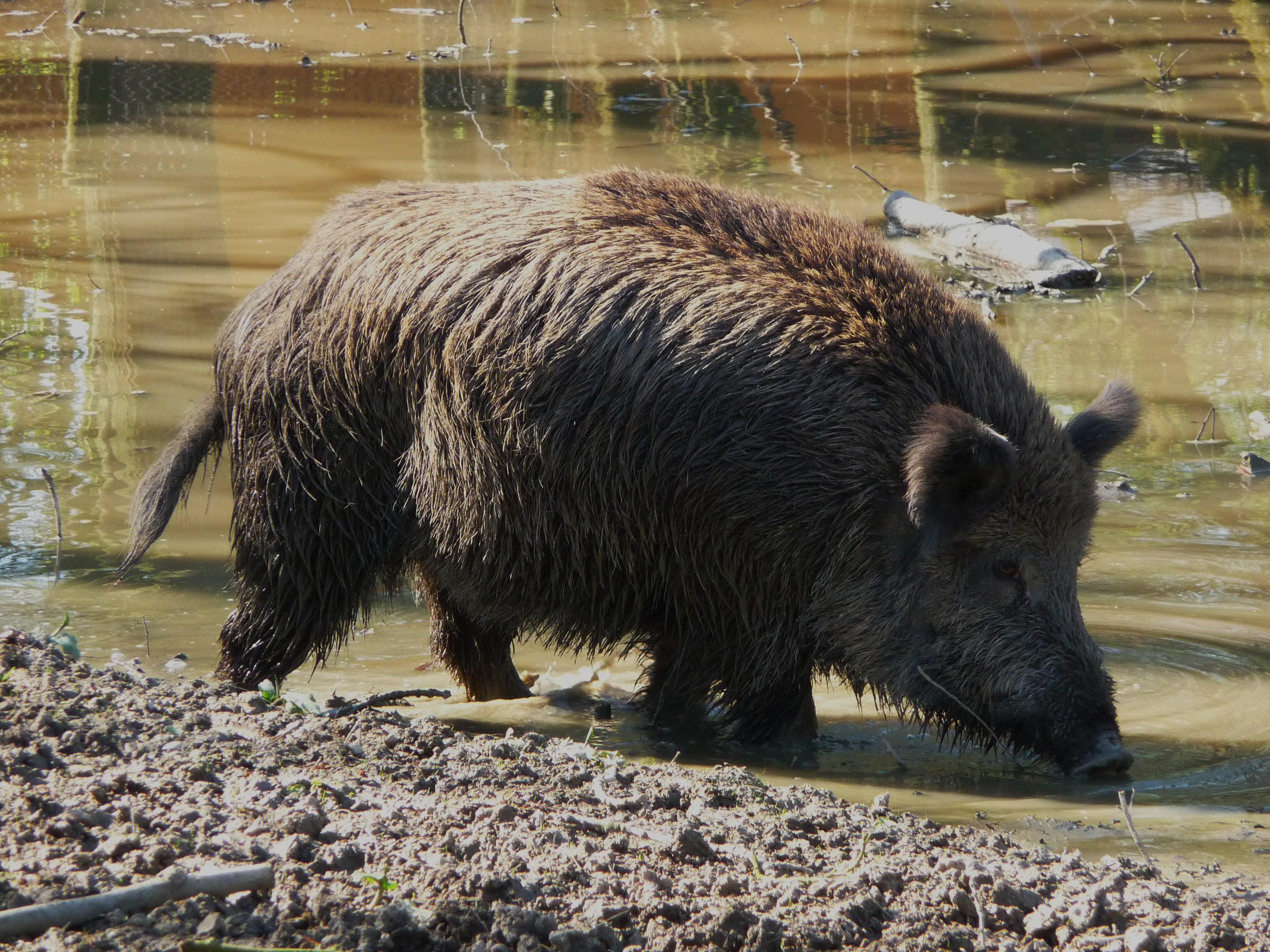
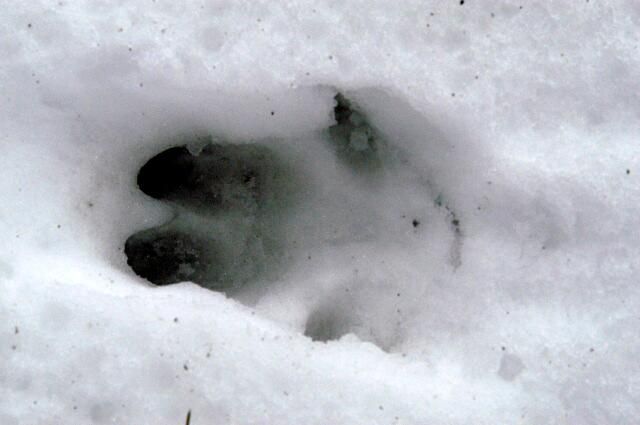
Wild boars are unmistakeable. Their bristles are grey, brown or black. The four parallel hoof prints can be detected particularly well in soft ground.
The male wild boar (hog) has a shorter snout.
The female (sow) has a longer and narrower snout.
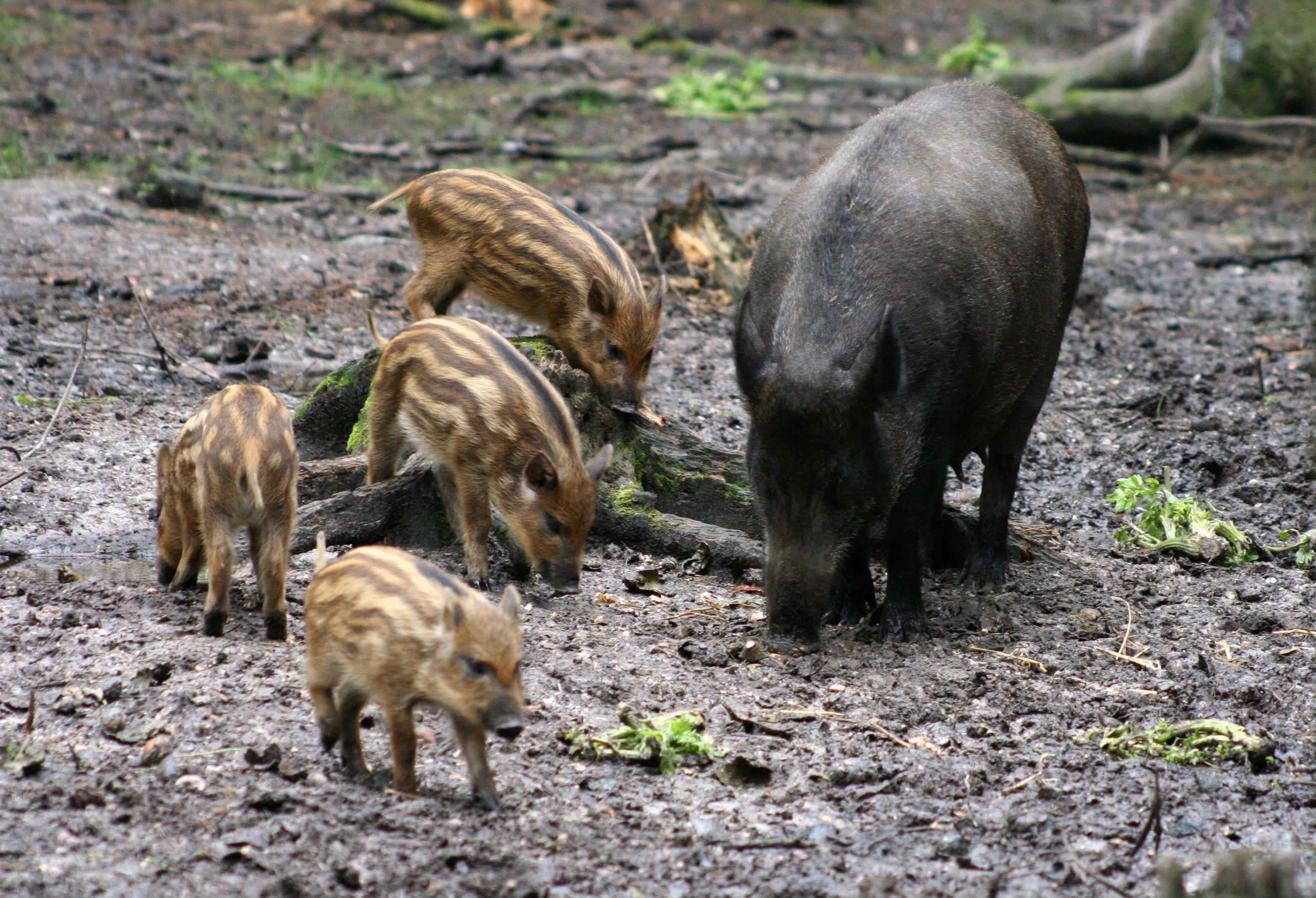
Wild boar piglets, called squeakers, have a pattern of longitudinal stripes for about the first four months.
Features
Wild boar
Sus scrofa
unmistakeable
Diverse Laute, am Ende Langlaute im Kontak
Tembrock, CC BY-SA 3.0

In the city
Wild boars can frequently be found in urban areas, mainly in the suburbs, but also in parks, gardens and cemeteries. However, they prefer forests. That is where these omnivores find their favourite food: acorns and beechnuts. But they also feed on carrion and food scraps.
If fed, the normally nocturnal animals will become less shy. They are very clever and learn fast. In their search for food, they can become intrusive and bothersome. This leads to frequent conflicts with humans.
Fun Facts
The wild boar is the parent form of the domesticated pig.
Wild boar with spotted coats are the results of “flings” with domesticated pigs.
Wild boar love to roll in moist ground and do so frequently. This is necessary to rid themselves of pests and parasites. Afterwards, they rub the mud off on tree trunks.
They are untiring and skilful swimmers.
- Endangerment level Germany: not evaluated
- Usage:
Wild boar is a popular game and can be prepared in different ways.
Wild boars originate from Eurasia. But their distribution area has extended considerably thanks to human activity. Wild boars can now also be found in North and South America, Australia and on many islands.
Sources
Habitus , 4028mdk09, CC BY-SA 3.0, https://commons.wikimedia.org/wiki/File:Ausgewachsenes_Wildschwein_beim_Suhlen.JPG

Jungtier, Dave Pape, gemeinfrei, https://commons.wikimedia.org/wiki/File:Sus_scrofa_1_-_Otter,_Owl,_and_Wildlife_Park.jpg

Trittsiegel, James Lindsey, CC-BY-SA 3.0, http://popgen.unimaas.nl/~jlindsey/commanster.html
Leibniz-Institut für Zoo- und Wildtierforschung (n.d.) Wildschwein, URL: http://www.izw-berlin.de/wildschwein.html (Accessed: 09.04.2016).
Page „Wildschwein“. : Wikipedia, The Free Encyclopedia. Date of last revision: 07.05.2016, 15:12 UTC. URL: https://de.wikipedia.org/w/index.php?title=Wildschwein&oldid=154171397 (Accessed: 09.05.2016).
Landesforstamt Berlin (n.d.) Wildschwein, URL: http://www.stadtentwicklung.berlin.de/forsten/wildtiere/de/wildschwein.shtml (Accessed: 30.12.2016).
NABU Landesverband Berlin (n.d.) Wildschweine im Berliner Stadtgebiet. NABU-Position zum Umgang mit Wildschweinen, URL: https://berlin.nabu.de/tiere-und-pflanzen/saeugetiere/wildschwein/ (Accessed: 30.12.2016).
Deutscher Jagdverband e.V. (2005) Fährten und Spuren: Bestimmungshilfe für Naturfreunde, URL: https://www.jagdverband.de/sites/default/files/Faehrten-und-Spuren_2015_RZ-vs.pdf (Accessed: 30.03.2021).