
Short Description
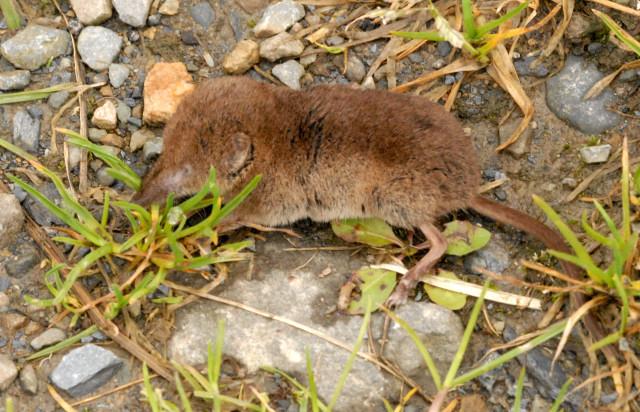
The common shrew has quite a pointed muzzle and small eyes. Its upper parts are black-brown. Its flanks are light brown. Its underside is greyish. The tiny outer ears are partially covered by fur. Its teeth are red-brown. It has five splayed toes on each of its front and back paws. A fine line from its tail can also often be seen.
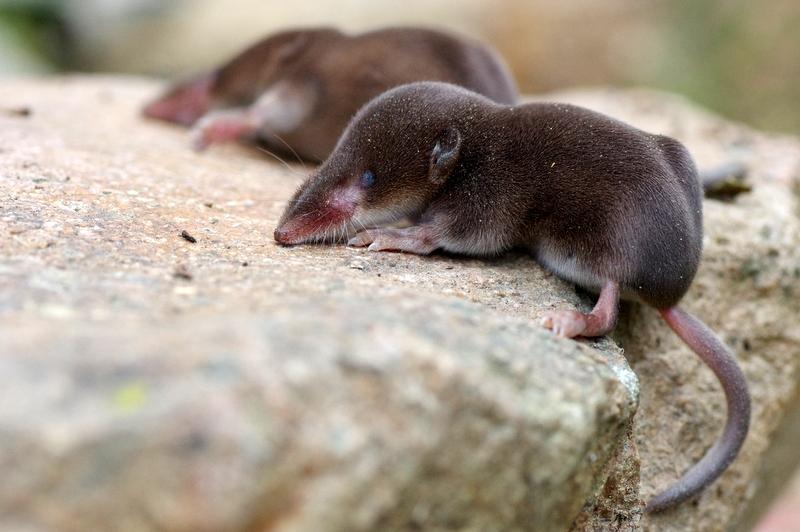
Juveniles have paler upper parts and less contrast between the colours of back and flanks.

Features
Common shrew
Sorex araneus
long, pointed nose
small ears

In the city
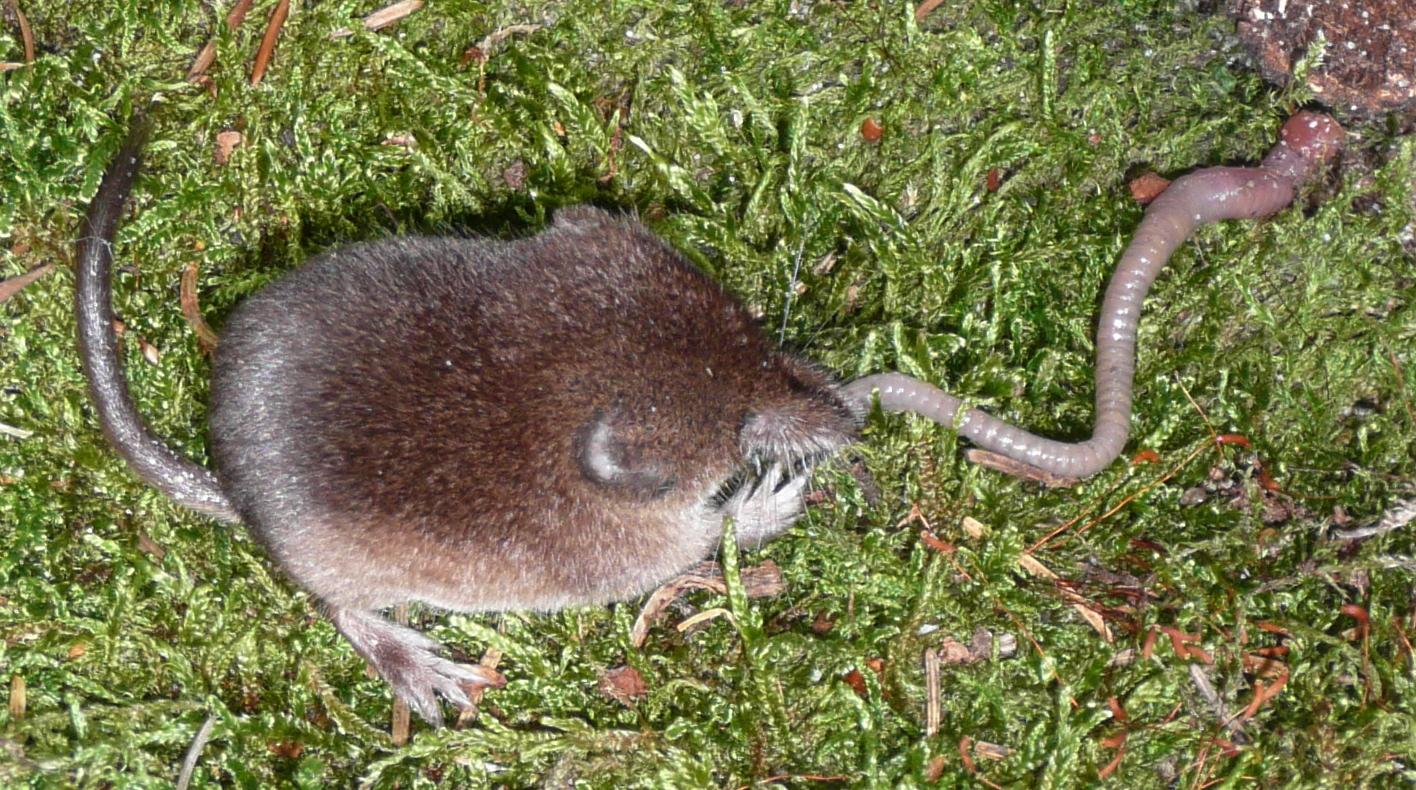
The common shrew prefers habitats that are close to water, damp and with thick vegetation. However, it is highly adaptable and also inhabits numerous dry locations. For that reason, it is also found in areas with open dunes. In contrast with the more common bicoloured shrew, the common shrew is rarely found in towns.
Fun Facts
Common shrews are active during day and night.
The common shrew is not a mouse. It is an insectivore and more closely related to hedgehogs and moles.
The heart of a shrew beats approx. 800 to 1000 times per minute.
- Endangerment level Germany: not endangered
Each day, the common shrew consumes a multiple of its own bodyweight.
Sources
Habitus , James Lindsey, CC-BY-SA 3.0, https://commons.wikimedia.org/wiki/File:Sorex.araneus.-.lindsey.jpg

Habitus , Sophie von Merten, CC BY-SA 3.0, https://commons.wikimedia.org/wiki/File:Sorex-araneus.jpg

Jungtier, WWalas, CC-BY-SA 3.0, https://commons.wikimedia.org/wiki/File:SorexAraneus_wwalas_01.JPG

Page „Waldspitzmaus“. : Wikipedia, The Free Encyclopedia. Date of last revision: 13.11.2016, 16:55 UTC. URL: https://de.wikipedia.org/w/index.php?title=Waldspitzmaus&oldid=159658051 (Accessed: 29.12.2016).
Hutterer, R. & Kryštufek, B. (2016) Sorex araneus. The IUCN Red List of Threatened Species, URL: http://www.iucnredlist.org/details/29661/0 (Accessed: 29.12.2016).
Böttcher, S. (2014) Die Waldspitzmaus – Winzling mit langer Nase, URL: http://www.wildes-berlin.de/die-waldspitzmaus-winzling-mit-langer-nase/ (Accessed: 29.12.2016).
Resch, C. & Resch, S. (2016) Waldspitzmaus - Sorex araneus. Internethandbuch über Kleinsäugerarten im mitteleuropäischen Raum: Körpermerkmale, Ökologie und Verbreitung, Haus im Ennstal: apodemus - Priv. Institut f. Wildtierbiologie, URL: http://kleinsaeuger.at/sorex-araneus.html (Accessed: 29.12.2016).
Haupt, H., Ludwig, G., Gruttke, H., Binot-Hafke, M., Otto C. & Pauly, A. (2009) Rote Liste gefährdeter Tiere, Pflanzen und Pilze Deutschlands. volume 1: Wirbeltiere, Bonn-Bad Godesberg: Bundesamt für Naturschutz.
Klawitter, J., Altenkamp, R., Kallasch, C., Köhler, D., Krauß, M., Rosenau, S. & Teige, T. (2005) Rote Liste und Gesamtartenliste der Säugetiere (Mammalia) von Berlin. : Der Landesbeauftragte für Naturschutz und Landschaftspflege / Senatsverwaltung für Stadtentwicklung (eds.) Rote Listen der gefährdeten Pflanzen und Tiere von Berlin, URL: https://www.berlin.de/sen/uvk/natur-und-gruen/naturschutz/artenschutz/artenlisten-rote-listen/saeugetiere/ (Accessed: 30.03.2021).
Boye, P. (1993) Heimische Säugetiere. Ein Bestimmungsschlüssel für die in der Bundesrepublik Deutschland wildlebenden Säugetiere, ausser den Ordnungen Robben, Paarhufer und Wale, Hamburg: Deutscher Jugendbund für Naturbeobachtungen.