
Short Description
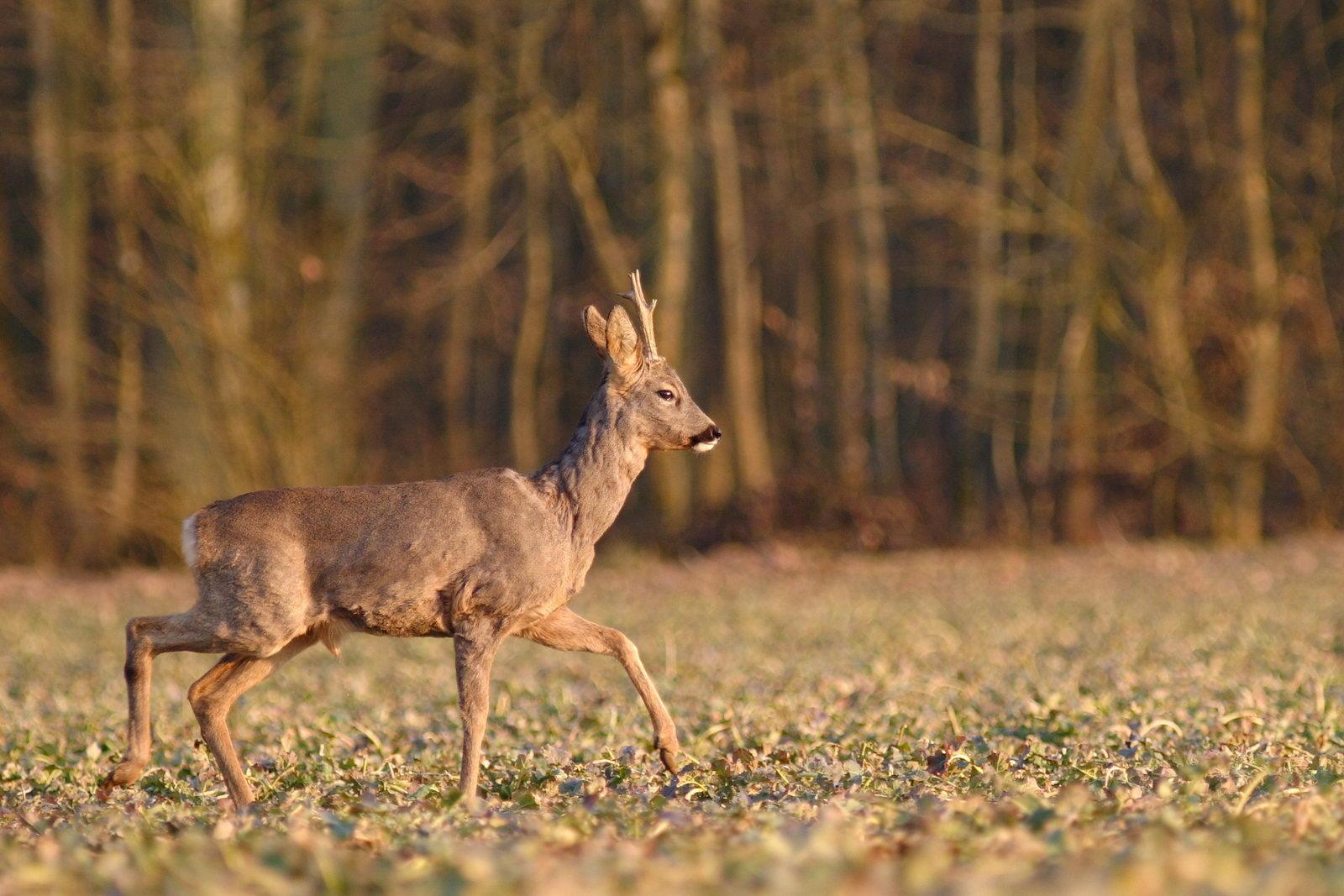
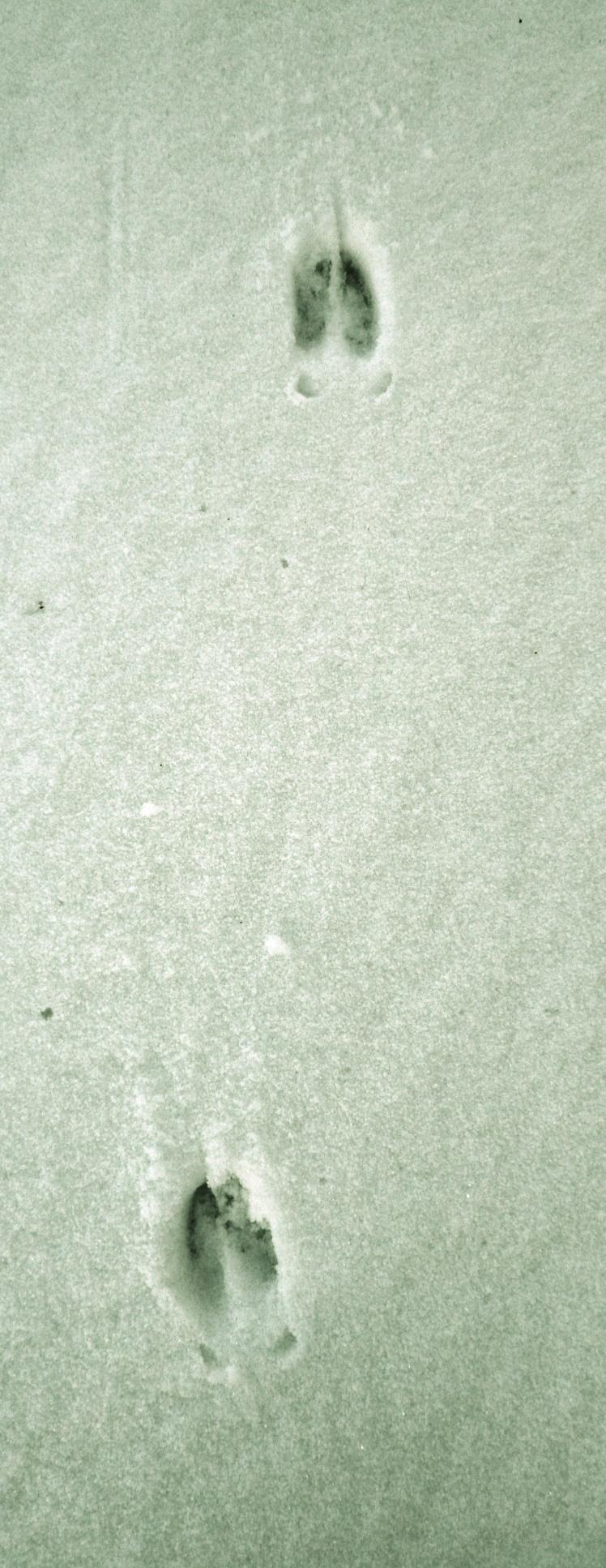
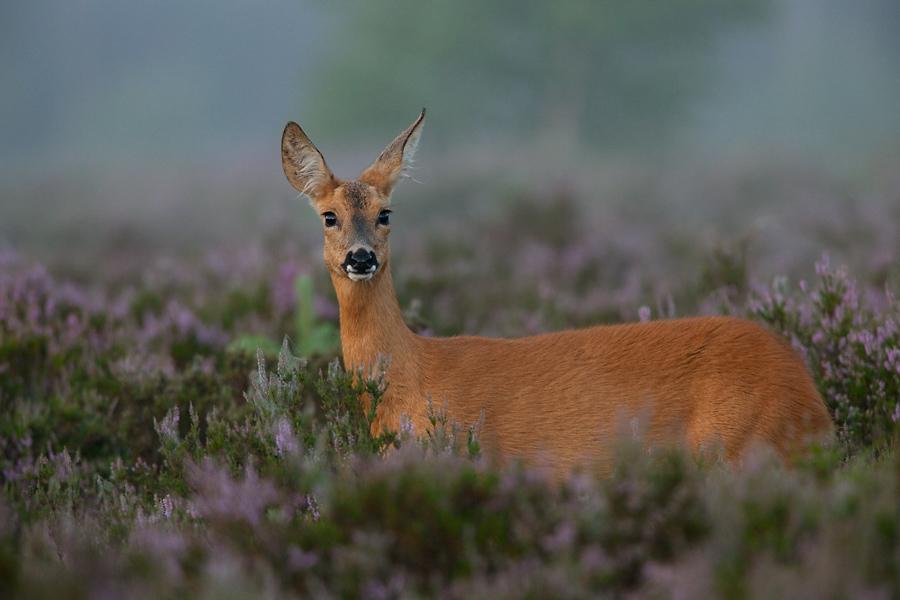
Roe deer are reddish-brown in summer and more grey in winter. They have no visible tail and a white rump. In its tracks, the two parallel hooves can be seen.
Males (bucks) have antlers that get shed in autumn.
Juveniles (fawns) are brown with white patches.
Features
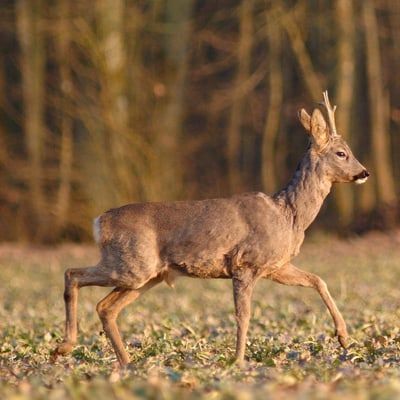
Roe deer
Capreolus capreolus
white rump without visible tail
Schrecken von zwei Rehböcken
Frommolt, CC BY-SA 3.0

Similar species
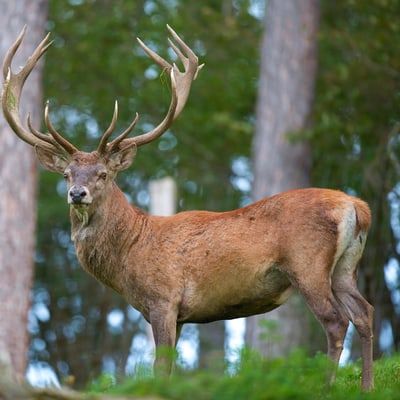
Red deer
Cervus elaphus
In the city
Originally, the habitat of roe deer tended to be forest verges. In their search for food, they are more often seen in the urban fringe and in gardens, parks and cemeteries.
Roe deer are quite shy. In an urban environment, they are often active at twilight (crepuscular). In the wild, they tend to be more active during the day.
Fun Facts
Startled roe deer make a kind of barking sound.
Bambi in the Walt Disney film is not a roe deer, but a white-tailed deer. They are two completely different species.
Female roe deer (does) often give birth in open meadows. Dogs running free or combine harvesters are thus potential hazards to the fawns.
Roe deer are closer related to reindeer, elk and the American white-tailed deer than to the European red deer.
Roe deer are ruminants, i.e. they chew the cud regurgitated from their multi-chambered stomach. They feed exclusively on plants.
Roe deer have a keen sense of smell. They can smell a human from a distance of about 400 metres.
- Endangerment level Germany: not endangered
Sources
Männchen , Sylvouille, CC BY-SA 1.0, https://commons.wikimedia.org/wiki/File:Chevreuil%28brocard%29-HAYE_sylvain.jpg
-HAYE_sylvain.jpg)
Trittsiegel, Ramessos, CC0, https://commons.wikimedia.org/wiki/File:RehSpur.jpg

Weibchen, Marek Szczepanek, CC BY-SA 4.0, https://commons.wikimedia.org/wiki/File:Capreolus_capreolus_2_%28Marek_Szczepanek%29.jpg
.jpg)
Artenfinder (2016) Capreolus capreolus (Reh), URL: https://arteninfo.net/elearning/saeugetiere/speciesportrait/3255 (Accessed: 09.05.2016).
Page „Reh“. : Wikipedia, The Free Encyclopedia. Date of last revision: 02.04.2016, 11:56 UTC. URL: https://de.wikipedia.org/w/index.php?title=Reh&oldid=153098156 (Accessed: 09.05.2016).
Böttcher, S. (2016) Rehe in der Großstadt, URL: http://www.wildes-berlin.de/rehe-in-der-grossstadt/ (Accessed: 29.12.2016).
Verein Stadtnatur, SWILD (n.d.) Reh. Capreolus capreolus, URL: http://winterthur.stadtwildtiere.ch/tiere/reh (Accessed: 29.12.2016).
Deutsche Wildtier Stiftung (n.d.) Reh. Anpassungsfähiger Kräuterprofi, URL: https://www.deutschewildtierstiftung.de/wildtiere/reh (Accessed: 29.12.2016).
Deutscher Jagdverband e.V. (2005) Fährten und Spuren: Bestimmungshilfe für Naturfreunde, URL: https://www.jagdverband.de/sites/default/files/Faehrten-und-Spuren_2015_RZ-vs.pdf (Accessed: 30.03.2021).
Haupt, H., Ludwig, G., Gruttke, H., Binot-Hafke, M., Otto C. & Pauly, A. (2009) Rote Liste gefährdeter Tiere, Pflanzen und Pilze Deutschlands. volume 1: Wirbeltiere, Bonn-Bad Godesberg: Bundesamt für Naturschutz.
Klawitter, J., Altenkamp, R., Kallasch, C., Köhler, D., Krauß, M., Rosenau, S. & Teige, T. (2005) Rote Liste und Gesamtartenliste der Säugetiere (Mammalia) von Berlin. : Der Landesbeauftragte für Naturschutz und Landschaftspflege / Senatsverwaltung für Stadtentwicklung (eds.) Rote Listen der gefährdeten Pflanzen und Tiere von Berlin, URL: https://www.berlin.de/sen/uvk/natur-und-gruen/naturschutz/artenschutz/artenlisten-rote-listen/saeugetiere/ (Accessed: 30.03.2021).